Events & Promotions
|
|

GMAT Club Daily Prep
Thank you for using the timer - this advanced tool can estimate your performance and suggest more practice questions. We have subscribed you to Daily Prep Questions via email.
Customized
for You
Track
Your Progress
Practice
Pays
Not interested in getting valuable practice questions and articles delivered to your email? No problem, unsubscribe here.
 Sep 09
07:00 AM PDT
-10:00 AM PDT
Meet AdComs and explore top Master’s programs - MiM, MiF, MSc, MSBA and more. - Application Fee Waivers - Free 1-Week of GMAT Club Tests: - Master's Application Toolkit - Grand Prize Giveaway- Sep 09
10:00 AM PDT
-11:00 AM PDT
Three MBA applications. Three rejections. No interview invites. A year later, Aman was admitted to Cambridge Judge, SMU, and IMD. In this episode of MBA Admit Stories, Aman shares how he rebuilt his MBA application...  Sep 04
10:00 AM EDT
-11:59 PM EDT
We’ve worked incredibly hard to build TTP into the best test prep experience possible, and it would mean a lot to us to win Newsweek’s 2026 Readers’ Choice Award for Best Test Prep. If TTP has helped you, we’d be incredibly grateful for your vote.


E
Be sure to select an answer first to save it in the Error Log before revealing the correct answer (OA)!
Difficulty:
 55%
(hard)
55%
(hard)
Question Stats:
64% (02:08) correct 36%
(02:06)
wrong
based on 622
sessions
36%
(02:06)
wrong
based on 622
sessions
History
Date
Time
Result
Not Attempted Yet
If \(x\) is a positive number and \(\sqrt{\frac{3}{2}+{\sqrt{\frac{3}{2}+\sqrt{\frac{3}{2}+\sqrt{\frac{3}{2}+...}}}}}=x\), where the given expression extends to an infinite number of roots, then what is the value of \(x\)?
A. \(\frac{1-\sqrt{7}}{2}\)
B. \(\frac{1}{2}\)
C. \(\frac{\sqrt{7}-1}{2}\)
D. \(\frac{\sqrt{7}}{2}\)
E. \(\frac{1+\sqrt{7}}{2}\)
A. \(\frac{1-\sqrt{7}}{2}\)
B. \(\frac{1}{2}\)
C. \(\frac{\sqrt{7}-1}{2}\)
D. \(\frac{\sqrt{7}}{2}\)
E. \(\frac{1+\sqrt{7}}{2}\)

 06 Mar 2020, 02:25
Kudos
Bookmarks
This is a very good type of question:
please see the approach to solve the question
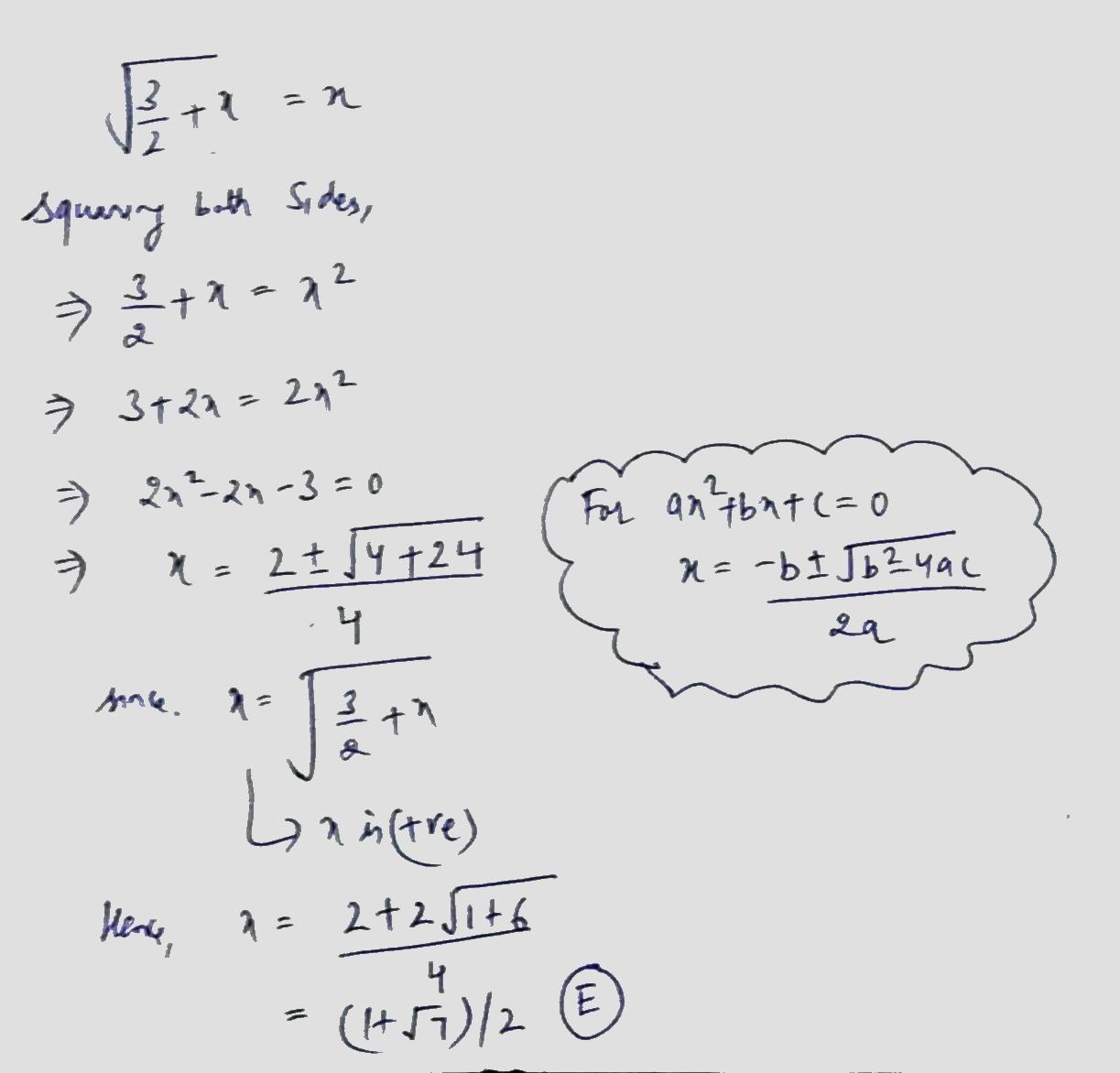

WhatsApp Image 2020-03-06 at 2.53.20 PM.jpeg [ 58.9 KiB | Viewed 10809 times ]
please see the approach to solve the question
Attachment:
WhatsApp Image 2020-03-06 at 2.53.20 PM.jpeg [ 58.9 KiB | Viewed 10809 times ]
06 Mar 2020, 02:08
Kudos
Bookmarks
Similar questions to practice:
https://gmatclub.com/forum/tough-and-tri ... l#p1029228
https://gmatclub.com/forum/find-the-valu ... 38049.html
https://gmatclub.com/forum/find-the-valu ... 75403.html
https://gmatclub.com/forum/if-the-expre ... 32547.html
https://gmatclub.com/forum/if-the-expre ... 98647.html
https://gmatclub.com/forum/if-z2-2-2-2- ... 41717.html
https://gmatclub.com/forum/if-x-is-a-po ... 17508.html
https://gmatclub.com/forum/if-the-follo ... 17548.html
https://gmatclub.com/forum/if-x-is-a-po ... 17673.html
Hope it helps.
https://gmatclub.com/forum/tough-and-tri ... l#p1029228
https://gmatclub.com/forum/find-the-valu ... 38049.html
https://gmatclub.com/forum/find-the-valu ... 75403.html
https://gmatclub.com/forum/if-the-expre ... 32547.html
https://gmatclub.com/forum/if-the-expre ... 98647.html
https://gmatclub.com/forum/if-z2-2-2-2- ... 41717.html
https://gmatclub.com/forum/if-x-is-a-po ... 17508.html
https://gmatclub.com/forum/if-the-follo ... 17548.html
https://gmatclub.com/forum/if-x-is-a-po ... 17673.html
Hope it helps.