Last visit was: 24 Apr 2026, 22:22 It is currently 24 Apr 2026, 22:22
Close
GMAT Club Daily Prep
Thank you for using the timer - this advanced tool can estimate your performance and suggest more practice questions. We have subscribed you to Daily Prep Questions via email.

Customized
for You

we will pick new questions that match your level based on your Timer History

Track
Your Progress

every week, we’ll send you an estimated GMAT score based on your performance

Practice
Pays

we will pick new questions that match your level based on your Timer History
Not interested in getting valuable practice questions and articles delivered to your email? No problem, unsubscribe here.
Close
Request Expert Reply
Confirm Cancel
User avatar
v12345
Joined: 01 Mar 2015
Last visit: 19 Jan 2026
Posts: 398
Own Kudos:
1,118
 [11]
Given Kudos: 44
Location: India
Posts: 398
Kudos: 1,118
 [11]
Kudos
Add Kudos
11
Bookmarks
Bookmark this Post
User avatar
chetan2u
User avatar
GMAT Expert
Joined: 02 Aug 2009
Last visit: 24 Apr 2026
Posts: 11,229
Own Kudos:
45,009
 [3]
Given Kudos: 335
Status:Math and DI Expert
Location: India
Concentration: Human Resources, General Management
GMAT Focus 1: 735 Q90 V89 DI81
Products:
Expert
Expert reply
GMAT Focus 1: 735 Q90 V89 DI81
Posts: 11,229
Kudos: 45,009
 [3]
3
Kudos
Add Kudos
Bookmarks
Bookmark this Post
avatar
Harshjha001
Joined: 14 Sep 2019
Last visit: 08 Oct 2021
Posts: 54
Own Kudos:
Given Kudos: 19
Posts: 54
Kudos: 25
Kudos
Add Kudos
Bookmarks
Bookmark this Post
User avatar
v12345
Joined: 01 Mar 2015
Last visit: 19 Jan 2026
Posts: 398
Own Kudos:
Given Kudos: 44
Location: India
Posts: 398
Kudos: 1,118
Kudos
Add Kudos
Bookmarks
Bookmark this Post
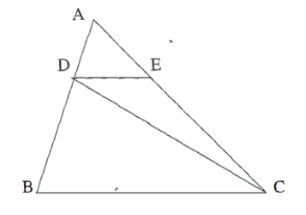
Area of DBC is 12.
Hence, OA is (D).
Attachments

Capture.PNG
Capture.PNG [ 3.64 KiB | Viewed 6077 times ]

User avatar
Fdambro294
Joined: 10 Jul 2019
Last visit: 20 Aug 2025
Posts: 1,331
Own Kudos:
Given Kudos: 1,656
Posts: 1,331
Kudos: 772
Kudos
Add Kudos
Bookmarks
Bookmark this Post
Obviously, chetan2u has the quickest and easiest way to get to the answer. But an alternative method:

Formula: one way to find the Area of a triangle is to multiply two adjacent sides —- then take that product and multiply it by the (SINE of the included angle between those sides) such that:


Area of Triangle = (1/2) (a) (b) (SIN of included angle)

Where A and B are the adjacent sides and the included angle is the angle found BETWEEN those 2 sides


(Step 1) focusing on triangle ADE and triangle ADC


We are given the actual Areas of these 2 triangles.

Since AE and AC are both on the same line, we can use those sides as the respective Bases for each triangle.

Since there exists only one perpendicular height from a single point to a line, the Perpendicular Height drawn from vertex D will be the same for both triangles.

Using the regular Area of a Triangle formula:

Area ADE = (1/2) (h) (AE) = 1

Area ADC = (1/2) (h) (AC) = 4

Dividing the 2 equations we get the RATIO of the 2 Bases:

(AE) : (AC) = 1 : 4


(Step 2). We are given that DE is parallel to BC

This makes triangle ADE a Similar Triangle to the whole triangle ABC

The corresponding sides will be in a Constant Ratio ——-> which we found in step 1

Corresponding sides of the similar triangles ——-> AE : AC = 1 : 4

The other corresponding sides will be in the same ratio and we can use K to stand for the unknown ratio multiplier

DE : BC = 1k : 4k

AD : AB = 1k : 4k


Side DB (one of the sides of triangle DBC, the area we need to find) will be equal to the difference between Side AB and Side AD ——-> 4k - 1k = 3k


Thus, in summary:

Triangle ADE:

AD = 1k

DE = 1k

Included Angle between these sides ———Angle < D


Triangle DBC:

DB = 3k

BC = 4k

Included Angle between these sides ——— Angle < B


(Step 3) we can use the formula listed in the beginning to find the Area of triangle ADE and then finally the target Triangle, triangle DBC

Area of Triangle ADE = (1/2) (AD) (DE) (SIN of included angle D) = 1

Or

(1/2) (1k) (1k) (Sin X) = 1


(k^2) (Sin X) = 2


we are told that DE is parallel to BC ——-> making Angle < D and Angle < B corresponding CONGRUENT angles in the Similar triangles ADE and ABC

SIN of Angle < D = SIN of Angle < B = (Sin X)


**Area of triangle DBC =

(1/2) (DB) (BC) (Sin of Angle < B) =

(1/2) (3k) (4k) (Sin X) = ?

Or

(6) (k^2) (Sin X) = ?

From the above Area of triangle ADE, we found:

(k^2) (Sin X) = 2

Substituting this in for our Area of triangle DBC we get:

(6) (2) = 12


Area of triangle DBC = 12

D

Posted from my mobile device
User avatar
bumpbot
User avatar
Non-Human User
Joined: 09 Sep 2013
Last visit: 04 Jan 2021
Posts: 38,978
Own Kudos:
Posts: 38,978
Kudos: 1,117
Kudos
Add Kudos
Bookmarks
Bookmark this Post
Automated notice from GMAT Club BumpBot:

A member just gave Kudos to this thread, showing it’s still useful. I’ve bumped it to the top so more people can benefit. Feel free to add your own questions or solutions.

This post was generated automatically.
Moderators:
Math Expert
109818 posts
Tuck School Moderator
853 posts