Last visit was: 24 Apr 2026, 15:33 It is currently 24 Apr 2026, 15:33
Close
GMAT Club Daily Prep
Thank you for using the timer - this advanced tool can estimate your performance and suggest more practice questions. We have subscribed you to Daily Prep Questions via email.

Customized
for You

we will pick new questions that match your level based on your Timer History

Track
Your Progress

every week, we’ll send you an estimated GMAT score based on your performance

Practice
Pays

we will pick new questions that match your level based on your Timer History
Not interested in getting valuable practice questions and articles delivered to your email? No problem, unsubscribe here.
Close
Request Expert Reply
Confirm Cancel
User avatar
singh_amit19
Joined: 11 Sep 2005
Last visit: 05 Aug 2012
Posts: 181
Own Kudos:
3,920
 [9]
Posts: 181
Kudos: 3,920
 [9]
1
Kudos
Add Kudos
8
Bookmarks
Bookmark this Post
Most Helpful Reply
User avatar
Bunuel
User avatar
Math Expert
Joined: 02 Sep 2009
Last visit: 24 Apr 2026
Posts: 109,818
Own Kudos:
811,074
 [8]
Given Kudos: 105,873
Products:
Expert
Expert reply
Active GMAT Club Expert! Tag them with @ followed by their username for a faster response.
Posts: 109,818
Kudos: 811,074
 [8]
5
Kudos
Add Kudos
3
Bookmarks
Bookmark this Post
General Discussion
User avatar
FN
User avatar
Current Student
Joined: 28 Dec 2004
Last visit: 07 May 2012
Posts: 1,575
Own Kudos:
Given Kudos: 2
Location: New York City
Concentration: Social Enterprise
Schools:Wharton'11 HBS'12
Posts: 1,575
Kudos: 687
Kudos
Add Kudos
Bookmarks
Bookmark this Post
User avatar
beckee529
Joined: 11 Jun 2007
Last visit: 23 Feb 2012
Posts: 393
Own Kudos:
1,974
 [1]
Posts: 393
Kudos: 1,974
 [1]
Kudos
Add Kudos
1
Bookmarks
Bookmark this Post
fresinha12
singh_amit19
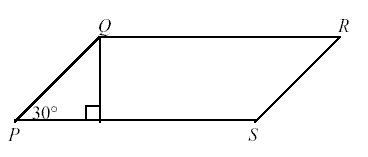
In parallelogram PQRS shown, if PQ = 4 and QR = 6, what is the area of PQRS?

A. 8
B. 12
C. 24
D. 8√3
E. 12√3

Ok if you look at the first triangle. the one with one side =4..we know its a 30-60-90 triangle

so based on that we know that side opposite 30 is (sqrt(3)*x)

we know x=2 so we know that the height is sqrt(3)*2


we know the base is 6, height is sqrt(3)2 area= base*height

12sqrt(3)


30:60:90
x: √3: 2x
2: 2√3: 4<-given to us

i get 2√3 for part of my base. the height i got was 2

height * base = 2*6 = 12
even when i did it the long way of adding the two triangles with the quad in the middle i was able to deduce the answer to 12
User avatar
ashkrs
Joined: 08 Jun 2007
Last visit: 21 Feb 2019
Posts: 282
Own Kudos:
GMAT 1: 680 Q48 V35
Posts: 282
Kudos: 345
Kudos
Add Kudos
Bookmarks
Bookmark this Post
singh_amit19
In parallelogram PQRS shown, if PQ = 4 and QR = 6, what is the area of PQRS?

A. 8
B. 12
C. 24
D. 8√3
E. 12√3


B .
easy if you know some formulas of triginometry

sin(30) = 1/2 = height/hypetenuse(4) => height = 2
area = base * height = 2*6=12
User avatar
beckee529
Joined: 11 Jun 2007
Last visit: 23 Feb 2012
Posts: 393
Own Kudos:
Posts: 393
Kudos: 1,974
Kudos
Add Kudos
Bookmarks
Bookmark this Post
ashkrs
singh_amit19
In parallelogram PQRS shown, if PQ = 4 and QR = 6, what is the area of PQRS?

A. 8
B. 12
C. 24
D. 8√3
E. 12√3

B .
easy if you know some formulas of triginometry

sin(30) = 1/2 = height/hypetenuse(4) => height = 2
area = base * height = 2*6=12


nice one! hhahaah.. dont remember much about this.. took trig well over 10 years ago freshmen year of HS
User avatar
ggarr
Joined: 12 Jun 2006
Last visit: 20 Mar 2010
Posts: 263
Own Kudos:
Given Kudos: 1
Posts: 263
Kudos: 843
Kudos
Add Kudos
Bookmarks
Bookmark this Post
I get E.

triangle is 30:60:90 ==> x:x(sqrt)3:2x ==> 2:2(sqrt)3:4

area(triangle)=2(sqrt)3*2/2 = 2(sqrt)3

6 [parallelogram base] - 2(sqrt)3 [triangle base] = 4(sqrt)3 [trapezoid base]

area(trapezoid)=6+4(sqrt)3*2/2 = 10(sqrt)3

10(sqrt)3 + 2(sqrt)3 = 12(sqrt)3
User avatar
beckee529
Joined: 11 Jun 2007
Last visit: 23 Feb 2012
Posts: 393
Own Kudos:
Posts: 393
Kudos: 1,974
Kudos
Add Kudos
Bookmarks
Bookmark this Post
this is how i got 12 by finding the 3 subparts (by drawing two lines to create two triangles and quadrilateral):

30:60:90
x: √3: 2x
2: 2√3: 4

h = 2,
base of triangle => b = 2√3,
base of quad => B = 6 - 2√3

area of two triangles = 2 * 1/2 b*h
= 2 [ 1/2 * 2 * 2√3 ] = 4√3

area of middle part (quad) = B * h
(6 - 2√3) * 2 = 12 - 4√3

adding the two together:
4√3 + 12 - 4√3 = 12 B
User avatar
ggarr
Joined: 12 Jun 2006
Last visit: 20 Mar 2010
Posts: 263
Own Kudos:
Given Kudos: 1
Posts: 263
Kudos: 843
Kudos
Add Kudos
Bookmarks
Bookmark this Post
Quote:
area of middle part (quad) = B * h
(6 - 2√3) * 2 = 12 - 4√3

aren't we solving what's inside the parentheses first?
6 - 2√3 = 4√3
4√3 * 2 = 8√3
should we be using the distributive property here?
User avatar
beckee529
Joined: 11 Jun 2007
Last visit: 23 Feb 2012
Posts: 393
Own Kudos:
Posts: 393
Kudos: 1,974
Kudos
Add Kudos
Bookmarks
Bookmark this Post
ggarr
Quote:
area of middle part (quad) = B * h
(6 - 2√3) * 2 = 12 - 4√3
aren't we solving what's inside the parentheses first?
6 - 2√3 = 4√3
4√3 * 2 = 8√3
should we be using the distributive property here?


6 - 2√3 does not = to 4√3!!
6√3 - 2√3 = 4√3
use a calculator and you will see the difference
and i did use distributive property
(6 - 2√3) * 2 =
6*2 - 2√3*2 =
12 - 4√3
User avatar
GK_Gmat
Joined: 09 Aug 2006
Last visit: 28 Feb 2009
Posts: 348
Own Kudos:
Posts: 348
Kudos: 1,078
Kudos
Add Kudos
Bookmarks
Bookmark this Post
singh_amit19
In parallelogram PQRS shown, if PQ = 4 and QR = 6, what is the area of PQRS?

A. 8
B. 12
C. 24
D. 8√3
E. 12√3


B.

The right triangle w/ hypotenuese PQ is a 30, 60, 90 triangle with sides a, sqrt 2a and 2a.

Side 2a corresponds to 4.
2a = 4
a = 2

a is the shortest side, therefore facing the smallest angle which is P. Therefore 2 is the height.

ar = b*h = 12
User avatar
Orange08
Joined: 25 Jul 2010
Last visit: 24 Oct 2010
Posts: 75
Own Kudos:
Given Kudos: 29
Posts: 75
Kudos: 3,939
Kudos
Add Kudos
Bookmarks
Bookmark this Post
beckee529
this is how i got 12 by finding the 3 subparts (by drawing two lines to create two triangles and quadrilateral):

30:60:90
x: √3: 2x
2: 2√3: 4


Is it mandatory to mug up this rule regarding 30:60:90 triangle?
No other ways of solving this problem? Isn't it correct that opposite sides of angles 30 and 60 are in ratio 1:2?

Any help is appreciated.
User avatar
Orange08
Joined: 25 Jul 2010
Last visit: 24 Oct 2010
Posts: 75
Own Kudos:
Given Kudos: 29
Posts: 75
Kudos: 3,939
Kudos
Add Kudos
Bookmarks
Bookmark this Post
Sounds assuring. Thanks a lot Bunuel.
User avatar
saxenashobhit
Joined: 20 Jul 2010
Last visit: 14 Nov 2013
Posts: 135
Own Kudos:
Given Kudos: 9
Products:
Posts: 135
Kudos: 256
Kudos
Add Kudos
Bookmarks
Bookmark this Post
Thanks Bunuel for the triangle. I was deciding on what is sin 30 to get height. I was confused in 1/2 and sqrt(3)/2
User avatar
Bunuel
User avatar
Math Expert
Joined: 02 Sep 2009
Last visit: 24 Apr 2026
Posts: 109,818
Own Kudos:
Given Kudos: 105,873
Products:
Expert
Expert reply
Active GMAT Club Expert! Tag them with @ followed by their username for a faster response.
Posts: 109,818
Kudos: 811,074
Kudos
Add Kudos
Bookmarks
Bookmark this Post
saxenashobhit
Thanks Bunuel for the triangle. I was deciding on what is sin 30 to get height. I was confused in 1/2 and sqrt(3)/2

Trigonometry is not tested on GMAT, so any GMAT geometry question can be solved without it.

Anyway: The sine of an angle is the ratio of the length of the opposite side to the length of the hypotenuse.

Sin (30 degrees)= cos (60 degrees) = 1/2 --> in out case: sin(30 degrees)=height/PQ=height/4=1/2 --> height=2.
User avatar
prashantbacchewar
Joined: 20 Apr 2010
Last visit: 28 Mar 2014
Posts: 150
Own Kudos:
Given Kudos: 28
Concentration: Finacee, General Management
Schools:ISB, HEC, Said
Posts: 150
Kudos: 321
Kudos
Add Kudos
Bookmarks
Bookmark this Post
Bunuel

Are we supposed to remeber the corelations for the standard triangles
User avatar
Bunuel
User avatar
Math Expert
Joined: 02 Sep 2009
Last visit: 24 Apr 2026
Posts: 109,818
Own Kudos:
Given Kudos: 105,873
Products:
Expert
Expert reply
Active GMAT Club Expert! Tag them with @ followed by their username for a faster response.
Posts: 109,818
Kudos: 811,074
Kudos
Add Kudos
Bookmarks
Bookmark this Post
prashantbacchewar
Bunuel

Are we supposed to remeber the corelations for the standard triangles

Yes, I think it's good to know below 2 cases:

• A right triangle where the angles are 30°, 60°, and 90°.

This is one of the 'standard' triangles you should be able recognize on sight. A fact you should commit to memory is: The sides are always in the ratio \(1 : \sqrt{3}: 2\).
Notice that the smallest side (1) is opposite the smallest angle (30°), and the longest side (2) is opposite the largest angle (90°).

• A right triangle where the angles are 45°, 45°, and 90°.

This is one of the 'standard' triangles you should be able recognize on sight. A fact you should also commit to memory is: The sides are always in the ratio \(1 : 1 : \sqrt{2}\). With the \(\sqrt{2}\) being the hypotenuse (longest side). This can be derived from Pythagoras' Theorem. Because the base angles are the same (both 45°) the two legs are equal and so the triangle is also isosceles.
• Area of a 45-45-90 triangle. As you see from the figure above, two 45-45-90 triangles together make a square, so the area of one of them is half the area of the square. As a formula \(A=\frac{S^2}{2}\). Where S is the length of either short side.

For more on this issues check Triangles chapter of Math Book (link in my signature).

Hope it helps.
User avatar
Kimberly77
Joined: 16 Nov 2021
Last visit: 07 Sep 2024
Posts: 421
Own Kudos:
Given Kudos: 5,898
Location: United Kingdom
GMAT 1: 450 Q42 V34
Products:
GMAT 1: 450 Q42 V34
Posts: 421
Kudos: 47
Kudos
Add Kudos
Bookmarks
Bookmark this Post
Hi brunel, What about if if PQ = 5 then? Will it still be 5/2 ? Thanks
User avatar
bumpbot
User avatar
Non-Human User
Joined: 09 Sep 2013
Last visit: 04 Jan 2021
Posts: 38,974
Own Kudos:
Posts: 38,974
Kudos: 1,117
Kudos
Add Kudos
Bookmarks
Bookmark this Post
Automated notice from GMAT Club BumpBot:

A member just gave Kudos to this thread, showing it’s still useful. I’ve bumped it to the top so more people can benefit. Feel free to add your own questions or solutions.

This post was generated automatically.
Moderators:
Math Expert
109818 posts
Tuck School Moderator
853 posts