Last visit was: 23 Apr 2026, 10:03 It is currently 23 Apr 2026, 10:03
Close
GMAT Club Daily Prep
Thank you for using the timer - this advanced tool can estimate your performance and suggest more practice questions. We have subscribed you to Daily Prep Questions via email.

Customized
for You

we will pick new questions that match your level based on your Timer History

Track
Your Progress

every week, we’ll send you an estimated GMAT score based on your performance

Practice
Pays

we will pick new questions that match your level based on your Timer History
Not interested in getting valuable practice questions and articles delivered to your email? No problem, unsubscribe here.
Close
Request Expert Reply
Confirm Cancel
User avatar
kenguva
Joined: 13 Mar 2007
Last visit: 07 Feb 2012
Posts: 11
Own Kudos:
65
 [39]
Given Kudos: 2
Posts: 11
Kudos: 65
 [39]
3
Kudos
Add Kudos
36
Bookmarks
Bookmark this Post
User avatar
Bunuel
User avatar
Math Expert
Joined: 02 Sep 2009
Last visit: 23 Apr 2026
Posts: 109,782
Own Kudos:
810,818
 [3]
Given Kudos: 105,853
Products:
Expert
Expert reply
Active GMAT Club Expert! Tag them with @ followed by their username for a faster response.
Posts: 109,782
Kudos: 810,818
 [3]
2
Kudos
Add Kudos
1
Bookmarks
Bookmark this Post
avatar
pavanpuneet
Joined: 26 Dec 2011
Last visit: 13 Feb 2014
Posts: 75
Own Kudos:
Given Kudos: 17
Posts: 75
Kudos: 139
Kudos
Add Kudos
Bookmarks
Bookmark this Post
User avatar
Bunuel
User avatar
Math Expert
Joined: 02 Sep 2009
Last visit: 23 Apr 2026
Posts: 109,782
Own Kudos:
Given Kudos: 105,853
Products:
Expert
Expert reply
Active GMAT Club Expert! Tag them with @ followed by their username for a faster response.
Posts: 109,782
Kudos: 810,818
Kudos
Add Kudos
Bookmarks
Bookmark this Post
pavanpuneet
L2 is steeper thus its slope is more negative (the absolute value of its slope is greater) than the slope of L2 ... Does it mean than L1??

Yes, that is correct.
User avatar
Bunuel
User avatar
Math Expert
Joined: 02 Sep 2009
Last visit: 23 Apr 2026
Posts: 109,782
Own Kudos:
810,818
 [1]
Given Kudos: 105,853
Products:
Expert
Expert reply
Active GMAT Club Expert! Tag them with @ followed by their username for a faster response.
Posts: 109,782
Kudos: 810,818
 [1]
Kudos
Add Kudos
1
Bookmarks
Bookmark this Post
Bumping for review and further discussion*. Get a kudos point for an alternative solution!

*New project from GMAT Club!!! Check HERE

Theory on Coordinate Geometry: math-coordinate-geometry-87652.html

All DS Coordinate Geometry Problems to practice: search.php?search_id=tag&tag_id=41
All PS Coordinate Geometry Problems to practice: search.php?search_id=tag&tag_id=62
User avatar
stne
Joined: 27 May 2012
Last visit: 23 Apr 2026
Posts: 1,808
Own Kudos:
Given Kudos: 678
Posts: 1,808
Kudos: 2,090
Kudos
Add Kudos
Bookmarks
Bookmark this Post
Hi can anyone help me here, in the figure above for the blue case it looks to me that L2 is steeper than L1, lets take a very large value and a very small value for the x intercept.Lets suppose L1 passes through 100 and L2 passes through 5,so x intercept of L1 is more than L2,since L2 is closer to the y axis on account of lesser x intercept it is more vertical hence its steeper and hence it looks to me that for Blue case( when both the lines have negative slope ) slope of L2 is greater than L1.

Also Visually in the Graph above for the Blue case it looks as though L2 is steeper than L1, what am I missing here?
avatar
anirudh777
Joined: 03 Feb 2013
Last visit: 27 Jun 2015
Posts: 16
Own Kudos:
Concentration: General Management, Entrepreneurship
GMAT Date: 06-30-2014
Kudos
Add Kudos
Bookmarks
Bookmark this Post
ALTERNATE SOLUTION:

Equation 1 : l1 : y=(m1)X+c1 , where m1 is slope and c1 is constant
Equation 2 : l2 : y=(m2)X+c2 , where m2 is slope and c2 is constant

Also given that slope are of same sign. Means--either both m1, m2 are positive or both are negative.

Statement 1 : intersect at point (a,b) where in both a and b are positive.

(1)==> y=b=(m1)a+c1=(m2)a+c2 -simply putting coordinates in both the equations of lines.

But from here we cannot conclude whether m1 > or < m2

Hence Insufficient.


Statement 2 : The X-intercept of line l1 is greater than the X-intercept of line l2

==> As value of x, when y=0, is the X intercept. Thus, X intercept for l1 and l2 are:
l1: -c1/(m1)
l2: -c2/(m2)

(2)==> -c1/(m1) > -c2/(m2), Since we dont know the sogn of c1 and c2 and we dont know there values we cannot conclude anything from this.

Hence Insufficient.


Combining both the statements :
and solving (1) and (2) we get,

a-b/(m1) >a-b/(m2) ---> m1<m2 Hence SUFFICIENT. Thus answer is C.
User avatar
stne
Joined: 27 May 2012
Last visit: 23 Apr 2026
Posts: 1,808
Own Kudos:
Given Kudos: 678
Posts: 1,808
Kudos: 2,090
Kudos
Add Kudos
Bookmarks
Bookmark this Post
anirudh777
ALTERNATE SOLUTION:

Equation 1 : l1 : y=(m1)X+c1 , where m1 is slope and c1 is constant
Equation 2 : l2 : y=(m2)X+c2 , where m2 is slope and c2 is constant

Also given that slope are of same sign. Means--either both m1, m2 are positive or both are negative.

Statement 1 : intersect at point (a,b) where in both a and b are positive.

(1)==> y=b=(m1)a+c1=(m2)a+c2 -simply putting coordinates in both the equations of lines.

But from here we cannot conclude whether m1 > or < m2

Hence Insufficient.


Statement 2 : The X-intercept of line l1 is greater than the X-intercept of line l2

==> As value of x, when y=0, is the X intercept. Thus, X intercept for l1 and l2 are:
l1: -c1/(m1)
l2: -c2/(m2)

(2)==> -c1/(m1) > -c2/(m2), Since we dont know the sogn of c1 and c2 and we dont know there values we cannot conclude anything from this.

Hence Insufficient.


Combining both the statements :
and solving (1) and (2) we get,

a-b/(m1) >a-b/(m2) ---> m1<m2 Hence SUFFICIENT. Thus answer is C.

Hi

I have been able to figure out the graphical way by myself, but I cannot figure out how you combined the two equations to get \(\frac{(a-b)}{m1} >\frac{(a-b)}{m2}\) in your algebraic method, can anyone help with the algebraic method here.

Thanks
avatar
anirudh777
Joined: 03 Feb 2013
Last visit: 27 Jun 2015
Posts: 16
Own Kudos:
5
 [2]
Concentration: General Management, Entrepreneurship
GMAT Date: 06-30-2014
2
Kudos
Add Kudos
Bookmarks
Bookmark this Post
stne
anirudh777
ALTERNATE SOLUTION:

Equation 1 : l1 : y=(m1)X+c1 , where m1 is slope and c1 is constant
Equation 2 : l2 : y=(m2)X+c2 , where m2 is slope and c2 is constant

Also given that slope are of same sign. Means--either both m1, m2 are positive or both are negative.

Statement 1 : intersect at point (a,b) where in both a and b are positive.

(1)==> y=b=(m1)a+c1=(m2)a+c2 -simply putting coordinates in both the equations of lines.

But from here we cannot conclude whether m1 > or < m2

Hence Insufficient.


Statement 2 : The X-intercept of line l1 is greater than the X-intercept of line l2

==> As value of x, when y=0, is the X intercept. Thus, X intercept for l1 and l2 are:
l1: -c1/(m1)
l2: -c2/(m2)

(2)==> -c1/(m1) > -c2/(m2), Since we dont know the sogn of c1 and c2 and we dont know there values we cannot conclude anything from this.

Hence Insufficient.


Combining both the statements :
and solving (1) and (2) we get,

a-b/(m1) >a-b/(m2) ---> m1<m2 Hence SUFFICIENT. Thus answer is C.

Hi

I have been able to figure out the graphical way by myself, but I cannot figure out how you combined the two equations to get \(\frac{(a-b)}{m1} >\frac{(a-b)}{m2}\) in your algebraic method, can anyone help with the algebraic method here.

Thanks
______________________


solving Equations (1) and (2) means, substituting the value of c1 and c2 from equation (1) in equation (2)-

From (1) :
c1= b-a(m1)
c2= b-1(m2)

putting these values in eq2

-c1/(m1) > -c2/(m2)

==> -[b-a(m1)]/m1 > -[b-a(m2)]/m2

--> -b/m1 + a > -b/m2 + a

--> since we know a and b are positive constant values, we can cancel them out from the equality and we are then left with

==> m1<m2.

Hence Sufficient. :lol:
User avatar
stne
Joined: 27 May 2012
Last visit: 23 Apr 2026
Posts: 1,808
Own Kudos:
2,090
 [2]
Given Kudos: 678
Posts: 1,808
Kudos: 2,090
 [2]
2
Kudos
Add Kudos
Bookmarks
Bookmark this Post
anirudh777
stne
anirudh777
ALTERNATE SOLUTION:

Equation 1 : l1 : y=(m1)X+c1 , where m1 is slope and c1 is constant
Equation 2 : l2 : y=(m2)X+c2 , where m2 is slope and c2 is constant

Also given that slope are of same sign. Means--either both m1, m2 are positive or both are negative.

Statement 1 : intersect at point (a,b) where in both a and b are positive.

(1)==> y=b=(m1)a+c1=(m2)a+c2 -simply putting coordinates in both the equations of lines.

But from here we cannot conclude whether m1 > or < m2

Hence Insufficient.


Statement 2 : The X-intercept of line l1 is greater than the X-intercept of line l2

==> As value of x, when y=0, is the X intercept. Thus, X intercept for l1 and l2 are:
l1: -c1/(m1)
l2: -c2/(m2)

(2)==> -c1/(m1) > -c2/(m2), Since we dont know the sogn of c1 and c2 and we dont know there values we cannot conclude anything from this.

Hence Insufficient.


Combining both the statements :
and solving (1) and (2) we get,

a-b/(m1) >a-b/(m2) ---> m1<m2 Hence SUFFICIENT. Thus answer is C.

Hi

I have been able to figure out the graphical way by myself, but I cannot figure out how you combined the two equations to get \(\frac{(a-b)}{m1} >\frac{(a-b)}{m2}\) in your algebraic method, can anyone help with the algebraic method here.

Thanks
______________________


solving Equations (1) and (2) means, substituting the value of c1 and c2 from equation (1) in equation (2)-

From (1) :
c1= b-a(m1)
c2= b-1(m2)

putting these values in eq2

-c1/(m1) > -c2/(m2)

==> -[b-a(m1)]/m1 > -[b-a(m2)]/m2

--> -b/m1 + a > -b/m2 + a

--> since we know a and b are positive constant values, we can cancel them out from the equality and we are then left with

==> m1<m2.

Hence Sufficient. :lol:


many thanks +1

however slope of m1>m2 and not m1<m2 as you have arrived at, guess small oversight in your calculation.

Here we go:


\(b=m_1.a+c_1\), and \(b=m_2.a+c_2\) these are the two equations of the line from statement 1

\(c_1= b-m_1a\) and \(c_2=b-m_2a\).. ( 1)

x intercept's \(\frac{-c_1}{m_1}\) and \(\frac{-c_2}{m_2}\)...(2)

given \(\frac{-c_1}{m_1} > \frac{-c_2}{m_2}\). from statement 2

now substituting the values of \(c_1\) and \(c_2\) from ..(1) in ...(2)

\(\frac{-(b-m_1a)}{m_1} > \frac{-(b-m_2a)}{m_2}\)

\(\frac{-b+m_1a}{m_1} > \frac{-b+m_2a}{m_2}\) ,multiplying the negative sign in the numerator

\(\frac{-b}{m_1}+a >\frac{-b}{m_2}+a\) , dividing LHS by \(m_1\) and RHS by \(m_2\)
\(\frac{-b}{m_1}>\frac{-b}{m_2}\), cancelling out a from both sides

\(\frac{b}{m_1}<\frac{b}{m_2}\), Multiplying both sides by negative and reversing the > sign to < , since in inequality we reverse the operator when we multiply( or divide)by a negative sign. ( Guess you forgot this part )

so finally we are left with \(\frac{b}{m_1}<\frac{b}{m_2}\)

\(\frac{1}{m_1}<\frac{1}{m_2}\) , cancelling b from both sides

\(\frac{1}{m_1}<\frac{1}{m_2}\)

Now we are still not sure of the signs of slope , both could be + or both could be -

if both are positive then
\(m_1>m_2\)

if both are negative

then we have \(\frac{1}{- m_1}<\frac{1}{- m_2}\)

here also we have \(m_1>m_2\)

hence \(m_1>m_2\) for all cases and hence sufficient

Hope I have done everything correctly


Thank you for showing the way.
User avatar
jlgdr
Joined: 06 Sep 2013
Last visit: 24 Jul 2015
Posts: 1,302
Own Kudos:
2,976
 [2]
Given Kudos: 355
Concentration: Finance
Posts: 1,302
Kudos: 2,976
 [2]
1
Kudos
Add Kudos
1
Bookmarks
Bookmark this Post
My approach

y = mx + f (Line 1)

y = nx + g (Line 2)

Is m>n or m-n>0?

(1) b=am + f

b = an + g

m-n = g-f/a where 'a' is a positive integer

So m>n only when g>f Insuff

(2) n=-f/x
m=-g/x

-f>-g
g>f

Insuff

(1) and (2)

We know that g>f therefore m>n

C
User avatar
Gmatboat
Joined: 14 Nov 2016
Last visit: 21 Jun 2022
Posts: 11
Own Kudos:
Given Kudos: 289
Posts: 11
Kudos: 4
Kudos
Add Kudos
Bookmarks
Bookmark this Post
Bunuel
Topic moved to DS subforum.

kenguva
If the slopes of the line l1 and l2 are of the same sign, is the slope of the line l1 greater than that of line l2?

(1) Lines l1 and l2 intersect at point(a,b) where a and b are positive
(2) The X-intercept of line l1 is greater than the X-intercept of line l2

If the slopes of the line l1 and l2 are of the same sign, is the slope of the line l1 greater than that of line l2?

(1) Lines l1 and l2 intersect at point (a,b) where a and b are positive --> clearly insufficient: we can rotate the lines on this point so that we get an YES, as well as NO answers. Not sufficient.

(2) The X-intercept of line l1 is greater than the X-intercept of line l2 --> also insufficient: we can draw numerous lines with the same sign slopes so that we get an YES, as well as NO answers. Not sufficient.

(1)+(2) We know that: the slopes of the lines are of the same sign, that they intersect in I quadrant and the X-intercept of line l1 is greater than the X-intercept of line l2. There can be two cases:
Attachment:
graph 5.png
You can see that in both cases the slope of L1 is greater than the slope of L1 as a steeper incline indicates a higher absolute value of the slope.


Hi Bunuel, could you kindly enlighten on 2 questions please?
1 - How do we know the slopes of the lines are of the same sign as per the highlighted quote above?
2 - Why is that information on X-intercept can be used to solve this question, but not on another question when the intersection point of 2 lines is (-2,4).
This "other" question is referenced below, posted by dreambeliever

Other question: Lines m and n lie in the xy-plane and intersect at the point (-2; 4). Is the slope of line m less than the slope of line n?

(1) The x-intercept of line m is greater than the x-intercept of line n.
(2) The y-intercept of line n is greater than the y-intercept of line m.

PS: Apologies for any errors in posting, this is my first post.

Thank you!
User avatar
CEdward
Joined: 11 Aug 2020
Last visit: 14 Apr 2022
Posts: 1,162
Own Kudos:
Given Kudos: 332
Posts: 1,162
Kudos: 289
Kudos
Add Kudos
Bookmarks
Bookmark this Post
Bunuel
Topic moved to DS subforum.

kenguva
If the slopes of the line l1 and l2 are of the same sign, is the slope of the line l1 greater than that of line l2?

(1) Lines l1 and l2 intersect at point(a,b) where a and b are positive
(2) The X-intercept of line l1 is greater than the X-intercept of line l2

If the slopes of the line l1 and l2 are of the same sign, is the slope of the line l1 greater than that of line l2?

(1) Lines l1 and l2 intersect at point (a,b) where a and b are positive --> clearly insufficient: we can rotate the lines on this point so that we get an YES, as well as NO answers. Not sufficient.

(2) The X-intercept of line l1 is greater than the X-intercept of line l2 --> also insufficient: we can draw numerous lines with the same sign slopes so that we get an YES, as well as NO answers. Not sufficient.

(1)+(2) We know that: the slopes of the lines are of the same sign, that they intersect in I quadrant and the X-intercept of line l1 is greater than the X-intercept of line l2. There can be two cases:
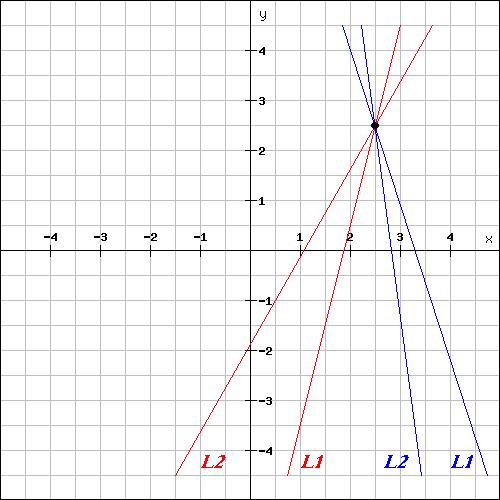
Attachment:
graph 5.png
You can see that in both cases the slope of L1 is greater than the slope of L1 as a steeper incline indicates a higher absolute value of the slope.

In red case: both lines have positive slope, L1 is steeper thus its slope is greater than the slope of L2;
In blue case: both lines have negative slope, L2 is steeper thus its slope is more negative (the absolute value of its slope is greater) than the slope of L1, which also means that the slope of L1 is greater than the slope of L2.

Answer: C.

For more on this topic check Coordinate Geometry chapter of Math Book: https://gmatclub.com/forum/math-coordina ... 87652.html

P.S.
Please post PS questions in the PS subforum: https://gmatclub.com/forum/gmat-problem-solving-ps-140/
Please post DS questions in the DS subforum: https://gmatclub.com/forum/gmat-data-sufficiency-ds-141/

No posting of PS/DS questions is allowed in the main Math forum.

Hi Bunuel, this distinction between 'greater/lesser' and 'steeper/less steep' still eludes me.

So basically for the red lines with POSITIVE slope, we say that the slope of line 1 is GREATER because it is STEEPER.
But, for the blue lines with NEGATIVE slope, we say that the slope of line 1 is SMALLER because it is LESS STEEP

How would you compare the slope of red line1 with blue line2? Which one has a 'greater' slope?
User avatar
WiziusCareers1
Joined: 27 Apr 2009
Last visit: 23 Apr 2026
Posts: 176
Own Kudos:
Given Kudos: 35
Status:Not Applying
Location: India
Schools: HBS '14 (A)
GMAT 1: 730 Q51 V36
Schools: HBS '14 (A)
GMAT 1: 730 Q51 V36
Posts: 176
Kudos: 542
Kudos
Add Kudos
Bookmarks
Bookmark this Post
To determine if the slope of line l1 (m1) is greater than the slope of line l2 (m2), we need to analyze the relationship between their intercepts and their intersection point.

We are given that m1 and m2 have the same sign (both positive or both negative).

Considering Statement (1)
Lines l1 and l2 intersect at point (a,b) where a, b > 0.
Knowing only the intersection point in the first quadrant doesn't tell us about the steepness of the lines. For any point (a,b), we could draw two lines with positive slopes where m1 >m2, or two lines where m2 >m1. The same applies to negative slopes.
Insufficient.

Considering Statement (2)
The x-intercept of l1 is greater than the x-intercept of l2.
Let x1 be the x-intercept of l1 and x2 be the x-intercept of l2. We know x1 > x2. However, without knowing a second point (like the intersection) or whether the slopes are positive or negative, we cannot determine which line is steeper.
Insufficient.


Combining (1) and (2)
When we combine the statements, we have a fixed intersection point (a, b) in the first quadrant and a specific relationship between their x-intercepts (x1 > x2).

The formula for the slope m given an intersection (a, b) and an x-intercept (xi, 0) is:
m = (b - 0)/(a - xi) = b/(a - xi)

Since b is positive (from statement 1), the sign of the slope depends entirely on the denominator (a−xi). Because the prompt states both slopes have the same sign, both x-intercepts must be on the same side of a (either both are less than a, or both are greater than a).

Case 1: Positive Slopes (x1, x2 < a)
If the slopes are positive, the x-intercepts must be to the left of a. Given x1 > x2:

- The denominator (a − x1) is smaller than (a − x2).
- Since the denominator is smaller, the fraction m1 = b/(a−x1) is larger.
- Therefore, m1 > m2.

Case 2: Negatiive Slopes (x1, x2 > a)
- (a - x1) is more negative than (a - x2) (For example a - x1 = -10 and a - x2 = -5)
- m1 = -b/10 and ma = -b/5
- m1 > m2

So, the answer is (C)
Moderators:
Math Expert
109782 posts
498 posts
212 posts