Events & Promotions
|
|

GMAT Club Daily Prep
Thank you for using the timer - this advanced tool can estimate your performance and suggest more practice questions. We have subscribed you to Daily Prep Questions via email.
Customized
for You
Track
Your Progress
Practice
Pays
Not interested in getting valuable practice questions and articles delivered to your email? No problem, unsubscribe here.
 Apr 25
12:30 AM EDT
-01:30 AM EDT
At one point, she believed GMAT wasn’t for her. After scoring 595, self-doubt crept in and she questioned her potential. But instead of quitting, she made the right strategic changes. The result? A remarkable comeback to 695. Check out how Saakshi did it. Apr 26
10:00 AM EDT
-11:00 AM EDT
The Target Test Prep course represents a quantum leap forward in GMAT preparation, a radical reinterpretation of the way that students should study. Try before you buy with a 5-day, full-access trial of the course for FREE! Apr 27
11:00 AM EDT
-12:00 PM EDT
Prefer video-based learning? The Target Test Prep OnDemand course is a one-of-a-kind video masterclass featuring 400 hours of lecture-style teaching by Scott Woodbury-Stewart, founder of Target Test Prep and one of the most accomplished GMAT instructors Apr 28
08:00 AM PDT
-11:00 AM PDT
Whether you are just beginning your MBA journey or fine-tuning your path to a 700+ score, GMAT Day is designed to give you a competitive edge.

 18 Sep 2011, 00:08
Kudos
Bookmarks


C
Be sure to select an answer first to save it in the Error Log before revealing the correct answer (OA)!
Difficulty:
 85%
(hard)
85%
(hard)
Question Stats:
34% (01:26) correct 66%
(01:26)
wrong
based on 292
sessions
66%
(01:26)
wrong
based on 292
sessions
History
Date
Time
Result
Not Attempted Yet

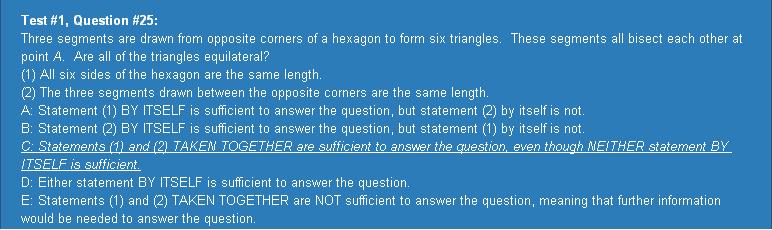
In the figure above, three segments are drawn from the opposite vertices of a hexagon to form six triangles. These segments all bisect each other at point A. Are all of the triangles equilateral?
(1) All six sides of the hexagon are the same length.
(2) The three segments drawn between the opposite vertices are the same length are are bisected by point A.
Attachment:
File comment: Question
img_1.JPG [ 44.87 KiB | Viewed 7718 times ]
img_1.JPG [ 44.87 KiB | Viewed 7718 times ]
 27 Aug 2013, 15:21
Kudos
Bookmarks
I try to visualize the question as following:
Note: if all six triangles in a hexagon are equilateral, then the hexagon has all equal sides and six 120 degrees internal angles. The hexagon is regular.
If the hexagon has only six equal sides, the hexagon may not be regular. Thus, six triangles may not be equilateral.
Answer is C.
Hope it helps.
Note: if all six triangles in a hexagon are equilateral, then the hexagon has all equal sides and six 120 degrees internal angles. The hexagon is regular.
If the hexagon has only six equal sides, the hexagon may not be regular. Thus, six triangles may not be equilateral.
Answer is C.
Hope it helps.
Attachments
Hexagon.jpg [ 58.69 KiB | Viewed 9231 times ]

vaishnogmat
Joined: 10 Jul 2012
Last visit: 27 Oct 2014
Posts: 10
Given Kudos: 4
Status:Finance Analyst
Affiliations: CPA Australia
Location: Australia
Concentration: Finance, Healthcare
Schools: AGSM '16 (A$)
GMAT 1: 470 Q38 V19
GMAT 2: 600 Q44 V34
GPA: 3.5
WE:Accounting (Healthcare/Pharmaceuticals)
Updated on: 27 Aug 2013, 03:25
Originally posted by vaishnogmat on 26 Aug 2013, 22:18.
Last edited by Bunuel on 27 Aug 2013, 03:25, edited 1 time in total.
Last edited by Bunuel on 27 Aug 2013, 03:25, edited 1 time in total.
RENAMED THE TOPIC.
Kudos
Bookmarks
Attachment:
File comment: Image
Hexagon.png [ 4.42 KiB | Viewed 9743 times ]
Hexagon.png [ 4.42 KiB | Viewed 9743 times ]
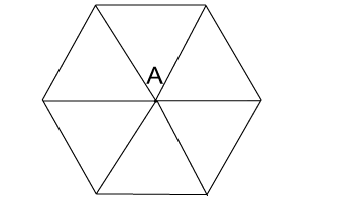
In the figure above, three segments are drawn from the opposite vertices of a hexagon to form six triangles. These segments all bisect each other at point A. Are all of the triangles equilateral?
(1) All six sides of the hexagon are the same length.
(2) The three segments drawn between the opposite vertices are the same length are are bisected by point A.