Last visit was: 23 Apr 2026, 10:03 It is currently 23 Apr 2026, 10:03
Close
GMAT Club Daily Prep
Thank you for using the timer - this advanced tool can estimate your performance and suggest more practice questions. We have subscribed you to Daily Prep Questions via email.

Customized
for You

we will pick new questions that match your level based on your Timer History

Track
Your Progress

every week, we’ll send you an estimated GMAT score based on your performance

Practice
Pays

we will pick new questions that match your level based on your Timer History
Not interested in getting valuable practice questions and articles delivered to your email? No problem, unsubscribe here.
Close
Request Expert Reply
Confirm Cancel
User avatar
zbvl
Joined: 27 Oct 2013
Last visit: 04 Feb 2015
Posts: 2
Own Kudos:
215
 [22]
Posts: 2
Kudos: 215
 [22]
5
Kudos
Add Kudos
16
Bookmarks
Bookmark this Post
User avatar
mau5
User avatar
Verbal Forum Moderator
Joined: 10 Oct 2012
Last visit: 31 Dec 2024
Posts: 478
Own Kudos:
3,386
 [3]
Given Kudos: 141
Posts: 478
Kudos: 3,386
 [3]
2
Kudos
Add Kudos
1
Bookmarks
Bookmark this Post
avatar
unceldolan
Joined: 21 Oct 2013
Last visit: 03 Jun 2015
Posts: 151
Own Kudos:
247
 [1]
Given Kudos: 19
Location: Germany
GMAT 1: 660 Q45 V36
GPA: 3.51
Kudos
Add Kudos
1
Bookmarks
Bookmark this Post
User avatar
stonecold
Joined: 12 Aug 2015
Last visit: 09 Apr 2024
Posts: 2,231
Own Kudos:
Given Kudos: 893
GRE 1: Q169 V154
GRE 1: Q169 V154
Posts: 2,231
Kudos: 3,643
Kudos
Add Kudos
Bookmarks
Bookmark this Post
Here is my approach
W need to prove that x1/a^x >1/b^x
now we can flip the inequality if they are of same sign while doing the reciprocal..
hence we need to prove => a^x<b^y
statement 1 => no clue of x and y => not sufficient
statement 2 => no clue of a and b => not sufficient
combing them we can say that the bae an exponent of rhs are always greater hence rhs would be greater
thus C
User avatar
coolnuts
Joined: 17 Jan 2016
Last visit: 04 Oct 2022
Posts: 34
Own Kudos:
Given Kudos: 251
Location: India
Concentration: General Management, General Management
Posts: 34
Kudos: 18
Kudos
Add Kudos
Bookmarks
Bookmark this Post
We can redefine the question as (1/a)^x > (1/b)^y

S1 a < b We know nothing about x and y here. So if a=3 and b = 4 and x = 1 and y = 1 then YES. But if a = 3 and b = 4 and x = 10 and y = 1 then NO. This statement is insufficient.

S2 x < y We know nothing about a and b here.So if a = 3 and b = 4 and x = 1 and y = 2 then YES. But if a = 10 and b = 1 and x=1 and y=2 then NO. This statement is insufficient.

Taking S1 and S2 together is sufficient to get the answer.

Hence C.
User avatar
BrentGMATPrepNow
User avatar
Major Poster
Joined: 12 Sep 2015
Last visit: 31 Oct 2025
Posts: 6,733
Own Kudos:
36,451
 [2]
Given Kudos: 799
Location: Canada
Expert
Expert reply
Posts: 6,733
Kudos: 36,451
 [2]
Kudos
Add Kudos
2
Bookmarks
Bookmark this Post
zbvl
If a, b, x, and y are positive integers, is \(a^{(-x)} > b^{(-y)}\)?

(1) a < b
(2) x < y

Target question: Is a^(-x) > b^(-y)?
This is a great candidate for rephrasing the target question.
Aside: At the bottom of this post, you can find a video with tips on rephrasing the target question

First recognize the following: a^(-x) = 1/(a^x) and b^(-y) = 1/(b^y)
So, we can ask Is 1/(a^x) > 1/(b^y)?
Also, since a and b are POSITIVE, we can be certain that (a^x) is POSITIVE and (b^y) is POSITIVE
So, we can safely take the inequality 1/(a^x) > 1/(b^y) and multiply both sides by (a^x) to get: 1 > (a^x)/(b^y)
Next, we can multiply both sides by (b^y) to get: (b^y) > (a^x)
So, we can now ask...
REPHRASED target question: Is (b^y) > (a^x)?

Statement 1: a < b
No information about x or y.
So, statement 1 is NOT SUFFICIENT

Statement 2: x < y
No information about a or b.
So, statement 2 is NOT SUFFICIENT

Statements 1 and 2 combined
The key here is that all 4 variables are positive.
If b is greater than a AND y is greater than x, we can be certain that (b^y) > (a^x)
Since we can answer the REPHRASED target question with certainty, the combined statements are SUFFICIENT

Answer: C

RELATED VIDEO
User avatar
ScottTargetTestPrep
User avatar
Target Test Prep Representative
Joined: 14 Oct 2015
Last visit: 23 Apr 2026
Posts: 22,282
Own Kudos:
Given Kudos: 302
Status:Founder & CEO
Affiliations: Target Test Prep
Location: United States (CA)
Expert
Expert reply
Active GMAT Club Expert! Tag them with @ followed by their username for a faster response.
Posts: 22,282
Kudos: 26,530
Kudos
Add Kudos
Bookmarks
Bookmark this Post
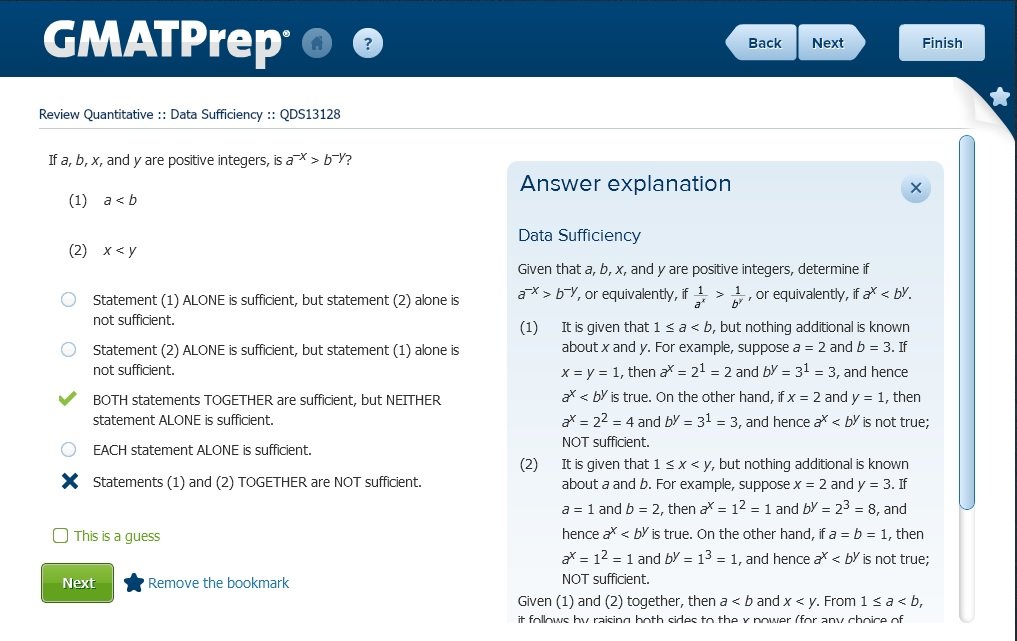
zbvl
If a, b, x, and y are positive integers, is \(a^{(-x)} > b^{(-y)}\)?

(1) a < b
(2) x < y


[spoiler=OFFICIAL SOLUTION]
Attachment:
GmatPrepDS.jpg

Rephrasing the question we have:

Is 1/a^x > 1/b^y ?

Is b^y > a^x ?

Statement One Alone:

a < b

Since we do now know anything about x and y, statement one alone is not sufficient to answer the question.

Statement Two Alone:

x < y

Since we do now know anything about a and b, statement two alone is not sufficient to answer the question.

Statements One and Two Together:

Since b is greater than a, and y is greater than x, we know that b^y is greater than a^x.

Answer: C
User avatar
MathRevolution
User avatar
Math Revolution GMAT Instructor
Joined: 16 Aug 2015
Last visit: 27 Sep 2022
Posts: 10,063
Own Kudos:
Given Kudos: 4
GMAT 1: 760 Q51 V42
GPA: 3.82
Expert
Expert reply
GMAT 1: 760 Q51 V42
Posts: 10,063
Kudos: 20,000
Kudos
Add Kudos
Bookmarks
Bookmark this Post
Forget the conventional way to solve DS questions.

We will solve this DS question using the variable approach.

DS question with 4 variables: Let the original condition in a DS question contain 4 variables. Now, 4 variables would generally require 4 equations for us to be able to solve for the value of the variable.

We know that each condition would usually give us an equation, and Since we need 4 equations to match the numbers of variables and equations in the original condition, the logical answer is E.

To master the Variable Approach, visit https://www.mathrevolution.com and check our lessons and proven techniques to score high in DS questions.

Let’s apply the 3 steps suggested previously. [Watch lessons on our website to master these 3 steps]

Step 1 of the Variable Approach: Modifying and rechecking the original condition and the question.

We have to find whether \(a^{-x} > b^{-y}\) .


=> \(\frac{1}{ a^{x}} > \frac{1 }{ b^{y}} OR \\
\\
=> b^{y} > a^{x}\)

=> Given that a, b, x, and y are positive integers.

Second and the third step of Variable Approach: From the original condition, we have 4 variables (a, b, x, and y).To match the number of variables with the number of equations, we need 4 equations. Since conditions (1) and (2) will provide 2 equations, E would most likely be the answer.

Let’s take look at both condition together.

Condition(1) tells us that a < b.

Condition(2) tells us that x < y .

=> when b > a then \(b^{y} > a^{y}\)

=> When y > x, then \(a^{y} > a^{x} \)

=> Therefore, \(b^{y} > a^{x}\) - YES

Since the answer is a unique YES, both conditions combined together are sufficient by CMT 1.

Both conditions combined together are sufficient.

So, C is the correct answer.

Answer: C
User avatar
Basshead
Joined: 09 Jan 2020
Last visit: 07 Feb 2024
Posts: 907
Own Kudos:
Given Kudos: 431
Location: United States
Posts: 907
Kudos: 323
Kudos
Add Kudos
Bookmarks
Bookmark this Post
zbvl
If a, b, x, and y are positive integers, is \(a^{(-x)} > b^{(-y)}\)?

(1) a < b
(2) x < y


Is \(\frac{1}{a^x} > \frac{1}{b^y}\)?

Is \(a^x < b^y\)?

(1) We don't know the value of x or y; INSUFFICIENT.

(2) We don't know the value of a or b; INSUFFICIENT.

(1&2) We have \(a < b\); \(x < y\)

Therefore \(a^x < b^y\) (b is larger and raised to a higher exponent). SUFFICIENT.

Answer is C.
User avatar
v12345
Joined: 01 Mar 2015
Last visit: 19 Jan 2026
Posts: 398
Own Kudos:
Given Kudos: 44
Location: India
Posts: 398
Kudos: 1,117
Kudos
Add Kudos
Bookmarks
Bookmark this Post
a, b, x, and y are positive integers
\(a^{(-x)} > b^{(-y)}\)
= \(a^{x} < b^{y}\)

(1) a < b . Insufficient
let a=3,b=4
if x=3,y=1 then false
if x=1,y=2 then true

(2) x < y . Insufficient
let x=1,y=2
if a=3,b=1 then false
if a=1,b=2 then true

Combining both, we get . Sufficient
a < b and x < y
\(a^{x} < b^{y}\)

Hence, OA is (C).
User avatar
bumpbot
User avatar
Non-Human User
Joined: 09 Sep 2013
Last visit: 04 Jan 2021
Posts: 38,965
Own Kudos:
Posts: 38,965
Kudos: 1,117
Kudos
Add Kudos
Bookmarks
Bookmark this Post
Automated notice from GMAT Club BumpBot:

A member just gave Kudos to this thread, showing it’s still useful. I’ve bumped it to the top so more people can benefit. Feel free to add your own questions or solutions.

This post was generated automatically.
Moderators:
Math Expert
109782 posts
498 posts
212 posts
