Last visit was: 25 Apr 2026, 06:02 It is currently 25 Apr 2026, 06:02
Close
GMAT Club Daily Prep
Thank you for using the timer - this advanced tool can estimate your performance and suggest more practice questions. We have subscribed you to Daily Prep Questions via email.

Customized
for You

we will pick new questions that match your level based on your Timer History

Track
Your Progress

every week, we’ll send you an estimated GMAT score based on your performance

Practice
Pays

we will pick new questions that match your level based on your Timer History
Not interested in getting valuable practice questions and articles delivered to your email? No problem, unsubscribe here.
Close
Request Expert Reply
Confirm Cancel
User avatar
Bunuel
User avatar
Math Expert
Joined: 02 Sep 2009
Last visit: 25 Apr 2026
Posts: 109,827
Own Kudos:
811,172
 [8]
Given Kudos: 105,878
Products:
Expert
Expert reply
Active GMAT Club Expert! Tag them with @ followed by their username for a faster response.
Posts: 109,827
Kudos: 811,172
 [8]
1
Kudos
Add Kudos
7
Bookmarks
Bookmark this Post
User avatar
GMATBusters
User avatar
GMAT Tutor
Joined: 27 Oct 2017
Last visit: 23 Apr 2026
Posts: 1,922
Own Kudos:
6,857
 [3]
Given Kudos: 241
WE:General Management (Education)
Expert
Expert reply
Posts: 1,922
Kudos: 6,857
 [3]
2
Kudos
Add Kudos
1
Bookmarks
Bookmark this Post
User avatar
satya2029
Joined: 10 Dec 2017
Last visit: 29 Sep 2025
Posts: 229
Own Kudos:
Given Kudos: 138
Location: India
Posts: 229
Kudos: 254
Kudos
Add Kudos
Bookmarks
Bookmark this Post
User avatar
GMATBusters
User avatar
GMAT Tutor
Joined: 27 Oct 2017
Last visit: 23 Apr 2026
Posts: 1,922
Own Kudos:
Given Kudos: 241
WE:General Management (Education)
Expert
Expert reply
Posts: 1,922
Kudos: 6,857
Kudos
Add Kudos
Bookmarks
Bookmark this Post
you interpreted the meaning of T(n) incorrectly.
T(20) = number of prime numbers less than 20
prime numbers less than 20 are 2,3,5,7,11,13,17,29.
Hence T(20) = 8
similarly for other T(21) = 8 only

satya2029
gmatbusters
This is a very good question on the understanding of prime number.
the solution is as attached.


Bunuel
Let T(n) represent the number of prime numbers less than n. What is the value of positive integer a?

(1) \(\frac{T(a+1)}{T(a)}-1=\frac{1}{T(a)}\)

(2) \(20\leq a <29\)


Are You Up For the Challenge: 700 Level Questions
Attachment:
WhatsApp Image 2019-12-03 at 2.47.16 PM.jpeg

T(21)=T(20+1)=21-8=13
T(20)=20-8=12
a=20
again
T(22)=22-8=14
T(21)=21-8=13
a=21
why not E? Could you please where I am going wrong?
User avatar
satya2029
Joined: 10 Dec 2017
Last visit: 29 Sep 2025
Posts: 229
Own Kudos:
Given Kudos: 138
Location: India
Posts: 229
Kudos: 254
Kudos
Add Kudos
Bookmarks
Bookmark this Post
satya2029
gmatbusters
This is a very good question on the understanding of prime number.
the solution is as attached.
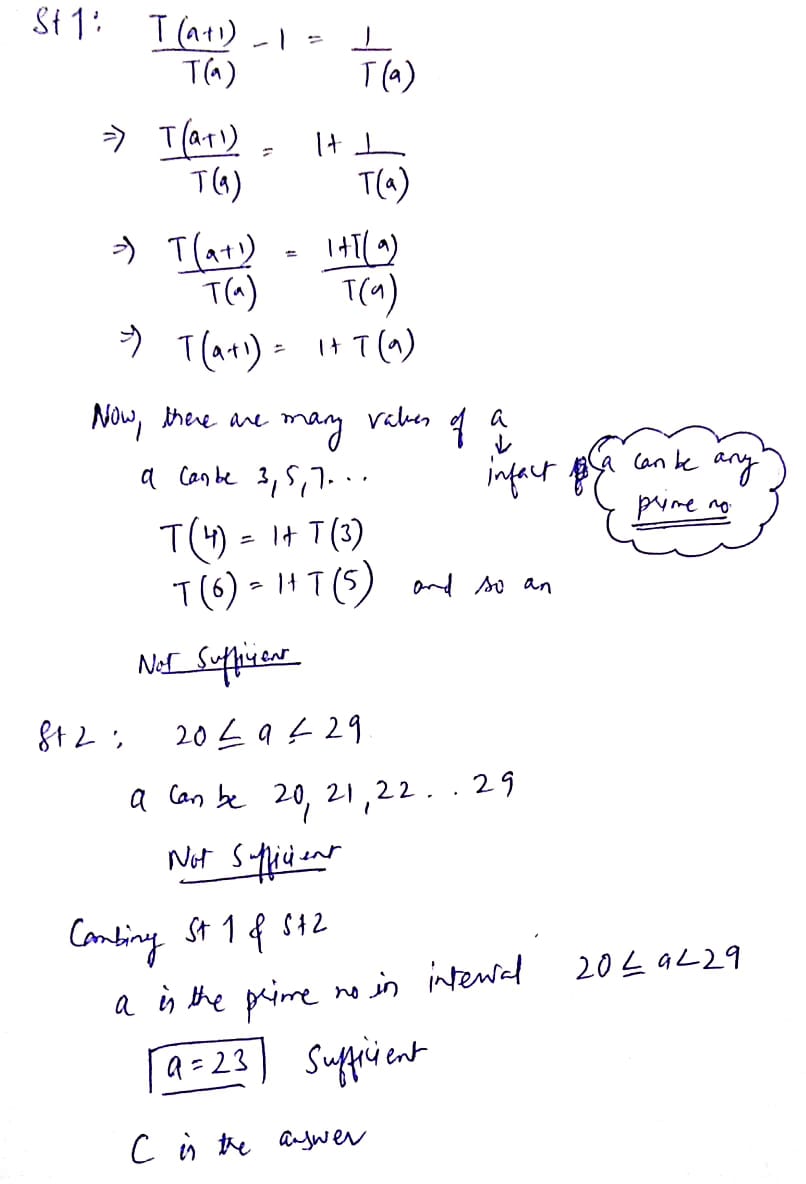

Bunuel
Let T(n) represent the number of prime numbers less than n. What is the value of positive integer a?

(1) \(\frac{T(a+1)}{T(a)}-1=\frac{1}{T(a)}\)

(2) \(20\leq a <29\)


Are You Up For the Challenge: 700 Level Questions
Attachment:
WhatsApp Image 2019-12-03 at 2.47.16 PM.jpeg

T(21)=T(20+1)=21-8=13
T(20)=20-8=12
a=20
again
T(22)=22-8=14
T(21)=21-8=13
a=21
why not E? Could you please where I am going wrong?
Thanks:)
User avatar
exc4libur
Joined: 24 Nov 2016
Last visit: 22 Mar 2022
Posts: 1,680
Own Kudos:
Given Kudos: 607
Location: United States
Posts: 1,680
Kudos: 1,469
Kudos
Add Kudos
Bookmarks
Bookmark this Post
Bunuel
Let T(n) represent the number of prime numbers less than n. What is the value of positive integer a?

(1) \(\frac{T(a+1)}{T(a)}-1=\frac{1}{T(a)}\)

(2) \(20\leq a <29\)


(1) \(\frac{T(a+1)}{T(a)}-1=\frac{1}{T(a)}\) insufic

\(\frac{T(a+1)}{T(a)}-1=\frac{1}{T(a)}…T(a+1)-T(a)=1\)

\(T(a,a+1)=T(3,4)…T(a)=[2]=1…T(a+1)=[2,3]=2…T(a+1)-T(a)=1=TRUE\)
\(T(a,a+1)=T(5,6)…T(a)=[2,3]=2…T(a+1)=[2,3,5]=3…T(a+1)-T(a)=1=TRUE\)

Any \(a = prime\) fits the description.

(2) \(20\leq a <29\) insufic

(1)&(2) sufic

\(20\leq a <29…only.prime=23…a=23\)

Ans (C)
User avatar
TestPrepUnlimited
Joined: 17 Sep 2014
Last visit: 30 Jun 2022
Posts: 1,223
Own Kudos:
Given Kudos: 6
Location: United States
GMAT 1: 780 Q51 V45
GRE 1: Q170 V167
Expert
Expert reply
GMAT 1: 780 Q51 V45
GRE 1: Q170 V167
Posts: 1,223
Kudos: 1,138
Kudos
Add Kudos
Bookmarks
Bookmark this Post
Bunuel
Let T(n) represent the number of prime numbers less than n. What is the value of positive integer a?

(1) \(\frac{T(a+1)}{T(a)}-1=\frac{1}{T(a)}\)

(2) \(20\leq a <29\)


Are You Up For the Challenge: 700 Level Questions

Analyzing the question:
It may help to visual what T(n) represents. If n = 10, the primes less than 10 are 2, 3, 5, 7. So T(10) = 4. If n = 11, it is the same list so T(11) = 4. However, for n = 12, we can include 11 in the prime list so T(12) = 5.

Statement 1:

T(n) in a fraction form doesn't really make sense so let's try to get rid of the fraction by multiplying both sides by T(a).

We get: \(T(a + 1) - T(a) = 1 \) or \(T(a + 1) = T(a) + 1\)
Now T(a) represents the amount of primes less than \(a\). So from \(a\) to a + 1, T(a + 1) must have included another prime in the list, in order to have T(a + 1) just one bigger than T(a).
Hence \(a\) must be prime. Now finally we simplified the statement to: \(a\) is prime. Of course, there are many primes so this is insufficient.

Statement 2:
Insufficient.

Combined:
The only prime in the range is a = 23, Sufficient.

Ans: C
User avatar
LJ11
Joined: 17 Jun 2018
Last visit: 16 Mar 2021
Posts: 7
Own Kudos:
Given Kudos: 33
Location: India
Kudos
Add Kudos
Bookmarks
Bookmark this Post
Shouldn't this question come with the condition that n >2,
for 1/T(n) becomes not defined in that case
User avatar
chetan2u
User avatar
GMAT Expert
Joined: 02 Aug 2009
Last visit: 24 Apr 2026
Posts: 11,229
Own Kudos:
Given Kudos: 335
Status:Math and DI Expert
Location: India
Concentration: Human Resources, General Management
GMAT Focus 1: 735 Q90 V89 DI81
Products:
Expert
Expert reply
GMAT Focus 1: 735 Q90 V89 DI81
Posts: 11,229
Kudos: 45,017
Kudos
Add Kudos
Bookmarks
Bookmark this Post
Let T(n) represent the number of prime numbers less than n. What is the value of positive integer a?

(1) \(\frac{T(a+1)}{T(a)}-1=\frac{1}{T(a)}..........\frac{T(a+1)-T(a)}{T(a)}=\frac{1}{T(a)}......T(a+1)-T(a)=1\)
So, a+1 has ONE more prime number than a, meaning that a itself is a prime number. a can take infinite values, 3, 5, etc.

(2) \(20\leq a <29\)
a could be any of the values from 20 to 28

Combined..
There is ONLY one prime number 23 in range \(20\leq a <29\), so a=23

C

Yes, LJ11 it could have been written that a>2. But even if it is not written, the moment there is a statement, that is, it is given that 1/x=1/y is true, it should mean that x and y are not 0.
And if I ask you 'is 1/x=1/y', then yes it should surely be mentioned that x and y are not 0.
User avatar
desertEagle
Joined: 14 Jun 2014
Last visit: 03 Aug 2025
Posts: 550
Own Kudos:
Given Kudos: 413
Posts: 550
Kudos: 348
Kudos
Add Kudos
Bookmarks
Bookmark this Post
GMATBusters
This is a very good question on the understanding of prime number.
the solution is as attached.


Bunuel
Let T(n) represent the number of prime numbers less than n. What is the value of positive integer a?

(1) \(\frac{T(a+1)}{T(a)}-1=\frac{1}{T(a)}\)

(2) \(20\leq a <29\)


Are You Up For the Challenge: 700 Level Questions
Attachment:
https://gmatclub.com/chat Image 2019-12-03 at 2.47.16 PM.jpeg


What if a=28
Then a+1 = 29

then T(a+1) = T(a) + 1
Ie T(29) = T(28) + 1
User avatar
bumpbot
User avatar
Non-Human User
Joined: 09 Sep 2013
Last visit: 04 Jan 2021
Posts: 38,981
Own Kudos:
Posts: 38,981
Kudos: 1,117
Kudos
Add Kudos
Bookmarks
Bookmark this Post
Automated notice from GMAT Club BumpBot:

A member just gave Kudos to this thread, showing it’s still useful. I’ve bumped it to the top so more people can benefit. Feel free to add your own questions or solutions.

This post was generated automatically.
Moderators:
Math Expert
109826 posts
498 posts
212 posts