Events & Promotions
|
|

GMAT Club Daily Prep
Thank you for using the timer - this advanced tool can estimate your performance and suggest more practice questions. We have subscribed you to Daily Prep Questions via email.
Customized
for You
Track
Your Progress
Practice
Pays
Not interested in getting valuable practice questions and articles delivered to your email? No problem, unsubscribe here.
 Sep 15
07:00 PM EDT
-09:00 PM EST
Elite scores are possible when you enroll in a powerful GMAT course, taught live online + 6 months access to TTP OnDemand video courses included! Class starts Tues/Thurs Sept. 15, 2026 - Nov. 15, 2027, 7:00pm-9:00pm EST Sep 21
07:00 PM EDT
-10:00 PM EDT
Boost your GMAT score in less than one month in a live online class + 6 months access to TTP OnDemand video courses included! Class starts Mon, Tues, Wed, Thur, Fri Sept. 21, 2026 - Oct. 9, 2027, 7:00pm-10:00pm EST

 01 Feb 2020, 19:05
Kudos
Bookmarks


D
Be sure to select an answer first to save it in the Error Log before revealing the correct answer (OA)!
Difficulty:
 75%
(hard)
75%
(hard)
Question Stats:
48% (01:55) correct 52%
(02:00)
wrong
based on 142
sessions
52%
(02:00)
wrong
based on 142
sessions
History
Date
Time
Result
Not Attempted Yet
GMATBusters’ Quant Quiz Question -2
For questions from previous quizzes click here
Is the mean of Set A equal to mean of Set B?
A is a set containing 7 different numbers. B is a set containing 6 different positive numbers, all of which are members of set A.
1) Range of set A is greater than the range of set B.
2) Sum of all numbers in set A < Sum of all the numbers in set B
01 Feb 2020, 19:09
Kudos
Bookmarks
The Official Solution is as follows
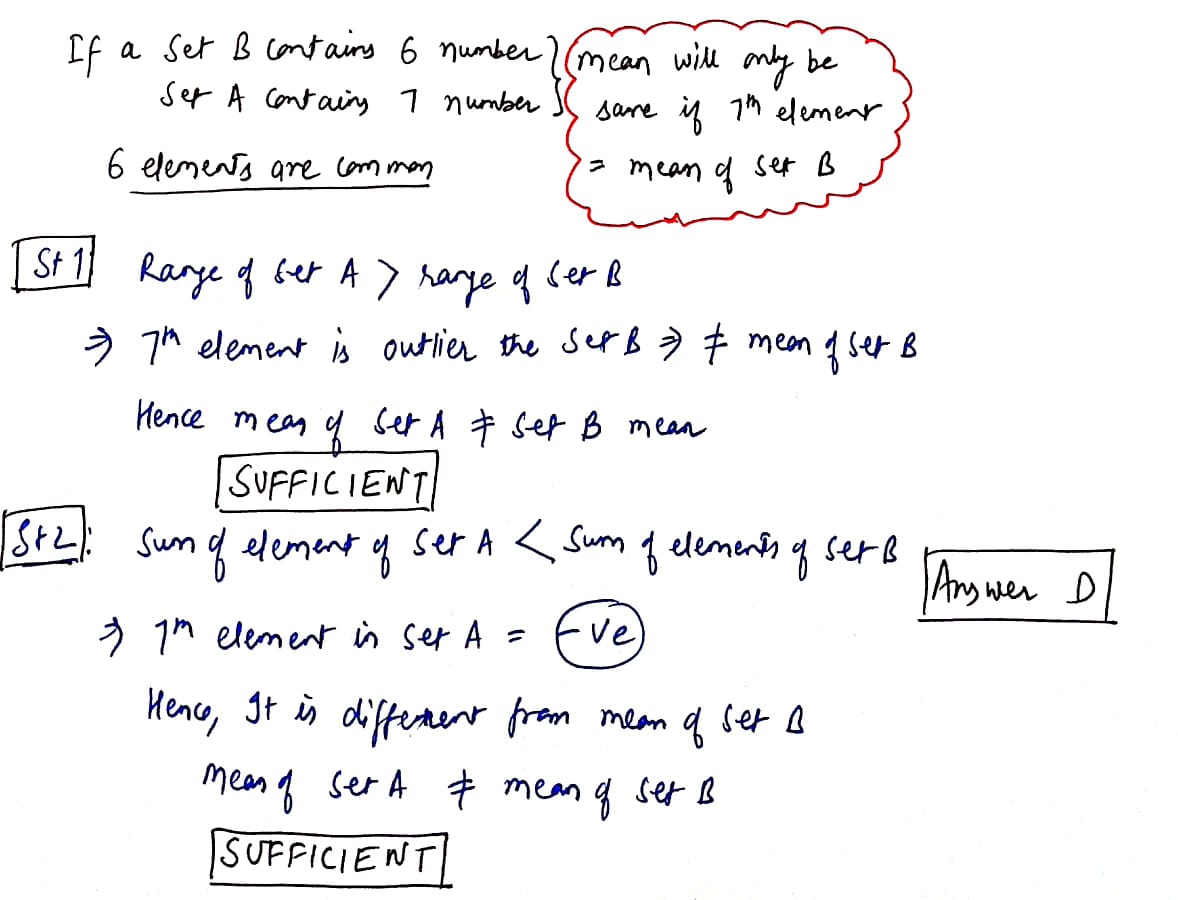

WhatsApp Image 2020-02-03 at 6.49.55 PM (1).jpeg [ 82.86 KiB | Viewed 3508 times ]
Attachment:
WhatsApp Image 2020-02-03 at 6.49.55 PM (1).jpeg [ 82.86 KiB | Viewed 3508 times ]

 01 Feb 2020, 19:29
Kudos
Bookmarks
Is the mean of Set A equal to mean of Set B?
A is a set containing 7 different numbers. B is a set containing 6 different positive numbers, all of which are members of set A.
Given:
1.Set A Consists of 7 different numbers - There is no specific information about whether they have 0 or negative numbers.
2.Set B consists of 6 positive numbers and all elements of Set B are part of Set A
1) Range of set A is greater than the range of set B.
Consider two different sets given below
Set A with first 7 numbers as elements and Set 6 with either from 2 to 7 or 1 to 6. When set B consists of 1 {1,2,3,4,5,6} , the mean is 3.5 and when set B consists of {2,3,4,5,6,7}, the mean is 4.5. In both the case the mean is not equal.
Consider having 0 in set A, in this case the range will be higher and the mean will remain same.
If A has a negative number, then range of A will be higher but the mean will vary.
Option A is not sufficient.
2) Sum of all numbers in set A < Sum of all the numbers in set B
Since Sum of all numbers is same and all of elements of Set B is in set A, the only number that could be in set A in this case is 0.
If we add only 0 to A, then mean of set A will be smaller than mean of set B.
Option B is sufficient.
Ans: B
A is a set containing 7 different numbers. B is a set containing 6 different positive numbers, all of which are members of set A.
Given:
1.Set A Consists of 7 different numbers - There is no specific information about whether they have 0 or negative numbers.
2.Set B consists of 6 positive numbers and all elements of Set B are part of Set A
1) Range of set A is greater than the range of set B.
Consider two different sets given below
Set A with first 7 numbers as elements and Set 6 with either from 2 to 7 or 1 to 6. When set B consists of 1 {1,2,3,4,5,6} , the mean is 3.5 and when set B consists of {2,3,4,5,6,7}, the mean is 4.5. In both the case the mean is not equal.
Consider having 0 in set A, in this case the range will be higher and the mean will remain same.
If A has a negative number, then range of A will be higher but the mean will vary.
Option A is not sufficient.
2) Sum of all numbers in set A < Sum of all the numbers in set B
Since Sum of all numbers is same and all of elements of Set B is in set A, the only number that could be in set A in this case is 0.
If we add only 0 to A, then mean of set A will be smaller than mean of set B.
Option B is sufficient.
Ans: B





