Events & Promotions
|
|

GMAT Club Daily Prep
Thank you for using the timer - this advanced tool can estimate your performance and suggest more practice questions. We have subscribed you to Daily Prep Questions via email.
Customized
for You
Track
Your Progress
Practice
Pays
Not interested in getting valuable practice questions and articles delivered to your email? No problem, unsubscribe here.
 Apr 28
08:00 AM PDT
-11:00 AM PDT
Whether you are just beginning your MBA journey or fine-tuning your path to a 700+ score, GMAT Day is designed to give you a competitive edge.

KeyurJoshi

GMAT 1: 710 Q49 V38
Posts: 143
 Updated on: 23 Jan 2022, 04:15
Originally posted by KeyurJoshi on 23 Jan 2022, 04:13.
Last edited by Bunuel on 23 Jan 2022, 04:15, edited 1 time in total.
Last edited by Bunuel on 23 Jan 2022, 04:15, edited 1 time in total.
Formatted.
Kudos
Bookmarks


B
Be sure to select an answer first to save it in the Error Log before revealing the correct answer (OA)!
Difficulty:
 75%
(hard)
75%
(hard)
Question Stats:
46% (01:37) correct 54%
(02:05)
wrong
based on 101
sessions
54%
(02:05)
wrong
based on 101
sessions
History
Date
Time
Result
Not Attempted Yet

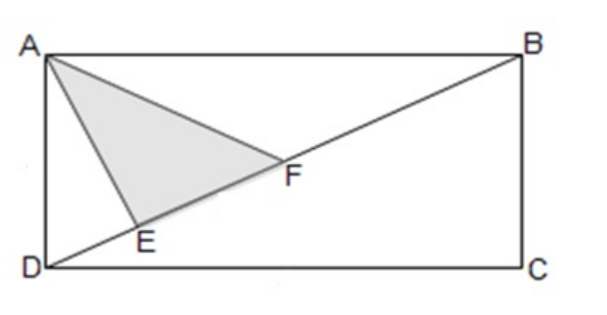
In the figure shown ABCD is a rectangle. The shaded region represents what percentage of rectangle ABCD?
(1) AD : BD = 5 : 12
(2) EF : BD = 1 : 3
Had to guess C on this, any property that we need to remember for these types of questions next time?
png.PNG [ 50.97 KiB | Viewed 4166 times ]
Attachment:
png.PNG [ 50.97 KiB | Viewed 4166 times ]
 23 Jan 2022, 05:59
Kudos
Bookmarks
KeyurJoshi
Pretty straightforward..
Now, \(\triangle ABD\) and \(\triangle EFA\) have SAME height, say h, so the area depends only on the base, that is EF and BD.
\(\frac{A(\triangle EFA)}{A(\triangle ABD)}=\frac{\frac{1}{2}*h*EF}{\frac{1}{2}*h*BD}=\frac{EF}{BD}\)
Area of rectangle is twice that of \(\triangle ABD\).
So our answer = \(\frac{A(\triangle EFA)}{2*A(\triangle ABD)}=\frac{\frac{1}{2}*h*EF}{2*\frac{1}{2}*h*BD}=\frac{EF}{2*BD}\)
(1) AD : BD = 5 : 12
We cannot say the exact lengths of any of the lines or location of E and F.
We can just say: Ratio of the sides of triangles so formed by the diagonal is 5:12:13
(2) EF : BD = 1 : 3
Gives us \(\frac{EF}{BD}=\frac{1}{3}\).
\(\frac{EF}{2*BD}=\frac{1}{2*3}=\frac{1}{6}\)
Sufficient
B
 02 Apr 2023, 12:48
Kudos
Bookmarks
chetan2u
Hey "chetan2u" thank you for the explanation.
I understood every other part of the answer except for one thing: How come the base of the triangle ABD is BD, shouldn't be AB?
Please let me know. TIA