Events & Promotions
| Last visit was: 06 Sep 2026, 17:06 |
It is currently 06 Sep 2026, 17:06 |
|
|

GMAT Club Daily Prep
Thank you for using the timer - this advanced tool can estimate your performance and suggest more practice questions. We have subscribed you to Daily Prep Questions via email.
Customized
for You
Track
Your Progress
Practice
Pays
Not interested in getting valuable practice questions and articles delivered to your email? No problem, unsubscribe here.
 Sep 07
12:01 AM PDT
-11:59 PM PDT
On the 7th, GMAT Club Tests will be Free! Including all the Quizzes, Questions, and Tests. 12 AM - 11:59 PM PDT- Sep 07
10:00 AM PDT
-11:00 AM PDT
A complete walkthrough of GMAT Club’s free 12-week GMAT study plan: what you study each week, how progress and goals are tracked, how the error log works, and how your practice unlocks paid tools at no cost.  Sep 02
01:00 PM EDT
-11:59 PM EDT
Take 30% off all study plans with code COURSEWORK - Expires on Monday 9/7 Sep 04
10:00 AM EDT
-11:59 PM EDT
We’ve worked incredibly hard to build TTP into the best test prep experience possible, and it would mean a lot to us to win Newsweek’s 2026 Readers’ Choice Award for Best Test Prep. If TTP has helped you, we’d be incredibly grateful for your vote. Sep 06
09:30 AM EDT
-12:30 PM EST
Top scores are possible when you enroll in a powerful EA course, taught live online + 6 months access to TTP OnDemand video courses included! Perfect class schedule and easy course access for working professionals. Class starts Sundays Sept. 6, 2026.- Sep 09
07:00 AM PDT
-10:00 AM PDT
Meet AdComs and explore top Master’s programs - MiM, MiF, MSc, MSBA and more. - Application Fee Waivers - Free 1-Week of GMAT Club Tests: - Master's Application Toolkit - Grand Prize Giveaway - Sep 09
10:00 AM PDT
-11:00 AM PDT
Three MBA applications. Three rejections. No interview invites. A year later, Aman was admitted to Cambridge Judge, SMU, and IMD. In this episode of MBA Admit Stories, Aman shares how he rebuilt his MBA application...  Sep 15
07:00 PM EDT
-09:00 PM EST
Elite scores are possible when you enroll in a powerful GMAT course, taught live online + 6 months access to TTP OnDemand video courses included! Class starts Tues/Thurs Sept. 15, 2026 - Nov. 15, 2027, 7:00pm-9:00pm EST Sep 21
08:00 PM EDT
-10:00 PM EDT
Boost your GMAT score in less than one month in a live online class + 6 months access to TTP OnDemand video courses included! Class starts Mon, Tues, Wed, Thur, Fri Sept. 21, 2026 - Oct. 9, 2027, 7:00pm-10:00pm EST

variantguy

Joined: 03 Feb 2019
Last visit: 13 Aug 2022
Posts: 288
Own Kudos:
Given Kudos: 250
Location: India
Concentration: Technology, Entrepreneurship
Schools: Haas '23 (M$) Ross '23 (A$) Anderson '22 (A$)
GMAT 1: 750 Q49 V42
WE:Marketing (Computer Software)
Products:
 Updated on: 05 May 2019, 00:33
Originally posted by variantguy on 04 May 2019, 13:14.
Last edited by variantguy on 05 May 2019, 00:33, edited 1 time in total.
Last edited by variantguy on 05 May 2019, 00:33, edited 1 time in total.
Kudos
Bookmarks
Hi experts,
I took the GMAT today (May 4, 2019) and managed a 720 (Q47, V42, IR6). It is my first official attempt after roughly 12 weeks of prep, and while I'm happy to have achieved a decent score, I am not entirely satisfied (especially with Quant ).
).
Background: I plan to apply to PhD programs (Marketing: Consumer Behaviour track) at the top 20 US b-schools. The reason I want to get a 750+ is that my profile seems to be a part of an over-represented pool, and since PhD applications are more competitive I feel this score doesn't offer any competitive advantage to me. I also believe that I can achieve my target score or get closer to it, given my current preparation circumstances (8-9 hr/day of marketing job) and the time I'm planning to take to prep more.
Profile Summary: Indian, Male; School Grades >95%, Engg. (IIT) GPA 4.0, MBA in Communication (#1 School in Category) GPA 3.2/4.0; Work ex - 5 years across Marketing Research, Advertising/Digital Marketing, and Product Marketing; no RA/TA experience, some academic research experience - MBA dissertation thesis, live research projects, research focused work-ex.
GMAT Preparation Overview:
Material: OG 18-19; OG Quant Review 19, Verbal Review 19; Manhattan Guides for Quant and SC
Test Series: Veritas, GMAC Official 1-4
Other Free Online Resources: Veritas free Question Bank, eGMAT free section of Scholaranium, free resources on GMATClub.
My strategy was to begin with refreshing all fundamentals of Quant and Verbal using Manhattan Guides, after which I solved the OGs and then the Review OGs. I started taking weekly tests at the same day and time as my intended test slot. I always ensured that I did a thorough analysis of each full length test, identified areas of weakness and patterns in mistakes, and worked on them. I moved to more challenging resources like the free question banks from Veritas and eGMAT, and solved GMATClub free resources closer to the real exam.
GMATPrep results so far:
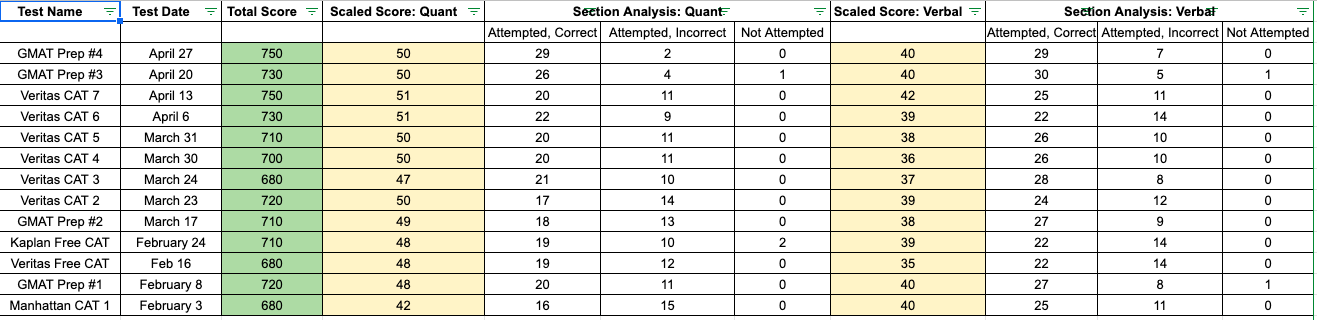
Screenshot 2019-04-28 at 2.33.48 AM.png [ 95.58 KiB | Viewed 4275 times ]
Real Test Experience:
Picked the order that I have been following in all my tests: Verbal - Quant - IR/Writing (I love Verbal, and also feel like I would rather do Quant in semi-fatigued state than Verbal).
Verbal: The whole section felt much easier than any of my mock experiences. I honestly felt I was doing really bad, because I didn't feel particularly challenged at any point in the test. But as advised by many, I stayed away from thinking about how I was performing, and actually focused on the question at the screen. Due to some silly time management error, I was left with 9 questions in the last 10 minutes, but managed to speed through and finish 10 seconds before time, and I don't think my accuracy took a major hit because of this! (Update: As ESR shows, had an 88% accuracy in the last section, which could well have been 100% if I had managed time better. Ironically, had the least accuracy in the third section where I spent the most time per question).
Quant:Honestly, I have no clue what's gone wrong. I am no math wizard, but after the first few weeks of prep, I was consistently improving in my Quant scores. The upward trend continued from 48 and I managed to hit 50 multiple times and even 51 in two Veritas tests. I was at least hoping to hit a Q50 today, and given that I exceeded expectations in Verbal, it's even more of a bummer.
Overall, can't help but feel that the delta has been virtually zero as I had the same score in my first GMATPrep Mock. But, not letting it overwhelm me too much.
Plan of Action
Update: Have received the ESR and analysed it a bit to validate my initial hypotheses about my performance. Experts, please take a look at my ESR and guide further.
I am planning to retake the exam in 1 month, and the obvious plan seems to be to improve Quant, while continuing to maintain and improve Verbal performance. My target is to move the Quant score up to a 50, and in Verbal I believe that with my current understanding and better time management I should be able tomaintain a 42 improve to a 42+. 
IR: I think I'd be okay at managing the same level, and would not put this high on my list considering higher returns can be reaped primarily from Quant, and if possible, from Verbal.
AWA: I practiced 3-4 essays before the real test, and think I managed to do a decent job in the exam. About 500 words, three valid points, the works. Again, wouldn't care much about this section (provided I get a >5, will get to know that in a few days and update on this post).
I would really appreciate the input on where I should focus my prep on and if my plan is sound:
1. Is 4 weeks a realistic timeline given my current and target score? Work shouldn't get any crazier than what it is right now, and even though I'd love to take a bit more time, there are other aspects of my application that I'd like to work upon after I'm settled on the score. So, 4 weeks seems like a sweet spot.
2. How should I move from Q47 to a Q50.My performance is worse in DS, and I'm usually not so confident with Geometry and Inequalities. More importantly, how do I ensure a consistent Quant performance, as today really seems to have been one of those anomaly days (worst time, eh).
3. Also on my mind: Should I consider not taking the test again? I've heard a lot about the diminishing returns on GMAT re-attempts, however I want to take all that with a pinch of salt and at least give it one more attempt, as I think I can get better. Update: The ESR has given me a fact check that only confirms my initial feeling that I can do better on my next attempt.
I took the GMAT today (May 4, 2019) and managed a 720 (Q47, V42, IR6). It is my first official attempt after roughly 12 weeks of prep, and while I'm happy to have achieved a decent score, I am not entirely satisfied (especially with Quant
). Background: I plan to apply to PhD programs (Marketing: Consumer Behaviour track) at the top 20 US b-schools. The reason I want to get a 750+ is that my profile seems to be a part of an over-represented pool, and since PhD applications are more competitive I feel this score doesn't offer any competitive advantage to me. I also believe that I can achieve my target score or get closer to it, given my current preparation circumstances (8-9 hr/day of marketing job) and the time I'm planning to take to prep more.
Profile Summary: Indian, Male; School Grades >95%, Engg. (IIT) GPA 4.0, MBA in Communication (#1 School in Category) GPA 3.2/4.0; Work ex - 5 years across Marketing Research, Advertising/Digital Marketing, and Product Marketing; no RA/TA experience, some academic research experience - MBA dissertation thesis, live research projects, research focused work-ex.
GMAT Preparation Overview:
Material: OG 18-19; OG Quant Review 19, Verbal Review 19; Manhattan Guides for Quant and SC
Test Series: Veritas, GMAC Official 1-4
Other Free Online Resources: Veritas free Question Bank, eGMAT free section of Scholaranium, free resources on GMATClub.
My strategy was to begin with refreshing all fundamentals of Quant and Verbal using Manhattan Guides, after which I solved the OGs and then the Review OGs. I started taking weekly tests at the same day and time as my intended test slot. I always ensured that I did a thorough analysis of each full length test, identified areas of weakness and patterns in mistakes, and worked on them. I moved to more challenging resources like the free question banks from Veritas and eGMAT, and solved GMATClub free resources closer to the real exam.
GMATPrep results so far:
Attachment:
Screenshot 2019-04-28 at 2.33.48 AM.png [ 95.58 KiB | Viewed 4275 times ]
Real Test Experience:
Picked the order that I have been following in all my tests: Verbal - Quant - IR/Writing (I love Verbal, and also feel like I would rather do Quant in semi-fatigued state than Verbal).
Verbal: The whole section felt much easier than any of my mock experiences. I honestly felt I was doing really bad, because I didn't feel particularly challenged at any point in the test. But as advised by many, I stayed away from thinking about how I was performing, and actually focused on the question at the screen. Due to some silly time management error, I was left with 9 questions in the last 10 minutes, but managed to speed through and finish 10 seconds before time, and I don't think my accuracy took a major hit because of this! (Update: As ESR shows, had an 88% accuracy in the last section, which could well have been 100% if I had managed time better. Ironically, had the least accuracy in the third section where I spent the most time per question).
Quant:
Overall, can't help but feel that the delta has been virtually zero as I had the same score in my first GMATPrep Mock. But, not letting it overwhelm me too much.
Plan of Action
Update: Have received the ESR and analysed it a bit to validate my initial hypotheses about my performance. Experts, please take a look at my ESR and guide further.
I am planning to retake the exam in 1 month, and the obvious plan seems to be to improve Quant, while continuing to maintain and improve Verbal performance. My target is to move the Quant score up to a 50, and in Verbal I believe that with my current understanding and better time management I should be able to
IR: I think I'd be okay at managing the same level, and would not put this high on my list considering higher returns can be reaped primarily from Quant, and if possible, from Verbal.
AWA: I practiced 3-4 essays before the real test, and think I managed to do a decent job in the exam. About 500 words, three valid points, the works. Again, wouldn't care much about this section (provided I get a >5, will get to know that in a few days and update on this post).
I would really appreciate the input on where I should focus my prep on and if my plan is sound:
1. Is 4 weeks a realistic timeline given my current and target score? Work shouldn't get any crazier than what it is right now, and even though I'd love to take a bit more time, there are other aspects of my application that I'd like to work upon after I'm settled on the score. So, 4 weeks seems like a sweet spot.
2. How should I move from Q47 to a Q50.
Attachments
 ESR_variantguy.pdf [485.92 KiB]
Downloaded 470 times
 04 May 2019, 18:08
Kudos
Bookmarks
Hi Varun.
Let's start with this.
Now, in your case, you started at 720 and are still at 720, and the idea that you can't get your score to increase by 30 points, that you are now at a "peak score" is ridiculous.
So, what's the answer? What levers do you have to pull?
I think, in quant, you have to find weaker areas and strengthen them. You can find them one by one, and make areas of weakness into areas of complete mastery. You mentioned inequalities and geometry. So, you could start with those two, and don't mess around. Learn ALL about, for instance, inequalities, and then do many dozens of inequalities questions, until you could teach inequalities in a class. At THAT point, you will be ready to see inequalities questions. Then, you would move to the next thing.
Go back over your practice tests and figure out what that next thing is, and master it too. if you want to score 50+ in quant, there can't be question types, or not many types, that you "are not comfortable with." If there are, you may hit Q50, but you may not. If there are, you are messing around and wondering about "diminishing returns."
You can be sure that, if you are strong in all quant areas, you will hit Q50 or Q51, sure as day follows night. Learn, practice, and make it happen.
Here's a post on How To Increase Your GMAT Quant Score.
Regarding verbal, just keep going, and keep looking for levers to pull, and don't expect those levers to be gimmicky strategies that you might hear about.
For SC, develop an eye for issues in sentence versions by carefully analyzing question after question, choice by choice.
For CR and RC, become supremely skilled at seeing the differences between trap choices and correct answers, by, yup, analyzing question after question, choice by choice.
Yes, if you are well prepared, as you noticed, GMAT verbal may seem to be easier than you expected it to be. So, prepare even more, and shoot for an even higher verbal section score. Why stop at V42? You are comfortable with verbal. Shoot for V51. I have seen someone whose English was comical score V47. Get used to the idea that you can score V51, and go for it.
Overall, you have to take the attitude that you could score 800 on this test with some more preparation. You might not score 800 four weeks from now, but 800 is your only true peak score. Given all the work you have already done, four weeks might be long enough for you to get to 750, IF you invest your time well. If it isn't, then keep going a little longer. You aren't very far from your score goal.
This post on The Phases of Preparing for the GMAT may be helpful, and you might get some inspiration and insights from this one too. How Can You Score 800 on the GMAT
Let's start with this.
Quote:
To a large degree, the diminishing returns to GMAT preparation that people experience are the results of people continuing to do the same thing. To increase your score, you have to keep finding new levers to pull. If you keep pulling the same levers, yes, you may not see any increase. Of course, if you believe the "peak score" myth, then you won't be surprised by a stall in your score increase, and you won't look for new levers to pull, because you are getting what you expect. If, on the other hand, you have a growth mindset, then, if your score stalls, you'll figure that something is wrong with the way you are approaching the GMAT, and find new levers to pull.
Now, in your case, you started at 720 and are still at 720, and the idea that you can't get your score to increase by 30 points, that you are now at a "peak score" is ridiculous.
So, what's the answer? What levers do you have to pull?
I think, in quant, you have to find weaker areas and strengthen them. You can find them one by one, and make areas of weakness into areas of complete mastery. You mentioned inequalities and geometry. So, you could start with those two, and don't mess around. Learn ALL about, for instance, inequalities, and then do many dozens of inequalities questions, until you could teach inequalities in a class. At THAT point, you will be ready to see inequalities questions. Then, you would move to the next thing.
Go back over your practice tests and figure out what that next thing is, and master it too. if you want to score 50+ in quant, there can't be question types, or not many types, that you "are not comfortable with." If there are, you may hit Q50, but you may not. If there are, you are messing around and wondering about "diminishing returns."
You can be sure that, if you are strong in all quant areas, you will hit Q50 or Q51, sure as day follows night. Learn, practice, and make it happen.
Here's a post on How To Increase Your GMAT Quant Score.
Regarding verbal, just keep going, and keep looking for levers to pull, and don't expect those levers to be gimmicky strategies that you might hear about.
For SC, develop an eye for issues in sentence versions by carefully analyzing question after question, choice by choice.
For CR and RC, become supremely skilled at seeing the differences between trap choices and correct answers, by, yup, analyzing question after question, choice by choice.
Yes, if you are well prepared, as you noticed, GMAT verbal may seem to be easier than you expected it to be. So, prepare even more, and shoot for an even higher verbal section score. Why stop at V42? You are comfortable with verbal. Shoot for V51. I have seen someone whose English was comical score V47. Get used to the idea that you can score V51, and go for it.
Overall, you have to take the attitude that you could score 800 on this test with some more preparation. You might not score 800 four weeks from now, but 800 is your only true peak score. Given all the work you have already done, four weeks might be long enough for you to get to 750, IF you invest your time well. If it isn't, then keep going a little longer. You aren't very far from your score goal.
This post on The Phases of Preparing for the GMAT may be helpful, and you might get some inspiration and insights from this one too. How Can You Score 800 on the GMAT

Harimati
Joined: 26 Aug 2018
Last visit: 09 Feb 2020
Posts: 5
Given Kudos: 6
Location: India
Schools: SMU Singapore PT MBA"19
04 May 2019, 20:18
Kudos
Bookmarks
Shut the internet and focus on the study.
Posted from my mobile device
Posted from my mobile device
variantguy
Joined: 03 Feb 2019
Last visit: 13 Aug 2022
Posts: 288
Own Kudos:
Given Kudos: 250
Location: India
Concentration: Technology, Entrepreneurship
Schools: Haas '23 (M$) Ross '23 (A$) Anderson '22 (A$)
GMAT 1: 750 Q49 V42
WE:Marketing (Computer Software)
Products:
05 May 2019, 00:59
Kudos
Bookmarks
MartyTargetTestPrep
Thanks for your response MartyTargetTestPrep
I have attached my ESR to my original post. Could you please take a look and advice further? This is my current understanding:
1. Verbal: All three sub-sections scores accurately reflect my experience of the exam. However, this is a rather unfortunate reversal of sorts for me. When I started preparing for GMAT, SC was my weakest area and CR was my strongest, with RC being fairly strong (>90% accuracy). Naturally, I devoted more time to SC and RC, while practicing CR frequently enough. However, in the couple of weeks leading up to the exam, my CR accuracy was lower than average, and I felt not so confident about it going into the exam.
And it seems like it was actually my pacing in the second section that affected my accuracy in the third section (and not my pacing in the third section that affected accuracy in the fourth, as I had initially assumed). I remember that both second and third sections had a few CR questions where I took >3 minutes.
2. Quant: My initial assessment was quite off the mark. I assumed I had done worse on DS, whereas ESR shows that my DS score was ~50, while PS was an awful ~43. I can't believe that I did as well on the first and second sections because in my head I was doing just about average. Similarly, I can't believe I did that bad in fourth section (and I'm wondering that maybe I was en route to at least a 49-50 kinda score up until third section). Avg. time per DS question is affecting my overall time management, could possibly have also affected my accuracy on PS as I went in with the mindset of saving time on PS questions since they were my strong suit and allocating it to DS. Obviously, it was a flawed strategy that took more than it gave. My takeaway would be to not have a blanket rule, treat each question to its merit and try and solve it as quickly+accurately as possible.





