Events & Promotions
|
|

GMAT Club Daily Prep
Thank you for using the timer - this advanced tool can estimate your performance and suggest more practice questions. We have subscribed you to Daily Prep Questions via email.
Customized
for You
Track
Your Progress
Practice
Pays
Not interested in getting valuable practice questions and articles delivered to your email? No problem, unsubscribe here.
 Sep 10
01:00 AM EDT
-02:00 AM EDT
Learn how Keshav, a Chartered Accountant, scored an impressive 705 on GMAT in just 30 days with GMATWhiz's expert guidance. In this video, he shares preparation tips and strategies that worked for him, including the mock, time management, and more. Sep 04
10:00 AM EDT
-11:59 PM EDT
We’ve worked incredibly hard to build TTP into the best test prep experience possible, and it would mean a lot to us to win Newsweek’s 2026 Readers’ Choice Award for Best Test Prep. If TTP has helped you, we’d be incredibly grateful for your vote. Sep 08
12:30 AM EDT
-01:30 AM EDT
Looking for your GMAT motivation to break through the score plateau? Pragati improved her score by massive 160 points with strategic guidance and hard-work! Find out how personalized mentorship and a strong mindset can turn GMAT struggles into success. Sep 09
07:00 AM PDT
-10:00 AM PDT
Meet AdComs and explore top Master’s programs - MiM, MiF, MSc, MSBA and more. - Application Fee Waivers - Free 1-Week of GMAT Club Tests: - Master's Application Toolkit - Grand Prize Giveaway- Sep 09
10:00 AM PDT
-11:00 AM PDT
Three MBA applications. Three rejections. No interview invites. A year later, Aman was admitted to Cambridge Judge, SMU, and IMD. In this episode of MBA Admit Stories, Aman shares how he rebuilt his MBA application...  Sep 10
08:00 PM PDT
-09:00 PM PDT
Free- full-length test + 15 concept videos + 150+ short videos + study plan! Sep 15
07:00 PM EDT
-09:00 PM EST
Elite scores are possible when you enroll in a powerful GMAT course, taught live online + 6 months access to TTP OnDemand video courses included! Class starts Tues/Thurs Sept. 15, 2026 - Nov. 15, 2027, 7:00pm-9:00pm EST Sep 21
07:00 PM EDT
-10:00 PM EDT
Boost your GMAT score in less than one month in a live online class + 6 months access to TTP OnDemand video courses included! Class starts Mon, Tues, Wed, Thur, Fri Sept. 21, 2026 - Oct. 9, 2027, 7:00pm-10:00pm EST

 06 Dec 2019, 08:18
Kudos
Bookmarks
A triangle is a polygon with the least number of sides, or in other words, a triangle is a 3-sided polygon.
On the Quant section of the GMAT, questions on triangles constitute a considerable chunk of the questions that come from Geometry. This is because there are a number of different concepts related to triangles, on which you can be tested. One such category of questions is where you need to compare two or more triangles and ascertain how they are related. It is here that you need to know the concepts of equality, similarity and congruency of triangles.
So, let’s get started!
Equal Triangles
What are equal triangles? Two or more triangles which have the same area are said to be equal triangles. Note that there is no compulsion that the triangles should have the same dimensions or the same angles. What’s more, they don’t even have to be of the same type.
We could think of an analogy here. Think of two persons who are equally rich. As long as they have the same amount of cash with them, you won’t worry about them being tall or short, intelligent or stupid. The only parameter you will consider is the money that they have. As long as that is equal, nothing else matters.
Likewise, with equal triangles, as long as the area of two triangles is same, you do not have to worry about any other parameter related to the triangles.
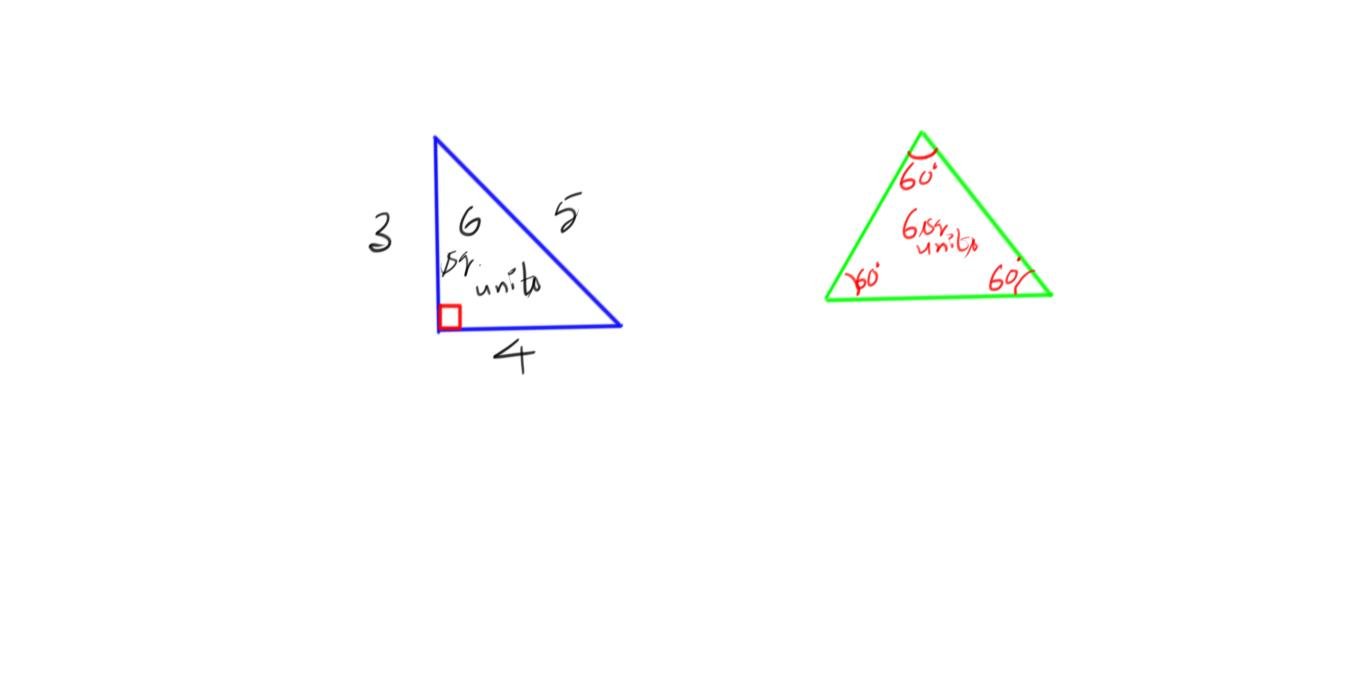
Can an equilateral triangle and a right- angled triangle be equal? Why not!
Think of a right - angled triangle with sides in the golden ratio, 3,4 and 5. The area of this right - angled triangle is ½ * 3 * 4 = 6 square units. Now, can there be an equilateral triangle with an area of 6 square units? The obvious answer is YES.
6th Dec 2019 - Post - 1.jpg [ 24.83 KiB | Viewed 1346 times ]
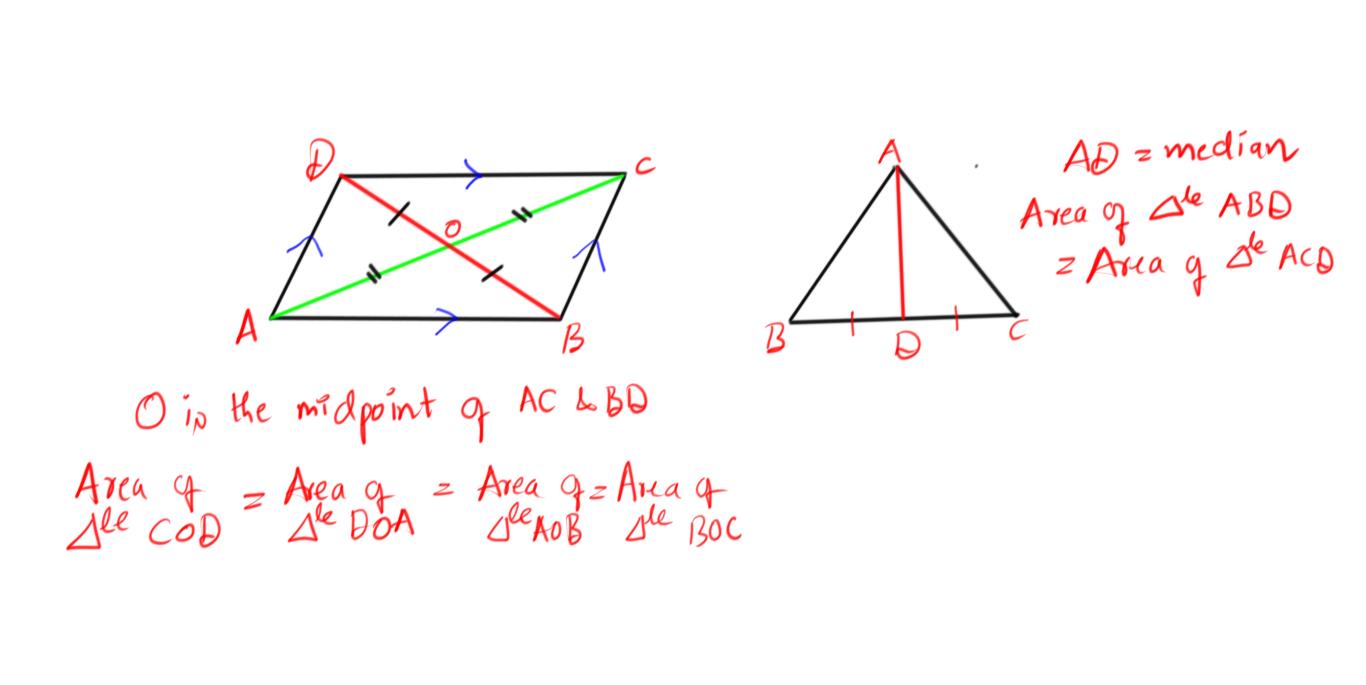
An example where we use the case of equal triangles is in the case of the diagonals of a parallelogram. The diagonals of a parallelogram bisect each other. This essentially means one half of one diagonal represents the median of the other diagonal.
The median of a triangle divides the triangle into two triangles of equal area, OR, into 2 equal triangles.
6th Dec 2019 - Post - 2.jpg [ 49.35 KiB | Viewed 1338 times ]
Using this concept, it can be proven that the four smaller triangles that are formed when we draw the two diagonals of a parallelogram, represent equal triangles i.e. they are all equal to one-fourth the area of the parallelogram.
So, equal triangles are two or more triangles which have the same area. They need not have the same dimensions and angles. But, if they do, they will necessarily be equal triangles.
Similar Triangles
The next obvious question would be, “What are similar triangles?”.
Let’s take a shot at an analogy again, this time from the animal world. Does a Cheetah look similar to a Leopard? You’d say, “Oh, yes, for sure!”.
Is a Cheetah similar to a Cat? You’d probably think for a while, but then conclude and say, “ Hey, yes, although bigger in size, they have a lot of features in common.”.
But, is a Cheetah similar to a wolf? Well, that’s a NO for sure, isn’t it?. Dogs are probably similar to wolves but not a cheetah.
I hope this has given you an idea of what similarity is.
Two or more triangles are similar to each other if they have the same shape. Having the same size is not a mandate.
The SHAPE of a triangle depends on the angles of that triangle. Therefore, when you say that two triangles should have the same shape, you are invariably saying that they should have the same set of angles. This is why we always consider equality of corresponding angles to prove that two triangles are similar.
On the contrary, the SIZE of a triangle depends on the sides of that triangle. This is obviously why the 3-4-5 right triangle is smaller in size to a 6-8-10 right triangle, although it has the same angles.
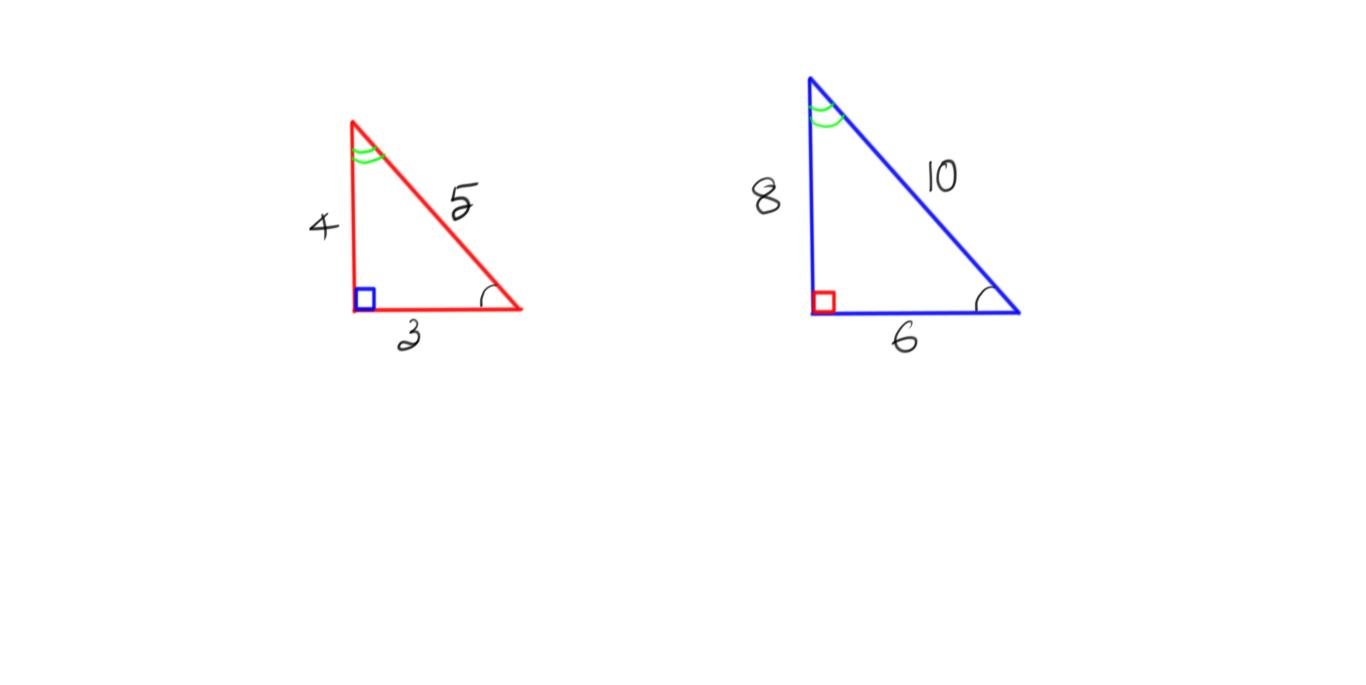
Alternatively, you can also prove similarity based on the ratio of the corresponding sides. Take a look at the example below to see how you can prove similarity based on ratio of sides. Let us consider our pet example, the 3-4-5 and the 6-8-10 right triangles.
6th Dec 2019 - Post - 3.jpg [ 23.47 KiB | Viewed 1331 times ]
This shows us another way of understanding similar triangles.
You observe that the former is half of the latter in terms of size. This means that the first triangle can grow to become the second triangle at some stage. Vice – versa is true as well. This is possible only because they have the same ratio of sides and hence are similar.
Remember the Cheetah and Cat analogy? The Cat evolved to become a larger version of itself i.e. the Cheetah; wait, is it the other way round?
However it is, we understand that one shape could become another shape as long as they had certain things in common. I hope this has made it easy to pick up this aspect of similarity. But, however big or small you make the Cat, it can never become the wolf. That’s because they don't have the same silhouettes and hence not similar.
I hope that you have a better understanding of the concept of similarity now.
Let’s now move to the next stage in our discussion on similarity which is where we discuss the methods of proving similarity. On GMAT quant questions, you can use any of the following three methods to prove similarity of triangles:
1. AA – IF two angles of one triangle are equal to two angles of the second triangle, then the two triangles are similar. Note that the order in which you take the angles is not important.
2. SAS – IF two sides of one triangle bear the same ratio with the two corresponding sides of the second triangle AND the angles included between these two sides, are equal, then the two triangles are similar.
3. SSS – If three sides of one triangle are similar to three corresponding sides of the other triangle, then the two triangles are similar.
In the last two cases, remember that you need to take the corresponding sides to prove similarity.
Once you are able to prove that two triangles are similar, the following results can be established:
Ratio of Heights = Ratio of corresponding sides
Ratio of Medians = Ratio of corresponding sides
Ratio of Angle Bisectors = Ratio of corresponding sides
Ratio of Perimeters = Ratio of Corresponding sides
Ratio of Areas = \((Ratio of Corresponding sides)^2\)
The last result is tested in a lot of problems on GMAT Quant, in one way or the other. But, are there any ways in which one can identify when to use the concept of similarity in a GMAT Quant question?? The good news is that the answer is YES.
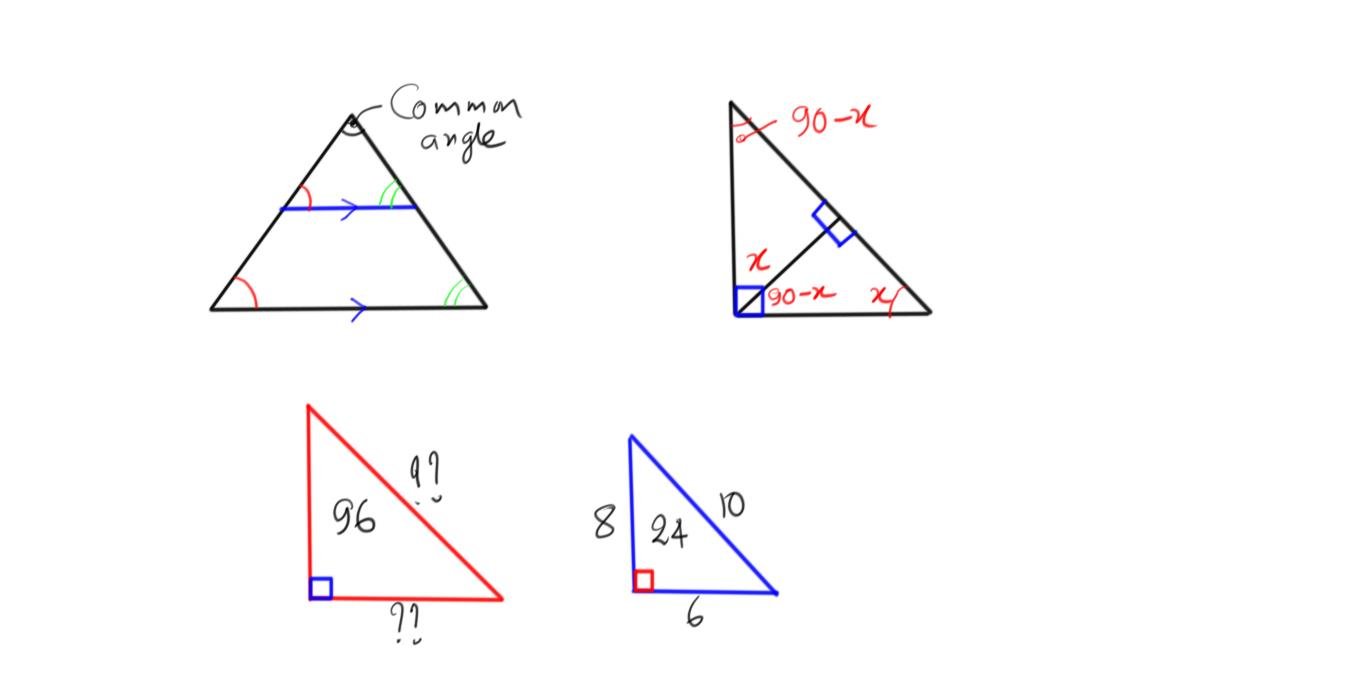
Following are a few situations in which similarity is tested:
A smaller triangle inside a larger triangle with one side of the smaller one parallel to the corresponding side of the larger one.
A right angled triangle which has been divided into two smaller right triangles by dropping a perpendicular from the vertex containing the right angle onto the hypotenuse.
A problem which gives you the ratio of the areas, the sides of one of the triangles and asks you to find the sides of the other triangle.
The ratio of sides is given and the ratio of areas is to be found out.
6th Dec 2019 - Post - 4.jpg [ 34.7 KiB | Viewed 1328 times ]
We would like you to know that the concept of similarity is tested extensively on GMAT Quant. Therefore, it’s a good idea to spend enough time in understanding the concept and in solving questions where you learn how to apply the concept in different situations.
Let’s get to the last part of this post now, which is about congruency.
Congruent Triangles
Paradoxically, the concept of congruency of triangles is tested very rarely on the GMAT. In some ways, that’s good because it means that’s one less concept to learn.
However, if you put your head into it, congruency is the easiest of the three concepts to understand.
Two or more triangles are congruent if they have the same SHAPE as well as the same SIZE. In other words, they have to be identical in all respects.
One last analogy, if I may please! If you ever visit a Mercedes Benz showroom and look at two absolutely stunning AMG- G 63 cars, standing one beside the other draped in that killer Black shade and teasing you to take one home, when the sales person asks “ Which one do you want to pick?”, you’d be like, “ Dude, both look exactly the same, how does it matter?”.
Unless of course, there is a sliver of a dent on one of them and the sales person secretly wished that you’d select that.
So, you now understand what congruency means. You are looking at two exactly identical triangles.
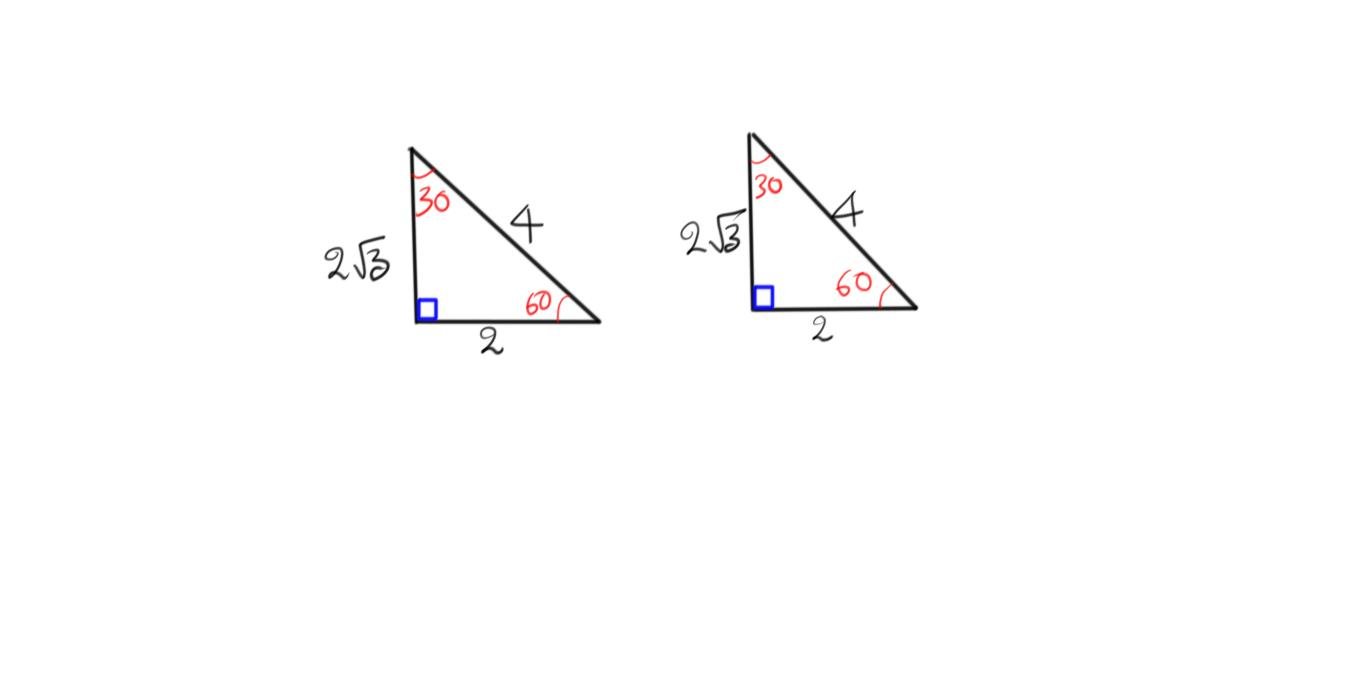
6th Dec 2019 - Post - 5.jpg [ 24.08 KiB | Viewed 1322 times ]
So, if we have to prove that two triangles are congruent, how do we do it? Simple, we use one of the following three rules:
1. SSS – If three sides of one triangle are EQUAL to the three corresponding sides of the second triangle, then the two triangles are congruent.
2. SAS – If two sides and the angle included between them are equal to two corresponding sides and the angle included between them, then the two triangles are congruent.
3. RHS – This can be applied only in right angled triangles. If two right triangles have a right angle (really, that’s the funny part) and the same length for their hypotenuses, then they are congruent if any one of the perpendicular sides of one is equal to any one of the perpendicular sides of the other.
Lastly, what are some of the common situations where you encounter congruent triangles?
The height drawn from any vertex of an equilateral triangle divides it into two congruent triangles
The diagonals of a square and a rhombus divide the figure into 4 congruent triangles
From an external point, if two tangents are drawn to the same circle and the point is connected to the centre of the circle using a line segment, the two triangles thus obtained will be congruent triangles.
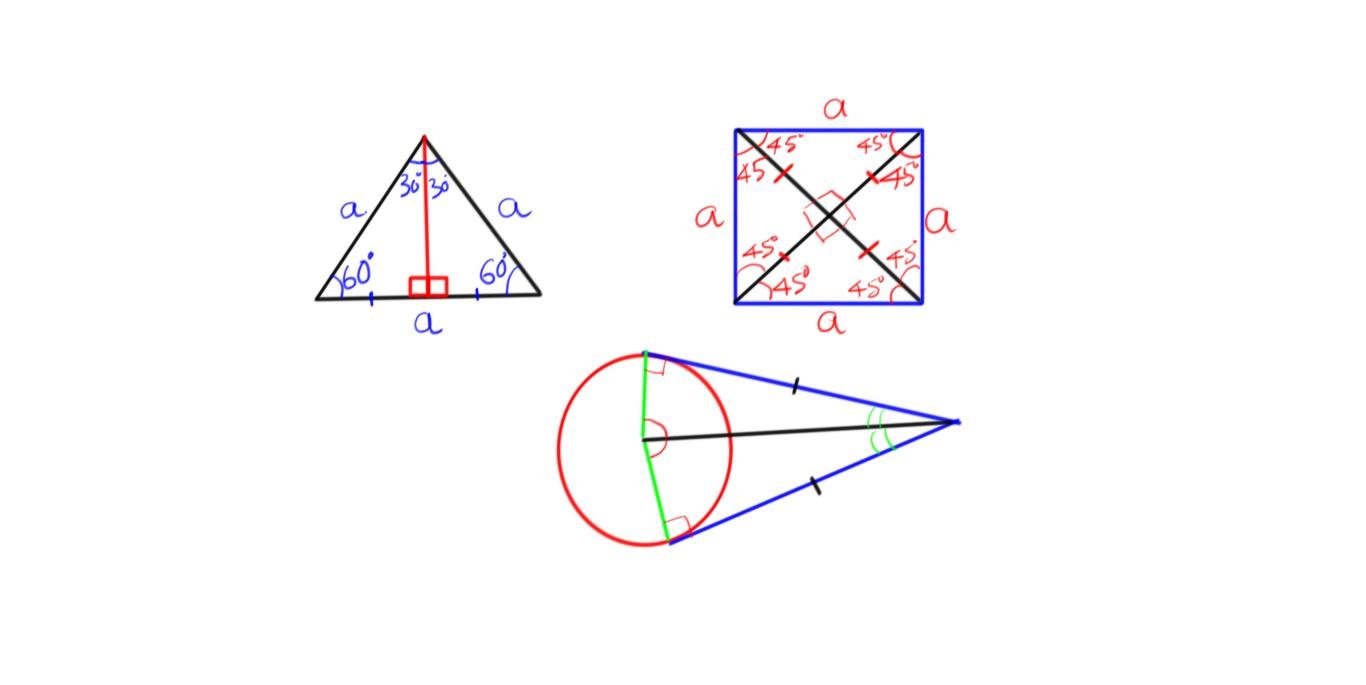
6th Dec 2019 - Post - 6.jpg [ 37.57 KiB | Viewed 1323 times ]
To put things in perspective, bear in mind that,
All congruent triangles are necessarily similar but all similar triangles need not be congruent.
All congruent triangles are necessarily equal but all equal triangles need not be congruent.
All similar triangles are necessarily equal but all equal triangles are not similar.
I hope that this article has given you some insights into how to differentiate between the concepts of equality, similarity and congruency of triangles. On an ending note, why don’t you try solving a few questions on similarity of triangles? Here are a couple of links from the GMAT Club forum.
https://gmatclub.com/forum/in-the-figur ... 27532.html
https://gmatclub.com/forum/what-is-the- ... 67798.html
On the Quant section of the GMAT, questions on triangles constitute a considerable chunk of the questions that come from Geometry. This is because there are a number of different concepts related to triangles, on which you can be tested. One such category of questions is where you need to compare two or more triangles and ascertain how they are related. It is here that you need to know the concepts of equality, similarity and congruency of triangles.
So, let’s get started!
Equal Triangles
What are equal triangles? Two or more triangles which have the same area are said to be equal triangles. Note that there is no compulsion that the triangles should have the same dimensions or the same angles. What’s more, they don’t even have to be of the same type.
We could think of an analogy here. Think of two persons who are equally rich. As long as they have the same amount of cash with them, you won’t worry about them being tall or short, intelligent or stupid. The only parameter you will consider is the money that they have. As long as that is equal, nothing else matters.
Likewise, with equal triangles, as long as the area of two triangles is same, you do not have to worry about any other parameter related to the triangles.
Can an equilateral triangle and a right- angled triangle be equal? Why not!
Think of a right - angled triangle with sides in the golden ratio, 3,4 and 5. The area of this right - angled triangle is ½ * 3 * 4 = 6 square units. Now, can there be an equilateral triangle with an area of 6 square units? The obvious answer is YES.
Attachment:
6th Dec 2019 - Post - 1.jpg [ 24.83 KiB | Viewed 1346 times ]
An example where we use the case of equal triangles is in the case of the diagonals of a parallelogram. The diagonals of a parallelogram bisect each other. This essentially means one half of one diagonal represents the median of the other diagonal.
The median of a triangle divides the triangle into two triangles of equal area, OR, into 2 equal triangles.
Attachment:
6th Dec 2019 - Post - 2.jpg [ 49.35 KiB | Viewed 1338 times ]
Using this concept, it can be proven that the four smaller triangles that are formed when we draw the two diagonals of a parallelogram, represent equal triangles i.e. they are all equal to one-fourth the area of the parallelogram.
So, equal triangles are two or more triangles which have the same area. They need not have the same dimensions and angles. But, if they do, they will necessarily be equal triangles.
Similar Triangles
The next obvious question would be, “What are similar triangles?”.
Let’s take a shot at an analogy again, this time from the animal world. Does a Cheetah look similar to a Leopard? You’d say, “Oh, yes, for sure!”.
Is a Cheetah similar to a Cat? You’d probably think for a while, but then conclude and say, “ Hey, yes, although bigger in size, they have a lot of features in common.”.
But, is a Cheetah similar to a wolf? Well, that’s a NO for sure, isn’t it?. Dogs are probably similar to wolves but not a cheetah.
I hope this has given you an idea of what similarity is.
Two or more triangles are similar to each other if they have the same shape. Having the same size is not a mandate.
The SHAPE of a triangle depends on the angles of that triangle. Therefore, when you say that two triangles should have the same shape, you are invariably saying that they should have the same set of angles. This is why we always consider equality of corresponding angles to prove that two triangles are similar.
On the contrary, the SIZE of a triangle depends on the sides of that triangle. This is obviously why the 3-4-5 right triangle is smaller in size to a 6-8-10 right triangle, although it has the same angles.
Alternatively, you can also prove similarity based on the ratio of the corresponding sides. Take a look at the example below to see how you can prove similarity based on ratio of sides. Let us consider our pet example, the 3-4-5 and the 6-8-10 right triangles.
Attachment:
6th Dec 2019 - Post - 3.jpg [ 23.47 KiB | Viewed 1331 times ]
This shows us another way of understanding similar triangles.
You observe that the former is half of the latter in terms of size. This means that the first triangle can grow to become the second triangle at some stage. Vice – versa is true as well. This is possible only because they have the same ratio of sides and hence are similar.
Remember the Cheetah and Cat analogy? The Cat evolved to become a larger version of itself i.e. the Cheetah; wait, is it the other way round?
However it is, we understand that one shape could become another shape as long as they had certain things in common. I hope this has made it easy to pick up this aspect of similarity. But, however big or small you make the Cat, it can never become the wolf. That’s because they don't have the same silhouettes and hence not similar.
I hope that you have a better understanding of the concept of similarity now.
Let’s now move to the next stage in our discussion on similarity which is where we discuss the methods of proving similarity. On GMAT quant questions, you can use any of the following three methods to prove similarity of triangles:
1. AA – IF two angles of one triangle are equal to two angles of the second triangle, then the two triangles are similar. Note that the order in which you take the angles is not important.
2. SAS – IF two sides of one triangle bear the same ratio with the two corresponding sides of the second triangle AND the angles included between these two sides, are equal, then the two triangles are similar.
3. SSS – If three sides of one triangle are similar to three corresponding sides of the other triangle, then the two triangles are similar.
In the last two cases, remember that you need to take the corresponding sides to prove similarity.
Once you are able to prove that two triangles are similar, the following results can be established:
Ratio of Heights = Ratio of corresponding sides
Ratio of Medians = Ratio of corresponding sides
Ratio of Angle Bisectors = Ratio of corresponding sides
Ratio of Perimeters = Ratio of Corresponding sides
Ratio of Areas = \((Ratio of Corresponding sides)^2\)
The last result is tested in a lot of problems on GMAT Quant, in one way or the other. But, are there any ways in which one can identify when to use the concept of similarity in a GMAT Quant question?? The good news is that the answer is YES.
Following are a few situations in which similarity is tested:
A smaller triangle inside a larger triangle with one side of the smaller one parallel to the corresponding side of the larger one.
A right angled triangle which has been divided into two smaller right triangles by dropping a perpendicular from the vertex containing the right angle onto the hypotenuse.
A problem which gives you the ratio of the areas, the sides of one of the triangles and asks you to find the sides of the other triangle.
The ratio of sides is given and the ratio of areas is to be found out.
Attachment:
6th Dec 2019 - Post - 4.jpg [ 34.7 KiB | Viewed 1328 times ]
We would like you to know that the concept of similarity is tested extensively on GMAT Quant. Therefore, it’s a good idea to spend enough time in understanding the concept and in solving questions where you learn how to apply the concept in different situations.
Let’s get to the last part of this post now, which is about congruency.
Congruent Triangles
Paradoxically, the concept of congruency of triangles is tested very rarely on the GMAT. In some ways, that’s good because it means that’s one less concept to learn.
However, if you put your head into it, congruency is the easiest of the three concepts to understand.
Two or more triangles are congruent if they have the same SHAPE as well as the same SIZE. In other words, they have to be identical in all respects.
One last analogy, if I may please! If you ever visit a Mercedes Benz showroom and look at two absolutely stunning AMG- G 63 cars, standing one beside the other draped in that killer Black shade and teasing you to take one home, when the sales person asks “ Which one do you want to pick?”, you’d be like, “ Dude, both look exactly the same, how does it matter?”.
Unless of course, there is a sliver of a dent on one of them and the sales person secretly wished that you’d select that.
So, you now understand what congruency means. You are looking at two exactly identical triangles.
Attachment:
6th Dec 2019 - Post - 5.jpg [ 24.08 KiB | Viewed 1322 times ]
So, if we have to prove that two triangles are congruent, how do we do it? Simple, we use one of the following three rules:
1. SSS – If three sides of one triangle are EQUAL to the three corresponding sides of the second triangle, then the two triangles are congruent.
2. SAS – If two sides and the angle included between them are equal to two corresponding sides and the angle included between them, then the two triangles are congruent.
3. RHS – This can be applied only in right angled triangles. If two right triangles have a right angle (really, that’s the funny part) and the same length for their hypotenuses, then they are congruent if any one of the perpendicular sides of one is equal to any one of the perpendicular sides of the other.
Lastly, what are some of the common situations where you encounter congruent triangles?
The height drawn from any vertex of an equilateral triangle divides it into two congruent triangles
The diagonals of a square and a rhombus divide the figure into 4 congruent triangles
From an external point, if two tangents are drawn to the same circle and the point is connected to the centre of the circle using a line segment, the two triangles thus obtained will be congruent triangles.
Attachment:
6th Dec 2019 - Post - 6.jpg [ 37.57 KiB | Viewed 1323 times ]
To put things in perspective, bear in mind that,
All congruent triangles are necessarily similar but all similar triangles need not be congruent.
All congruent triangles are necessarily equal but all equal triangles need not be congruent.
All similar triangles are necessarily equal but all equal triangles are not similar.
I hope that this article has given you some insights into how to differentiate between the concepts of equality, similarity and congruency of triangles. On an ending note, why don’t you try solving a few questions on similarity of triangles? Here are a couple of links from the GMAT Club forum.
https://gmatclub.com/forum/in-the-figur ... 27532.html
https://gmatclub.com/forum/what-is-the- ... 67798.html





