Events & Promotions
|
|

GMAT Club Daily Prep
Thank you for using the timer - this advanced tool can estimate your performance and suggest more practice questions. We have subscribed you to Daily Prep Questions via email.
Customized
for You
Track
Your Progress
Practice
Pays
Not interested in getting valuable practice questions and articles delivered to your email? No problem, unsubscribe here.
 Sep 06
09:30 AM EDT
-12:30 PM EST
Top scores are possible when you enroll in a powerful EA course, taught live online + 6 months access to TTP OnDemand video courses included! Perfect class schedule and easy course access for working professionals. Class starts Sundays Sept. 6, 2026. Sep 02
01:00 PM EDT
-11:59 PM EDT
Take 30% off all study plans with code COURSEWORK - Expires on Monday 9/7 Sep 04
10:00 AM EDT
-11:59 PM EDT
We’ve worked incredibly hard to build TTP into the best test prep experience possible, and it would mean a lot to us to win Newsweek’s 2026 Readers’ Choice Award for Best Test Prep. If TTP has helped you, we’d be incredibly grateful for your vote. Sep 07
12:01 AM PDT
-11:59 PM PDT
On the 7th, GMAT Club Tests will be Free! Including all the Quizzes, Questions, and Tests. 12 AM - 11:59 PM PDT- Sep 07
10:00 AM PDT
-11:00 AM PDT
A complete walkthrough of GMAT Club’s free 12-week GMAT study plan: what you study each week, how progress and goals are tracked, how the error log works, and how your practice unlocks paid tools at no cost. - Sep 09
07:00 AM PDT
-10:00 AM PDT
Meet AdComs and explore top Master’s programs - MiM, MiF, MSc, MSBA and more. - Application Fee Waivers - Free 1-Week of GMAT Club Tests: - Master's Application Toolkit - Grand Prize Giveaway - Sep 09
10:00 AM PDT
-11:00 AM PDT
Three MBA applications. Three rejections. No interview invites. A year later, Aman was admitted to Cambridge Judge, SMU, and IMD. In this episode of MBA Admit Stories, Aman shares how he rebuilt his MBA application...  Sep 15
07:00 PM EDT
-09:00 PM EST
Elite scores are possible when you enroll in a powerful GMAT course, taught live online + 6 months access to TTP OnDemand video courses included! Class starts Tues/Thurs Sept. 15, 2026 - Nov. 15, 2027, 7:00pm-9:00pm EST Sep 21
08:00 PM EDT
-10:00 PM EDT
Boost your GMAT score in less than one month in a live online class + 6 months access to TTP OnDemand video courses included! Class starts Mon, Tues, Wed, Thur, Fri Sept. 21, 2026 - Oct. 9, 2027, 7:00pm-10:00pm EST

 20 Mar 2019, 01:54
Kudos
Bookmarks
GMAT Quant DS - 3 Mistakes Students Make in Number Properties Questions - Part II
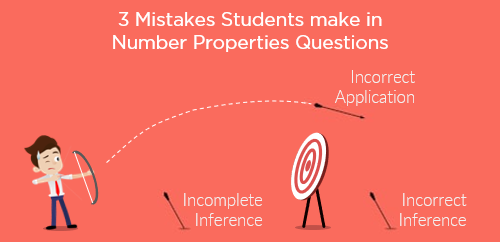
This is the second article in the series of 3 most common mistakes students make in the Number Properties DS question.
To read the first article: GMAT Quant DS - 3 Mistakes Students Make in Number Properties Questions - Part I
Highlights of the Previous Article
In the previous, we discussed why students make two of the three most common mistakes while solving a DS question.
These two mistakes were:
- 1. Drawing incorrect inference from the question stem.
2. Drawing incomplete inference from the question stem.
Before reading further, we suggest that you read the first article if you have not read it yet.
Agenda of this Article
In this article, we will discuss the third mistake that students make in a DS question.
- • The third mistake is: Faltering while applying the inferences
Mistake 3: Faltering while Applying the Inferences
In the first article, we learned how to avoid drawing incorrect and incomplete inferences.
- • And, once we have mastered the skill of drawing correct and complete inferences, the next step is to apply those inferences correctly.
If this step is also executed properly, then you are 80% close to marking the correct answer choice.
- • Why only 80%?
- o Because reaming 20% is the application of the concepts.
So, let us look at one e-GMAT question to understand the 3rd most common type of mistake.
e-GMAT Question 1
If t is a positive integer, can \(t^2 + 1\) be completely divided by 10?
- 1. \(91^2 * t\) leaves a remainder of 1 when divided by 2.
2. \(91^2 * t = 5q + 2\), where q is a non-negative integer.
(For e-GMAT students: This question is present in Divisibility practice quiz of Number properties module)

Accuracy of this question is 41.85%
Total relevant forum post queries posted for this question: 13
- • 58% of the students got this question wrong and out of this 58%, 60% of the students got this one wrong despite knowing the required concepts.
So, let us understand the question first.
Given:
- • t is a positive integer.
To find:
- • Whether \(t^2 + 1\) is completely divisible by 10 or not.
Inference from what we need to find:
\(t^2 + 1\) will be completely divisible by 10 when the last digit of \(t^2 + 1\) is 0.
- • That is, last digit of \(t^2\) must be 9.
• And, it is only possible when last digit of t is either 3 or 7.
Hence, if last digit of t is either 3, or 7, then:
- • Our answer will be yes.
If last digit of t is neither 3 nor 7 then answer will be NO.
Let us look at statement 2 where student faltered while applying this inference.
Statement 2: \(91^2 × t = 5q + 2\), where q is a non-negative integer.
Student’s Mistake – Faltering while Applying the Inferences
Notice the highlighted part of this query.

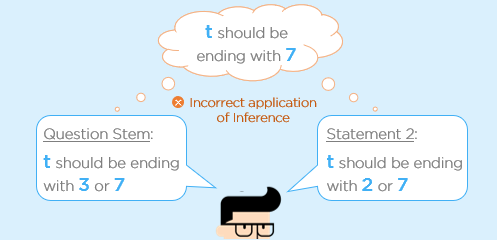
Wrong Application of Inference
The student thinks that:
- • From question stem, t should be a number with last digit 3 or 7.
• From statement 2, t should be a number with last digit 2 or 7.
- o Now, on combining both the results, we can conclude that t must be a number with last digit 7.
Here, I want you to think and find the mistake before reading any further.
Correct Application of Inference
First, I want to ask, did we infer that last digit of t can be 3 or 7 only?
- • No!!!
We inferred that IF the last digit of t is either 3 or 7, then the answer will be YES.
- • Please notice the word “IF”.
• We still have to find out the exact value of units digit of t.
- o However, the student assumes that the last digit of t is either 3 or 7 which is incorrect.
o From statement 2, last digit of t comes out to be 2 and 7.
- Now, we can apply the inference.
- • For last digit 2-> \(t^2 + 1\) is not divisible by 10.
• For last digit 7-> \(t^2 + 1\) is completely divisible by 10.
- o Hence, statement 2 is not sufficient to find the answer.
So, even when you have completely inferred all the inferences, you still need to apply them properly in order to mark the right answer.
How to Avoid Incorrect Application of Inferences
- 1. One reason for making this type of mistake can be because you might have solved a similar type of question in the past. And, assuming that this is the same question, you don’t pay much attention to read the question carefully and you incorrectly solve the question.
- a. This type of mistake can be avoided by treating every question you come across as a new question and keeping an open mind to solve the question.
2. Keep a check on whether the inferred information is from the information given in the question stem or from the information that we need to find.
Takeaways from this Article
- 1. In this article, we learned how to avoid the 3rd most common mistake that students make in solving DS questions related to number properties.
2. We understood how important it is to read a question carefully.
- a. Always be mindful of the keywords like – IF, BUT.
b. These keywords can decide the conditions when we will apply the inference.
3. Finally, always read every question with an open mind.
- a. Do not solve a question thinking that you have solved a similar type of question previously.
If you consciously apply all the learnings from both the articles, you will surely see your accuracy and score improving.
Want to read more articles like this?
If you liked this article, then I am sure that you want to read some more articles like this.
To read all our article go here:Must Read Articles and Practice Questions to score Q51
You will also get a lot of practice questions to learn from.
Happy learning.
Archived Topic
Hi there,
This topic has been closed and archived due to inactivity or violation of community quality standards. No more replies are possible here.
Where to now? Join ongoing discussions on thousands of quality questions in our Quantitative Questions Forum
Still interested in this question? Check out the "Best Topics" block below for a better discussion on this exact question, as well as several more related questions.
Thank you for understanding, and happy exploring!
 08 Apr 2019, 22:37
Kudos
Bookmarks
Please add the pdffff
 23 May 2020, 04:49
Kudos
Bookmarks
Automated notice from GMAT Club BumpBot:
A member just gave Kudos to this thread, showing it’s still useful. I’ve bumped it to the top so more people can benefit. Feel free to add your own questions or solutions.
This post was generated automatically.
A member just gave Kudos to this thread, showing it’s still useful. I’ve bumped it to the top so more people can benefit. Feel free to add your own questions or solutions.
This post was generated automatically.
Archived Topic
Hi there,
This topic has been closed and archived due to inactivity or violation of community quality standards. No more replies are possible here.
Where to now? Join ongoing discussions on thousands of quality questions in our Quantitative Questions Forum
Still interested in this question? Check out the "Best Topics" block above for a better discussion on this exact question, as well as several more related questions.
Thank you for understanding, and happy exploring!





