Events & Promotions
|
|

GMAT Club Daily Prep
Thank you for using the timer - this advanced tool can estimate your performance and suggest more practice questions. We have subscribed you to Daily Prep Questions via email.
Customized
for You
Track
Your Progress
Practice
Pays
Not interested in getting valuable practice questions and articles delivered to your email? No problem, unsubscribe here.
 Sep 09
07:00 AM PDT
-10:00 AM PDT
Meet AdComs and explore top Master’s programs - MiM, MiF, MSc, MSBA and more. - Application Fee Waivers - Free 1-Week of GMAT Club Tests: - Master's Application Toolkit - Grand Prize Giveaway- Sep 09
10:00 AM PDT
-11:00 AM PDT
Three MBA applications. Three rejections. No interview invites. A year later, Aman was admitted to Cambridge Judge, SMU, and IMD. In this episode of MBA Admit Stories, Aman shares how he rebuilt his MBA application...  Sep 04
10:00 AM EDT
-11:59 PM EDT
We’ve worked incredibly hard to build TTP into the best test prep experience possible, and it would mean a lot to us to win Newsweek’s 2026 Readers’ Choice Award for Best Test Prep. If TTP has helped you, we’d be incredibly grateful for your vote.


 30 May 2020, 11:59
Kudos
Bookmarks
Hi,
i'm uncertain if A is true or if B is true. I am assuming they say the same thing.
A. IMPORTANT PROPERTY
When x≤0, then |x|=−x, or more generally when some expression≤0 then |some expression|=−(some expression). For example: |−5|=5=−(−5). Notice that in the negative scenario, we don't simply remove the absolute value bars. We remove the absolute value bars and negate the entire expression contained within, thus making it positive again;
When x≥0, then |x|=x, or more generally when some expression≥0 then |some expression|=some expression. For example: |5|=5
from bunuel post: https://gmatclub.com/forum/absolute-value-tips-and-hints-175002.html
B.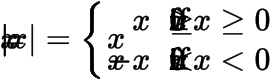
from wiki: https://en.wikipedia.org/wiki/Absolute_value
could someone please help clarify?
i'm uncertain if A is true or if B is true. I am assuming they say the same thing.
A. IMPORTANT PROPERTY
When x≤0, then |x|=−x, or more generally when some expression≤0 then |some expression|=−(some expression). For example: |−5|=5=−(−5). Notice that in the negative scenario, we don't simply remove the absolute value bars. We remove the absolute value bars and negate the entire expression contained within, thus making it positive again;
When x≥0, then |x|=x, or more generally when some expression≥0 then |some expression|=some expression. For example: |5|=5
from bunuel post: https://gmatclub.com/forum/absolute-value-tips-and-hints-175002.html
B.
from wiki: https://en.wikipedia.org/wiki/Absolute_value
could someone please help clarify?
Archived Topic
Hi there,
This topic has been closed and archived due to inactivity or violation of community quality standards. No more replies are possible here.
Where to now? Join ongoing discussions on thousands of quality questions in our Quantitative Questions Forum
Still interested in this question? Check out the "Best Topics" block below for a better discussion on this exact question, as well as several more related questions.
Thank you for understanding, and happy exploring!

 30 May 2020, 19:13
Kudos
Bookmarks
Lazybum
hie there,
bunuel has correctly written
lxl = x; if x>=0
lxl = -x; if x<=0
the above formulae implies
if x>=0, say x=2, lxl = l2l =2 = x
if x<=0, say x=-2, lxl = l-2l = 2 or -(-2) = -(x)
well, if x=0, lxl = l0l = 0
positive or negative zero is always zero
the above formulae well can be written as
lxl = x; if x>0
lxl = -x; if x<0
what you have understood is same as what you wrote in B, B is just the standard form for writing inequality when removing modulus.
well, to learn more on inequality you can check out Khan academy (note: the same has been suggested by TARGET TEST PREP) or Target test prep (i have seen only positive reviews about it)
https://youtu.be/iI_2Piwn_og
 02 Jun 2020, 04:22
Kudos
Bookmarks
Because 0 and -0 are both equal to 0, then when x = 0, both |x| = x and |x| = -x are true. So it really doesn't matter which case zero is included in. And as a practical matter, if you see |x| in an equation, and you are using cases to solve, then if zero is a solution for x, you'll find that solution both when you replace |x| with x and when you replace |x| with -x anyway, so you don't really need to be too concerned about this issue.
Archived Topic
Hi there,
This topic has been closed and archived due to inactivity or violation of community quality standards. No more replies are possible here.
Where to now? Join ongoing discussions on thousands of quality questions in our Quantitative Questions Forum
Still interested in this question? Check out the "Best Topics" block above for a better discussion on this exact question, as well as several more related questions.
Thank you for understanding, and happy exploring!





