Last visit was: 23 Apr 2026, 12:49 It is currently 23 Apr 2026, 12:49
Close
GMAT Club Daily Prep
Thank you for using the timer - this advanced tool can estimate your performance and suggest more practice questions. We have subscribed you to Daily Prep Questions via email.

Customized
for You

we will pick new questions that match your level based on your Timer History

Track
Your Progress

every week, we’ll send you an estimated GMAT score based on your performance

Practice
Pays

we will pick new questions that match your level based on your Timer History
Not interested in getting valuable practice questions and articles delivered to your email? No problem, unsubscribe here.
Close
Request Expert Reply
Confirm Cancel
User avatar
Yash12345
Joined: 21 Sep 2013
Last visit: 09 Dec 2015
Posts: 25
Own Kudos:
135
 [64]
Given Kudos: 82
Location: United States
Concentration: Finance, General Management
GMAT Date: 10-25-2013
GPA: 3
WE:Operations (Mutual Funds and Brokerage)
Posts: 25
Kudos: 135
 [64]
3
Kudos
Add Kudos
60
Bookmarks
Bookmark this Post
Most Helpful Reply
avatar
PareshGmat
Joined: 27 Dec 2012
Last visit: 10 Jul 2016
Posts: 1,531
Own Kudos:
8,271
 [7]
Given Kudos: 193
Status:The Best Or Nothing
Location: India
Concentration: General Management, Technology
WE:Information Technology (Computer Software)
Posts: 1,531
Kudos: 8,271
 [7]
7
Kudos
Add Kudos
Bookmarks
Bookmark this Post
General Discussion
User avatar
Bunuel
User avatar
Math Expert
Joined: 02 Sep 2009
Last visit: 23 Apr 2026
Posts: 109,785
Own Kudos:
Given Kudos: 105,853
Products:
Expert
Expert reply
Active GMAT Club Expert! Tag them with @ followed by their username for a faster response.
Posts: 109,785
Kudos: 810,848
 [11]
6
Kudos
Add Kudos
5
Bookmarks
Bookmark this Post
User avatar
chitrasekar2k5
Joined: 10 Sep 2012
Last visit: 13 Jul 2014
Posts: 2
Own Kudos:
Given Kudos: 26
GMAT Date: 08-27-2013
GPA: 3.5
WE:Investment Banking (Energy)
Posts: 2
Kudos: 55
Kudos
Add Kudos
Bookmarks
Bookmark this Post
Bunuel
Yash12345
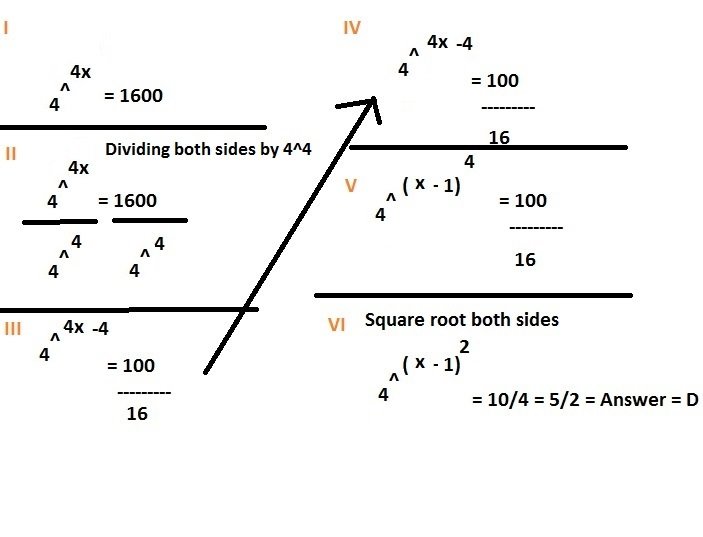
If 4^(4x) = 1600, what is the value of [4^(x–1)]^2?

A. 40
B. 20
C. 10
D. 5/2
E. 5/4

\(4^{4x} = 1600\) --> \(4^{2x} = 40\) -

\(4^{(x-1)^2}=4^{2(x-1)}=4^{2x-2}=\frac{4^{2x}}{4^2}=\frac{40}{16}=\frac{5}{2}\).

Answer: D.

I am getting the answer as 5/4.. I just can figure out what have i missed?

4^4 . 4^x = 4^3 . 5^2
4^2x = 25

now, 4^2x/4^2 = 25/16 =5/4.
User avatar
Bunuel
User avatar
Math Expert
Joined: 02 Sep 2009
Last visit: 23 Apr 2026
Posts: 109,785
Own Kudos:
810,848
 [1]
Given Kudos: 105,853
Products:
Expert
Expert reply
Active GMAT Club Expert! Tag them with @ followed by their username for a faster response.
Posts: 109,785
Kudos: 810,848
 [1]
1
Kudos
Add Kudos
Bookmarks
Bookmark this Post
chitrasekar2k5
Bunuel
Yash12345
If 4^(4x) = 1600, what is the value of [4^(x–1)]^2?

A. 40
B. 20
C. 10
D. 5/2
E. 5/4

\(4^{4x} = 1600\) --> \(4^{2x} = 40\) -

\(4^{(x-1)^2}=4^{2(x-1)}=4^{2x-2}=\frac{4^{2x}}{4^2}=\frac{40}{16}=\frac{5}{2}\).

Answer: D.

I am getting the answer as 5/4.. I just can figure out what have i missed?

4^4 . 4^x = 4^3 . 5^2
4^2x = 25

now, 4^2x/4^2 = 25/16 =5/4.

\(4^{4}*4^x=4^{4+x}\) not \(4^{4x}\): \(a^n*a^m=a^{n+m}\)

Check here for more: math-number-theory-88376.html
User avatar
ronr34
Joined: 08 Apr 2012
Last visit: 10 Oct 2014
Posts: 240
Own Kudos:
Given Kudos: 58
Posts: 240
Kudos: 253
Kudos
Add Kudos
Bookmarks
Bookmark this Post
Bunuel
Yash12345
If 4^(4x) = 1600, what is the value of [4^(x–1)]^2?

A. 40
B. 20
C. 10
D. 5/2
E. 5/4

\(4^{4x} = 1600\) --> \(4^{2x} = 40\) -

\(4^{(x-1)^2}=4^{2(x-1)}=4^{2x-2}=\frac{4^{2x}}{4^2}=\frac{40}{16}=\frac{5}{2}\).

Answer: D.
Is there another aproach?What if I don't realize the \(4^{4x} = 1600\) --> \(4^{2x} = 40\) - ?
User avatar
mau5
User avatar
Verbal Forum Moderator
Joined: 10 Oct 2012
Last visit: 31 Dec 2024
Posts: 478
Own Kudos:
3,386
 [14]
Given Kudos: 141
Posts: 478
Kudos: 3,386
 [14]
12
Kudos
Add Kudos
2
Bookmarks
Bookmark this Post
ronr34
Bunuel
Yash12345
If 4^(4x) = 1600, what is the value of [4^(x–1)]^2?

A. 40
B. 20
C. 10
D. 5/2
E. 5/4

\(4^{4x} = 1600\) --> \(4^{2x} = 40\) -

\(4^{(x-1)^2}=4^{2(x-1)}=4^{2x-2}=\frac{4^{2x}}{4^2}=\frac{40}{16}=\frac{5}{2}\).

Answer: D.
Is there another aproach?What if I don't realize the \(4^{4x} = 1600\) --> \(4^{2x} = 40\) - ?


I think what Bunuel did is the easiest approach. However, if you are worried that this might not strike you, start with the unknown entity.

\(4^{(x-1)^2} = [\frac{4^x}{4^1}]^2 = [\frac{4^{2x}}{4^2}]\) and let \(t = [\frac{4^{2x}}{4^2}]\)

Now, given that \(4^{4x} = 1600.\) Thus,\(t^2 = [\frac{4^{4x}}{4^4}]\) =\([\frac{1600}{16*16}] = [\frac{100}{16}]\)and \(t = \frac{10}{4} =\frac{5}{2}\)
User avatar
ronr34
Joined: 08 Apr 2012
Last visit: 10 Oct 2014
Posts: 240
Own Kudos:
Given Kudos: 58
Posts: 240
Kudos: 253
Kudos
Add Kudos
Bookmarks
Bookmark this Post
Great!!!
Thanks a lot.
avatar
streamingline
Joined: 16 Feb 2013
Last visit: 07 Dec 2015
Posts: 4
Own Kudos:
Given Kudos: 9
Posts: 4
Kudos: 6
Kudos
Add Kudos
Bookmarks
Bookmark this Post
Bunuel
Yash12345
If 4^(4x) = 1600, what is the value of [4^(x–1)]^2?

A. 40
B. 20
C. 10
D. 5/2
E. 5/4

\(4^{4x} = 1600\) --> \(4^{2x} = 40\) -

\(4^{(x-1)^2}=4^{2(x-1)}=4^{2x-2}=\frac{4^{2x}}{4^2}=\frac{40}{16}=\frac{5}{2}\).

Answer: D.


Hi Bunuel, why isn't (x-1)^2 is not treated like (a-b)^2 formula?

Thanks
User avatar
Bunuel
User avatar
Math Expert
Joined: 02 Sep 2009
Last visit: 23 Apr 2026
Posts: 109,785
Own Kudos:
810,848
 [3]
Given Kudos: 105,853
Products:
Expert
Expert reply
Active GMAT Club Expert! Tag them with @ followed by their username for a faster response.
Posts: 109,785
Kudos: 810,848
 [3]
2
Kudos
Add Kudos
1
Bookmarks
Bookmark this Post
streamingline
Bunuel
Yash12345
If 4^(4x) = 1600, what is the value of [4^(x–1)]^2?

A. 40
B. 20
C. 10
D. 5/2
E. 5/4

\(4^{4x} = 1600\) --> \(4^{2x} = 40\) -

\(4^{(x-1)^2}=4^{2(x-1)}=4^{2x-2}=\frac{4^{2x}}{4^2}=\frac{40}{16}=\frac{5}{2}\).

Answer: D.


Hi Bunuel, why isn't (x-1)^2 is not treated like (a-b)^2 formula?

Thanks

Actually parenthesis were missing there. Edited, it should read: \((4^{(x-1)})^2=4^{2(x-1)}=4^{2x-2}=\frac{4^{2x}}{4^2}=\frac{40}{16}=\frac{5}{2}\).

If exponentiation is indicated by stacked symbols, the rule is to work from the top down, thus:
\(a^m^n=a^{(m^n)}\) and not \((a^m)^n\), which on the other hand equals to \(a^{mn}\).

So:
\((a^m)^n=a^{mn}\);

\(a^m^n=a^{(m^n)}\) and not \((a^m)^n\).

Hope it helps.
avatar
hieracity
Joined: 07 Jul 2013
Last visit: 10 Apr 2014
Posts: 3
Given Kudos: 7
Posts: 3
Kudos: 0
Kudos
Add Kudos
Bookmarks
Bookmark this Post
Bunuel
Yash12345
If 4^(4x) = 1600, what is the value of [4^(x–1)]^2?

A. 40
B. 20
C. 10
D. 5/2
E. 5/4

\(4^{4x} = 1600\) --> \(4^{2x} = 40\) -

\((4^{(x-1)})^2=4^{2(x-1)}=4^{2x-2}=\frac{4^{2x}}{4^2}=\frac{40}{16}=\frac{5}{2}\).

Answer: D.

Hi Bruno,

thank you for posting all these answers. They are a great tool!!

Quick question though. I just want to confirm the steps of \(4^{4x} = 1600\) TO \(4^{2x} = 40\) -

Do you just squareroot the two sides? \(\sqrt{4^{4x}} = \sqrt{1600}\)
So the base, 4, doesn't change, only the ^4x gets rooted to ^2x. Is that right?

Thank you again!
User avatar
Bunuel
User avatar
Math Expert
Joined: 02 Sep 2009
Last visit: 23 Apr 2026
Posts: 109,785
Own Kudos:
810,848
 [2]
Given Kudos: 105,853
Products:
Expert
Expert reply
Active GMAT Club Expert! Tag them with @ followed by their username for a faster response.
Posts: 109,785
Kudos: 810,848
 [2]
2
Kudos
Add Kudos
Bookmarks
Bookmark this Post
hieracity
Bunuel
Yash12345
If 4^(4x) = 1600, what is the value of [4^(x–1)]^2?

A. 40
B. 20
C. 10
D. 5/2
E. 5/4

\(4^{4x} = 1600\) --> \(4^{2x} = 40\) -

\((4^{(x-1)})^2=4^{2(x-1)}=4^{2x-2}=\frac{4^{2x}}{4^2}=\frac{40}{16}=\frac{5}{2}\).

Answer: D.

Hi Bruno,

thank you for posting all these answers. They are a great tool!!

Quick question though. I just want to confirm the steps of \(4^{4x} = 1600\) TO \(4^{2x} = 40\) -

Do you just squareroot the two sides? \(\sqrt{4^{4x}} = \sqrt{1600}\)
So the base, 4, doesn't change, only the ^4x gets rooted to ^2x. Is that right?

Thank you again!

Yes:
\(4^{4x} = 1600\);

\((4^{2x})^2 = 40^2\);

\(4^{2x} =40\).

Hope it's clear.
User avatar
KanishkM
Joined: 09 Mar 2018
Last visit: 18 Dec 2021
Posts: 755
Own Kudos:
512
 [1]
Given Kudos: 123
Location: India
Posts: 755
Kudos: 512
 [1]
1
Kudos
Add Kudos
Bookmarks
Bookmark this Post
Bunuel
Yash12345
If 4^(4x) = 1600, what is the value of [4^(x–1)]^2?

A. 40
B. 20
C. 10
D. 5/2
E. 5/4

\(4^{4x} = 1600\) --> \(4^{2x} = 40\) -

\((4^{(x-1)})^2=4^{2(x-1)}=4^{2x-2}=\frac{4^{2x}}{4^2}=\frac{40}{16}=\frac{5}{2}\).

Answer: D.

Hi Bunuel

What is wrong in this approach?? Can you please share your thoughts on this.

If 4^(4x) = 1600

\(2^{8x} = 2^6 * 5^2\)
8x = 6
x= 3/4

Now [4^(x–1)]^2

[2^2(x–1)]^2

[ 2 ^(2x -2)] ^ 2 (substituted the value of x= 3/4 here)

[2^-1/2]^2

1/2

Here i was able to guess D, because the denominator was 2 and somehow that 5 has come to the numerator as it is the root of 25.
User avatar
Bunuel
User avatar
Math Expert
Joined: 02 Sep 2009
Last visit: 23 Apr 2026
Posts: 109,785
Own Kudos:
810,848
 [2]
Given Kudos: 105,853
Products:
Expert
Expert reply
Active GMAT Club Expert! Tag them with @ followed by their username for a faster response.
Posts: 109,785
Kudos: 810,848
 [2]
2
Kudos
Add Kudos
Bookmarks
Bookmark this Post
KanishkM
Bunuel
Yash12345
If 4^(4x) = 1600, what is the value of [4^(x–1)]^2?

A. 40
B. 20
C. 10
D. 5/2
E. 5/4

\(4^{4x} = 1600\) --> \(4^{2x} = 40\) -

\((4^{(x-1)})^2=4^{2(x-1)}=4^{2x-2}=\frac{4^{2x}}{4^2}=\frac{40}{16}=\frac{5}{2}\).

Answer: D.

Hi Bunuel

What is wrong in this approach?? Can you please share your thoughts on this.

If 4^(4x) = 1600

\(2^{8x} = 2^6 * 5^2\)
8x = 6
x= 3/4


Now [4^(x–1)]^2

[2^2(x–1)]^2

[ 2 ^(2x -2)] ^ 2 (substituted the value of x= 3/4 here)

[2^-1/2]^2

1/2

Here i was able to guess D, because the denominator was 2 and somehow that 5 has come to the numerator as it is the root of 25.

The red part is not correct.
If you could get 8x = 6 from here \(2^{8x} = 2^6 * 5^2\), then you'd get 1=5^2, which is obviously not correct. The point is that you cannot equate the powers there. Some power of 2 (2^(8x)) to be equal to 2^6 * 5^2, x must be some irrational number.
User avatar
KanishkM
Joined: 09 Mar 2018
Last visit: 18 Dec 2021
Posts: 755
Own Kudos:
Given Kudos: 123
Location: India
Posts: 755
Kudos: 512
Kudos
Add Kudos
Bookmarks
Bookmark this Post
Bunuel
KanishkM

Hi Bunuel

What is wrong in this approach?? Can you please share your thoughts on this.

If 4^(4x) = 1600

\(2^{8x} = 2^6 * 5^2\)
8x = 6
x= 3/4

.

The red part is not correct.
If you could get 8x = 6 from here \(2^{8x} = 2^6 * 5^2\), then you'd get 1=5^2, which is obviously not correct. The point is that you cannot equate the powers there. Some power of 2 (2^(8x)) to be equal to 2^6 * 5^2, x must be some irrational number.

Thank you Bunuel, I think i got your point

So basically if i had to get a value of x, i need to find a value which will completely consume RHS

Which now i realize, will be a cumbersome task.
User avatar
bv8562
Joined: 01 Dec 2020
Last visit: 01 Oct 2025
Posts: 415
Own Kudos:
Given Kudos: 360
GMAT 1: 680 Q48 V35
GMAT 1: 680 Q48 V35
Posts: 415
Kudos: 505
Kudos
Add Kudos
Bookmarks
Bookmark this Post
4^4x = 1600
(4^x)^4 = 1600
4^x = 2√10 (Dividing both sides by 4)

4^x/4 = 2√10/4 => 4^x-1 = √10/2

∴ (4^x-1)^2 = (√10/2)^2 = 10/4 = 5/2 (D)
User avatar
anirchat
Joined: 30 Jun 2024
Last visit: 06 Feb 2026
Posts: 387
Own Kudos:
Given Kudos: 323
GMAT Focus 1: 655 Q88 V81 DI78
Products:
GMAT Focus 1: 655 Q88 V81 DI78
Posts: 387
Kudos: 50
Kudos
Add Kudos
Bookmarks
Bookmark this Post
I think there is something incorrect in th depiction of the question. A badly needed paranthesis is missing.
i. 4^(x-1)^2 is not equal to ii. {4^(x-1)}^2.
The solution assumes ii but the question is depicted as i.
User avatar
Bunuel
User avatar
Math Expert
Joined: 02 Sep 2009
Last visit: 23 Apr 2026
Posts: 109,785
Own Kudos:
810,848
 [1]
Given Kudos: 105,853
Products:
Expert
Expert reply
Active GMAT Club Expert! Tag them with @ followed by their username for a faster response.
Posts: 109,785
Kudos: 810,848
 [1]
1
Kudos
Add Kudos
Bookmarks
Bookmark this Post
anirchat
I think there is something incorrect in th depiction of the question. A badly needed paranthesis is missing.
i. 4^(x-1)^2 is not equal to ii. {4^(x-1)}^2.
The solution assumes ii but the question is depicted as i.

Fixed the formatting. Thank you!
User avatar
totaltestprepNick
Joined: 25 Aug 2014
Last visit: 22 Apr 2026
Posts: 469
Own Kudos:
Given Kudos: 2
GMAT 1: 750 Q49 V42
GMAT 1: 750 Q49 V42
Posts: 469
Kudos: 4
Kudos
Add Kudos
Bookmarks
Bookmark this Post
Yash12345
If \(4^{4x} = 1600\), what is the value of \((4^{(x–1)})^2\)?

A. 40
B. 20
C. 10
D. 5/2
E. 5/4


Nick Slavkovich, GMAT/GRE tutor with 20+ years of experience

[email protected]
Moderators:
Math Expert
109785 posts
Tuck School Moderator
853 posts