Events & Promotions
|
|

GMAT Club Daily Prep
Thank you for using the timer - this advanced tool can estimate your performance and suggest more practice questions. We have subscribed you to Daily Prep Questions via email.
Customized
for You
Track
Your Progress
Practice
Pays
Not interested in getting valuable practice questions and articles delivered to your email? No problem, unsubscribe here.
 Sep 06
09:30 AM EDT
-12:30 PM EST
Top scores are possible when you enroll in a powerful EA course, taught live online + 6 months access to TTP OnDemand video courses included! Perfect class schedule and easy course access for working professionals. Class starts Sundays Sept. 6, 2026. Sep 02
01:00 PM EDT
-11:59 PM EDT
Take 30% off all study plans with code COURSEWORK - Expires on Monday 9/7 Sep 04
10:00 AM EDT
-11:59 PM EDT
We’ve worked incredibly hard to build TTP into the best test prep experience possible, and it would mean a lot to us to win Newsweek’s 2026 Readers’ Choice Award for Best Test Prep. If TTP has helped you, we’d be incredibly grateful for your vote. Sep 07
12:01 AM PDT
-11:59 PM PDT
On the 7th, GMAT Club Tests will be Free! Including all the Quizzes, Questions, and Tests. 12 AM - 11:59 PM PDT- Sep 07
10:00 AM PDT
-11:00 AM PDT
A complete walkthrough of GMAT Club’s free 12-week GMAT study plan: what you study each week, how progress and goals are tracked, how the error log works, and how your practice unlocks paid tools at no cost. - Sep 09
07:00 AM PDT
-10:00 AM PDT
Meet AdComs and explore top Master’s programs - MiM, MiF, MSc, MSBA and more. - Application Fee Waivers - Free 1-Week of GMAT Club Tests: - Master's Application Toolkit - Grand Prize Giveaway - Sep 09
10:00 AM PDT
-11:00 AM PDT
Three MBA applications. Three rejections. No interview invites. A year later, Aman was admitted to Cambridge Judge, SMU, and IMD. In this episode of MBA Admit Stories, Aman shares how he rebuilt his MBA application...  Sep 15
07:00 PM EDT
-09:00 PM EST
Elite scores are possible when you enroll in a powerful GMAT course, taught live online + 6 months access to TTP OnDemand video courses included! Class starts Tues/Thurs Sept. 15, 2026 - Nov. 15, 2027, 7:00pm-9:00pm EST Sep 21
08:00 PM EDT
-10:00 PM EDT
Boost your GMAT score in less than one month in a live online class + 6 months access to TTP OnDemand video courses included! Class starts Mon, Tues, Wed, Thur, Fri Sept. 21, 2026 - Oct. 9, 2027, 7:00pm-10:00pm EST

 05 Jul 2010, 09:34
Kudos
Bookmarks
Can someone please explain the negate test if you are between two possible answers? Please provide examples if you could. Thanks.
Archived Topic
Hi there,
This topic has been closed and archived due to inactivity or violation of community quality standards. No more replies are possible here.
Where to now? Join ongoing discussions on thousands of quality questions in our Verbal Questions Forum
Still interested in this question? Check out the "Best Topics" block below for a better discussion on this exact question, as well as several more related questions.
Thank you for understanding, and happy exploring!
 06 Jul 2010, 09:12
Kudos
Bookmarks
The negation test works on CR Assumption questions. Assumptions basically complete the argument (i.e. when verbalized, they become premises), and therefore they support the conclusion. On GMAT Assumption questions, it is common for several choices to support the argument, and often these choices all “sound good.” The trick is to sort out the truly necessary statement from the merely helpful statements.
Rather than being a supporting statement, the correct Assumption is a statement that’s opposite (negation) would kill the argument.
For example, here’s one from GMATPrep.
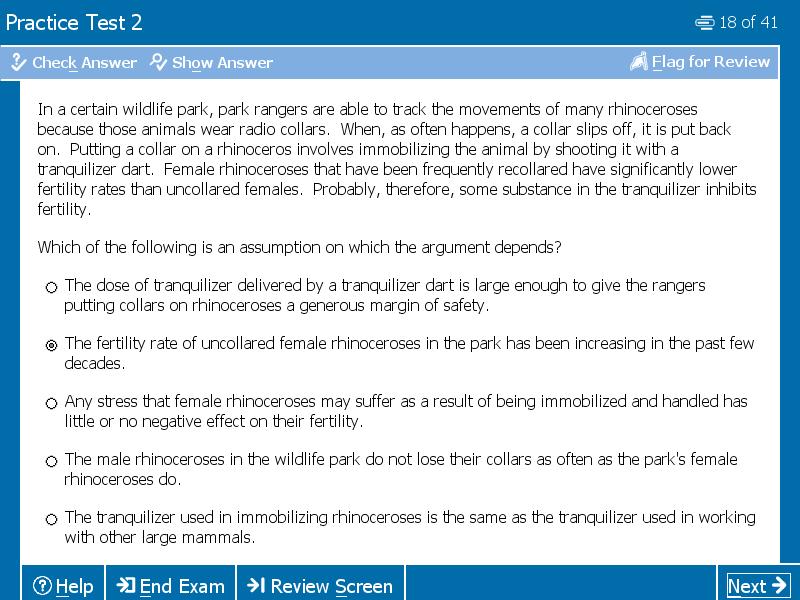
CR_18.JPG [ 101.34 KiB | Viewed 10339 times ]
Notice the “on which the argument depends” language, not simply “what helps the argument?”
If we mistakenly look for answers that support, we might think the following:
(A) Supports: Large tranquilizer dose. Possible overdose? This does seem to indicate that the tranquilizer is a problem.
(B) Supports: If uncollared females have increasing fertility, then what else would explain the reduced fertility of the tranquilized/collared females? It would have to be the tranquilizer, the only other difference between the two groups.
(C) Supports: Rules out other factors involved in the tranquilizing, and allows us to conclude the reduced fertility is due to a substance in the tranquilizer.
(D) Supports (maybe): At least it suggests that female rhinos are tranquilized more frequently than males, and would be affected more by whatever substance is in the tranquilizer.
(E) Neutral: Just a fact about the tranquilizer.
You can see how unproductive this thought process is! The choices start to sound similar, and you could talk yourself into almost any one.
In contrast, if we negate each statement to see the effect on the conclusion (“some substance in the tranquilizer inhibits fertility”), the correct answer stands out. I’ve put the negated idea/word(s) in caps.
(A) The tranquilizer dose is NOT large. No effect on the conclusion.
(B) The fertility rate of uncollared female rhinos has been STEADY or DECLINING. No effect on the conclusion.
(C) The stress of being tranquilized and handled DOES have a negative effect on fertility. This kills the conclusion that some substance in the tranquilizer is to blame.
(D) Male rhinos lose their collars AS FREQUENTLY as females. No effect on the conclusion.
(E) The tranquilizer used on the rhinos is DIFFERENT than that used on other large mammals. No effect on the conclusion.
The correct answer is C.
Rather than being a supporting statement, the correct Assumption is a statement that’s opposite (negation) would kill the argument.
For example, here’s one from GMATPrep.
Attachment:
CR_18.JPG [ 101.34 KiB | Viewed 10339 times ]
If we mistakenly look for answers that support, we might think the following:
(A) Supports: Large tranquilizer dose. Possible overdose? This does seem to indicate that the tranquilizer is a problem.
(B) Supports: If uncollared females have increasing fertility, then what else would explain the reduced fertility of the tranquilized/collared females? It would have to be the tranquilizer, the only other difference between the two groups.
(C) Supports: Rules out other factors involved in the tranquilizing, and allows us to conclude the reduced fertility is due to a substance in the tranquilizer.
(D) Supports (maybe): At least it suggests that female rhinos are tranquilized more frequently than males, and would be affected more by whatever substance is in the tranquilizer.
(E) Neutral: Just a fact about the tranquilizer.
You can see how unproductive this thought process is! The choices start to sound similar, and you could talk yourself into almost any one.
In contrast, if we negate each statement to see the effect on the conclusion (“some substance in the tranquilizer inhibits fertility”), the correct answer stands out. I’ve put the negated idea/word(s) in caps.
(A) The tranquilizer dose is NOT large. No effect on the conclusion.
(B) The fertility rate of uncollared female rhinos has been STEADY or DECLINING. No effect on the conclusion.
(C) The stress of being tranquilized and handled DOES have a negative effect on fertility. This kills the conclusion that some substance in the tranquilizer is to blame.
(D) Male rhinos lose their collars AS FREQUENTLY as females. No effect on the conclusion.
(E) The tranquilizer used on the rhinos is DIFFERENT than that used on other large mammals. No effect on the conclusion.
The correct answer is C.
07 Jul 2010, 07:02
Kudos
Bookmarks
Thanks this was a lot of help. For assumption CR questions, is it beneficial to jump right to using the negate technique? The negate test doesn't work for any other type of CR question, correct?

 Thats an awesome score Emily !