Events & Promotions
| Last visit was: 06 Sep 2026, 01:26 |
It is currently 06 Sep 2026, 01:26 |
|
|

GMAT Club Daily Prep
Thank you for using the timer - this advanced tool can estimate your performance and suggest more practice questions. We have subscribed you to Daily Prep Questions via email.
Customized
for You
Track
Your Progress
Practice
Pays
Not interested in getting valuable practice questions and articles delivered to your email? No problem, unsubscribe here.
 Sep 06
09:30 AM EDT
-12:30 PM EST
Top scores are possible when you enroll in a powerful EA course, taught live online + 6 months access to TTP OnDemand video courses included! Perfect class schedule and easy course access for working professionals. Class starts Sundays Sept. 6, 2026. Sep 07
12:01 AM PDT
-11:59 PM PDT
On the 7th, GMAT Club Tests will be Free! Including all the Quizzes, Questions, and Tests. 12 AM - 11:59 PM PDT Sep 07
12:30 AM EDT
-01:30 AM EDT
Tejas studied hard but kept repeating the same mistakes. After 3 attempts at 645, a focused 4-week strategy helped him identify and fix what was holding him back—leading to a 695 with just 12–15 hours of study per week. Sep 02
01:00 PM EDT
-11:59 PM EDT
Take 30% off all study plans with code COURSEWORK - Expires on Monday 9/7 Sep 04
01:30 AM EDT
-02:30 AM EDT
This Labor Day, turn your hard work into real score gains. From 615→715 in 15 days to 705 in 30 days, our students prove what's possible with personalized, expert guidance. Save up to 25% on 1-on-1 tutoring. Sep 04
10:00 AM EDT
-11:59 PM EDT
We’ve worked incredibly hard to build TTP into the best test prep experience possible, and it would mean a lot to us to win Newsweek’s 2026 Readers’ Choice Award for Best Test Prep. If TTP has helped you, we’d be incredibly grateful for your vote.- Sep 07
10:00 AM PDT
-11:00 AM PDT
A complete walkthrough of GMAT Club’s free 12-week GMAT study plan: what you study each week, how progress and goals are tracked, how the error log works, and how your practice unlocks paid tools at no cost. - Sep 09
07:00 AM PDT
-10:00 AM PDT
Meet AdComs and explore top Master’s programs - MiM, MiF, MSc, MSBA and more. - Application Fee Waivers - Free 1-Week of GMAT Club Tests: - Master's Application Toolkit - Grand Prize Giveaway - Sep 09
10:00 AM PDT
-11:00 AM PDT
Three MBA applications. Three rejections. No interview invites. A year later, Aman was admitted to Cambridge Judge, SMU, and IMD. In this episode of MBA Admit Stories, Aman shares how he rebuilt his MBA application...  Sep 10
08:00 PM PDT
-09:00 PM PDT
Free- full-length test + 15 concept videos + 150+ short videos + study plan! Sep 15
07:00 PM EDT
-09:00 PM EST
Elite scores are possible when you enroll in a powerful GMAT course, taught live online + 6 months access to TTP OnDemand video courses included! Class starts Tues/Thurs Sept. 15, 2026 - Nov. 15, 2027, 7:00pm-9:00pm EST Sep 21
08:00 PM EDT
-10:00 PM EDT
Boost your GMAT score in less than one month in a live online class + 6 months access to TTP OnDemand video courses included! Class starts Mon, Tues, Wed, Thur, Fri Sept. 21, 2026 - Oct. 9, 2027, 7:00pm-10:00pm EST


H: 14
V: 6
Be sure to select an answer first to save it in the Error Log before revealing the correct answer (OA)!
Difficulty:
 45%
(medium)
45%
(medium)
Question Stats:
68% (02:04) correct 32%
(02:27)
wrong
based on 1088
sessions
32%
(02:27)
wrong
based on 1088
sessions
History
Date
Time
Result
Not Attempted Yet
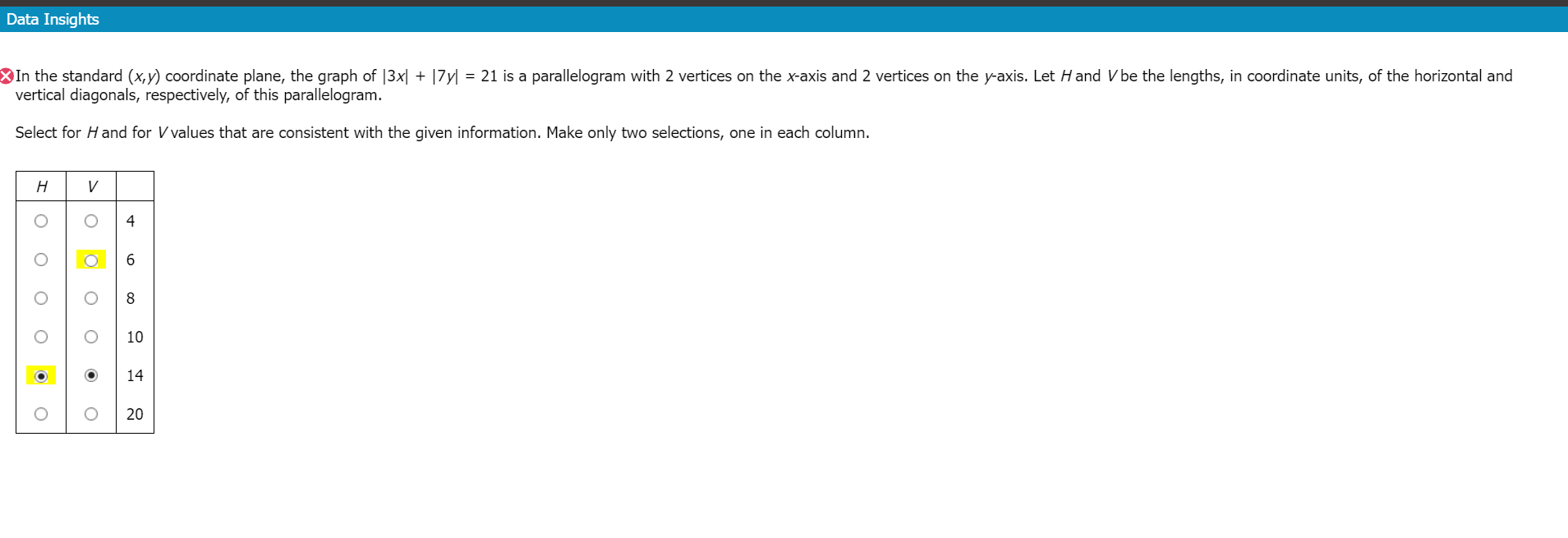
In the standard (x,y) coordinate plane, the graph of \(|3x| + |7y| = 21\) is a parallelogram with 2 vertices on the x-axis and 2 vertices on the y-axis. Let H and V be the lengths, in coordinate units, of the horizontal and vertical diagonals, respectively, of this parallelogram.
Select for H and for V values that are consistent with the given information. Make only two selections, one in each column.
DI -3.png [ 45.75 KiB | Viewed 10784 times ]
Select for H and for V values that are consistent with the given information. Make only two selections, one in each column.
Attachment:
DI -3.png [ 45.75 KiB | Viewed 10784 times ]
| H | V | |
| 4 | ||
| 6 | ||
| 8 | ||
| 10 | ||
| 14 | ||
| 20 |
ShowHide Answer
Official Answer
H: 14
V: 6
Need more Tests to Practice?
GMAT Club Tests give expert solutions for every question in full and sectional GMAT Focus mocks.
Learn more →


 19 Jan 2024, 05:52
Kudos
Bookmarks
yikes000
The question tells us that the points make a parallelogram.
Even the solution of equation will give two intersection on x axis at equal distance from origin and similarly 2 points on y axis at equal distance from origin.
One of the diagonals will be formed by y-axis intersection and the other by x-axis intersection.
Let us solve it
\(|3x| + |7y| = 21\) Take y as 0 to find intersection at y-axis. |3x|=21 or x=7 and -7.
Horizontal Diagonal = 7-(-7)=14
\(|3x| + |7y| = 21\) Take x as 0 to find intersection at x-axis. |7y|=21 or y=3 and -3.
Vertical Diagonal = 3-(-3)=6
sukoon9334, you are correct with your method.
General Discussion

sukoon9334
Joined: 22 Oct 2019
Last visit: 01 Feb 2024
Posts: 29
Given Kudos: 70
Location: India
Schools: HEC Montreal '21
GMAT 1: 660 Q50 V30
19 Jan 2024, 01:37
Kudos
Bookmarks
It's an 80% inequalities question and 20% coordinate planes.
|3x|+|7y|=21 can be written as |7y|=21-|3x|
Now, since |7y| is always zero or positive, hence, 21 - |3x| will also always be zero or positive.
This means that 0≤ |3x|≤ 21
Case 1: 3x ≤ 21
=> x≤7
Case 2: -3x≤21
=> x≥-7
Case 3: 0≤ |3x|
=> x=0
Analysis I:
|7y|=0 for both extremes i.e. x=7 and x=-7
This implies, y=0
So, our two coordinate points of the parallelogram are (7,0) and (-7,0)
Analysis II:
|7y|=21 for x=0
This creates two more cases:
Case 3: 7y≤ 21
=> y≤ 3
Case 4: -7y≤ 21
=> y≥ -3
So, our other two coordinates for the parallelogram are (0,3) and (0,-3)
Now, when we plot these 4 coordinates on the coordinate plane, we get a shape whose diagonals are the x-axis and y-axis itself.
V=distance from (0,3) to (0,-3) = 6 units
H= distance from (7,0) to (-7,0) = 14 units
This might seem daunting. I felt the same when I saw it and got it incorrect in the mock test but when I sat down later, I got this one in one shot. All the best.
Bunuel approve this, please.
|3x|+|7y|=21 can be written as |7y|=21-|3x|
Now, since |7y| is always zero or positive, hence, 21 - |3x| will also always be zero or positive.
This means that 0≤ |3x|≤ 21
Case 1: 3x ≤ 21
=> x≤7
Case 2: -3x≤21
=> x≥-7
Case 3: 0≤ |3x|
=> x=0
Analysis I:
|7y|=0 for both extremes i.e. x=7 and x=-7
This implies, y=0
So, our two coordinate points of the parallelogram are (7,0) and (-7,0)
Analysis II:
|7y|=21 for x=0
This creates two more cases:
Case 3: 7y≤ 21
=> y≤ 3
Case 4: -7y≤ 21
=> y≥ -3
So, our other two coordinates for the parallelogram are (0,3) and (0,-3)
Now, when we plot these 4 coordinates on the coordinate plane, we get a shape whose diagonals are the x-axis and y-axis itself.
V=distance from (0,3) to (0,-3) = 6 units
H= distance from (7,0) to (-7,0) = 14 units
This might seem daunting. I felt the same when I saw it and got it incorrect in the mock test but when I sat down later, I got this one in one shot. All the best.
Bunuel approve this, please.
 24 Jan 2024, 16:03
Kudos
Bookmarks
Isn't geometry not being tested? why is it being asked here?
I got this wrong because I am trying to imagine how'd a parallelogram have all vertices lied on both X and Y axsis.
I got this wrong because I am trying to imagine how'd a parallelogram have all vertices lied on both X and Y axsis.









