Events & Promotions
|
|

GMAT Club Daily Prep
Thank you for using the timer - this advanced tool can estimate your performance and suggest more practice questions. We have subscribed you to Daily Prep Questions via email.
Customized
for You
Track
Your Progress
Practice
Pays
Not interested in getting valuable practice questions and articles delivered to your email? No problem, unsubscribe here.
 Sep 02
01:00 PM EDT
-11:59 PM EDT
Take 30% off all study plans with code COURSEWORK - Expires on Monday 9/7 Sep 04
10:00 AM PDT
-11:00 AM PDT
What does test anxiety really look like on the GMAT? For many test takers, it does not look like a panic attack. Instead, it shows up as brain fog, rereading, negative comparisons, mental noise.... Sep 04
10:00 AM EDT
-11:59 PM EDT
We’ve worked incredibly hard to build TTP into the best test prep experience possible, and it would mean a lot to us to win Newsweek’s 2026 Readers’ Choice Award for Best Test Prep. If TTP has helped you, we’d be incredibly grateful for your vote. Sep 06
09:30 AM EDT
-12:30 PM EST
Top scores are possible when you enroll in a powerful EA course, taught live online + 6 months access to TTP OnDemand video courses included! Perfect class schedule and easy course access for working professionals. Class starts Sundays Sept. 6, 2026.- Sep 07
12:01 AM PDT
-11:59 PM PDT
On the 7th, GMAT Club Tests will be Free! Including all the Quizzes, Questions, and Tests. 12 AM - 11:59 PM PDT - Sep 07
10:00 AM PDT
-11:00 AM PDT
A complete walkthrough of GMAT Club’s free 12-week GMAT study plan: what you study each week, how progress and goals are tracked, how the error log works, and how your practice unlocks paid tools at no cost. - Sep 09
07:00 AM PDT
-10:00 AM PDT
Meet AdComs and explore top Master’s programs - MiM, MiF, MSc, MSBA and more. - Application Fee Waivers - Free 1-Week of GMAT Club Tests: - Master's Application Toolkit - Grand Prize Giveaway - Sep 09
10:00 AM PDT
-11:00 AM PDT
Three MBA applications. Three rejections. No interview invites. A year later, Aman was admitted to Cambridge Judge, SMU, and IMD. In this episode of MBA Admit Stories, Aman shares how he rebuilt his MBA application...  Sep 15
07:00 PM EDT
-09:00 PM EST
Elite scores are possible when you enroll in a powerful GMAT course, taught live online + 6 months access to TTP OnDemand video courses included! Class starts Tues/Thurs Sept. 15, 2026 - Nov. 15, 2027, 7:00pm-9:00pm EST Sep 21
08:00 PM EDT
-10:00 PM EDT
Boost your GMAT score in less than one month in a live online class + 6 months access to TTP OnDemand video courses included! Class starts Mon, Tues, Wed, Thur, Fri Sept. 21, 2026 - Oct. 9, 2027, 7:00pm-10:00pm EST

 Updated on: 13 Jun 2024, 01:54
Originally posted by akshay.sachdeva on 13 Mar 2024, 03:45.
Last edited by Bunuel on 13 Jun 2024, 01:54, edited 6 times in total.
Last edited by Bunuel on 13 Jun 2024, 01:54, edited 6 times in total.
Kudos
Bookmarks
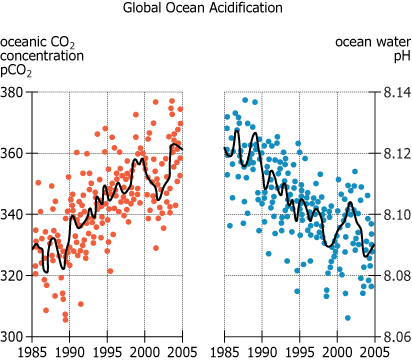
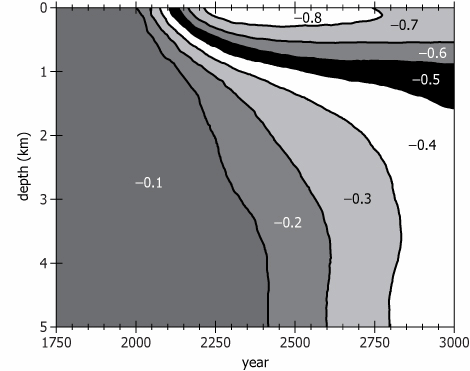
Increasing concentrations of carbon dioxide (CO2) in the atmosphere are making the oceans more acidic—in other words, lowering the pH of ocean water. Worldwide, the average pH of the upper ocean—the top 1,000 m—has declined 0.12, to 8.1, between 1750 and 2010. If humans continue to emit greenhouse gases at current rates, atmospheric CO2 concentrations will reach 500 parts per million (ppm) by 2050 and 800 ppm by 2100, by which time the pH of the upper ocean could drop to 7.8 or 7.7. The deep ocean—below 4,000 m—had a pH of 8.2 in 2010. At that depth, acidity is relatively stable and not expected to increase as quickly, as is shown in the graph labeled Long-Term Graph.
The base of the ocean food web is phytoplankton, which, like plants, use sunlight for photosynthesis and thus can live only in the upper ocean. For many types of phytoplankton, acidification makes it harder to absorb iron, a vital nutrient. Research suggests that a 0.3 decline in pH reduces phytoplankton iron consumption by about 15 percent, slowing photosynthesis and impacting growth and reproduction. Comparable changes in the past correlated with massive extinctions of sea life.
The base of the ocean food web is phytoplankton, which, like plants, use sunlight for photosynthesis and thus can live only in the upper ocean. For many types of phytoplankton, acidification makes it harder to absorb iron, a vital nutrient. Research suggests that a 0.3 decline in pH reduces phytoplankton iron consumption by about 15 percent, slowing photosynthesis and impacting growth and reproduction. Comparable changes in the past correlated with massive extinctions of sea life.


Decreased iron absorption by phytoplankton will contribute to increased extinctions of sea life.: Projected
Increased iron absorption by phytoplankton will contribute to decreased oceanic CO2 concentrations.: Not Projected
Increased atmospheric CO2 concentrations will contribute to decreased ocean water pH: Projected
Be sure to select an answer first to save it in the Error Log before revealing the correct answer (OA)!
Difficulty:
 15%
(low)
15%
(low)
Question Stats:
78% (03:08) correct 22%
(03:16)
wrong
based on 2548
sessions
22%
(03:16)
wrong
based on 2548
sessions
History
Date
Time
Result
Not Attempted Yet
ID: 100299
Assuming that current trends will continue, for each of the following, select Projected if it is a long-term projection of the information provided, and otherwise select Not projected.
Assuming that current trends will continue, for each of the following, select Projected if it is a long-term projection of the information provided, and otherwise select Not projected.
| Projected | Not Projected | |
| Decreased iron absorption by phytoplankton will contribute to increased extinctions of sea life. | ||
| Increased iron absorption by phytoplankton will contribute to decreased oceanic CO2 concentrations. | ||
| Increased atmospheric CO2 concentrations will contribute to decreased ocean water pH |
ShowHide Answer
Official Answer
Decreased iron absorption by phytoplankton will contribute to increased extinctions of sea life.: Projected
Increased iron absorption by phytoplankton will contribute to decreased oceanic CO2 concentrations.: Not Projected
Increased atmospheric CO2 concentrations will contribute to decreased ocean water pH: Projected
The pH of the deep ocean will be greater than 7.9.
Be sure to select an answer first to save it in the Error Log before revealing the correct answer (OA)!
Difficulty:
 95%
(hard)
95%
(hard)
Question Stats:
45% (02:25) correct
55%
(02:15)
wrong
based on 3202
sessions
History
Date
Time
Result
Not Attempted Yet
ID: 100300
Assuming that current trends will continue, which one of the following projections about the year 2500 most accurately reflects the information in the passage and Long-Term Graph?
Assuming that current trends will continue, which one of the following projections about the year 2500 most accurately reflects the information in the passage and Long-Term Graph?
| The pH of the upper ocean will be less than 7.0. | |
| The pH of the upper ocean will be greater than 7.5. | |
| The pH of the deep ocean will be 7.8 or less. | |
| The pH of the deep ocean will be greater than 7.9. | |
| As compared to 2010, the amount of iron consumed by phytoplankton will have decreased by more than 30 percent. |
ShowHide Answer
Official Answer
The pH of the deep ocean will be greater than 7.9.
1 - Scatter plot.png [ 84.95 KiB | Viewed 27407 times ]
2 - Long term graph.png [ 36.2 KiB | Viewed 27465 times ]
Attachment:
1 - Scatter plot.png [ 84.95 KiB | Viewed 27407 times ]
Attachment:
2 - Long term graph.png [ 36.2 KiB | Viewed 27465 times ]
Solving this question helps.
Taking a timed set of similar questions in
GMAT Club Forum Quiz →
is even better.


 17 Mar 2024, 05:02
Kudos
Bookmarks
Q.1. Assuming that current trends will continue, for each of the following, select Projected if it is a long-term projection of the information provided, and otherwise select Not projected.
Let us check the relevant information.
(a) Decreased iron absorption by phytoplankton will contribute to increased extinctions of sea life.
The above info is directly available from lines - Research suggests that a 0.3 decline in pH reduces phytoplankton iron consumption by about 15 percent, slowing photosynthesis and impacting growth and reproduction. Comparable changes in the past correlated with massive extinctions of sea life.
So, 'Projected'.
(b) Increased iron absorption by phytoplankton will contribute to decreased oceanic CO2 concentrations.
'Increased iron absorption by phytoplankton' has not been linked to 'decreased oceanic CO2 concentrations' anywhere in the para.
So, 'Not Projected'.
(c) Increased atmospheric CO2 concentrations will contribute to decreased ocean water pH
The above info is again directly from the first few lines in the first para. - 'Increasing concentrations of carbon dioxide (CO2) in the atmosphere are making the oceans more acidic—in other words, lowering the pH of ocean water'.
So, 'Projected'.
Q.2. Assuming that current trends will continue, which one of the following projections about the year 2500 most accurately reflects the information in the passage and Long-Term Graph?
Since the para speaks about Upper and deep ocean, let us check the trend in these two regions
Upper Ocean: It is the top 1000 m. The pH in 2010 was 8.1 and, in 2500, is likely to be affected by an amount of -0.5 at 1000 m to -0.8 at top surface as per the long term graph. So, the pH should be anywhere between 8.1-0.8 and 8.1-0.5 or 7.3 and 7.6
(a) The pH of the upper ocean will be less than 7.0: The entire range is not a part. Hence, not true.
(b) The pH of the upper ocean will be greater than 7.5: The range 7.3 to 7.5 is not a part. Hence, not true.
(e) As compared to 2010, the amount of iron consumed by phytoplankton will have decreased by more than 30 percent: A decline of 0.3 results in decrease by 15%, so for a decrease of 30%, we are looking at a decline of more than 0.3*2 or 0.6 pH, but the range is 0.5 to 0.8.: Need not be true
Deep Ocean: It is at depth of 4000 m and more. The pH in 2010 was 8.2 and, in 2500, is likely to be affected by an amount of -0.2 over pre-1750 levels as per the long term graph. So, the pH should be about 8.2-0.1 or 8.1, as -0.1 out of -0.2 is already catered in 2010 readings.
(c) The pH of the deep ocean will be 7.8 or less: Not true
(d) The pH of the deep ocean will be greater than 7.9: True
@akshay.sachdeva, nolounta, please look at the solution and get back if any query.
kirallight, there may be an issue in the last portion. We are not looking at 2010, but comparison of 2500 to 2010.
Let us check the relevant information.
(a) Decreased iron absorption by phytoplankton will contribute to increased extinctions of sea life.
The above info is directly available from lines - Research suggests that a 0.3 decline in pH reduces phytoplankton iron consumption by about 15 percent, slowing photosynthesis and impacting growth and reproduction. Comparable changes in the past correlated with massive extinctions of sea life.
So, 'Projected'.
(b) Increased iron absorption by phytoplankton will contribute to decreased oceanic CO2 concentrations.
'Increased iron absorption by phytoplankton' has not been linked to 'decreased oceanic CO2 concentrations' anywhere in the para.
So, 'Not Projected'.
(c) Increased atmospheric CO2 concentrations will contribute to decreased ocean water pH
The above info is again directly from the first few lines in the first para. - 'Increasing concentrations of carbon dioxide (CO2) in the atmosphere are making the oceans more acidic—in other words, lowering the pH of ocean water'.
So, 'Projected'.
Q.2. Assuming that current trends will continue, which one of the following projections about the year 2500 most accurately reflects the information in the passage and Long-Term Graph?
Since the para speaks about Upper and deep ocean, let us check the trend in these two regions
Upper Ocean: It is the top 1000 m. The pH in 2010 was 8.1 and, in 2500, is likely to be affected by an amount of -0.5 at 1000 m to -0.8 at top surface as per the long term graph. So, the pH should be anywhere between 8.1-0.8 and 8.1-0.5 or 7.3 and 7.6
(a) The pH of the upper ocean will be less than 7.0: The entire range is not a part. Hence, not true.
(b) The pH of the upper ocean will be greater than 7.5: The range 7.3 to 7.5 is not a part. Hence, not true.
(e) As compared to 2010, the amount of iron consumed by phytoplankton will have decreased by more than 30 percent: A decline of 0.3 results in decrease by 15%, so for a decrease of 30%, we are looking at a decline of more than 0.3*2 or 0.6 pH, but the range is 0.5 to 0.8.: Need not be true
Deep Ocean: It is at depth of 4000 m and more. The pH in 2010 was 8.2 and, in 2500, is likely to be affected by an amount of -0.2 over pre-1750 levels as per the long term graph. So, the pH should be about 8.2-0.1 or 8.1, as -0.1 out of -0.2 is already catered in 2010 readings.
(c) The pH of the deep ocean will be 7.8 or less: Not true
(d) The pH of the deep ocean will be greater than 7.9: True
@akshay.sachdeva, nolounta, please look at the solution and get back if any query.
kirallight, there may be an issue in the last portion. We are not looking at 2010, but comparison of 2500 to 2010.


 21 May 2024, 08:25
Kudos
Bookmarks
PReciSioN
The final paragraph tell us that acidification makes it harder for phytoplankton to absorb iron, a VITAL nutrient. How much harder? Well, we don't know for sure, but research suggests that a 0.3 decline in pH reduces phytoplankton iron consumption by about 15 percent, slowing photosynthesis and impacting growth and reproduction.
So we have a 15% decrease in consumption of a vital nutrient. Maybe that's not so bad? Well, on more than one occasion in the past ("changes" is plural), a 0.3 decline in pH has correlated with a massive extinction of sea life.
The evidence paints a very clear picture: pH drops 0.3, consumption of a vital nutrient drops by about 15%, growth and reproduction at the base of the food chain are affected, and there are massive extinctions of sea life.
Now, does this PROVE that the extinctions were caused by the declines in pH? Of course not. All we have is the data, which shows a consistent pattern -- a pattern that makes perfect sense given everything we know about phytoplankton. So if pH is expected to drop by 0.3 or more in the future, then we would certainly PROJECT a similar outcome: extinctions of sea life.
Remember, a projection is not a guarantee. When a business releases its projected fourth-quarter earnings, those are just educated guesses based on the available data. Is it POSSIBLE for a projection to be wrong? Of course, but based on the data and information in the tabs, those extinctions are indeed projected to occur.
I hope that helps!