Events & Promotions
|
|

GMAT Club Daily Prep
Thank you for using the timer - this advanced tool can estimate your performance and suggest more practice questions. We have subscribed you to Daily Prep Questions via email.
Customized
for You
Track
Your Progress
Practice
Pays
Not interested in getting valuable practice questions and articles delivered to your email? No problem, unsubscribe here.
 Sep 07
12:01 AM PDT
-11:59 PM PDT
On the 7th, GMAT Club Tests will be Free! Including all the Quizzes, Questions, and Tests. 12 AM - 11:59 PM PDT- Sep 09
07:00 AM PDT
-10:00 AM PDT
Meet AdComs and explore top Master’s programs - MiM, MiF, MSc, MSBA and more. - Application Fee Waivers - Free 1-Week of GMAT Club Tests: - Master's Application Toolkit - Grand Prize Giveaway


 22 Jan 2024, 04:44
Kudos
Bookmarks
DNA (Deoxyribonucleic Acid) is a molecule that contains the genetic instructions necessary for the growth, development, functioning, and reproduction of all known living organisms. DNA is a long, double-stranded molecule composed of four nucleotide building blocks: adenine (A), cytosine (C), guanine (G), and thymine (T). The structure of DNA is often referred to as a double helix, where two strands of DNA are wound together in a spiral shape, with the nucleotide bases forming pairs and connecting the two strands. Adenine pairs with thymine (A-T), and cytosine pairs with guanine (C-G), held together by hydrogen bonds. This base-pairing arrangement allows DNA to carry and store genetic information in the sequence of its nucleotide bases, which form a genetic code. DNA carries the genetic information that determines an organism's traits, characteristics, and inherited traits from one generation to the next through a process called DNA replication and cell division.


Genetic information is passed from one generation to the next through DNA replication and cell division.: Inferred
Adenine (A) pairs with thymine (T), and cytosine (C) pairs with guanine (G) in RNA.: Cannot be inferred
RNA plays a crucial role in the synthesis of proteins in living organisms.: Inferred
Be sure to select an answer first to save it in the Error Log before revealing the correct answer (OA)!
Difficulty:
 25%
(medium)
25%
(medium)
Question Stats:
91% (02:22) correct 9%
(02:36)
wrong
based on 255
sessions
9%
(02:36)
wrong
based on 255
sessions
History
Date
Time
Result
Not Attempted Yet
1. For each of the following statements, select Infer if the statement can be inferred from the information provided, otherwise select cannot be inferred.
| Inferred | Cannot be inferred | |
| Genetic information is passed from one generation to the next through DNA replication and cell division. | ||
| Adenine (A) pairs with thymine (T), and cytosine (C) pairs with guanine (G) in RNA. | ||
| RNA plays a crucial role in the synthesis of proteins in living organisms. |
ShowHide Answer
Official Answer
Genetic information is passed from one generation to the next through DNA replication and cell division.: Inferred
Adenine (A) pairs with thymine (T), and cytosine (C) pairs with guanine (G) in RNA.: Cannot be inferred
RNA plays a crucial role in the synthesis of proteins in living organisms.: Inferred
RNA uses uracil (U) as one of its nucleotide bases, which replaces thymine (T) found in DNA.: Correct
DNA and RNA are typically double-stranded molecules.: Incorrect
DNA is less stable than RNA.: Incorrect
Be sure to select an answer first to save it in the Error Log before revealing the correct answer (OA)!
Difficulty:
 5%
(low)
5%
(low)
Question Stats:
97% (00:42) correct
3%
(00:38)
wrong
based on 258
sessions
History
Date
Time
Result
Not Attempted Yet
2. For each of the following statements, select correct if the statement is true according to the information provided, otherwise select incorrect.
| Correct | Incorrect | |
| RNA uses uracil (U) as one of its nucleotide bases, which replaces thymine (T) found in DNA. | ||
| DNA and RNA are typically double-stranded molecules. | ||
| DNA is less stable than RNA. |
ShowHide Answer
Official Answer
RNA uses uracil (U) as one of its nucleotide bases, which replaces thymine (T) found in DNA.: Correct
DNA and RNA are typically double-stranded molecules.: Incorrect
DNA is less stable than RNA.: Incorrect
RNA performs functions such as catalyzing chemical reactions or regulating gene expression.
Be sure to select an answer first to save it in the Error Log before revealing the correct answer (OA)!
Difficulty:
15%
(low)
Question Stats:
91% (01:30) correct
9%
(01:18)
wrong
based on 254
sessions
History
Date
Time
Result
Not Attempted Yet
3. All of the following statements can be inferred from the information provided above EXCEPT.
| RNA Translates genetic information from DNA into proteins while DNA Stores genetic information and carries instructions for protein synthesis. | |
| DNA Found primarily in the nucleus of cells, with a small amount in mitochondria. | |
| RNA is a nucleic acid made up of a chain of nucleotide building blocks, similar to DNA, but it has some important differences in structure and function compared to DNA. | |
| RNA performs functions such as catalyzing chemical reactions or regulating gene expression. | |
| DNA can be found in the nucleus of cells in most living organisms. |
ShowHide Answer
Official Answer
RNA performs functions such as catalyzing chemical reactions or regulating gene expression.
Edited version of this question is here: topic-445513.html
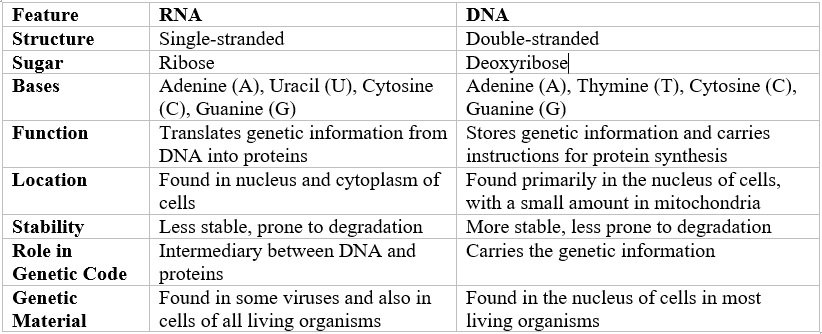
15.jpg [ 117.74 KiB | Viewed 5000 times ]
Data Insights (DI) Butler 2023-24 [Question #211, Date: Jan-22-2024] [Click here for Details]
Attachment:
15.jpg [ 117.74 KiB | Viewed 5000 times ]
Archived Topic
Hi there,
This topic has been closed and archived due to inactivity or violation of community quality standards. No more replies are possible here.
Where to now? Join ongoing discussions on thousands of quality questions in our Multi-Source Reasoning (MSR) Forum
Still interested in this question? Check out the "Best Topics" block below for a better discussion on this exact question, as well as several more related questions.
Thank you for understanding, and happy exploring!


 02 Jul 2024, 00:42
Kudos
Bookmarks
Q1.
Genetic information is passed from one generation to the next through DNA replication and cell division. - Inferred 1st tab last sentence
Adenine (A) pairs with thymine (T), and cytosine (C) pairs with guanine (G) in RNA. - Thymine not present in RNA check 2nd tab - Not inferred
RNA plays a crucial role in the synthesis of proteins in living organisms. - 2nd Tab 1st line - Inferred.
Q2.
RNA uses uracil (U) as one of its nucleotide bases, which replaces thymine (T) found in DNA. - Correct 2nd tab
DNA and RNA are typically double-stranded molecules. - Incorrect Tab2
DNA is less stable than RNA. - Incorrect Tab3
Q3
RNA Translates genetic information from DNA into proteins while DNA Stores genetic information and carries instructions for protein synthesis. - Inferred Tab3
DNA Found primarily in the nucleus of cells, with a small amount in mitochondria. - Inferred Tab 3
RNA is a nucleic acid made up of a chain of nucleotide building blocks, similar to DNA, but it has some important differences in structure and function compared to DNA.- Inferred Tab 2
RNA performs functions such as catalyzing chemical reactions or regulating gene expression. - Not inferred
DNA can be found in the nucleus of cells in most living organisms. - Inferred Tab3
Genetic information is passed from one generation to the next through DNA replication and cell division. - Inferred 1st tab last sentence
Adenine (A) pairs with thymine (T), and cytosine (C) pairs with guanine (G) in RNA. - Thymine not present in RNA check 2nd tab - Not inferred
RNA plays a crucial role in the synthesis of proteins in living organisms. - 2nd Tab 1st line - Inferred.
Q2.
RNA uses uracil (U) as one of its nucleotide bases, which replaces thymine (T) found in DNA. - Correct 2nd tab
DNA and RNA are typically double-stranded molecules. - Incorrect Tab2
DNA is less stable than RNA. - Incorrect Tab3
Q3
RNA Translates genetic information from DNA into proteins while DNA Stores genetic information and carries instructions for protein synthesis. - Inferred Tab3
DNA Found primarily in the nucleus of cells, with a small amount in mitochondria. - Inferred Tab 3
RNA is a nucleic acid made up of a chain of nucleotide building blocks, similar to DNA, but it has some important differences in structure and function compared to DNA.- Inferred Tab 2
RNA performs functions such as catalyzing chemical reactions or regulating gene expression. - Not inferred
DNA can be found in the nucleus of cells in most living organisms. - Inferred Tab3
 22 Jan 2025, 12:03
Kudos
Bookmarks
1. Let's look at the statements and see which can be inferred.
- Genetic information is passed from one generation to the next through DNA replication and cell division. Tab DNA, "DNA carries the genetic information ... from one generation to the next through a process called DNA replication and cell division." So, this statement can be inferred.
- Adenine (A) pairs with thymine (T), and cytosine (C) pairs with guanine (G) in RNA. Tab RNA, "the four nucleotide bases in RNA are ... uracil (U), which replaces thymine (T) found in DNA." So, this statement cannot be inferred.
- RNA plays a crucial role in the synthesis of proteins in living organisms. Tab RNA, "RNA (Ribonucleic Acid) is a molecule that plays a crucial role in the synthesis of proteins in living organisms." So, this statement can be inferred.
2. Let's look at the statements and see which are correct and which are incorrect.
- RNA uses uracil (U) as one of its nucleotide bases, which replaces thymine (T) found in DNA. Tab RNA, "the four nucleotide bases in RNA are ... uracil (U), which replaces thymine (T) found in DNA." So, this statement is correct.
- DNA and RNA are typically double-stranded molecules. Tab RNA, "the structure of RNA is typically single-stranded." So, this statement is incorrect.
- DNA is less stable than RNA. Tab Comparison Table, "RNA: Less stable" and "DNA: More stable." So, this statement is incorrect.
3. Here, we need to find which of the following statements cannot be inferred.
- RNA Translates genetic information from DNA into proteins while DNA Stores genetic information and carries instructions for protein synthesis. This matches what is written in the tab Comparison Table, Function. So, this statement can be inferred.
- DNA Found primarily in the nucleus of cells, with a small amount in mitochondria. This matches what is written in the tab Comparison Table, DNA, Location. So, this statement can be inferred.
- RNA is a nucleic acid made up of a chain of nucleotide building blocks, similar to DNA, but it has some important differences in structure and function compared to DNA. Tab RNA, "RNA is a nucleic acid made up of a chain of nucleotide building blocks, but it has some important differences in structure and function compared to DNA." So, this statement can be inferred.
- RNA performs functions such as catalyzing chemical reactions or regulating gene expression. Catalyzing chemical reactions isn't mentioned anywhere. So, this statement cannot be inferred.
- DNA can be found in the nucleus of cells in most living organisms. This matches what is written in the tab Comparison Table, DNA, Location. So, this statement can be inferred.
- Genetic information is passed from one generation to the next through DNA replication and cell division. Tab DNA, "DNA carries the genetic information ... from one generation to the next through a process called DNA replication and cell division." So, this statement can be inferred.
- Adenine (A) pairs with thymine (T), and cytosine (C) pairs with guanine (G) in RNA. Tab RNA, "the four nucleotide bases in RNA are ... uracil (U), which replaces thymine (T) found in DNA." So, this statement cannot be inferred.
- RNA plays a crucial role in the synthesis of proteins in living organisms. Tab RNA, "RNA (Ribonucleic Acid) is a molecule that plays a crucial role in the synthesis of proteins in living organisms." So, this statement can be inferred.
2. Let's look at the statements and see which are correct and which are incorrect.
- RNA uses uracil (U) as one of its nucleotide bases, which replaces thymine (T) found in DNA. Tab RNA, "the four nucleotide bases in RNA are ... uracil (U), which replaces thymine (T) found in DNA." So, this statement is correct.
- DNA and RNA are typically double-stranded molecules. Tab RNA, "the structure of RNA is typically single-stranded." So, this statement is incorrect.
- DNA is less stable than RNA. Tab Comparison Table, "RNA: Less stable" and "DNA: More stable." So, this statement is incorrect.
3. Here, we need to find which of the following statements cannot be inferred.
- RNA Translates genetic information from DNA into proteins while DNA Stores genetic information and carries instructions for protein synthesis. This matches what is written in the tab Comparison Table, Function. So, this statement can be inferred.
- DNA Found primarily in the nucleus of cells, with a small amount in mitochondria. This matches what is written in the tab Comparison Table, DNA, Location. So, this statement can be inferred.
- RNA is a nucleic acid made up of a chain of nucleotide building blocks, similar to DNA, but it has some important differences in structure and function compared to DNA. Tab RNA, "RNA is a nucleic acid made up of a chain of nucleotide building blocks, but it has some important differences in structure and function compared to DNA." So, this statement can be inferred.
- RNA performs functions such as catalyzing chemical reactions or regulating gene expression. Catalyzing chemical reactions isn't mentioned anywhere. So, this statement cannot be inferred.
- DNA can be found in the nucleus of cells in most living organisms. This matches what is written in the tab Comparison Table, DNA, Location. So, this statement can be inferred.






