Events & Promotions
|
|

GMAT Club Daily Prep
Thank you for using the timer - this advanced tool can estimate your performance and suggest more practice questions. We have subscribed you to Daily Prep Questions via email.
Customized
for You
Track
Your Progress
Practice
Pays
Not interested in getting valuable practice questions and articles delivered to your email? No problem, unsubscribe here.
 Sep 07
12:01 AM PDT
-11:59 PM PDT
On the 7th, GMAT Club Tests will be Free! Including all the Quizzes, Questions, and Tests. 12 AM - 11:59 PM PDT- Sep 09
07:00 AM PDT
-10:00 AM PDT
Meet AdComs and explore top Master’s programs - MiM, MiF, MSc, MSBA and more. - Application Fee Waivers - Free 1-Week of GMAT Club Tests: - Master's Application Toolkit - Grand Prize Giveaway

 11 Jul 2024, 11:09
Kudos
Bookmarks


Be sure to select an answer first to save it in the Error Log before revealing the correct answer (OA)!
Difficulty:
(N/A)
Question Stats:
100% (00:45) correct 0% (00:00) wrong based on 2 sessions
History
Date
Time
Result
Not Attempted Yet
Quantity A
The sum of the odd integers from 1 to 199
Quantity B
The sum of the even integers from 2 to 198
The sum of the odd integers from 1 to 199
Quantity B
The sum of the even integers from 2 to 198


 26 Aug 2024, 11:59
Kudos
Bookmarks
Official Explanation
In this question, you are asked to compare the sum of the odd integers from 1 to 199 with the sum of the even integers from 2 to 198. Both of these sums involve many integers. How many integers are in each sum? Note that there are 200 integers from 1 to 200, where 100 of them are even and 100 of them are odd. The 100 odd integers are precisely the odd integers in Quantity A, whereas the 100 even integers include one more integer, 200, than the even integers in Quantity B. So Quantity A is the sum of 100 integers and Quantity B is the sum of 99 integers.
It would be very time-consuming to write out all the terms in each sum and add them together. Therefore, it is reasonable to find a more efficient way to calculate the sums or to find a way to compare the sums without actually calculating them. To find a more efficient way to calculate the two sums, it is often useful to look for ways to rearrange the terms in the sum so that they can be added more easily. You can begin by writing a few terms from the beginning and the end of the sum.
For the sum of the 100 odd integers from 1 to 199, you could write
1 + 3 + 5 + ... + 195 + 197 + 199
You can pair the odd integers in the sum and add the two integers in each pair as follows.
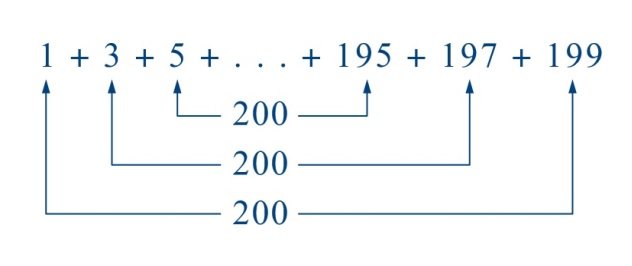
Note that the sum of the integers in each of the three pairs shown is 200. You can continue pairing terms in the sum in this way until all 100 terms have been rearranged in 50 pairs, where the sum of each pair is 200. It follows that
1 + 3 + 5 + ... + 195 + 197 + 199 = (1 + 199) + (3 + 197) + (5 + 195) + ... + (99 + 101) = 50(200) = 10,000
Now consider the sum of the 99 even integers from 2 to 198. For this sum, you could write
2 + 4 + 6 + ... + 194 + 196 + 198
In this sum, note that
the sum of the 1st and 99th terms is 2 + 198 = 200
the sum of the 2nd and 98th terms is 4 + 196 = 200
You can continue pairing terms in this way until 98 of the 99 terms in the sum have been rearranged into 49 pairs and the 50th term is unpaired. Note that the unpaired term is 100 (the 50th positive even integer). It follows that
2 + 4 + ... + 98 + 100 + 102 + ... + 196 + 198 = (2 + 198) + (4 + 196) + ... + (98 + 102) + 100 = 49(200) + 100 = 9,900
Therefore, Quantity A, 10,000, is greater than Quantity B, 9,900, and the correct answer is Choice A.
Answer: A
In this question, you are asked to compare the sum of the odd integers from 1 to 199 with the sum of the even integers from 2 to 198. Both of these sums involve many integers. How many integers are in each sum? Note that there are 200 integers from 1 to 200, where 100 of them are even and 100 of them are odd. The 100 odd integers are precisely the odd integers in Quantity A, whereas the 100 even integers include one more integer, 200, than the even integers in Quantity B. So Quantity A is the sum of 100 integers and Quantity B is the sum of 99 integers.
It would be very time-consuming to write out all the terms in each sum and add them together. Therefore, it is reasonable to find a more efficient way to calculate the sums or to find a way to compare the sums without actually calculating them. To find a more efficient way to calculate the two sums, it is often useful to look for ways to rearrange the terms in the sum so that they can be added more easily. You can begin by writing a few terms from the beginning and the end of the sum.
For the sum of the 100 odd integers from 1 to 199, you could write
1 + 3 + 5 + ... + 195 + 197 + 199
You can pair the odd integers in the sum and add the two integers in each pair as follows.
Note that the sum of the integers in each of the three pairs shown is 200. You can continue pairing terms in the sum in this way until all 100 terms have been rearranged in 50 pairs, where the sum of each pair is 200. It follows that
1 + 3 + 5 + ... + 195 + 197 + 199 = (1 + 199) + (3 + 197) + (5 + 195) + ... + (99 + 101) = 50(200) = 10,000
Now consider the sum of the 99 even integers from 2 to 198. For this sum, you could write
2 + 4 + 6 + ... + 194 + 196 + 198
In this sum, note that
the sum of the 1st and 99th terms is 2 + 198 = 200
the sum of the 2nd and 98th terms is 4 + 196 = 200
You can continue pairing terms in this way until 98 of the 99 terms in the sum have been rearranged into 49 pairs and the 50th term is unpaired. Note that the unpaired term is 100 (the 50th positive even integer). It follows that
2 + 4 + ... + 98 + 100 + 102 + ... + 196 + 198 = (2 + 198) + (4 + 196) + ... + (98 + 102) + 100 = 49(200) + 100 = 9,900
Therefore, Quantity A, 10,000, is greater than Quantity B, 9,900, and the correct answer is Choice A.
Answer: A
Attachment:
GMAT-Club-Forum-ao64y9rm.jpeg [ 21.6 KiB | Viewed 921 times ]





