Events & Promotions
|
|

GMAT Club Daily Prep
Thank you for using the timer - this advanced tool can estimate your performance and suggest more practice questions. We have subscribed you to Daily Prep Questions via email.
Customized
for You
Track
Your Progress
Practice
Pays
Not interested in getting valuable practice questions and articles delivered to your email? No problem, unsubscribe here.
 Sep 02
08:00 PM PDT
-09:00 PM PDT
Video explanations + diagnosis of 10 weakest areas + 150+ short videos + study plan! Sep 03
01:30 AM EDT
-02:30 AM EDT
At one point, she believed GMAT wasn’t for her. After scoring 595, self-doubt crept in and she questioned her potential. But instead of quitting, she made the right strategic changes. The result? A remarkable comeback to 695. Check out how Saakshi did it. Aug 27
10:00 AM EDT
-11:00 AM EDT
We’ve worked incredibly hard to build TTP into the best test prep experience possible, and it would mean a lot to us to win Newsweek’s 2026 Readers’ Choice Award for Best Test Prep. If TTP has helped you, we’d be incredibly grateful for your vote. Sep 02
12:30 AM EDT
-01:30 AM EDT
Thought your job leaves no time for GMAT prep? After multiple GMAT attempts and a demanding consulting job, Kshitij improved to 695 in under 2 months. Learn the mindset shifts, study strategy, and execution changes that made the breakthrough possible. Sep 02
01:00 PM EDT
-11:59 PM EDT
Take 30% off all study plans with code COURSEWORK - Expires on Monday 9/7 Sep 04
10:00 AM PDT
-11:00 AM PDT
What does test anxiety really look like on the GMAT? For many test takers, it does not look like a panic attack. Instead, it shows up as brain fog, rereading, negative comparisons, mental noise.... Sep 06
09:30 AM EDT
-12:30 PM EST
Top scores are possible when you enroll in a powerful EA course, taught live online + 6 months access to TTP OnDemand video courses included! Perfect class schedule and easy course access for working professionals. Class starts Sundays Sept. 6, 2026.- Sep 07
12:01 AM PDT
-11:59 PM PDT
On the 7th, GMAT Club Tests will be Free! Including all the Quizzes, Questions, and Tests. 12 AM - 11:59 PM PDT - Sep 09
07:00 AM PDT
-10:00 AM PDT
Meet AdComs and explore top Master’s programs - MiM, MiF, MSc, MSBA and more. - Application Fee Waivers - Free 1-Week of GMAT Club Tests: - Master's Application Toolkit - Grand Prize Giveaway  Sep 15
07:00 PM EDT
-09:00 PM EST
Elite scores are possible when you enroll in a powerful GMAT course, taught live online + 6 months access to TTP OnDemand video courses included! Class starts Tues/Thurs Sept. 15, 2026 - Nov. 15, 2027, 7:00pm-9:00pm EST Sep 21
08:00 PM EDT
-10:00 PM EDT
Boost your GMAT score in less than one month in a live online class + 6 months access to TTP OnDemand video courses included! Class starts Mon, Tues, Wed, Thur, Fri Sept. 21, 2026 - Oct. 9, 2027, 7:00pm-10:00pm EST



 28 Aug 2026, 04:35
Kudos
Bookmarks
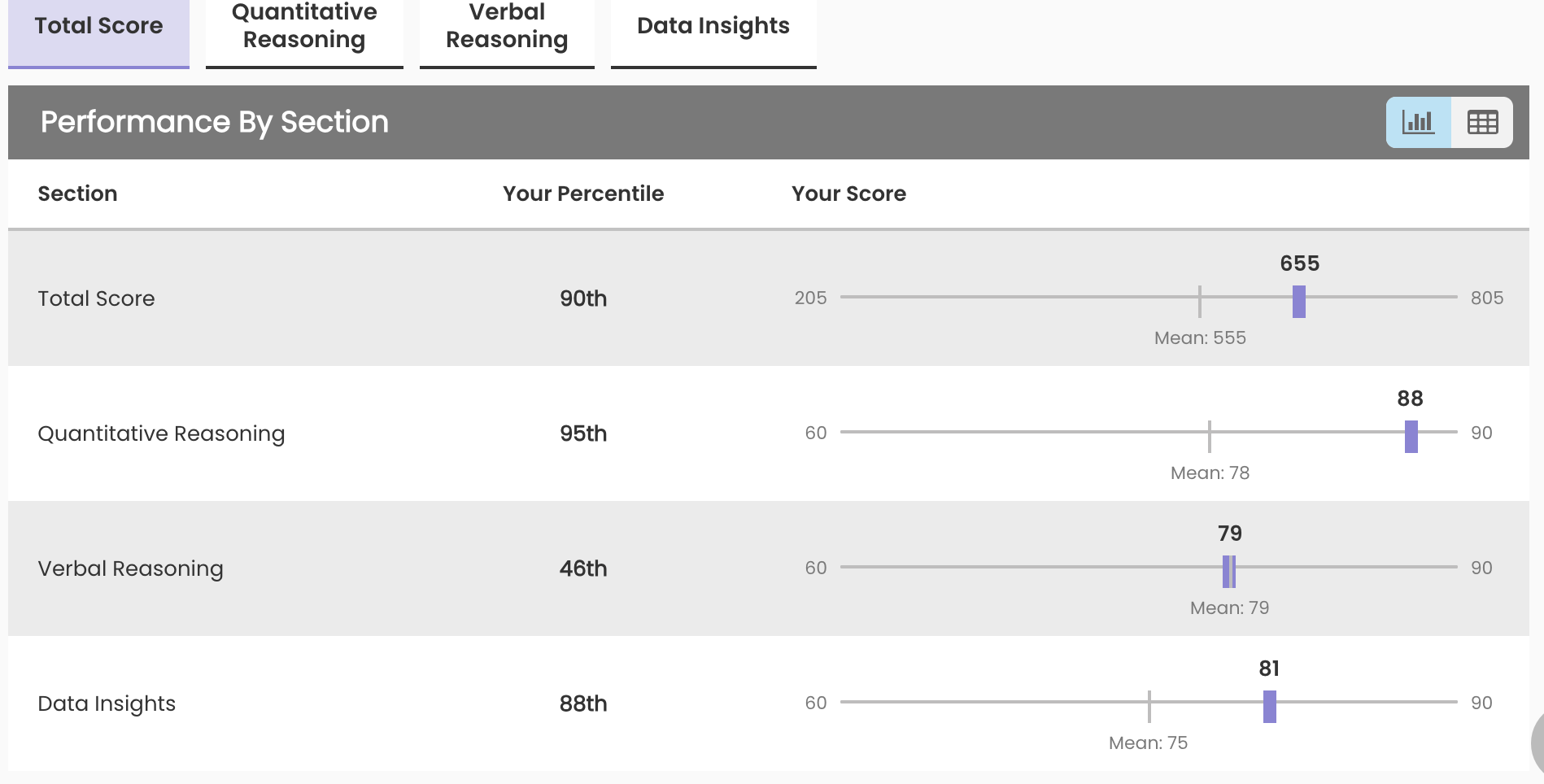
My best section was quietly holding me back. The fix was not more practice, it was finally learning to diagnose the problem properly. Here's how, with e-GMAT.
The realization that changed my whole prep
Fixing Quant by finding the real leak
The same method on a reasoning weakness
Timing: clear rules, no hesitation
The tools that made the diagnosis possible
What actually made the difference
GMAT-Club-Forum-8ni4p1h6.png [ 125.2 KiB | Viewed 78 times ]
Here is the one thing this debrief is about: when I saw my baseline, the section that shocked me was Quant, supposedly my strength. I could not understand what was going wrong or how to push it higher. What I eventually learned, and what changed everything, is that improvement does not come from doing more questions, it comes from diagnosing exactly what is broken and fixing that. Once I started analysing my data properly, my Quant went from an 85 to an 88, and this is how.
The realization that changed my whole prep
The single biggest shift in my entire journey was learning what proper analysis actually means. Before e-GMAT, I would finish a mock or a quiz, look at the score, and move on, I never really analysed anything. Once I started working with the platform and my mentor, Dhruv, I learned that the score is the least useful part of a mock. The real value is in breaking down every wrong answer to understand the specific cause behind it. That habit, treating each mistake as a piece of evidence rather than just a lost mark, is what turned my practice into actual improvement.
Fixing Quant by finding the real leak
Here is exactly how that played out in Quant. When my sectional scores were stuck at 81 to 82, my mentor pointed out that the problem was not my overall approach, something more specific was wrong. So instead of more full sections, I took cementing quizzes on each individual sub-topic, and the diagnosis was immediate: it became obvious precisely which topics were dragging me down. I then went and worked on those exact topics, and took more cementing quizzes to confirm the gaps had actually closed. Only after that did I return to sectional mocks, and this time my score came in consistently at 86 to 88. The jump did not come from working harder, it came from working on the right thing, which I could only do once the data showed me what that was.
The clearest example was algebra. My accuracy there had been sitting around 50 percent, which is exactly the kind of leak that quietly caps a Quant score. Through back-to-back quizzes on the topic and a careful diagnosis of what I was getting wrong each time, that accuracy climbed to 80 percent. That single topic turning around is a large part of what lifted the section as a whole.
The same method on a reasoning weakness
I used the identical loop on a reasoning weakness I had in Critical Reasoning, where I kept misjudging arguments. Rather than just doing more questions and hoping, I worked through back-to-back cementing quizzes and concept quizzes with my mentor, diagnosing after each round what type of reasoning I was getting wrong. The pattern is the same as Quant, locate the specific fault, drill it, confirm it is fixed, and it worked the same way.
Timing: clear rules, no hesitation
My pacing came down to two firm rules my mentor set, and having them removed all the in-the-moment agonising. At two and a half minutes on a question, I would recalibrate and decide whether I genuinely had a path, and three minutes was a hard stop, no matter how close I felt. Committing to those numbers rather than debating each question in real time is what kept my sections on track.
The tools that made the diagnosis possible
The tool that did the most for me was the cementing quizzes, in every section, because they are what pinpointed my weak points topic by topic, and their analysis is what told me how to fix them. Underneath all of it was the data analytics: every mock and quiz analysis handed me a clear list of weak points and a refinement to my strategy, so I was never guessing where to go next.
What actually made the difference
The greatest advantage I had was the personal attention and diagnosis from my mentor, which was genuinely different from any online coaching I had tried, he analysed my data with me and built a specific strategy for each weakness rather than handing me a generic plan. If I had to give one piece of advice to someone starting where I was, it would be this: do not just collect scores, learn to analyse them properly, because the moment you can see exactly what is broken is the moment your score starts to move. That is what took my Quant from an 85 to an 88.

Attachment:
GMAT-Club-Forum-8ni4p1h6.png [ 125.2 KiB | Viewed 78 times ]
 28 Aug 2026, 15:40
Kudos
Bookmarks
That's a huge improvement
Moderator:








