Events & Promotions
| Last visit was: 27 Sep 2026, 01:58 |
It is currently 27 Sep 2026, 01:58 |
|
|

GMAT Club Daily Prep
Thank you for using the timer - this advanced tool can estimate your performance and suggest more practice questions. We have subscribed you to Daily Prep Questions via email.
Customized
for You
Track
Your Progress
Practice
Pays
Not interested in getting valuable practice questions and articles delivered to your email? No problem, unsubscribe here.
 Sep 27
01:30 AM EDT
-02:30 AM EDT
At one point, she believed GMAT wasn’t for her. After scoring 595, self-doubt crept in and she questioned her potential. But instead of quitting, she made the right strategic changes. The result? A remarkable comeback to 695. Check out how Saakshi did it. Sep 28
07:00 PM EDT
-10:00 PM EDT
Boost your GMAT score in less than one month in a live online class + 6 months access to TTP OnDemand video courses included! Class starts Mon, Tues, Wed, Thur, Fri Sept. 28, 2026 - Oct. 16, 2027, 7:00pm-10:00pm EST Sep 29
11:00 AM EDT
-01:00 PM EDT
" Description: Top scores are possible when you enroll in a powerful GMAT course, taught live online + 6 months access to TTP OnDemand video courses included! Class starts Tues/Thur Sept. 29, 2026 - Dec. 3, 2026, 11:00am-1:00pm EST Oct 01
02:00 AM EDT
-03:00 AM EDT
Tejas studied hard but kept repeating the same mistakes. After 3 attempts at 645, a focused 4-week strategy helped him identify and fix what was holding him back—leading to a 695 with just 12–15 hours of study per week. Oct 01
07:00 AM BST
-08:00 AM GMT
Welcome to the GMAT Club's Free Interview Prep Event for Top MBA Programs! Buy tickets - Virtual series that’s all set to equip you to -excel in your MBA interviews. Oct 03
01:00 PM EDT
-04:00 PM EDT
Top scores are possible when you enroll in a powerful GMAT course, taught live online + 6 months access to TTP OnDemand video courses included! Class starts Saturdays Oct. 3, 2026 - Dec. 26, 2026, 1:00pm-4:00pm EST

 Updated on: 27 May 2026, 06:49
Originally posted by EgmatQuantExpert on 26 Aug 2016, 02:40.
Last edited by Bunuel on 27 May 2026, 06:49, edited 4 times in total.
Last edited by Bunuel on 27 May 2026, 06:49, edited 4 times in total.
Kudos
Bookmarks


C
Be sure to select an answer first to save it in the Error Log before revealing the correct answer (OA)!
Difficulty:
 25%
(medium)
25%
(medium)
Question Stats:
81% (01:35) correct 19%
(02:00)
wrong
based on 1033
sessions
19%
(02:00)
wrong
based on 1033
sessions
History
Date
Time
Result
Not Attempted Yet
Find the range of values of x that satisfy the inequality \(\frac{(x+1)(x-2)}{(x-5)(x+3)} > 0\)
A. x < -3
B. -1 < x < 2
C. x < -3 or -1 < x < 2 or x > 5
D. -1 < x < 2 or x > 5
E. x < -3 or -1 < x < 2
A. x < -3
B. -1 < x < 2
C. x < -3 or -1 < x < 2 or x > 5
D. -1 < x < 2 or x > 5
E. x < -3 or -1 < x < 2
Wavy Line Method Application has been explained in detail in the following post:: https://gmatclub.com/forum/wavy-line-method-application-complex-algebraic-inequalities-224319.html
Detailed solution will be posted soon.
To read all our articles: Must read articles to reach Q51

Detailed solution will be posted soon.
To read all our articles: Must read articles to reach Q51
Updated on: 07 Aug 2018, 21:29
Originally posted by EgmatQuantExpert on 18 Nov 2016, 03:16.
Last edited by EgmatQuantExpert on 07 Aug 2018, 21:29, edited 1 time in total.
Last edited by EgmatQuantExpert on 07 Aug 2018, 21:29, edited 1 time in total.
Kudos
Bookmarks
Solution:
Hey Everyone,
Please find below the solution of the given problem,
Plotting the zero points and drawing the wavy line:
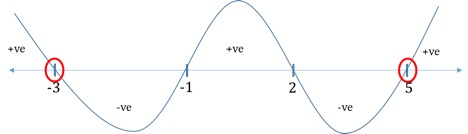
Required Range:
x < -3 or -1 < x < 2 or x > 5
Correct Answer: Option C

Hey Everyone,
Please find below the solution of the given problem,
Plotting the zero points and drawing the wavy line:
Required Range:
x < -3 or -1 < x < 2 or x > 5
Correct Answer: Option C

 26 Aug 2016, 10:02
Kudos
Bookmarks
EgmatQuantExpert
Equation is \(\frac{(x+1)(x-2)}{(x-5)(x+3)} > 0\)
We have the values of x as -3,-1,2 and 5.
Since x cannot be equal to 5 or -3 we need to exclude those values(they are at the denominator and we cannot have 0 at the denominator)
So, substituting these values of the number line, we will the range of x as
(-infinity,-3) U (-1,2) U (5,infinity)
Please correct me if I am missing anything.
General Discussion


 23 Oct 2018, 07:46
Kudos
Bookmarks
VeritasKarishma apologies for bothering you. I read your inequality series and it's been enlightening.
I was wondering, for a problem such as this one where you have (x+1)(x-2) on numerator and (x-5)(x+3) on denominator... how would you approach it? Clearly the "wavy" method works... but I wonder how would you tackle this with the method you explain in your series "Inequalities with complications".
Am I allowed to multiply by 1 since it's positive? For instance I multiply (x-5)/(x-5) and (x+3)/(x+3) on left side to get (x+1)(x-2)(x-5)(x+3) on numerator and then (x-5)^2 and (x+3)^2 on denominator! This means that I can ignore the denominator since it will be always positive, and hence I end with a structure similar to the ones you tackled on your post (x+1)(x-2)(x-5)(x+3) > 0.
Would that work? Thank you.
I was wondering, for a problem such as this one where you have (x+1)(x-2) on numerator and (x-5)(x+3) on denominator... how would you approach it? Clearly the "wavy" method works... but I wonder how would you tackle this with the method you explain in your series "Inequalities with complications".
Am I allowed to multiply by 1 since it's positive? For instance I multiply (x-5)/(x-5) and (x+3)/(x+3) on left side to get (x+1)(x-2)(x-5)(x+3) on numerator and then (x-5)^2 and (x+3)^2 on denominator! This means that I can ignore the denominator since it will be always positive, and hence I end with a structure similar to the ones you tackled on your post (x+1)(x-2)(x-5)(x+3) > 0.
Would that work? Thank you.






