Events & Promotions
|
|

GMAT Club Daily Prep
Thank you for using the timer - this advanced tool can estimate your performance and suggest more practice questions. We have subscribed you to Daily Prep Questions via email.
Customized
for You
Track
Your Progress
Practice
Pays
Not interested in getting valuable practice questions and articles delivered to your email? No problem, unsubscribe here.
 Sep 15
07:00 PM EDT
-09:00 PM EST
Elite scores are possible when you enroll in a powerful GMAT course, taught live online + 6 months access to TTP OnDemand video courses included! Class starts Tues/Thurs Sept. 15, 2026 - Nov. 15, 2027, 7:00pm-9:00pm EST Sep 21
07:00 PM EDT
-10:00 PM EDT
Boost your GMAT score in less than one month in a live online class + 6 months access to TTP OnDemand video courses included! Class starts Mon, Tues, Wed, Thur, Fri Sept. 21, 2026 - Oct. 9, 2027, 7:00pm-10:00pm EST


 13 Jan 2022, 11:22
Kudos
Bookmarks

What are Experimental Questions in the GMAT?
If you’re preparing for the GMAT as part of your process of applying to business school, you may have heard that some of the questions on the GMAT are experimental. If so, you may be wondering what experimental GMAT questions are, how many of the questions are experimental, and how the experimental questions affect the test-taking experience and your GMAT score. So, I’m going to answer these questions in this article, starting with explaining what exactly experimental questions on the GMAT are.What Are Experimental Questions on the GMAT?
As you’re likely aware, the GMAT is a standardized test that the test-makers seek to keep consistent from test to test and from year to year. In order to do so, the test-makers have to test the questions that appear on the GMAT for performance and difficulty before they use them. So, to test the questions, they include some experimental questions in every test-taker’s GMAT. These experimental questions appear in the Quantitative Reasoning section, the Verbal Reasoning section, and the Integrated Reasoning section. None appear in the Analytical Writing Assessment since the AWA doesn’t include any multiple choice questions.Of course, it’s only fair that your performance on questions that are being tested doesn’t count toward your score. So, as you would expect, the GMAT experimental questions on the GMAT don’t count toward your section scores or your final score.
OK, now that we know what GMAT experimental questions are, let’s discuss how many of the quant questions and verbal questions on the GMAT are experimental, since your performance on the quant and verbal sections is what determines your GMAT total score.
How Many Experimental Questions Appear on the GMAT
The makers of the GMAT don’t publish the number of experimental questions that appear on the exam. However, by reviewing information from test-takers Enhanced Score Reports (ESRs) we can tell how many experimental questions are included in the quant section and the verbal section. So, let’s do so and see how many experimental questions there are on these two important sections of the GMAT.The Number of Experiment Questions on the Quant Section
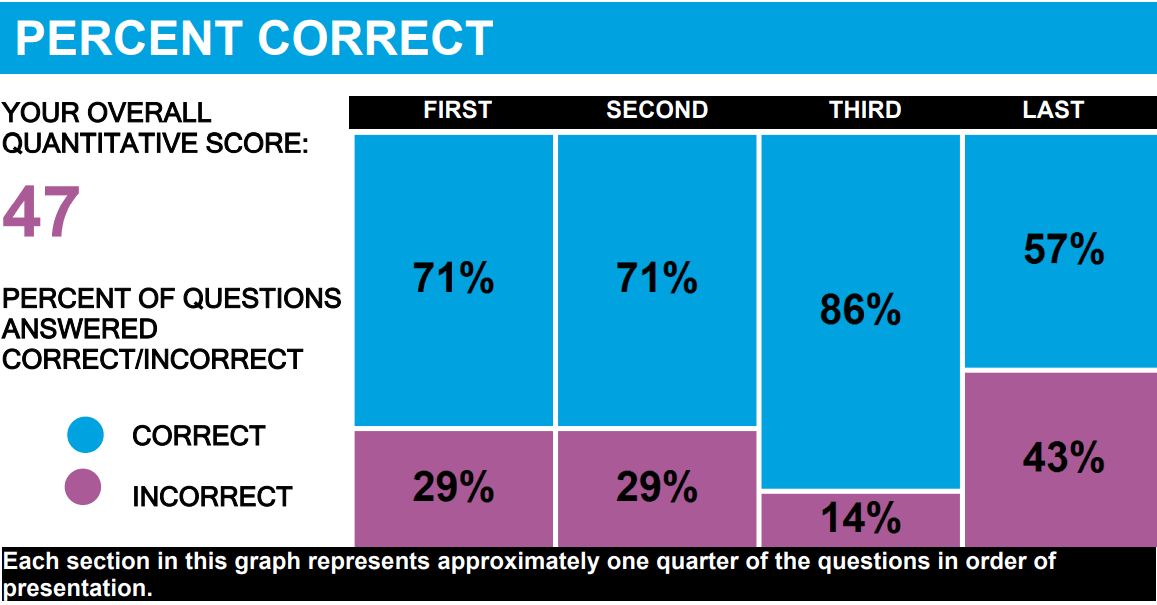
Let’s first see how many experimental questions there are on the quant section of the GMAT. As you may be aware, the quant section of the GMAT has 31 questions in total. However, only some of the questions, and not the experimental questions, count toward your score. So, by using ESR information to determine how many questions count toward your score, we can calculate how many experimental questions appear on the quant section.The graph below is from the quant portion of a GMAT test-taker’s ESR. Each of the four columns represents a quarter of the counted questions on the quant section. Notice that all of the percentages on the graph are multiples of 14.3 rounded to the nearest whole number. For example, the lowest number is 14, which is obviously a multiple of 14.3 rounded to the nearest whole number. Also, 29 = 14.3 x 2 rounded, 57 = 14.3 x 4 rounded, and 86 = 14.3 x 6 rounded.
OK, now that we know how many experimental questions are included in the quant section of the GMAT, let’s see how many experimental questions there are in the verbal section.
To read the complete article, view my full article on Target Test Prep’s blog.

Moderator:






