Events & Promotions
|
|

GMAT Club Daily Prep
Thank you for using the timer - this advanced tool can estimate your performance and suggest more practice questions. We have subscribed you to Daily Prep Questions via email.
Customized
for You
Track
Your Progress
Practice
Pays
Not interested in getting valuable practice questions and articles delivered to your email? No problem, unsubscribe here.
 Sep 13
12:30 AM EDT
-01:30 AM EDT
Struggling to find the right strategies to score a 99 %ile on GMAT Focus? Riya (GMAT 715) boosted her score by 100-points in just 15 days! Discover how the right mentorship, tailored strategies, and an unwavering mindset can transform your GMAT prep. Sep 13
01:30 AM EDT
-02:30 AM EDT
At one point, she believed GMAT wasn’t for her. After scoring 595, self-doubt crept in and she questioned her potential. But instead of quitting, she made the right strategic changes. The result? A remarkable comeback to 695. Check out how Saakshi did it. Sep 15
07:00 PM EDT
-09:00 PM EST
Elite scores are possible when you enroll in a powerful GMAT course, taught live online + 6 months access to TTP OnDemand video courses included! Class starts Tues/Thurs Sept. 15, 2026 - Nov. 15, 2027, 7:00pm-9:00pm EST Sep 18
08:00 PM PDT
-09:00 PM PDT
Video explanations + diagnosis of 10 weakest areas + 150+ short videos + study plan! Sep 21
07:00 PM EDT
-10:00 PM EDT
Boost your GMAT score in less than one month in a live online class + 6 months access to TTP OnDemand video courses included! Class starts Mon, Tues, Wed, Thur, Fri Sept. 21, 2026 - Oct. 9, 2027, 7:00pm-10:00pm EST

 Wed Nov 10, 2021 9:30 am
Kudos
Bookmarks
What is a Good AWA Score on the GMAT?
A solid GMAT score goes a long way in increasing an applicant’s competitiveness for MBA admissions, so it’s not surprising that most MBA applicants recognize the importance of earning a competitive overall GMAT score. However, many GMAT-takers wonder whether their scores on the essay portion of the GMAT, which is known as the Analytical Writing Assessment (AWA) section, also affect their competitiveness in MBA admissions, and if so, what constitutes a good GMAT AWA score. In this article, we’ll answer these and other common questions about the GMAT essay. Let’s begin by discussing what the GMAT AWA is.
The GMAT AWA
The GMAT Analytical Writing Assessment (AWA) measures your ability to examine and assess the underlying reasoning behind an argument, and then present your critique in the form of a written essay.Specifically, for the GMAT AWA, you’ll be presented with a one-paragraph prompt that contains a scenario or argument, which is often presented in the context of a statement provided by a company or a newspaper editorial.
Regardless of which AWA prompt you’re given, the argument will be flawed in some way(s). For example, the argument may contain flawed logic, faulty assumptions, conclusions that are supported by inadequate evidence, issues in the way supporting data was collected, or unreasonable comparisons.
The goal of your essay is simple: expose these flaws!
According to the GMAC, an ideal essay should:
- Identify and analyze significant flaws in the argument
- Support the critique using relevant supporting reasons and/or examples
- Be clearly organized and coherent
- Demonstrate control of language, diction, syntax, and conventions of written English
You’ll have 30 minutes to read the prompt and write your essay.
The good news is that with some practice and the right strategies, earning a perfect score on the GMAT AWA section is within reach for most GMAT test-takers. Let’s now discuss how the AWA is scored.
How the GMAT Analytical Writing Assessment (AWA) Section is Scored
Many GMAT-takers wonder whether the GMAT AWA counts toward their GMAT score. The GMAT AWA has its own unique score that does not count toward a test-taker’s overall GMAT score of 200 to 800. The GMAT AWA is graded on a scale of 0 to 6, in half-point increments. According to the Graduate Management Admission Council (GMAC), a score of 6, the highest possible score, is considered “outstanding,” 5 is “strong,” 4 is “adequate,” 3 is “limited,” 2 is “seriously flawed,” and 1, the lowest score possible, is considered “fundamentally deficient.”
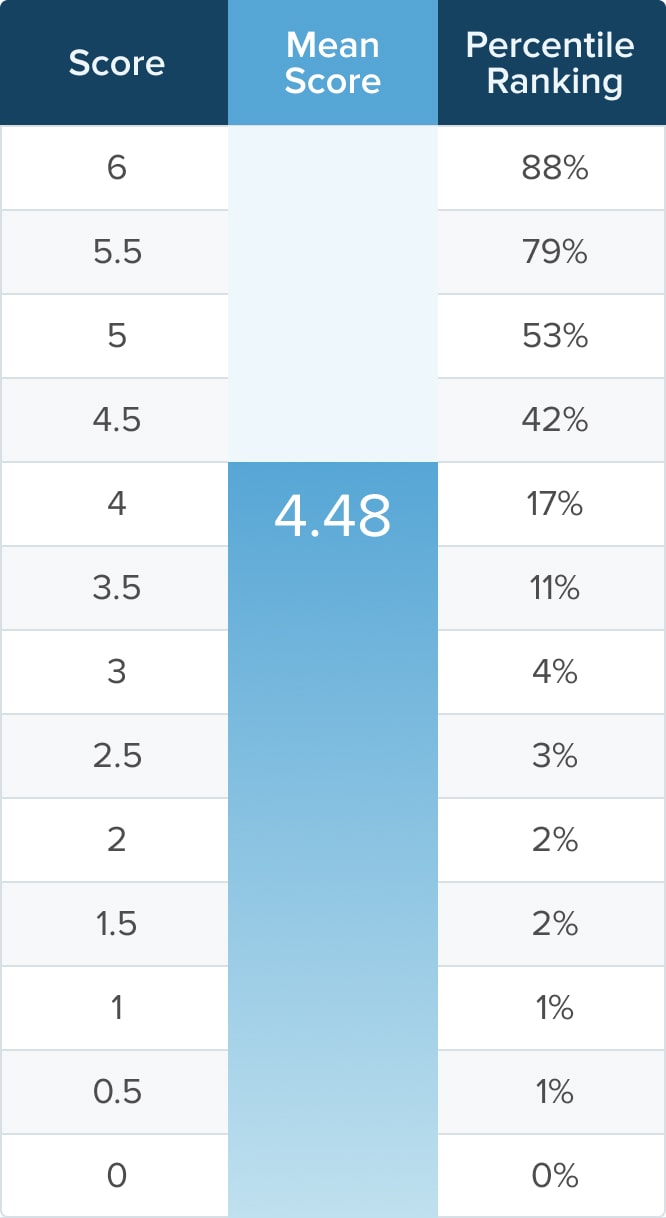
GMAT AWA Percentiles
Just as your other section scores are associated with percentile rankings, your AWA score will be associated with a score percentile. These percentile rankings allow you (and schools) to see how your GMAT AWA score compares to those of other GMAT test-takers.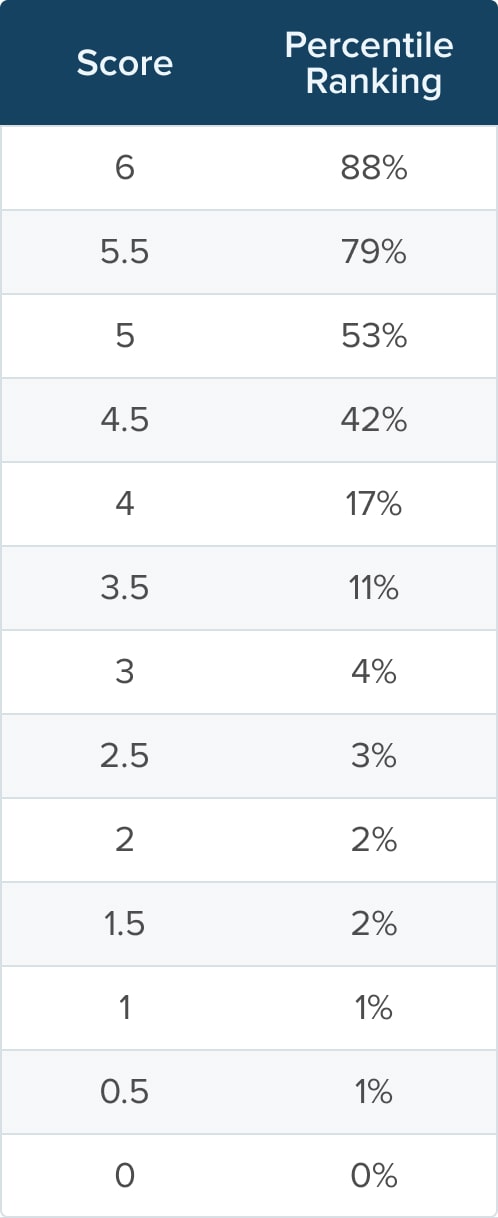
How Important is the GMAT AWA Section for MBA Admissions?
Out of every scored section of the GMAT, the AWA section probably carries the least importance for admissions to business schools. However, it would be a mistake to assume that having the least importance is the same as having no importance. In fact, the GMAT analytical writing score does matter for MBA admissions.The reason that the GMAT AWA score matters is that the purpose of the AWA section is to determine how well you’re able to convey ideas in written form, a skill that will be of utmost importance in business school and beyond. After all, how clearly you’re able to communicate in written form will have a significant impact on your success as an MBA student and as a business professional.
So, don’t neglect preparing for the AWA section!
Now, how much the GMAT AWA section matters to you is a function of a number of variables, some of which are easy to quantify.
If you’re applying to an M7 MBA program, such a Harvard Business School or Stanford Graduate School of Business, or a top 10 MBA program, then your GMAT AWA score will be of greater significance than it will if you’re applying to, for example, a top 25 MBA program. Thus, if you have your sights set on a top school, you’ll want to earn a 5 or above on the GMAT AWA. In fact, to be safe, a score of 5.5 or 6 should probably be your goal. After all, why let a low AWA score jeopardize your chances of admission to a great MBA program, right?
If you’re a nonnative speaker of English, then your GMAT AWA score might be of greater significance than it would be if English were your first language. With a few notable exceptions, the language of business and business schools is largely English. Therefore, business schools seek to ensure that their students have a strong command of written English. The good news is that if English is your second language, you can lean into preparing for the AWA, earn a strong AWA score, and leverage this score to help you stand out among the pack of other applicants whose native language is not English. Thus, if you’re a non-native English speaker, you’ll want to earn a 5 or above on the GMAT AWA section.
To read the complete article, view my full article on Target Test Prep’s blog.

Moderator:






