Events & Promotions
|
|

GMAT Club Daily Prep
Thank you for using the timer - this advanced tool can estimate your performance and suggest more practice questions. We have subscribed you to Daily Prep Questions via email.
Customized
for You
Track
Your Progress
Practice
Pays
Not interested in getting valuable practice questions and articles delivered to your email? No problem, unsubscribe here.
 Sep 24
08:00 AM EDT
-08:30 AM EDT
Meet Tuck at an informal student or staff-hosted coffee chat in a city near you! Sep 26
01:00 PM EDT
-04:00 PM EDT
Top scores are possible when you enroll in a powerful GMAT course, taught live online + 6 months access to TTP OnDemand video courses included. Class starts Saturdays Sept. 26, 2026 - Dec. 19, 2026, 1:00pm-4:00pm ES Sep 29
11:00 AM EDT
-01:00 PM EDT
" Description: Top scores are possible when you enroll in a powerful GMAT course, taught live online + 6 months access to TTP OnDemand video courses included! Class starts Tues/Thur Sept. 29, 2026 - Dec. 3, 2026, 11:00am-1:00pm EST Oct 01
07:00 AM BST
-08:00 AM GMT
Welcome to the GMAT Club's Free Interview Prep Event for Top MBA Programs! Buy tickets - Virtual series that’s all set to equip you to -excel in your MBA interviews.

ChiranjeevSingh
Expert
Tutor

Expert reply
 10 Jan 2026, 08:51
Kudos
Bookmarks
I just finished a session with a student who recently took the GMAT. When we looked at his performance reports together, something interesting emerged about how he was managing his time.
A Correct Answer That Cost 15 Minutes
Look at questions 1, 7, 8, and 9 on his Verbal report. Together, these four questions consumed about 15 minutes of his exam time. He got exactly one correct.
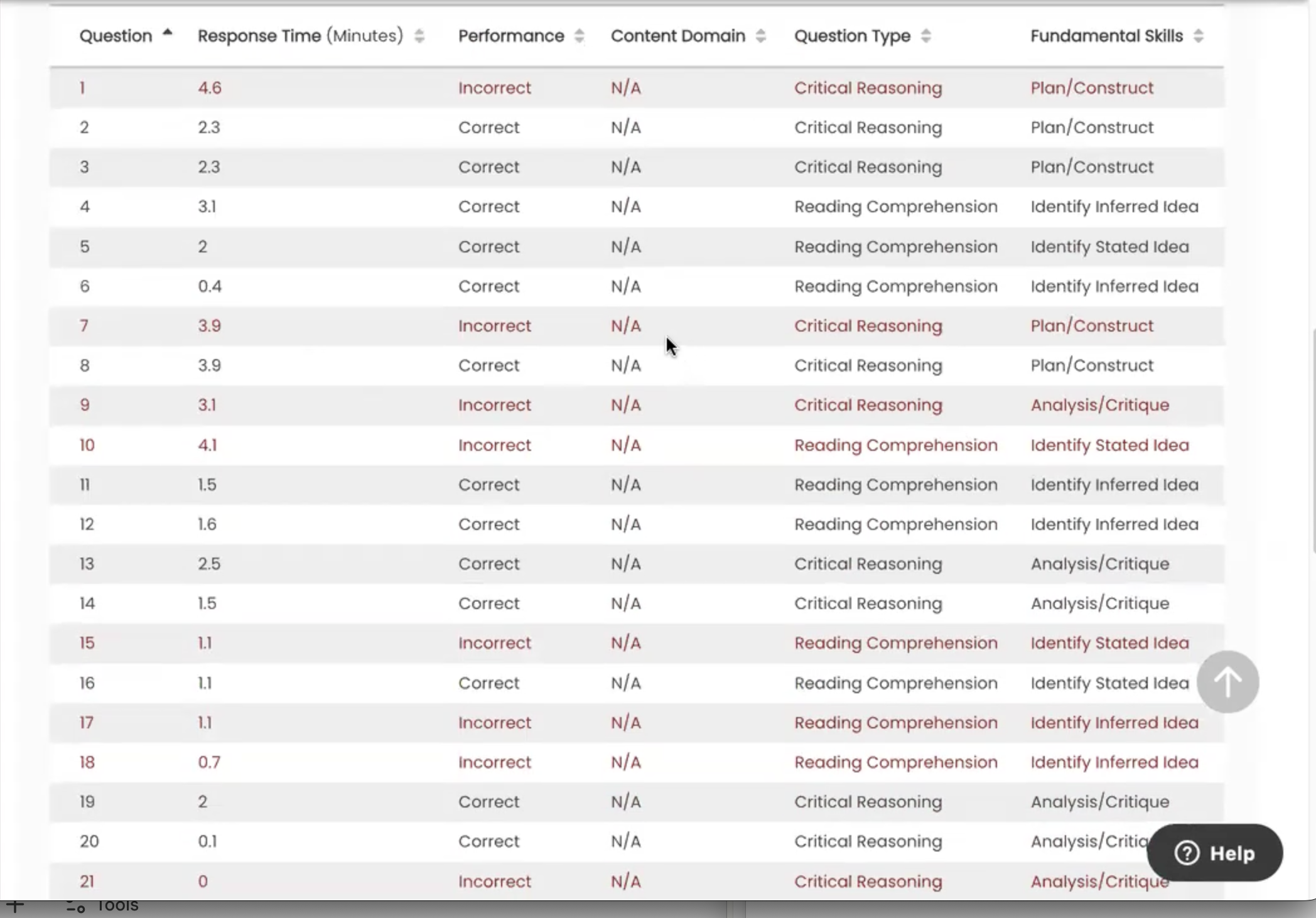
1.png [ 1.23 MiB | Viewed 1111 times ]
Let that sink in: 15 minutes. One correct answer.
Here's what I've observed across hundreds of students: when you need significant time on a question during the actual exam, your probability of getting it right hovers around 50%. It simply means that the question is hard for you.
Now do the math: if you're spending an average of 3.5 minutes on such questions and getting 50% correct, you're effectively spending 7 minutes per correct answer. That's an extraordinarily expensive investment.
What could you do with those 7 minutes instead? Answer approximately three questions that you can handle within your skill range. That's not a 50% success rate - that's potentially three correct answers instead of one.
The Recognition Problem
The strategic insight here isn't complicated: you need to identify these expensive questions quickly during the exam, make a random selection, and move on.
But here's the real work: this recognition capacity has to be built during your practice and mock exams. You need to train yourself to quickly distinguish between "I can work this out" and "I'm going to burn time here"
The Decision Framework: Three Critical Moments
So when exactly do you make the call to randomly mark a question? There are actually three distinct decision points, each with its own logic.
The Ideal Scenario: First 15-30 Seconds
The best time to identify an expensive question is within the first 15 to 30 seconds. You read it, you recognize it's beyond your current reach, you make a random selection, and you move on. No time invested, no emotional attachment, clean decision.
If you have time remaining at the end of the section, you can return to these questions. But you've preserved your energy and time for problems where you have genuine traction.
The 90-120 Second Check-In: Three Scenarios
But what if you've already invested 90 to 120 seconds? You've passed the early recognition window. Now you need a different framework.
Scenario 1: Still Nowhere Close
You've spent 90-120 seconds and you're still not close to solving it. The path forward isn't clear. You're hoping something will click.
Randomly mark it and move on. Do not think about sunk cost. Those 90 seconds are gone regardless of what you do next. The only question that matters is: what's the best use of your next 2-3 minutes?
The answer is almost never "continue hoping on this question"
Scenario 2: Clear Path Forward
You've spent 90-120 seconds, and now you can see how to solve it. You need about 2 more minutes, but the path is clear.
Solve it. Take your 2 minutes and complete the problem.
Do not think about the total time investment adding up to 4 minutes. That's not the decision you're making. The decision is: starting from right now, do I randomly mark this or do I invest 2 minutes to solve it?
That's the exact same decision you'll face with the next question. If you have a clear 2-minute path to the answer, that's worth taking.
Scenario 3: Narrowed to Two Options
You've spent 90-120 seconds and you've successfully eliminated three answer choices. You're down to two options, but you'd need another 2 minutes to determine which one is definitively correct.
Select one of the two and move on.
Here's why: you're already at 50% probability. Spending 2 more minutes to increase that from 50% to 100% is not a worthwhile investment.
In those same 2 minutes, you could attempt another complete question where you will start from a 20% probability of success. The expected value calculation strongly favors moving on.
The Underlying Principle
Notice what these three scenarios have in common: they all require you to ignore sunk cost and focus only on the decision in front of you right now.
This is psychologically difficult. You've invested time. Walking away feels like waste. But that feeling costs points. The time is already spent. The only question is: what's the best use of your next 2-3 minutes?
The Dangerous Success: When Getting It Right Is Still Wrong
Let's look at this student's Quantitative section now. Question 7 took him nearly 6 minutes. He got it correct.
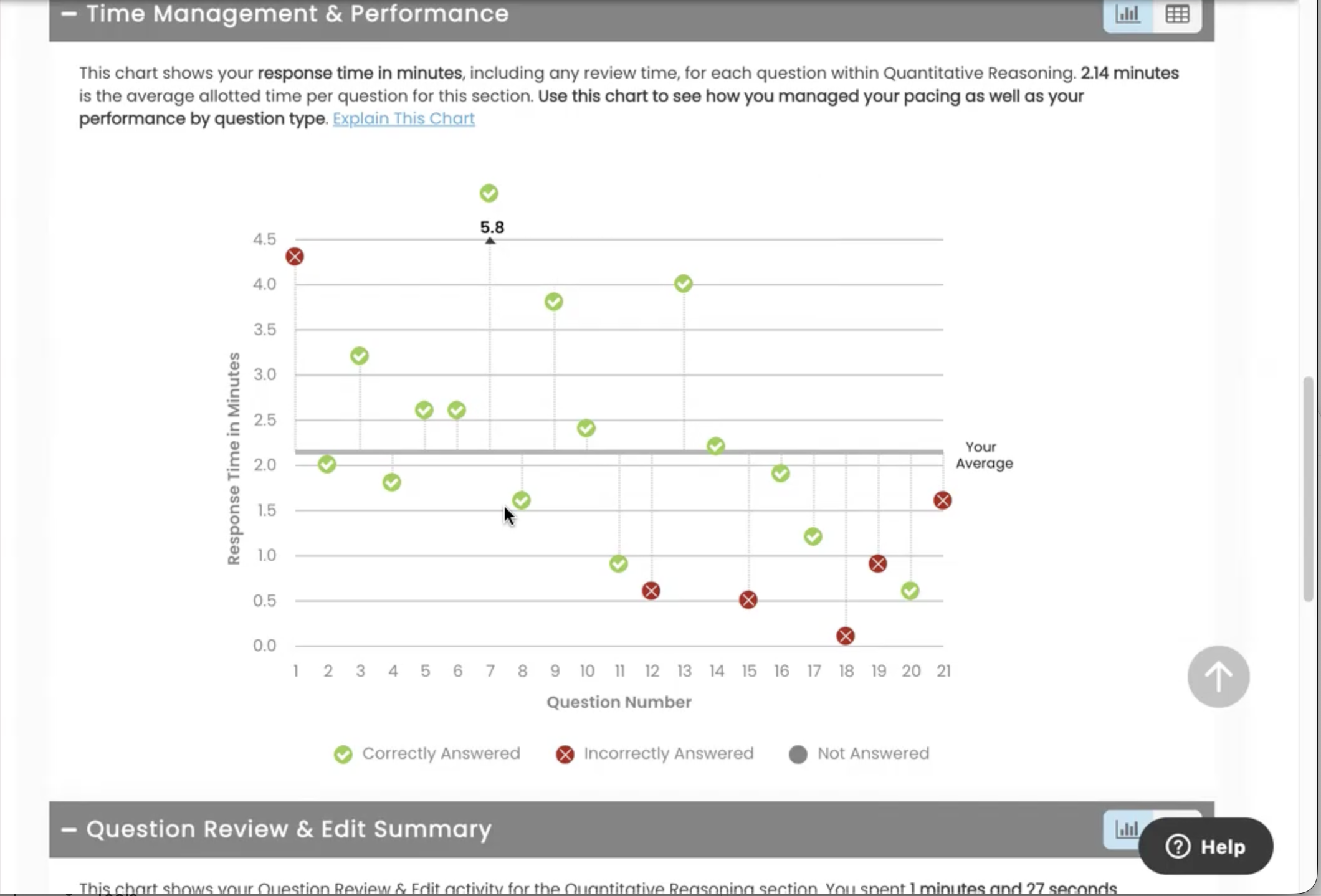
2.png [ 727.56 KiB | Viewed 1054 times ]
In his mind, this was justified. "I spent the time, but I got it right. That's a win, isn't it?"
Not really.
Here's what he's not accounting for: the GMAT is an adaptive test. When you get a very difficult question correct after spending 6 minutes, the algorithm doesn't give you much credit. It may consider it a fluke or a lucky guess.
Meanwhile, what did those 6 minutes cost him? In a section where you're allotted roughly 2 minutes per question, spending 6 minutes means you've borrowed time from 2-3 other questions. And here's the critical asymmetry: getting a very hard question correct doesn't improve your score nearly as much as missing medium-difficulty questions hurts it.
The adaptive algorithm values consistency more than occasional success on very hard questions. If you handle medium-difficulty questions well but miss a hard one, that's normal. If you get a hard question right but then miss medium ones because you're short on time, that looks like inconsistency. Missing medium questions hurts your score more than getting hard questions right helps it.
That 6-minute question likely added very little to his final score while creating a time shortage that hurt him significantly elsewhere.
The Thin-Spread Trap: Questions 15-18
The second pattern in this student's Verbal report is equally instructive. Questions 15 through 18 formed a Reading Comprehension passage. By this point, he was running short on time.
He spent 4 minutes total across these four questions. Got one correct.
Here's the thing: he would have gotten that one correct anyway through random selection. With five answer choices, randomly marking five questions gives you one correct answer statistically.
The error wasn't trying to answer the questions. The error was spreading his remaining time so thinly that he couldn't properly engage with any of them.
When you're genuinely short on time, the strategic move is clear: randomly mark some questions and properly attempt the remaining ones. This binary decision-fully engage or don't engage at all-is more effective than partial engagement with everything.
Since this was a reading comprehension passage, he couldn't have fully engaged with two while randomly marking the other two, since fully engaging with even one question would have required understanding the passage. In this case, it would have made sense to randomly mark all these questions and use the saved time on the remaining five questions in the test.
When Inefficiency Is The Norm: The Data Insights Section
Now let's examine his Data Insights section, where we see a different kind of problem entirely.
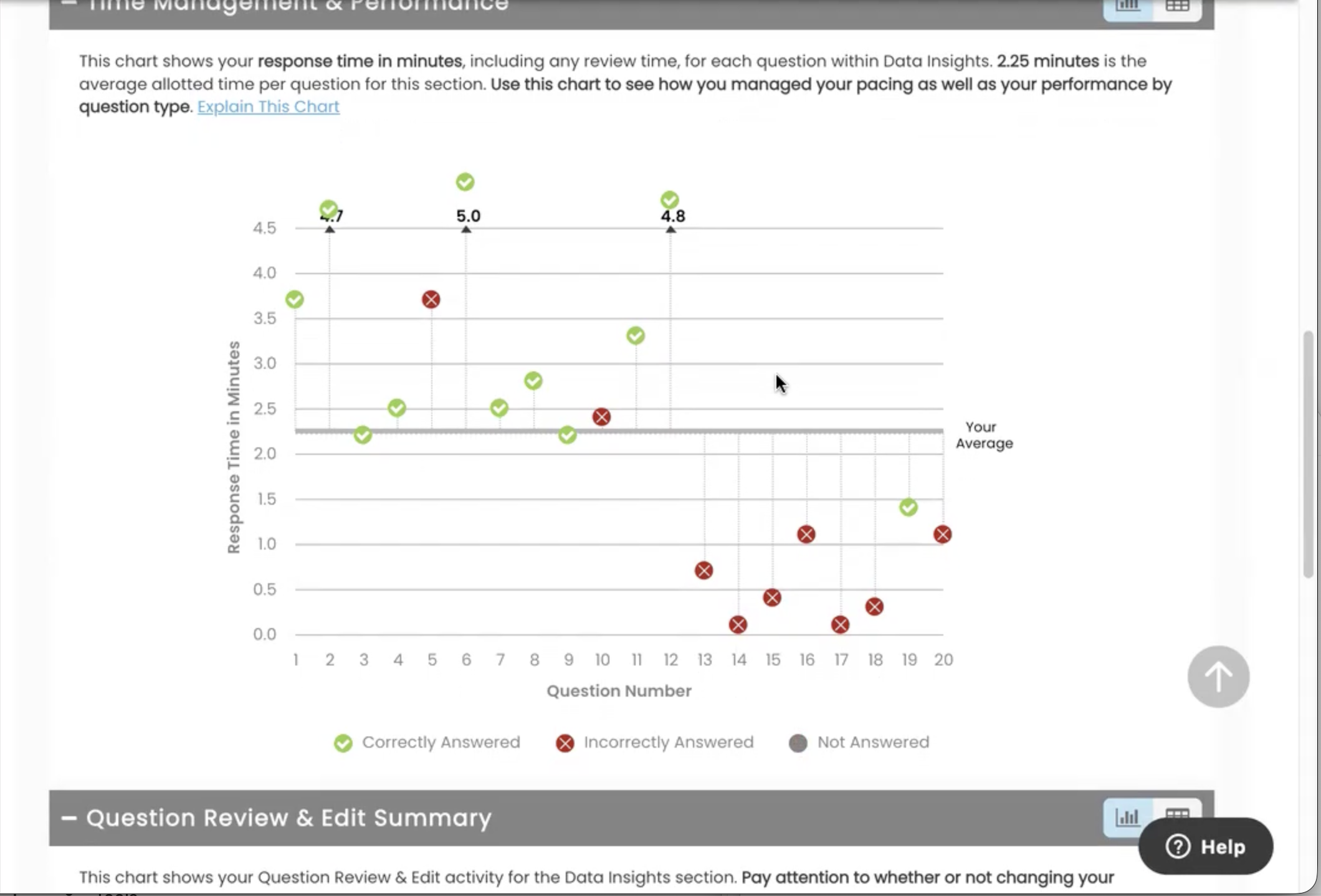
3.png [ 784.01 KiB | Viewed 1029 times ]
He spent approximately 15 minutes on three questions (questions 2, 7, and 12). He got all three correct.
At first glance, this looks better than the Verbal scenario. Perfect accuracy! But look more closely at the economics: this section allocates 2 minutes and 15 seconds per question. He spent roughly 5 minutes per question on these three. That's more than double the allocated time.
Even with 100% accuracy, he's borrowing heavily from other questions. The cost is still too high.
But this pattern is different from the Verbal and Quant issues. This isn't about failing to recognize expensive questions quickly enough. He seems to be genuinely slow at this question type, even when he knows how to solve it.
The Two-Track Solution
This requires a dual approach:
Short-term tactical: During the exam, he still needs to recognize and randomly mark time-consuming Data Insights questions. Even if he can solve them, if they're consistently eating 4-5 minutes, some need to be sacrificed strategically.
Long-term developmental: He needs to actually get faster at Data Insights. Not through more timed practice under pressure, but through deliberate practice focused on improving his solution processes and conceptual clarity.
The Speed Fallacy
Here's what most students misunderstand: speed doesn't come from doing more timed practice. Speed emerges from two sources:
First, clearer conceptual understanding. When you deeply understand the underlying principles, you don't have to think through each step-you recognize patterns and structures immediately.
Second, more efficient solution processes. There are often multiple ways to solve a problem. Some paths are inherently faster. Deliberate practice helps you discover and internalize these efficient approaches.
Notice what's not on this list: "doing more problems under time pressure." That approach might help you get slightly better at managing panic, but it doesn't address the root cause of slowness.
If you're consistently slow on a particular question type, that's diagnostic information. It's telling you where you need focused skill development-not more timed attempts, but deliberate practice aimed at building clearer understanding and more efficient processes.
What This Means for Your Practice
During your practice sessions, track not just whether you got questions right or wrong, but how you knew when to persist and when to move on.
In your mock tests, practice the moment of decision: "I've spent 90 seconds here. Do I have a clear path forward, or am I just hoping?"
That honest assessment is where test-taking skill develops.
When you notice you're consistently slow on certain question types, shift into deliberate practice. Work on those question types untimed, focusing on understanding the principles more deeply and finding more efficient solution paths. Speed will come naturally from this work.
(Originally posted here)
A Correct Answer That Cost 15 Minutes
Look at questions 1, 7, 8, and 9 on his Verbal report. Together, these four questions consumed about 15 minutes of his exam time. He got exactly one correct.
Attachment:
1.png [ 1.23 MiB | Viewed 1111 times ]
Let that sink in: 15 minutes. One correct answer.
Here's what I've observed across hundreds of students: when you need significant time on a question during the actual exam, your probability of getting it right hovers around 50%. It simply means that the question is hard for you.
Now do the math: if you're spending an average of 3.5 minutes on such questions and getting 50% correct, you're effectively spending 7 minutes per correct answer. That's an extraordinarily expensive investment.
What could you do with those 7 minutes instead? Answer approximately three questions that you can handle within your skill range. That's not a 50% success rate - that's potentially three correct answers instead of one.
The Recognition Problem
The strategic insight here isn't complicated: you need to identify these expensive questions quickly during the exam, make a random selection, and move on.
But here's the real work: this recognition capacity has to be built during your practice and mock exams. You need to train yourself to quickly distinguish between "I can work this out" and "I'm going to burn time here"
The Decision Framework: Three Critical Moments
So when exactly do you make the call to randomly mark a question? There are actually three distinct decision points, each with its own logic.
The Ideal Scenario: First 15-30 Seconds
The best time to identify an expensive question is within the first 15 to 30 seconds. You read it, you recognize it's beyond your current reach, you make a random selection, and you move on. No time invested, no emotional attachment, clean decision.
If you have time remaining at the end of the section, you can return to these questions. But you've preserved your energy and time for problems where you have genuine traction.
The 90-120 Second Check-In: Three Scenarios
But what if you've already invested 90 to 120 seconds? You've passed the early recognition window. Now you need a different framework.
Scenario 1: Still Nowhere Close
You've spent 90-120 seconds and you're still not close to solving it. The path forward isn't clear. You're hoping something will click.
Randomly mark it and move on. Do not think about sunk cost. Those 90 seconds are gone regardless of what you do next. The only question that matters is: what's the best use of your next 2-3 minutes?
The answer is almost never "continue hoping on this question"
Scenario 2: Clear Path Forward
You've spent 90-120 seconds, and now you can see how to solve it. You need about 2 more minutes, but the path is clear.
Solve it. Take your 2 minutes and complete the problem.
Do not think about the total time investment adding up to 4 minutes. That's not the decision you're making. The decision is: starting from right now, do I randomly mark this or do I invest 2 minutes to solve it?
That's the exact same decision you'll face with the next question. If you have a clear 2-minute path to the answer, that's worth taking.
Scenario 3: Narrowed to Two Options
You've spent 90-120 seconds and you've successfully eliminated three answer choices. You're down to two options, but you'd need another 2 minutes to determine which one is definitively correct.
Select one of the two and move on.
Here's why: you're already at 50% probability. Spending 2 more minutes to increase that from 50% to 100% is not a worthwhile investment.
In those same 2 minutes, you could attempt another complete question where you will start from a 20% probability of success. The expected value calculation strongly favors moving on.
The Underlying Principle
Notice what these three scenarios have in common: they all require you to ignore sunk cost and focus only on the decision in front of you right now.
This is psychologically difficult. You've invested time. Walking away feels like waste. But that feeling costs points. The time is already spent. The only question is: what's the best use of your next 2-3 minutes?
The Dangerous Success: When Getting It Right Is Still Wrong
Let's look at this student's Quantitative section now. Question 7 took him nearly 6 minutes. He got it correct.
Attachment:
2.png [ 727.56 KiB | Viewed 1054 times ]
In his mind, this was justified. "I spent the time, but I got it right. That's a win, isn't it?"
Not really.
Here's what he's not accounting for: the GMAT is an adaptive test. When you get a very difficult question correct after spending 6 minutes, the algorithm doesn't give you much credit. It may consider it a fluke or a lucky guess.
Meanwhile, what did those 6 minutes cost him? In a section where you're allotted roughly 2 minutes per question, spending 6 minutes means you've borrowed time from 2-3 other questions. And here's the critical asymmetry: getting a very hard question correct doesn't improve your score nearly as much as missing medium-difficulty questions hurts it.
The adaptive algorithm values consistency more than occasional success on very hard questions. If you handle medium-difficulty questions well but miss a hard one, that's normal. If you get a hard question right but then miss medium ones because you're short on time, that looks like inconsistency. Missing medium questions hurts your score more than getting hard questions right helps it.
That 6-minute question likely added very little to his final score while creating a time shortage that hurt him significantly elsewhere.
The Thin-Spread Trap: Questions 15-18
The second pattern in this student's Verbal report is equally instructive. Questions 15 through 18 formed a Reading Comprehension passage. By this point, he was running short on time.
He spent 4 minutes total across these four questions. Got one correct.
Here's the thing: he would have gotten that one correct anyway through random selection. With five answer choices, randomly marking five questions gives you one correct answer statistically.
The error wasn't trying to answer the questions. The error was spreading his remaining time so thinly that he couldn't properly engage with any of them.
When you're genuinely short on time, the strategic move is clear: randomly mark some questions and properly attempt the remaining ones. This binary decision-fully engage or don't engage at all-is more effective than partial engagement with everything.
Since this was a reading comprehension passage, he couldn't have fully engaged with two while randomly marking the other two, since fully engaging with even one question would have required understanding the passage. In this case, it would have made sense to randomly mark all these questions and use the saved time on the remaining five questions in the test.
When Inefficiency Is The Norm: The Data Insights Section
Now let's examine his Data Insights section, where we see a different kind of problem entirely.
Attachment:
3.png [ 784.01 KiB | Viewed 1029 times ]
He spent approximately 15 minutes on three questions (questions 2, 7, and 12). He got all three correct.
At first glance, this looks better than the Verbal scenario. Perfect accuracy! But look more closely at the economics: this section allocates 2 minutes and 15 seconds per question. He spent roughly 5 minutes per question on these three. That's more than double the allocated time.
Even with 100% accuracy, he's borrowing heavily from other questions. The cost is still too high.
But this pattern is different from the Verbal and Quant issues. This isn't about failing to recognize expensive questions quickly enough. He seems to be genuinely slow at this question type, even when he knows how to solve it.
The Two-Track Solution
This requires a dual approach:
Short-term tactical: During the exam, he still needs to recognize and randomly mark time-consuming Data Insights questions. Even if he can solve them, if they're consistently eating 4-5 minutes, some need to be sacrificed strategically.
Long-term developmental: He needs to actually get faster at Data Insights. Not through more timed practice under pressure, but through deliberate practice focused on improving his solution processes and conceptual clarity.
The Speed Fallacy
Here's what most students misunderstand: speed doesn't come from doing more timed practice. Speed emerges from two sources:
First, clearer conceptual understanding. When you deeply understand the underlying principles, you don't have to think through each step-you recognize patterns and structures immediately.
Second, more efficient solution processes. There are often multiple ways to solve a problem. Some paths are inherently faster. Deliberate practice helps you discover and internalize these efficient approaches.
Notice what's not on this list: "doing more problems under time pressure." That approach might help you get slightly better at managing panic, but it doesn't address the root cause of slowness.
If you're consistently slow on a particular question type, that's diagnostic information. It's telling you where you need focused skill development-not more timed attempts, but deliberate practice aimed at building clearer understanding and more efficient processes.
What This Means for Your Practice
During your practice sessions, track not just whether you got questions right or wrong, but how you knew when to persist and when to move on.
In your mock tests, practice the moment of decision: "I've spent 90 seconds here. Do I have a clear path forward, or am I just hoping?"
That honest assessment is where test-taking skill develops.
When you notice you're consistently slow on certain question types, shift into deliberate practice. Work on those question types untimed, focusing on understanding the principles more deeply and finding more efficient solution paths. Speed will come naturally from this work.
(Originally posted here)


 10 Jan 2026, 13:06
Kudos
Bookmarks
Honestly, these are great time-management tips. I think most students are actually aware of them, but still end up getting carried away during the test. A lot of the time, it’s the lure of a higher percentile and the fear of missing a question that makes us get stuck on one problem, worrying that it might break the score we’re aiming for. Ironically, this often does the exact opposite and causes us to miss easier questions toward the end.
This is also where I feel the GMAT is very different from traditional tests. In most exams, you are expected to know the proper solution to get the question right. On the GMAT, there are many test-taking strategies, like using answer choices or testing numbers, to manage time better and use it to your advantage instead of always trying to solve everything perfectly. It’s really important to practice these approaches in advance so they become muscle memory on test day.
One strategy I used to reduce the guilt factor was to assume that any question that felt unusually difficult was an experimental question, so I would just make an educated guess and move on. If time permitted, I would come back and spend more time at the end. Another thing I always reminded myself was that you are taking the test to maximize your score, not to get every single question right. Any time you overspend on one question, you eventually pay for it by rushing through several others at the end. So in the end, it’s about optimizing your overall score, and not just about getting the one in front of you right -> Lose the battle, win the war.
This is also where I feel the GMAT is very different from traditional tests. In most exams, you are expected to know the proper solution to get the question right. On the GMAT, there are many test-taking strategies, like using answer choices or testing numbers, to manage time better and use it to your advantage instead of always trying to solve everything perfectly. It’s really important to practice these approaches in advance so they become muscle memory on test day.
One strategy I used to reduce the guilt factor was to assume that any question that felt unusually difficult was an experimental question, so I would just make an educated guess and move on. If time permitted, I would come back and spend more time at the end. Another thing I always reminded myself was that you are taking the test to maximize your score, not to get every single question right. Any time you overspend on one question, you eventually pay for it by rushing through several others at the end. So in the end, it’s about optimizing your overall score, and not just about getting the one in front of you right -> Lose the battle, win the war.
 14 Jan 2026, 02:25
Kudos
Bookmarks
This really resonates with me. The idea that slowness is diagnostic rather than something to “fix” with more timed drills is spot on. I’ve noticed that whenever I’m consistently slow on a question type, it’s usually because my underlying framework isn’t solid yet, not because I lack speed.








