Events & Promotions
|
|

GMAT Club Daily Prep
Thank you for using the timer - this advanced tool can estimate your performance and suggest more practice questions. We have subscribed you to Daily Prep Questions via email.
Customized
for You
Track
Your Progress
Practice
Pays
Not interested in getting valuable practice questions and articles delivered to your email? No problem, unsubscribe here.
 Sep 28
07:00 PM EDT
-10:00 PM EDT
Boost your GMAT score in less than one month in a live online class + 6 months access to TTP OnDemand video courses included! Class starts Mon, Tues, Wed, Thur, Fri Sept. 28, 2026 - Oct. 16, 2027, 7:00pm-10:00pm EST Sep 29
11:00 AM EDT
-01:00 PM EDT
" Description: Top scores are possible when you enroll in a powerful GMAT course, taught live online + 6 months access to TTP OnDemand video courses included! Class starts Tues/Thur Sept. 29, 2026 - Dec. 3, 2026, 11:00am-1:00pm EST Oct 01
07:00 AM BST
-08:00 AM GMT
Welcome to the GMAT Club's Free Interview Prep Event for Top MBA Programs! Buy tickets - Virtual series that’s all set to equip you to -excel in your MBA interviews. Oct 03
01:00 PM EDT
-04:00 PM EDT
Top scores are possible when you enroll in a powerful GMAT course, taught live online + 6 months access to TTP OnDemand video courses included! Class starts Saturdays Oct. 3, 2026 - Dec. 26, 2026, 1:00pm-4:00pm EST

 06 May 2024, 14:07
Kudos
Bookmarks


For any two employees, if an employee had a greater length of employment, then the employee had an earlier time of update.: No
For any two employees, if an employee had an earlier time of update, then the length of time it took that employee to completely download the update was shorter.: No
Each employee who had a time of update within three minutes of another employee had longer download lengths than any employee who did not.: Yes
Be sure to select an answer first to save it in the Error Log before revealing the correct answer (OA)!
Difficulty:
 85%
(hard)
85%
(hard)
Question Stats:
58% (02:42) correct 42%
(02:52)
wrong
based on 1523
sessions
42%
(02:52)
wrong
based on 1523
sessions
History
Date
Time
Result
Not Attempted Yet
A small firm launched a computer software update that employees of the company had to download on Tuesday last week. For each of the 15 employees who downloaded the update on that day, the table shows the employee’s length of employment (in number of months), the time in the morning (hour and minute) at which the employee began the download, and the length of time it took the update to download completely (rounded to the nearest minute).
For each of the following statements about the 15 employees, select Yes if the statement is supported by the information provided. Otherwise, select No.
| Length of employment | Time of update | Length of download |
|---|---|---|
| 73 | 08:45 | 3 |
| 60 | 09:01 | 3 |
| 1 | 09:20 | 9 |
| 41 | 09:21 | 9 |
| 321 | 09:21 | 9 |
| 8 | 09:40 | 3 |
| 289 | 09:45 | 3 |
| 23 | 09:49 | 6 |
| 72 | 09:50 | 6 |
| 68 | 10:01 | 3 |
| 210 | 10:06 | 3 |
| 52 | 10:12 | 6 |
| 106 | 10:12 | 6 |
| 42 | 10:22 | 6 |
| 11 | 10:23 | 6 |
For each of the following statements about the 15 employees, select Yes if the statement is supported by the information provided. Otherwise, select No.
| Yes | No | |
| For any two employees, if an employee had a greater length of employment, then the employee had an earlier time of update. | ||
| For any two employees, if an employee had an earlier time of update, then the length of time it took that employee to completely download the update was shorter. | ||
| Each employee who had a time of update within three minutes of another employee had longer download lengths than any employee who did not. |
ShowHide Answer
Official Answer
For any two employees, if an employee had a greater length of employment, then the employee had an earlier time of update.: No
For any two employees, if an employee had an earlier time of update, then the length of time it took that employee to completely download the update was shorter.: No
Each employee who had a time of update within three minutes of another employee had longer download lengths than any employee who did not.: Yes
Using official mocks already?
Add GMAT Club Tests for harder practice, analytics, and explanations without overlapping Official Guide or official mock questions.
Try it now →
Try it now →

 06 May 2024, 19:12
Kudos
Bookmarks
A small firm launched a computer software update that employees of the company had to download on Tuesday last week. For each of the 15 employees who downloaded the update on that day, the table shows the employee’s length of employment (in number of months), the time in the morning (hour and minute) at which the employee began the download, and the length of time it took the update to download completely (rounded to the nearest minute).
For each of the following statements about the 15 employees, select Yes if the statement is supported by the information provided. Otherwise, select No.
For any two employees, if an employee had a greater length of employment, then the employee had an earlier time of update.
For this statement to be true, it must be that, in every case, the greater an employee's length of employment, the earlier was the time of update the employee had. If even one Length of employment/Time of update pair is out of order, then this statement won't be true.
So, to see whether the pattern holds for every length of employment and time of update, we can sort the Length of employment column from least to greatest and see whether the Time of update column is sorted from latest to earliest in every case.
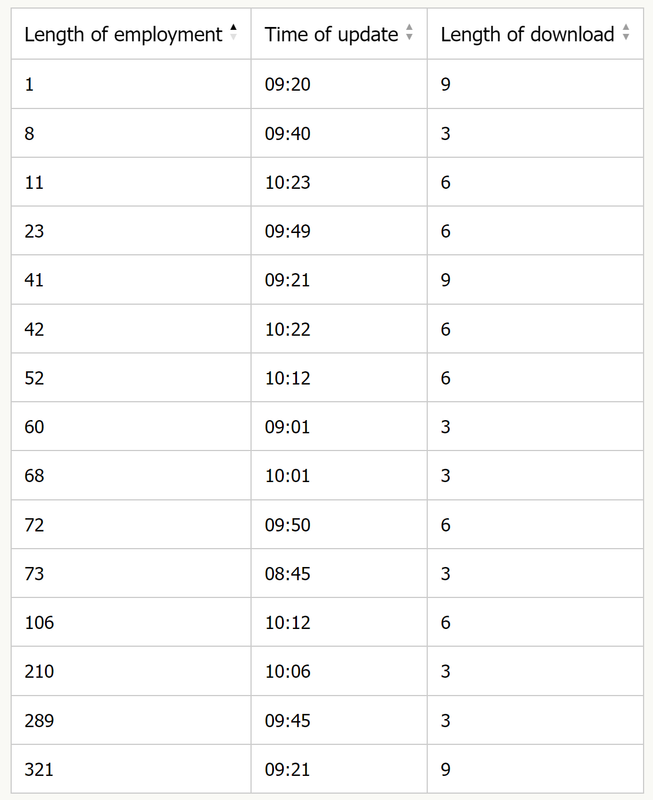
Doing so, we see that, with Length of employment sorted from least to greatest, Time of update is mixed up, with earlier times at the top of the column, then later times, then some more earlier and later times mixed as we go down the columns and Length of employment becomes greater.
So, it's clear that greater length of employment is not always associated with earlier time of update.
Select No.
For any two employees, if an employee had an earlier time of update, then the length of time it took that employee to completely download the update was shorter.
For this statement to be true, it must be that, in every case, the earlier an employee's time of update, the shorter was the length of time it took the employee to download the upate. If even one Time of update/Length of download pair is out of order, then this statement won't be true.
So, to see whether the pattern holds for every time of update and length of download, we can sort the Time of update column from earliest to latest and see whether the Length of download is sorted from shorter to longer in every case.
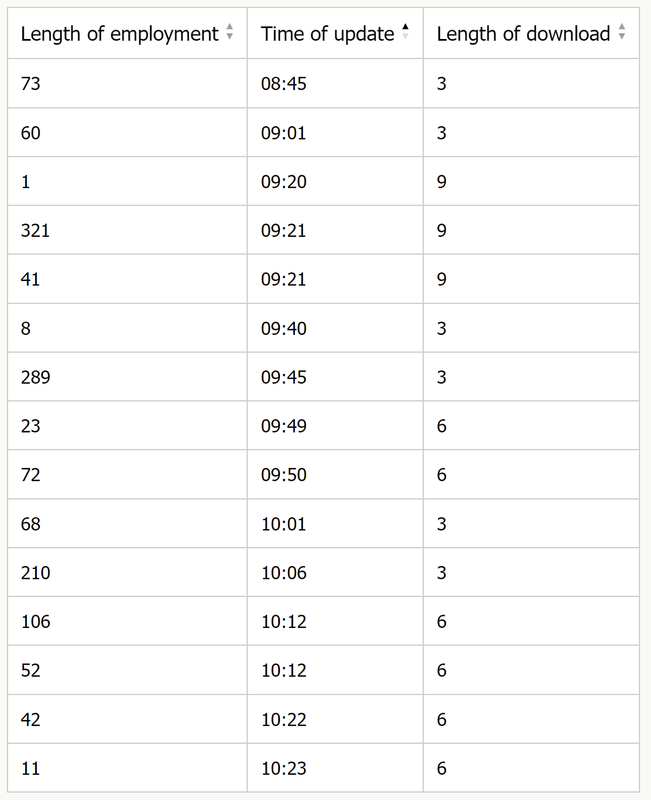
Doing so, we see that, with Time of update sorted from earliest to latest, Length of update is mixed up, with shorter times, 3, at the top of the column, then longer times, 9, then some more shorter times and longer times mixed as we go down the columns and Time of update becomes later.
So, it's clear that earlier time of update is not always associated with shorter length of update.
Select No.
Each employee who had a time of update within three minutes of another employee had longer download lengths than any employee who did not.
Since this statement is about employees having "longer download lengths," we can sort by Length of download to be able to compare download lengths.
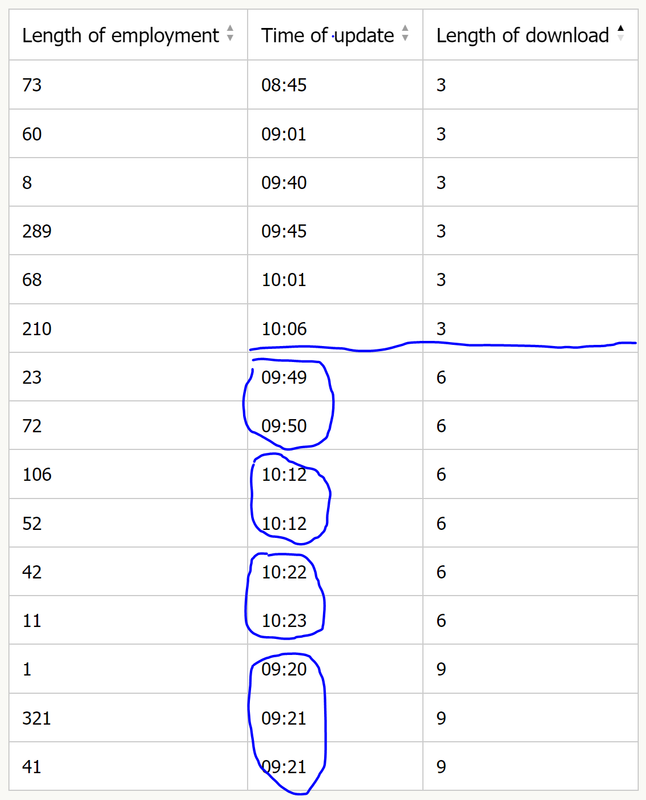
Having sorted Length of download from least to greatest, we can then go through the Time of update column to see whether it's true that "Each employee who had a time of update within three minutes of another employee had longer download lengths than any employee who did not."
Doing so, we see that, toward the top of the Time of update column, the times are spread out by at least five minutes until we get through all the 3s in the Length of download column.
Then, the times of update become less spread out so that each is "within three minutes of another," starting with 9:49 to 9:50, then 10:12 to 10:12 and so on. At the same time, the lengths of update also increase to 6 and 9.
So, we see that it is indeed the case that each employee who had a time of update within three minutes of another employee had longer download lengths (6 or 9) than any employee who did not (3).
Select Yes.
Correct answer: No, No, Yes
| Length of employment | Time of update | Length of download |
|---|---|---|
| 73 | 08:45 | 3 |
| 60 | 09:01 | 3 |
| 1 | 09:20 | 9 |
| 41 | 09:21 | 9 |
| 321 | 09:21 | 9 |
| 8 | 09:40 | 3 |
| 289 | 09:45 | 3 |
| 23 | 09:49 | 6 |
| 72 | 09:50 | 6 |
| 68 | 10:01 | 3 |
| 210 | 10:06 | 3 |
| 52 | 10:12 | 6 |
| 106 | 10:12 | 6 |
| 42 | 10:22 | 6 |
| 11 | 10:23 | 6 |
For each of the following statements about the 15 employees, select Yes if the statement is supported by the information provided. Otherwise, select No.
For any two employees, if an employee had a greater length of employment, then the employee had an earlier time of update.
For this statement to be true, it must be that, in every case, the greater an employee's length of employment, the earlier was the time of update the employee had. If even one Length of employment/Time of update pair is out of order, then this statement won't be true.
So, to see whether the pattern holds for every length of employment and time of update, we can sort the Length of employment column from least to greatest and see whether the Time of update column is sorted from latest to earliest in every case.
Doing so, we see that, with Length of employment sorted from least to greatest, Time of update is mixed up, with earlier times at the top of the column, then later times, then some more earlier and later times mixed as we go down the columns and Length of employment becomes greater.
So, it's clear that greater length of employment is not always associated with earlier time of update.
Select No.
For any two employees, if an employee had an earlier time of update, then the length of time it took that employee to completely download the update was shorter.
For this statement to be true, it must be that, in every case, the earlier an employee's time of update, the shorter was the length of time it took the employee to download the upate. If even one Time of update/Length of download pair is out of order, then this statement won't be true.
So, to see whether the pattern holds for every time of update and length of download, we can sort the Time of update column from earliest to latest and see whether the Length of download is sorted from shorter to longer in every case.
Doing so, we see that, with Time of update sorted from earliest to latest, Length of update is mixed up, with shorter times, 3, at the top of the column, then longer times, 9, then some more shorter times and longer times mixed as we go down the columns and Time of update becomes later.
So, it's clear that earlier time of update is not always associated with shorter length of update.
Select No.
Each employee who had a time of update within three minutes of another employee had longer download lengths than any employee who did not.
Since this statement is about employees having "longer download lengths," we can sort by Length of download to be able to compare download lengths.
Having sorted Length of download from least to greatest, we can then go through the Time of update column to see whether it's true that "Each employee who had a time of update within three minutes of another employee had longer download lengths than any employee who did not."
Doing so, we see that, toward the top of the Time of update column, the times are spread out by at least five minutes until we get through all the 3s in the Length of download column.
Then, the times of update become less spread out so that each is "within three minutes of another," starting with 9:49 to 9:50, then 10:12 to 10:12 and so on. At the same time, the lengths of update also increase to 6 and 9.
So, we see that it is indeed the case that each employee who had a time of update within three minutes of another employee had longer download lengths (6 or 9) than any employee who did not (3).
Select Yes.
Correct answer: No, No, Yes
General Discussion
 12 May 2024, 22:47
Kudos
Bookmarks
Hi Bunuel and MartyMurray, in this question there is a person who started the download at 09:20 after 19 minutes from prior got completed in 9 minutes. Another person who started at 10:23 within 3 minutes of the prior got completed in 6 minutes. So this shows that the person who started within 3 minutes of the another employee got lesser download time than the person who didn't start within 3 minutes of another employee...then how can be yes? Can you please explain?