Last visit was: 21 Apr 2026, 15:23 It is currently 21 Apr 2026, 15:23
Close
GMAT Club Daily Prep
Thank you for using the timer - this advanced tool can estimate your performance and suggest more practice questions. We have subscribed you to Daily Prep Questions via email.

Customized
for You

we will pick new questions that match your level based on your Timer History

Track
Your Progress

every week, we’ll send you an estimated GMAT score based on your performance

Practice
Pays

we will pick new questions that match your level based on your Timer History
Not interested in getting valuable practice questions and articles delivered to your email? No problem, unsubscribe here.
Close
Request Expert Reply
Confirm Cancel
505-555 (Easy)|   Fractions and Ratios|                     
User avatar
BANON
Joined: 20 Feb 2012
Last visit: 07 Aug 2014
Posts: 25
Own Kudos:
3,039
 [215]
Given Kudos: 6
Posts: 25
Kudos: 3,039
 [215]
21
Kudos
Add Kudos
193
Bookmarks
Bookmark this Post
Most Helpful Reply
User avatar
Bunuel
User avatar
Math Expert
Joined: 02 Sep 2009
Last visit: 21 Apr 2026
Posts: 109,728
Own Kudos:
Given Kudos: 105,800
Products:
Expert
Expert reply
Active GMAT Club Expert! Tag them with @ followed by their username for a faster response.
Posts: 109,728
Kudos: 810,465
 [42]
16
Kudos
Add Kudos
26
Bookmarks
Bookmark this Post
avatar
nvijayprasanna
Joined: 17 Apr 2012
Last visit: 10 May 2017
Posts: 12
Own Kudos:
46
 [23]
Given Kudos: 5
Location: United States
WE:Information Technology (Computer Software)
Posts: 12
Kudos: 46
 [23]
17
Kudos
Add Kudos
6
Bookmarks
Bookmark this Post
General Discussion
User avatar
BN1989
Joined: 12 Oct 2011
Last visit: 04 Mar 2014
Posts: 98
Own Kudos:
Given Kudos: 23
GMAT 1: 700 Q48 V37
GMAT 2: 720 Q48 V40
GMAT 2: 720 Q48 V40
Posts: 98
Kudos: 918
Kudos
Add Kudos
Bookmarks
Bookmark this Post
How can you solve this with an unknown multiplier?

let a=1st b=2nd c=3rd and d=4th graders

b/d=8/5 or b=8x and d=5x

so we get a=3/4*(8x)=6x and c=15/2*x

which obviously is not correct, why can't I apply this concept here?
User avatar
Bunuel
User avatar
Math Expert
Joined: 02 Sep 2009
Last visit: 21 Apr 2026
Posts: 109,728
Own Kudos:
810,465
 [1]
Given Kudos: 105,800
Products:
Expert
Expert reply
Active GMAT Club Expert! Tag them with @ followed by their username for a faster response.
Posts: 109,728
Kudos: 810,465
 [1]
1
Kudos
Add Kudos
Bookmarks
Bookmark this Post
BN1989
How can you solve this with an unknown multiplier?

let a=1st b=2nd c=3rd and d=4th graders

b/d=8/5 or b=8x and d=5x

so we get a=3/4*(8x)=6x and c=15/2*x

which obviously is not correct, why can't I apply this concept here?

Actually it's a perfectly valid approach. You've done everything right, there is just one final step missing: A/C=(6x)/(15x/2)=12/15=4/5.
avatar
Marcoson
Joined: 08 Jun 2013
Last visit: 09 Nov 2013
Posts: 2
Own Kudos:
2
 [1]
Given Kudos: 1
Posts: 2
Kudos: 2
 [1]
1
Kudos
Add Kudos
Bookmarks
Bookmark this Post
Bunuel, could you please explain this a little more wordy.
I don't get the step from this
Bunuel

Equate D's: \(\frac{B}{D}=\frac{8}{5}=\frac{16}{10}\) --> \(\frac{C}{D}=\frac{3}{2}=\frac{15}{10}\). Now, equate B's: \(\frac{A}{B}=\frac{3}{4}=\frac{12}{16}\);
to this
Bunuel

\(\frac{A}{C}=\frac{12}{15}=\frac{4}{5}\).

Thanks in advance.
User avatar
Bunuel
User avatar
Math Expert
Joined: 02 Sep 2009
Last visit: 21 Apr 2026
Posts: 109,728
Own Kudos:
Given Kudos: 105,800
Products:
Expert
Expert reply
Active GMAT Club Expert! Tag them with @ followed by their username for a faster response.
Posts: 109,728
Kudos: 810,465
 [14]
10
Kudos
Add Kudos
4
Bookmarks
Bookmark this Post
Marcoson
Bunuel, could you please explain this a little more wordy.
I don't get the step from this
Bunuel

Equate D's: \(\frac{B}{D}=\frac{8}{5}=\frac{16}{10}\) --> \(\frac{C}{D}=\frac{3}{2}=\frac{15}{10}\). Now, equate B's: \(\frac{A}{B}=\frac{3}{4}=\frac{12}{16}\);
to this
Bunuel

\(\frac{A}{C}=\frac{12}{15}=\frac{4}{5}\).

Thanks in advance.

We have B:D=16:10, C:D=15:10 --> B:C=16:15. Since A:B=12:16, then A:B:C=12:16:15 --> A:C=12:15=4:5.

Hope it's clear.
User avatar
pqhai
User avatar
Retired Moderator
Joined: 16 Jun 2012
Last visit: 26 Nov 2015
Posts: 864
Own Kudos:
8,939
 [6]
Given Kudos: 123
Location: United States
Posts: 864
Kudos: 8,939
 [6]
6
Kudos
Add Kudos
Bookmarks
Bookmark this Post
BANON
At a certain school, the ratio of the number of second graders to the number of fourth graders is 8 to 5, and the ratio of the number of first graders to the number of second graders is 3 to 4. If the ratio of the number of third graders to the number of fourth graders is 3 to 2, what is the ratio of the number of first graders to the number of third graders?

A. 16 to 15
B. 9 to 5
C. 5 to 16
D. 5 to 4
E. 4 to 5

Second / Four = 8/5
First / Second = 3/4
Third / Four = 3/2

==> First = 3/4 Second = 3/4 (8/5 four) = 3/4 * 8/5 * (2/3 Third) = 4//5 Third
==> First / Third = 4/5

E is correct
avatar
bytatia
Joined: 19 Jan 2014
Last visit: 21 Dec 2014
Posts: 21
Own Kudos:
58
 [2]
Given Kudos: 51
Posts: 21
Kudos: 58
 [2]
Kudos
Add Kudos
2
Bookmarks
Bookmark this Post
I actually plugged in the number.

I took 130. (8+5=13)

So
(1)2nd to 4th - 8:5
2nd grades (130/13=10) 10*8 and 4th graders 10*5

(2) 1st to 2nd - 3:4
2nd is 80 80/4 =20 so 1st 20*3=60

(3) 3rd to 4th 3:2
I know 4th is 50 so 3rd is (50/2=25) 25*3=75

(4)1st graders to 3rd graders?
60/75=4/5

But my method was more time consuming I think rather than the ones I saw here. I'll have to check.

Update: Actually it took me almost same time using the unknown multiplier method as well.
avatar
prasha6
Joined: 05 Aug 2014
Last visit: 04 Dec 2017
Posts: 1
Own Kudos:
7
 [7]
Given Kudos: 2
Posts: 1
Kudos: 7
 [7]
6
Kudos
Add Kudos
1
Bookmarks
Bookmark this Post
Let S= Second, P = Fourth , F = First, T = Third

Given: S/P = 8/5
F/S = 3/4
T/P = 3/2

Asked: F/T

F/T = (S/P)(F/S)(P/T) = (8/5)(3/4)(2/3) = 4/5
User avatar
EMPOWERgmatRichC
User avatar
Major Poster
Joined: 19 Dec 2014
Last visit: 31 Dec 2023
Posts: 21,777
Own Kudos:
13,044
 [1]
Given Kudos: 450
Status:GMAT Assassin/Co-Founder
Affiliations: EMPOWERgmat
Location: United States (CA)
GMAT 1: 800 Q51 V49
GRE 1: Q170 V170
Expert
Expert reply
GMAT 1: 800 Q51 V49
GRE 1: Q170 V170
Posts: 21,777
Kudos: 13,044
 [1]
1
Kudos
Add Kudos
Bookmarks
Bookmark this Post
Hi All,

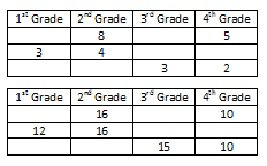
While this question is wordy (and requires that we stay organized), it can be solved by TESTing VALUES. The answer choices themselves also offer something of a "hint" as to what VALUES we should be TESTing....

First, we have to get all of the information down on the pad:

2nd:4th
8:5

1st: 2nd
3:4

3rd: 4th
3:2

1st: 3rd
?:?

From the answer choices, the number 16 stands out (maybe it's part of the correct answer, maybe it's not); I notice that it's a MULTIPLE of 8... Since ratio questions are all about MULTIPLES, it gets me thinking that I can TEST 16 as the number of 2nd graders...

So...
2nd graders = 16

2nd:4th
8:5

So...
4th graders = 10

3rd:4th:
3:2

So....
3rd graders = 15

1st:2nd
3:4

So...
1st gradres = 12

Thus...
1st:3rd
12:15

12:15 reduces to 4:5

Final Answer:
GMAT assassins aren't born, they're made,
Rich
User avatar
elisabettaportioli
Joined: 22 Nov 2012
Last visit: 23 Nov 2016
Posts: 13
Own Kudos:
Given Kudos: 90
Location: United States
Posts: 13
Kudos: 10
Kudos
Add Kudos
Bookmarks
Bookmark this Post
Bunuel
Bunuel
BN1989
How can you solve this with an unknown multiplier?

let a=1st b=2nd c=3rd and d=4th graders

b/d=8/5 or b=8x and d=5x

so we get a=3/4*(8x)=6x and c=15/2*x

which obviously is not correct, why can't I apply this concept here?

Actually it's a perfectly valid approach. You've done everything right, there is just one final step missing: A/C=(6x)/(15x/2)=12/15=4/5.

Hi there,
I ddn't get why he multiplied 3/4*8x.

Thanks in advance!
User avatar
Bunuel
User avatar
Math Expert
Joined: 02 Sep 2009
Last visit: 21 Apr 2026
Posts: 109,728
Own Kudos:
Given Kudos: 105,800
Products:
Expert
Expert reply
Active GMAT Club Expert! Tag them with @ followed by their username for a faster response.
Posts: 109,728
Kudos: 810,465
Kudos
Add Kudos
Bookmarks
Bookmark this Post
elisabettaportioli
Bunuel
Bunuel
BN1989
How can you solve this with an unknown multiplier?

let a=1st b=2nd c=3rd and d=4th graders

b/d=8/5 or b=8x and d=5x

so we get a=3/4*(8x)=6x and c=15/2*x

which obviously is not correct, why can't I apply this concept here?

Actually it's a perfectly valid approach. You've done everything right, there is just one final step missing: A/C=(6x)/(15x/2)=12/15=4/5.

Hi there,
I ddn't get why he multiplied 3/4*8x.

Thanks in advance!

The ratio of the number of first graders to the number of second graders is 3 to 4: a/b = 3/4 = a/(8x) = 3/4 --> a = 3/4*8x.
User avatar
ScottTargetTestPrep
User avatar
Target Test Prep Representative
Joined: 14 Oct 2015
Last visit: 21 Apr 2026
Posts: 22,276
Own Kudos:
26,526
 [11]
Given Kudos: 302
Status:Founder & CEO
Affiliations: Target Test Prep
Location: United States (CA)
Expert
Expert reply
Active GMAT Club Expert! Tag them with @ followed by their username for a faster response.
Posts: 22,276
Kudos: 26,526
 [11]
10
Kudos
Add Kudos
1
Bookmarks
Bookmark this Post
BANON
At a certain school, the ratio of the number of second graders to the number of fourth graders is 8 to 5, and the ratio of the number of first graders to the number of second graders is 3 to 4. If the ratio of the number of third graders to the number of fourth graders is 3 to 2, what is the ratio of the number of first graders to the number of third graders?

A. 16 to 15
B. 9 to 5
C. 5 to 16
D. 5 to 4
E. 4 to 5

We are given the following:

1) The ratio of the number of second graders to the number of fourth graders is 8 to 5.

2) The ratio of the number of first graders to the number of second graders is 3 to 4.

3) The ratio of the number of third graders to the number of fourth graders is 3 to 2.

We can use this information to create three different ratio expressions with variable multipliers. We have:

1) 2nd : 4th = 8x : 5x

2) 1st : 2nd = 3x : 4x

3) 3rd : 4th = 3x : 2x

We must determine the ratio of 1st to 3rd.

To determine this, we must manipulate our ratios. Let’s start with our first two ratios. We have:

1) 2nd : 4th = 8x : 5x

2) 1st : 2nd = 3x : 4x

Notice “2nd” is common to both ratios. So if we make 2nd the same in both ratios we can create a 3 part ratio comparing 1st to 2nd to 4th. To make the 2nd the same in both ratios, we can multiply 1st : 2nd by 2. That is:

1st : 2nd = 3x : 4x

1st : 2nd = 2(3x : 4x)

1st : 2nd = 6x : 8x

Because we know that 2nd : 4th = 8x : 5x, we can say that:

1st : 2nd : 4th = 6x : 8x : 5x

Eliminate the “2nd”, and we have:

1st : 4th = 6x : 5x

Now, recall that we were originally given:

3rd : 4th = 3x : 2x

We should notice that the common term in our two ratios is “4th”. Thus if we can make those values the same, we can compare 1st to 4th to 3rd, and this will be enough for us to calculate the ratio of 1st to 3rd. The easiest way to do this is to turn 5x and 2x into 10x. Let’s first adjust 1st : 4th

1st : 4th = 6x : 5x

1st : 4th = 2(6x : 5x)

1st : 4th = 12x : 10x

Next we can adjust 3rd : 4th.

3rd : 4th = 3x : 2x

3rd : 4th = 5(3x : 2x)

3rd : 4th = 15x : 10x

Since the “4th” is now 10x in both ratios, we can say:

1st : 4th : 3rd = 12x : 10x : 15x

By eliminating the “4th”, we can see that 1st : 3rd = 12x : 15x = 4x : 5x = 4 to 5

Answer E.
User avatar
gracie
Joined: 07 Dec 2014
Last visit: 11 Oct 2020
Posts: 1,028
Own Kudos:
2,019
 [1]
Given Kudos: 27
Posts: 1,028
Kudos: 2,019
 [1]
1
Kudos
Add Kudos
Bookmarks
Bookmark this Post
BANON
At a certain school, the ratio of the number of second graders to the number of fourth graders is 8 to 5, and the ratio of the number of first graders to the number of second graders is 3 to 4. If the ratio of the number of third graders to the number of fourth graders is 3 to 2, what is the ratio of the number of first graders to the number of third graders?

A. 16 to 15
B. 9 to 5
C. 5 to 16
D. 5 to 4
E. 4 to 5

g1:g2=3:4=12:16
g2:g4=8:5=16:10
g4:g3=2:3=10:15
g1:g3=12:15=4 to 5
E
User avatar
CEdward
Joined: 11 Aug 2020
Last visit: 14 Apr 2022
Posts: 1,162
Own Kudos:
289
 [2]
Given Kudos: 332
Posts: 1,162
Kudos: 289
 [2]
1
Kudos
Add Kudos
1
Bookmarks
Bookmark this Post
Best approach here is to generate a compound ratio that shows the relation between each grade to each other.

Second:Fourth = 8:5
First:Second = 3:4
Third:Fourth = 3:2
First:Third = ?

Let's start with the first two...the common term is "Second":
First:Second = 3:4 ---> 6:8
First:Second:Fourth = 6:8:5 <-----Combine the two inequalities after the transformation

Now we look at the third ratio 3:2...the common term is "Fourth"
First:Second:Fourth = 6:8:5 ----> 12:16:10
Third:Fourth = 3:2 ----> 15:10

Combine both ratios
12:16:15:10
So the ratio of first to third is 12:15 = 4/5

Answer is E.
User avatar
CrackverbalGMAT
User avatar
Major Poster
Joined: 03 Oct 2013
Last visit: 21 Apr 2026
Posts: 4,846
Own Kudos:
9,180
 [4]
Given Kudos: 226
Affiliations: CrackVerbal
Location: India
Expert
Expert reply
Posts: 4,846
Kudos: 9,180
 [4]
2
Kudos
Add Kudos
2
Bookmarks
Bookmark this Post
I totally agree to the explanations given by Bunuel and others on how to combine these ratios. But, I would like to add an other shortcut method with which you can save some more time .

Step 1. Assume first,second,third,fourth graders as a,b,c and d respectively.

Step 2: Analyze the ratio's given in the question.

b:d = 8:5, a:b = 3:4 , c:d = 3:2

Since ratios are nothing but fractions, we have values of \(\frac{b}{d}\), \(\frac{a}{b}\) and \(\frac{c}{d }\)and we need to find \(\frac{a}{c}\) ?

If we closely analyze the fractions, we can identify that there are few common terms in numerators and denominators. So try to arrange the fractions, in such a way that common terms will get cancelled , giving the end result \(\frac{a}{c.}\)

\(\frac{b}{d} * \frac{a}{b} * \frac{d}{c}\).

In the above step, if you look closely, I have taken the reciprocal of \(\frac{c}{d}\) , because I figured out that d will get cancelled in this case when we simplify.

Note: \(\frac{c}{d} =\frac{3}{2}\) so \(\frac{d}{c} = \frac{2}{3}\)

On cancelling the common terms, we will get \(\frac{a}{c }\) as the result, which is asked in the question.

So instead of combing the ratios, just arranging and multiplying the fractions wisely will give you the same result in very less time.

\(\frac{b}{d }* \frac{a}{b} * \frac{d}{c}\) = \(\frac{a}{c}\) = \(\frac{8}{5} * \frac{3}{4} * \frac{2}{3 } = \frac{4}{5} \)

Option E is the answer.

Thanks,
Clifin J Francis,
GMAT QUANT SME
User avatar
jkolachi
Joined: 12 Oct 2015
Last visit: 05 Feb 2025
Posts: 237
Own Kudos:
Given Kudos: 144
Location: Canada
Concentration: Leadership, Accounting
GMAT 1: 700 Q47 V39
GPA: 3
WE:Accounting (Accounting)
Products:
GMAT 1: 700 Q47 V39
Posts: 237
Kudos: 410
Kudos
Add Kudos
Bookmarks
Bookmark this Post
Bunuel
BANON
At a certain school, the ratio of the number of second graders to the number of fourth graders is 8 to 5, and the ratio of the number of first graders to the number of second graders is 3 to 4. If the ratio of the number of third graders to the number of fourth graders is 3 to 2, what is the ratio of the number of first graders to the number of third graders?

A. 16 to 15
B. 9 to 5
C. 5 to 16
D. 5 to 4
E. 4 to 5

Let # of first, second, third and fourth graders be A, B, C and D respectively. Question: \(\frac{A}{C}\);

Given: \(\frac{B}{D}=\frac{8}{5}\), \(\frac{A}{B}=\frac{3}{4}\), and \(\frac{C}{D}=\frac{3}{2}\);

Equate D's: \(\frac{B}{D}=\frac{8}{5}=\frac{16}{10}\) --> \(\frac{C}{D}=\frac{3}{2}=\frac{15}{10}\). Now, equate B's: \(\frac{A}{B}=\frac{3}{4}=\frac{12}{16}\);

\(\frac{A}{C}=\frac{12}{15}=\frac{4}{5}\).

Answer: E.

On point as always. Great solution.
User avatar
Debaditya123
Joined: 01 Aug 2023
Last visit: 18 Dec 2024
Posts: 41
Own Kudos:
Given Kudos: 41
Posts: 41
Kudos: 7
Kudos
Add Kudos
Bookmarks
Bookmark this Post
Bunuel
BANON
At a certain school, the ratio of the number of second graders to the number of fourth graders is 8 to 5, and the ratio of the number of first graders to the number of second graders is 3 to 4. If the ratio of the number of third graders to the number of fourth graders is 3 to 2, what is the ratio of the number of first graders to the number of third graders?

A. 16 to 15
B. 9 to 5
C. 5 to 16
D. 5 to 4
E. 4 to 5

Let # of first, second, third and fourth graders be A, B, C and D respectively. Question: \(\frac{A}{C}\);

Given: \(\frac{B}{D}=\frac{8}{5}\), \(\frac{A}{B}=\frac{3}{4}\), and \(\frac{C}{D}=\frac{3}{2}\);

Equate D's: \(\frac{B}{D}=\frac{8}{5}=\frac{16}{10}\) --> \(\frac{C}{D}=\frac{3}{2}=\frac{15}{10}\). Now, equate B's: \(\frac{A}{B}=\frac{3}{4}=\frac{12}{16}\);

\(\frac{A}{C}=\frac{12}{15}=\frac{4}{5}\).

Answer: E.


Is there any other way?
User avatar
Bunuel
User avatar
Math Expert
Joined: 02 Sep 2009
Last visit: 21 Apr 2026
Posts: 109,728
Own Kudos:
Given Kudos: 105,800
Products:
Expert
Expert reply
Active GMAT Club Expert! Tag them with @ followed by their username for a faster response.
Posts: 109,728
Kudos: 810,465
Kudos
Add Kudos
Bookmarks
Bookmark this Post
Debaditya123
Bunuel
BANON
At a certain school, the ratio of the number of second graders to the number of fourth graders is 8 to 5, and the ratio of the number of first graders to the number of second graders is 3 to 4. If the ratio of the number of third graders to the number of fourth graders is 3 to 2, what is the ratio of the number of first graders to the number of third graders?

A. 16 to 15
B. 9 to 5
C. 5 to 16
D. 5 to 4
E. 4 to 5

Let # of first, second, third and fourth graders be A, B, C and D respectively. Question: \(\frac{A}{C}\);

Given: \(\frac{B}{D}=\frac{8}{5}\), \(\frac{A}{B}=\frac{3}{4}\), and \(\frac{C}{D}=\frac{3}{2}\);

Equate D's: \(\frac{B}{D}=\frac{8}{5}=\frac{16}{10}\) --> \(\frac{C}{D}=\frac{3}{2}=\frac{15}{10}\). Now, equate B's: \(\frac{A}{B}=\frac{3}{4}=\frac{12}{16}\);

\(\frac{A}{C}=\frac{12}{15}=\frac{4}{5}\).

Answer: E.


Is there any other way?

??? Have you checked the discussion above?
 1   2   
Moderators:
Math Expert
109728 posts
Tuck School Moderator
853 posts