Last visit was: 25 Apr 2026, 19:23 It is currently 25 Apr 2026, 19:23
Close
GMAT Club Daily Prep
Thank you for using the timer - this advanced tool can estimate your performance and suggest more practice questions. We have subscribed you to Daily Prep Questions via email.

Customized
for You

we will pick new questions that match your level based on your Timer History

Track
Your Progress

every week, we’ll send you an estimated GMAT score based on your performance

Practice
Pays

we will pick new questions that match your level based on your Timer History
Not interested in getting valuable practice questions and articles delivered to your email? No problem, unsubscribe here.
Close
Request Expert Reply
Confirm Cancel
User avatar
ChiranjeevSingh
Joined: 22 Oct 2012
Last visit: 25 Apr 2026
Posts: 427
Own Kudos:
Given Kudos: 161
Status:Private GMAT Tutor
Location: India
Concentration: Economics, Finance
Schools: IIMA  (A)
GMAT Focus 1: 735 Q90 V85 DI85
GMAT Focus 2: 735 Q90 V85 DI85
GMAT Focus 3: 735 Q88 V87 DI84
GMAT 1: 780 Q51 V47
GRE 1: Q170 V168
Expert
Expert reply
Schools: IIMA  (A)
GMAT Focus 3: 735 Q88 V87 DI84
GMAT 1: 780 Q51 V47
GRE 1: Q170 V168
Posts: 427
Kudos: 3,209
Kudos
Add Kudos
Bookmarks
Bookmark this Post
User avatar
GMAT_KSD
Joined: 24 Sep 2023
Last visit: 25 Apr 2026
Posts: 16
Own Kudos:
Given Kudos: 244
Posts: 16
Kudos: 1
Kudos
Add Kudos
Bookmarks
Bookmark this Post
User avatar
ChiranjeevSingh
Joined: 22 Oct 2012
Last visit: 25 Apr 2026
Posts: 427
Own Kudos:
Given Kudos: 161
Status:Private GMAT Tutor
Location: India
Concentration: Economics, Finance
Schools: IIMA  (A)
GMAT Focus 1: 735 Q90 V85 DI85
GMAT Focus 2: 735 Q90 V85 DI85
GMAT Focus 3: 735 Q88 V87 DI84
GMAT 1: 780 Q51 V47
GRE 1: Q170 V168
Expert
Expert reply
Schools: IIMA  (A)
GMAT Focus 3: 735 Q88 V87 DI84
GMAT 1: 780 Q51 V47
GRE 1: Q170 V168
Posts: 427
Kudos: 3,209
Kudos
Add Kudos
Bookmarks
Bookmark this Post
User avatar
GMAT_KSD
Joined: 24 Sep 2023
Last visit: 25 Apr 2026
Posts: 16
Own Kudos:
Given Kudos: 244
Posts: 16
Kudos: 1
Kudos
Add Kudos
Bookmarks
Bookmark this Post
ChiranjeevSingh

As per ChatGPT and Perplexity Pro the statements "X causes Y" or "It rains on Monday" don't indicate sufficiency (And I agree with these answers).

I feel AI tools tend to please the users, thats why the discrepancy. As mentioned earlier, I don't want to beleive AI tools blindly.

But doesn't it make sense?

If according to you "X causes Y" indicate sufficiency, then what about "X always causes Y"?

If according to you "It rains on Monday" indicate sufficiency then what about "Every Monday it rains"?

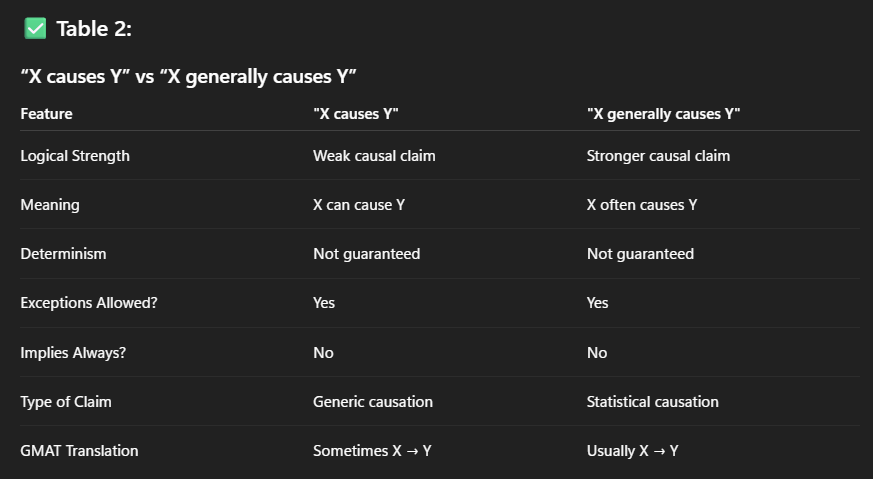
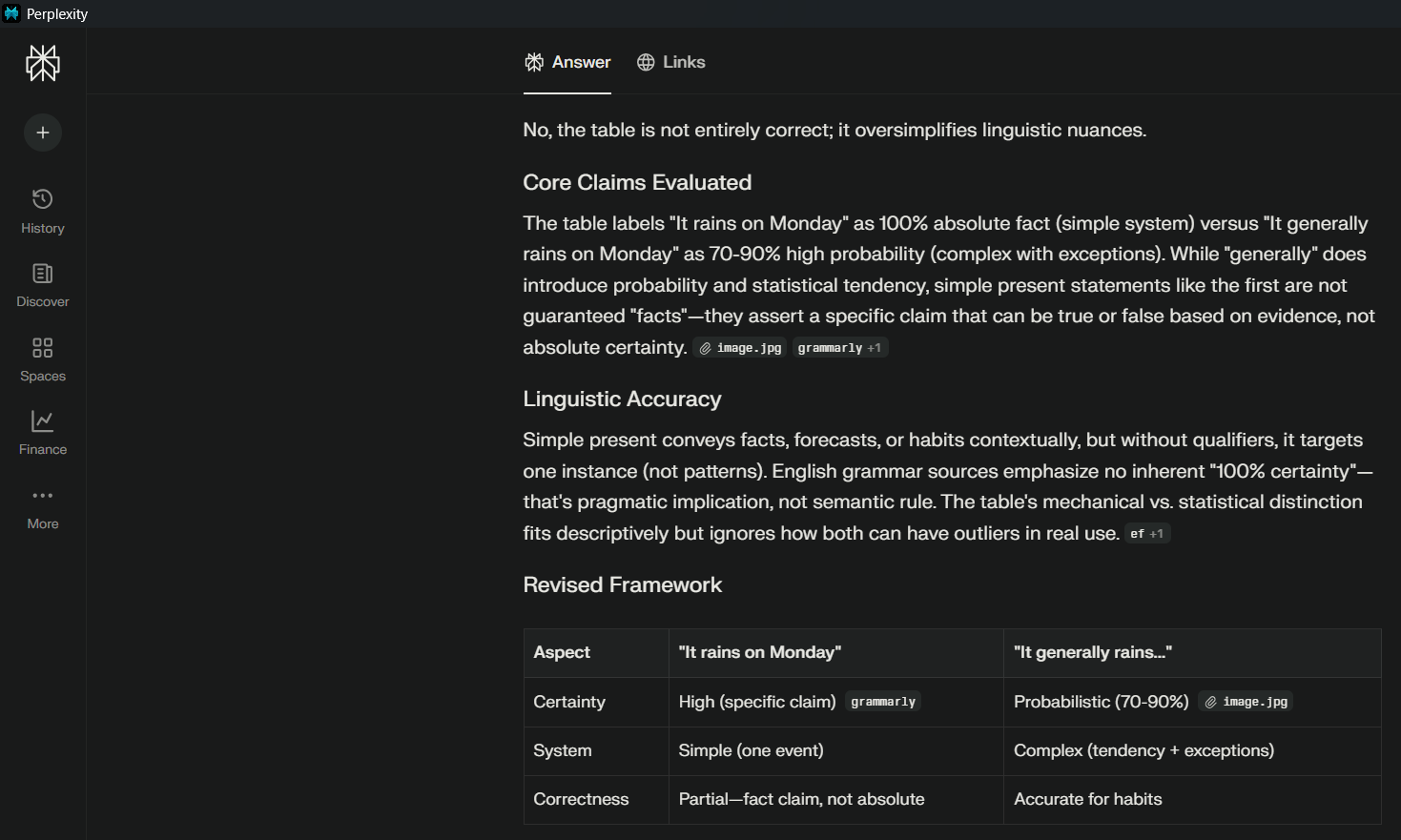

ChiranjeevSingh
Here's what Gemini Pro says (and I agree):

Feature"It rains on Monday""It generally rains on Monday"
Certainty100% (Absolute)~70-90% (High Probability)
ExceptionsNone implied.Exceptions are expected.
ToneFactual, Rule-based, Rigid.Descriptive, Observational.
Grammar NoteOften implies a specific Monday or a universal rule.Implies a habit occurring on Mondays (plural sense).

This is also the difference between "X causes Y" and "X generally causes Y"

Here's what Gemini Pro says (and I agree):

Feature"X causes Y""X generally causes Y"
Nature of LinkMechanical / AbsoluteStatistical / Tendency
ExceptionsExceptions prove the statement false.Exceptions are normal (outliers).
Predictive Power100% Certainty.High Probability.
ComplexitySimple system (A -> B).Complex system (A + others -> B).


Attachment:
GMAT-Club-Forum-ca7dfprb.png
GMAT-Club-Forum-ca7dfprb.png [ 50.28 KiB | Viewed 184 times ]
Attachment:
GMAT-Club-Forum-okgraolh.png
GMAT-Club-Forum-okgraolh.png [ 45.45 KiB | Viewed 187 times ]
Attachment:
GMAT-Club-Forum-bbsyu1h5.png
GMAT-Club-Forum-bbsyu1h5.png [ 184.31 KiB | Viewed 188 times ]
User avatar
ChiranjeevSingh
Joined: 22 Oct 2012
Last visit: 25 Apr 2026
Posts: 427
Own Kudos:
Given Kudos: 161
Status:Private GMAT Tutor
Location: India
Concentration: Economics, Finance
Schools: IIMA  (A)
GMAT Focus 1: 735 Q90 V85 DI85
GMAT Focus 2: 735 Q90 V85 DI85
GMAT Focus 3: 735 Q88 V87 DI84
GMAT 1: 780 Q51 V47
GRE 1: Q170 V168
Expert
Expert reply
Schools: IIMA  (A)
GMAT Focus 3: 735 Q88 V87 DI84
GMAT 1: 780 Q51 V47
GRE 1: Q170 V168
Posts: 427
Kudos: 3,209
Kudos
Add Kudos
Bookmarks
Bookmark this Post
Per me,

"X causes Y" and "X always causes Y" mean the same.

'It rains on Monday" and "Every Monday it rains" mean the same.
GMAT_KSD
ChiranjeevSingh

As per ChatGPT and Perplexity Pro the statements "X causes Y" or "It rains on Monday" don't indicate sufficiency (And I agree with these answers).

I feel AI tools tend to please the users, thats why the discrepancy. As mentioned earlier, I don't want to beleive AI tools blindly.

But doesn't it make sense?

If according to you "X causes Y" indicate sufficiency, then what about "X always causes Y"?

If according to you "It rains on Monday" indicate sufficiency then what about "Every Monday it rains"?


Attachment:
GMAT-Club-Forum-ca7dfprb.png
Attachment:
GMAT-Club-Forum-okgraolh.png
Attachment:
GMAT-Club-Forum-bbsyu1h5.png
User avatar
GMAT_KSD
Joined: 24 Sep 2023
Last visit: 25 Apr 2026
Posts: 16
Own Kudos:
Given Kudos: 244
Posts: 16
Kudos: 1
Kudos
Add Kudos
Bookmarks
Bookmark this Post
ChiranjeevSingh

Then does that mean "Smoking causes cancer". All smokers have cancer?

ChiranjeevSingh
Per me,

"X causes Y" and "X always causes Y" mean the same.

'It rains on Monday" and "Every Monday it rains" mean the same.

User avatar
ChiranjeevSingh
Joined: 22 Oct 2012
Last visit: 25 Apr 2026
Posts: 427
Own Kudos:
Given Kudos: 161
Status:Private GMAT Tutor
Location: India
Concentration: Economics, Finance
Schools: IIMA  (A)
GMAT Focus 1: 735 Q90 V85 DI85
GMAT Focus 2: 735 Q90 V85 DI85
GMAT Focus 3: 735 Q88 V87 DI84
GMAT 1: 780 Q51 V47
GRE 1: Q170 V168
Expert
Expert reply
Schools: IIMA  (A)
GMAT Focus 3: 735 Q88 V87 DI84
GMAT 1: 780 Q51 V47
GRE 1: Q170 V168
Posts: 427
Kudos: 3,209
Kudos
Add Kudos
Bookmarks
Bookmark this Post
"Smoking causes cancer" means that if you keep smoking, you will eventually have cancer. So, yes, all smokers will eventually have cancer.
GMAT_KSD
ChiranjeevSingh

Then does that mean "Smoking causes cancer". All smokers have cancer?


User avatar
GMAT_KSD
Joined: 24 Sep 2023
Last visit: 25 Apr 2026
Posts: 16
Own Kudos:
Given Kudos: 244
Posts: 16
Kudos: 1
Kudos
Add Kudos
Bookmarks
Bookmark this Post
ChiranjeevSingh

I think in our discussions, one of us is making a mistake in understanding the term sufficiency (most likely me, since you are an expert in this field).

I beleive sufficiency means the following: If there are two events A and B, and A is sufficient for B, then just by knowing the existence of a event A, I can tell the existence of event B with 100% guarantee. There will not exist an exceptional case where "A happens but B does not happen".

Qx: Similarly, with the satement "Smoking causes cancer" how can I tell it is sufficient if I find one person who smokes but does not get cancer?

You said if "you keep smoking you will eventually get cancer".

Here the event of "Smoking" did occur then why should I be concerned about "how long smoking lasts" if it is a sufficient to get cancer?

Qy: I would also like to know your perspective on this: Is there any difference between (a) "If you smoke you get cancer" and (b) "Smoking causes cancer"?

............................................................................................................................................................................................................................................

When I think about the question (Qy), I feel earlier I was trying to point out the sufficiency flaw in the statement "Smoking causes cancer" by showing that there exists one person who smokes but does not get cancer. If that is the case, then wouldn't it make above both statements (a) and (b) wrong?

Qz: So what is really going wrong here? Is it that I am mixing universally true statements (e.g. If you are a man then you are a human) with conditional Statements (e.g. If you smoke you get cancer)?

Am I implicitly adding "universally true" constraint on all conditional statements e.g. whenever I read "If X then Y" , I assume no exception exist since it is universally true.

But in case of "X causes Y", I don't apply the "universallly true" constraint because in real life I can find exceptions where people smokes and do not get cancer.


Qa: So what does "Sufficient" really mean then? Does a condition is sufficient only if it is universally true?


Before reading this article on Correlation to Causation, I was of the beleif that statements like "X causes Y", "X leads to Y" are different from "X implies Y" which is equivalent to "If X then Y" .

This belief was also supported by the fact that the negation of these statements are different: "X does not cause Y", "X does not lead to Y" compared to "Even if X, not Y".

Qb: If all these statements were the same, then why are their negation different?

............................................................................................................................................................................................................................................

To be honest, I am still confused and I cannot internalize "X causes Y" means "X is sufficient for Y" in the same way as I could do for "X implies Y" or "If X then Y".

ChiranjeevSingh
"Smoking causes cancer" means that if you keep smoking, you will eventually have cancer. So, yes, all smokers will eventually have cancer.

User avatar
ChiranjeevSingh
Joined: 22 Oct 2012
Last visit: 25 Apr 2026
Posts: 427
Own Kudos:
Given Kudos: 161
Status:Private GMAT Tutor
Location: India
Concentration: Economics, Finance
Schools: IIMA  (A)
GMAT Focus 1: 735 Q90 V85 DI85
GMAT Focus 2: 735 Q90 V85 DI85
GMAT Focus 3: 735 Q88 V87 DI84
GMAT 1: 780 Q51 V47
GRE 1: Q170 V168
Expert
Expert reply
Schools: IIMA  (A)
GMAT Focus 3: 735 Q88 V87 DI84
GMAT 1: 780 Q51 V47
GRE 1: Q170 V168
Posts: 427
Kudos: 3,209
Kudos
Add Kudos
Bookmarks
Bookmark this Post
I respect your persistence. If you are okay, we can get on a zoom call. We can then publish the video and paste the link on this thread for others.
GMAT_KSD
ChiranjeevSingh

I think in our discussions, one of us is making a mistake in understanding the term sufficiency (most likely me, since you are an expert in this field).

I beleive sufficiency means the following: If there are two events A and B, and A is sufficient for B, then just by knowing the existence of a event A, I can tell the existence of event B with 100% guarantee. There will not exist an exceptional case where "A happens but B does not happen".

Qx: Similarly, with the satement "Smoking causes cancer" how can I tell it is sufficient if I find one person who smokes but does not get cancer?

You said if "you keep smoking you will eventually get cancer".

Here the event of "Smoking" did occur then why should I be concerned about "how long smoking lasts" if it is a sufficient to get cancer?

Qy: I would also like to know your perspective on this: Is there any difference between (a) "If you smoke you get cancer" and (b) "Smoking causes cancer"?

............................................................................................................................................................................................................................................

When I think about the question (Qy), I feel earlier I was trying to point out the sufficiency flaw in the statement "Smoking causes cancer" by showing that there exists one person who smokes but does not get cancer. If that is the case, then wouldn't it make above both statements (a) and (b) wrong?

Qz: So what is really going wrong here? Is it that I am mixing universally true statements (e.g. If you are a man then you are a human) with conditional Statements (e.g. If you smoke you get cancer)?

Am I implicitly adding "universally true" constraint on all conditional statements e.g. whenever I read "If X then Y" , I assume no exception exist since it is universally true.

But in case of "X causes Y", I don't apply the "universallly true" constraint because in real life I can find exceptions where people smokes and do not get cancer.


Qa: So what does "Sufficient" really mean then? Does a condition is sufficient only if it is universally true?


Before reading this article on Correlation to Causation, I was of the beleif that statements like "X causes Y", "X leads to Y" are different from "X implies Y" which is equivalent to "If X then Y" .

This belief was also supported by the fact that the negation of these statements are different: "X does not cause Y", "X does not lead to Y" compared to "Even if X, not Y".

Qb: If all these statements were the same, then why are their negation different?

............................................................................................................................................................................................................................................

To be honest, I am still confused and I cannot internalize "X causes Y" means "X is sufficient for Y" in the same way as I could do for "X implies Y" or "If X then Y".


User avatar
GMAT_KSD
Joined: 24 Sep 2023
Last visit: 25 Apr 2026
Posts: 16
Own Kudos:
Given Kudos: 244
Posts: 16
Kudos: 1
Kudos
Add Kudos
Bookmarks
Bookmark this Post
ChiranjeevSingh

You are very kind, not only have you replied patiently to each of my queries over several days, but you are also now proposing a zoom call.

I would be really grateful if such a session could be arranged at your convinience, as it will help me as well as others (if any).

However, you should know in advance that I am an average student who has learned CR concepts such as sufficiency and neccessity more mechanically (using set theory) rather than pure comprehension as you do.

Each reply I have given to your answers has taken a considerable amount of time and thought, as well as some behind the scenes validation with AI tools.

That is why I am afraid, I may not be able to quickly answer any of the questions during zoom call in the same way it feels here in this forum discussion.

I have seen some of your videos on your website, and I know your teaching style is to ask question after question until the student accept where he or she has gone wrong. I am happy to be "roasted" by you if it enlightens me and helps me understand this concept crystal clear.

ChiranjeevSingh
I respect your persistence. If you are okay, we can get on a zoom call. We can then publish the video and paste the link on this thread for others.

User avatar
ChiranjeevSingh
Joined: 22 Oct 2012
Last visit: 25 Apr 2026
Posts: 427
Own Kudos:
Given Kudos: 161
Status:Private GMAT Tutor
Location: India
Concentration: Economics, Finance
Schools: IIMA  (A)
GMAT Focus 1: 735 Q90 V85 DI85
GMAT Focus 2: 735 Q90 V85 DI85
GMAT Focus 3: 735 Q88 V87 DI84
GMAT 1: 780 Q51 V47
GRE 1: Q170 V168
Expert
Expert reply
Schools: IIMA  (A)
GMAT Focus 3: 735 Q88 V87 DI84
GMAT 1: 780 Q51 V47
GRE 1: Q170 V168
Posts: 427
Kudos: 3,209
Kudos
Add Kudos
Bookmarks
Bookmark this Post
We will not be in a hurry. You can take your time during the session. Please email me at [email protected] so that we can coordinate the time for the session.

Causality and sufficient condition are interesting topics for me. Given your questions, I think I will also be able to dig deeper into these topics.
GMAT_KSD
ChiranjeevSingh

You are very kind, not only have you replied patiently to each of my queries over several days, but you are also now proposing a zoom call.

I would be really grateful if such a session could be arranged at your convinience, as it will help me as well as others (if any).

However, you should know in advance that I am an average student who has learned CR concepts such as sufficiency and neccessity more mechanically (using set theory) rather than pure comprehension as you do.

Each reply I have given to your answers has taken a considerable amount of time and thought, as well as some behind the scenes validation with AI tools.

That is why I am afraid, I may not be able to quickly answer any of the questions during zoom call in the same way it feels here in this forum discussion.

I have seen some of your videos on your website, and I know your teaching style is to ask question after question until the student accept where he or she has gone wrong. I am happy to be "roasted" by you if it enlightens me and helps me understand this concept crystal clear.


   1   2 
Moderators:
GMAT Club Verbal Expert
7391 posts
506 posts
361 posts