Events & Promotions
|
|

GMAT Club Daily Prep
Thank you for using the timer - this advanced tool can estimate your performance and suggest more practice questions. We have subscribed you to Daily Prep Questions via email.
Customized
for You
Track
Your Progress
Practice
Pays
Not interested in getting valuable practice questions and articles delivered to your email? No problem, unsubscribe here.
 Sep 04
10:00 AM PDT
-11:00 AM PDT
What does test anxiety really look like on the GMAT? For many test takers, it does not look like a panic attack. Instead, it shows up as brain fog, rereading, negative comparisons, mental noise.... Sep 02
01:00 PM EDT
-11:59 PM EDT
Take 30% off all study plans with code COURSEWORK - Expires on Monday 9/7 Sep 03
01:30 AM EDT
-02:30 AM EDT
At one point, she believed GMAT wasn’t for her. After scoring 595, self-doubt crept in and she questioned her potential. But instead of quitting, she made the right strategic changes. The result? A remarkable comeback to 695. Check out how Saakshi did it. Sep 06
09:30 AM EDT
-12:30 PM EST
Top scores are possible when you enroll in a powerful EA course, taught live online + 6 months access to TTP OnDemand video courses included! Perfect class schedule and easy course access for working professionals. Class starts Sundays Sept. 6, 2026.- Sep 07
12:01 AM PDT
-11:59 PM PDT
On the 7th, GMAT Club Tests will be Free! Including all the Quizzes, Questions, and Tests. 12 AM - 11:59 PM PDT  Sep 07
12:30 AM EDT
-01:30 AM EDT
Tejas studied hard but kept repeating the same mistakes. After 3 attempts at 645, a focused 4-week strategy helped him identify and fix what was holding him back—leading to a 695 with just 12–15 hours of study per week.- Sep 07
10:00 AM PDT
-11:00 AM PDT
A complete walkthrough of GMAT Club’s free 12-week GMAT study plan: what you study each week, how progress and goals are tracked, how the error log works, and how your practice unlocks paid tools at no cost. - Sep 09
07:00 AM PDT
-10:00 AM PDT
Meet AdComs and explore top Master’s programs - MiM, MiF, MSc, MSBA and more. - Application Fee Waivers - Free 1-Week of GMAT Club Tests: - Master's Application Toolkit - Grand Prize Giveaway - Sep 09
10:00 AM PDT
-11:00 AM PDT
Three MBA applications. Three rejections. No interview invites. A year later, Aman was admitted to Cambridge Judge, SMU, and IMD. In this episode of MBA Admit Stories, Aman shares how he rebuilt his MBA application...  Sep 10
08:00 PM PDT
-09:00 PM PDT
Free- full-length test + 15 concept videos + 150+ short videos + study plan! Sep 15
07:00 PM EDT
-09:00 PM EST
Elite scores are possible when you enroll in a powerful GMAT course, taught live online + 6 months access to TTP OnDemand video courses included! Class starts Tues/Thurs Sept. 15, 2026 - Nov. 15, 2027, 7:00pm-9:00pm EST Sep 21
08:00 PM EDT
-10:00 PM EDT
Boost your GMAT score in less than one month in a live online class + 6 months access to TTP OnDemand video courses included! Class starts Mon, Tues, Wed, Thur, Fri Sept. 21, 2026 - Oct. 9, 2027, 7:00pm-10:00pm EST


 23 Jun 2026, 00:25
Kudos
Bookmarks
The skills were there weeks before test day. The last 72 hours were a fight with my own nerves — and that turned out to be the real exam.
The number that scared me three days out
Why I needed a platform that shows you where you are stuck
Algebra and Advanced Topics: trusting process over lucky answers
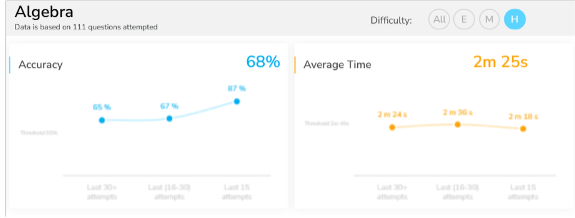
Algebra — hard-difficulty accuracy: 65% → 67% → 87% (time steady, ~2m18s)
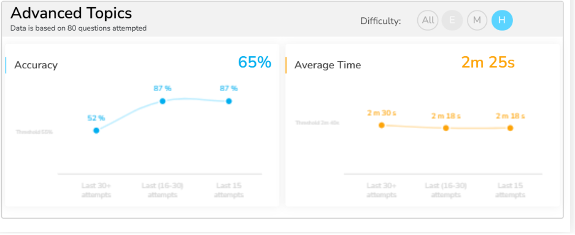
Advanced Topics — hard-difficulty accuracy: 52% → 87% → 87% (time down to ~2m18s)
Drilling the weak spots until they held
The fix that mattered most: a hard cap
The part nobody warns you about
What I would tell my earlier self

GMAT-Club-Forum-mg9yc9bg.png [ 28.4 KiB | Viewed 275 times ]

GMAT-Club-Forum-l4dn3enh.png [ 28.27 KiB | Viewed 275 times ]
The number that scared me three days out
Here is the strange part of my story. For weeks my section scores had been landing at Q89, Q90, a V90 on my last full attempt. Then, three days from the exam, I sat a full-length mock and pulled a Q79. How do you score a 79 when 89 and 90 are your normal? I lay awake that night, woke at midnight, took another sectional, got a Q90, and finally slept. That gap between what I could clearly do and what I was doing under pressure is the whole reason this debrief exists.
Why I needed a platform that shows you where you are stuck
I come from medicine, and I had lost a lot of touch with Algebra. My foundation was decent, but a decent base is exactly the kind that hides where you are actually leaking marks. I did not go comparison-shopping between options — I came in needing two things: tools that show me precisely what to fix, and a process I could repeat when my instincts failed. That is what made e-GMAT, an online GMAT prep platform, fit my situation.
Algebra and Advanced Topics: trusting process over lucky answers
My old habit in Algebra was to back-solve — substitute the answer choices and reverse-engineer the equation. It worked until it didn't, and on a clock of roughly two minutes a question it failed me when I most needed it. So instead of chasing the right answer, I decided I would rather get the process right even on a question I got wrong, because that pays off later. To find where the leaks actually were, I lived in the data analytics on the portal — it logs every question and breaks accuracy down to the sub-topic — and once it pointed me at my weak spots, I ground the cementing quizzes after each topic until the method was automatic. My hard-question accuracy in Algebra moved from 65% to 87%, with my time per question flat or slightly down.
Algebra — hard-difficulty accuracy: 65% → 67% → 87% (time steady, ~2m18s)
Advanced Topics was steeper. I used to force every probability and sets question through one formula and hope it fit. What broke that habit was the worked solutions sitting under each question — there is a subsection showing a couple of other ways the same question can be solved. Seeing two or three clean approaches let me pick the one I was actually comfortable with instead of defending one rigid framework. Hard-question accuracy in Advanced Topics went from 52% to 87%.
Advanced Topics — hard-difficulty accuracy: 52% → 87% → 87% (time down to ~2m18s)
Drilling the weak spots until they held
When a sectional mock flagged that my number properties were shaky, I leaned on Neuron — the bank of official-style questions with worked solutions written by the experts rather than the standard ones. What made it work for me was the filtering: I could narrow down to one sub-topic, set the difficulty, and pull only the questions I had got wrong or not yet tried, then drill until I was clearing 80–90% of them. When a question genuinely stumped me, the "ask the expert" section under it — the internal forums — meant I could post the doubt and get an expert response in a few hours instead of losing a day to it. The questions sat right on par with what the real exam threw at me; on test day, with barely any time left on my last Quant question, the exact same one I had practised came up, values and all, and I just knew it. Scholaranium did the same at a broader level, with topic-level analytics behind it.
The fix that mattered most: a hard cap
Even with the skills in place, my timing was sabotaging me. I would get grossly involved in the first five or six questions, burn four or five minutes on them, and then have seven or eight minutes left for the last five — which is how silly errors creep in. The sectional mocks made this visible, and the fix was blunt: a hard cap of 2 minutes 30 seconds per question, with maybe 15–20 seconds of grace only if I was almost there. Past the cap, I bookmarked, took an intelligent guess, and moved on. I started finishing with three or four minutes to spare and circling back to the bookmarked ones with a clear head.
The part nobody warns you about
On verbal, what turned fluctuating scores into consistent ones was prethinking — deciding what the answer should look like before reading the options — on critical reasoning and reading comprehension. My sectional verbal climbed into the high V80s and a V90.
But the last phase was pure drama. Tuesday before a Thursday exam I scored a 645, the next morning a 625 — a number from the start of my prep. Something was clearly wrong, and it was not the process; consistent Q89s and V89s do not happen by fluke. This is where my mentor, Dhruv, mattered most. He did not hand me a new technique — he talked me down, even messaging me to say he would be brutal if that was what it took, because he did not want to lose me to nervousness. The reassurance, plus one simple question — what is the worst case, really? It is one attempt, and there is always another — is what let me stop catastrophising. I finally internalised it: shrink the exam to one question, give it 100% focus, hold the 2:30 cap, forget the rest. My final mock jumped to a 725. The difference between 625 and 725 was never the skill; it was mindset, confidence and the basics. If you are heading into your closing weeks, find someone who will catch the behavioral patterns your own nerves can't — it is worth more than any extra question you could grind.
What I would tell my earlier self
Build the process, let the data point you, respect the clock — the skills only show on test day if your head lets them.
Attachment:
GMAT-Club-Forum-mg9yc9bg.png [ 28.4 KiB | Viewed 275 times ]
Attachment:
GMAT-Club-Forum-l4dn3enh.png [ 28.27 KiB | Viewed 275 times ]
 23 Jun 2026, 05:57
Kudos
Bookmarks
Congrats on the big score. Best wishes for the application process ahead.









