Events & Promotions
|
|

GMAT Club Daily Prep
Thank you for using the timer - this advanced tool can estimate your performance and suggest more practice questions. We have subscribed you to Daily Prep Questions via email.
Customized
for You
Track
Your Progress
Practice
Pays
Not interested in getting valuable practice questions and articles delivered to your email? No problem, unsubscribe here.
 Aug 27
10:00 AM EDT
-11:00 AM EDT
We’ve worked incredibly hard to build TTP into the best test prep experience possible, and it would mean a lot to us to win Newsweek’s 2026 Readers’ Choice Award for Best Test Prep. If TTP has helped you, we’d be incredibly grateful for your vote. Sep 04
10:00 AM PDT
-11:00 AM PDT
What does test anxiety really look like on the GMAT? For many test takers, it does not look like a panic attack. Instead, it shows up as brain fog, rereading, negative comparisons, mental noise.... Sep 06
09:30 AM EDT
-12:30 PM EST
Top scores are possible when you enroll in a powerful EA course, taught live online + 6 months access to TTP OnDemand video courses included! Perfect class schedule and easy course access for working professionals. Class starts Sundays Sept. 6, 2026.- Sep 07
12:01 AM PDT
-11:59 PM PDT
On the 7th, GMAT Club Tests will be Free! Including all the Quizzes, Questions, and Tests. 12 AM - 11:59 PM PDT - Sep 09
07:00 AM PDT
-10:00 AM PDT
Meet AdComs and explore top Master’s programs - MiM, MiF, MSc, MSBA and more. - Application Fee Waivers - Free 1-Week of GMAT Club Tests: - Master's Application Toolkit - Grand Prize Giveaway  Sep 15
07:00 PM EDT
-09:00 PM EST
Elite scores are possible when you enroll in a powerful GMAT course, taught live online + 6 months access to TTP OnDemand video courses included! Class starts Tues/Thurs Sept. 15, 2026 - Nov. 15, 2027, 7:00pm-9:00pm EST Sep 21
08:00 PM EDT
-10:00 PM EDT
Boost your GMAT score in less than one month in a live online class + 6 months access to TTP OnDemand video courses included! Class starts Mon, Tues, Wed, Thur, Fri Sept. 21, 2026 - Oct. 9, 2027, 7:00pm-10:00pm EST


 17 Jul 2016, 08:56
Kudos
Bookmarks
Hello All,
Below are the GMAT Club Quant tests that I took over the past 30 days. I am curious to know whether there has been any improvement in the scores in terms of the performance or strength of difficulty.
I am confused to guage the performance because if you notice the images of each test here, the difficulty level of questions has increased and the last test had more number of 700-level questions.
Please help me understand the stats below. Thank you.
TEST 1:
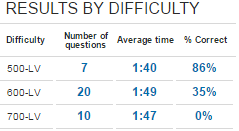
TEST 1.PNG [ 6.18 KiB | Viewed 2634 times ]
Score: 32
Percentile: 26%
Correct: 13
Incorrect: 24
TEST 2:
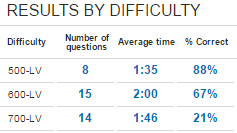
TEST 2.PNG [ 6.24 KiB | Viewed 2617 times ]
Score: 42
Percentile: 50%
Correct: 20
Incorrect: 17
TEST 3:
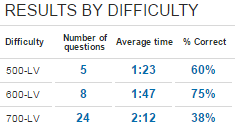
TEST 3.PNG [ 6.28 KiB | Viewed 2625 times ]
Score: 41
Percentile: 48%
Correct: 18
Incorrect: 19
Below are the GMAT Club Quant tests that I took over the past 30 days. I am curious to know whether there has been any improvement in the scores in terms of the performance or strength of difficulty.
I am confused to guage the performance because if you notice the images of each test here, the difficulty level of questions has increased and the last test had more number of 700-level questions.
Please help me understand the stats below. Thank you.
TEST 1:
Attachment:
TEST 1.PNG [ 6.18 KiB | Viewed 2634 times ]
Score: 32
Percentile: 26%
Correct: 13
Incorrect: 24
TEST 2:
Attachment:
TEST 2.PNG [ 6.24 KiB | Viewed 2617 times ]
Score: 42
Percentile: 50%
Correct: 20
Incorrect: 17
TEST 3:
Attachment:
TEST 3.PNG [ 6.28 KiB | Viewed 2625 times ]
Score: 41
Percentile: 48%
Correct: 18
Incorrect: 19
Archived Topic
Hi there,
This topic has been closed and archived due to inactivity or violation of community quality standards. No more replies are possible here.
Where to now? Join ongoing discussions on thousands of quality questions in our Quantitative Questions Forum
Still interested in this question? Check out the "Best Topics" block below for a better discussion on this exact question, as well as several more related questions.
Thank you for understanding, and happy exploring!


 18 Jul 2016, 10:37
Kudos
Bookmarks
You're asking a wise question here. The way that GMAT scoring works is a little hard to wrap your head around, but the images you've posted are a good example of what most test-takers will see as they improve. (By the way, 32 to 42 is a nice improvement -- excellent work!)
First of all, check out this article: https://www.manhattanprep.com/gmat/blog ... mat-quant/
The GMAT is a weird test - on a traditional test, everybody takes basically the same test, but some people get more questions right than others. On the GMAT, everybody effectively takes a different test, but gets roughly the same 'grade'. As you've seen, there is a small difference in how many you get right/wrong at the very low end and the very high end; people with very low Q scores, like your initial score, will typically get a few more problems wrong than people with mid to high scores. But there isn't a very wide range. Instead, the GMAT makes the test harder or easier until you're missing about half of the questions, and then gives you a score based on how hard your test was.
The numbers show that your second two tests were harder than the first one, so you're heading in the right direction! However (there's always a however...), be careful about your accuracy on the lower-difficulty questions. Ideally, I like to see close to 100% accuracy on the 'easier' questions, regardless of what 'easier' means for you, before you start working on the harder questions. Getting one or two super-tough questions right does very little for your score, but missing an easy question is particularly bad for you. Look out for those careless mistakes
First of all, check out this article: https://www.manhattanprep.com/gmat/blog ... mat-quant/
The GMAT is a weird test - on a traditional test, everybody takes basically the same test, but some people get more questions right than others. On the GMAT, everybody effectively takes a different test, but gets roughly the same 'grade'. As you've seen, there is a small difference in how many you get right/wrong at the very low end and the very high end; people with very low Q scores, like your initial score, will typically get a few more problems wrong than people with mid to high scores. But there isn't a very wide range. Instead, the GMAT makes the test harder or easier until you're missing about half of the questions, and then gives you a score based on how hard your test was.
The numbers show that your second two tests were harder than the first one, so you're heading in the right direction! However (there's always a however...), be careful about your accuracy on the lower-difficulty questions. Ideally, I like to see close to 100% accuracy on the 'easier' questions, regardless of what 'easier' means for you, before you start working on the harder questions. Getting one or two super-tough questions right does very little for your score, but missing an easy question is particularly bad for you. Look out for those careless mistakes
18 Jul 2016, 17:36
Kudos
Bookmarks
Hello Chelsy,
I read your blog and that gives me more insights into how far can we go in terms of getting questions wrong. That pretty much summarizes my confusion about those 3 images I shared in my first post. It is good that I am seeing more number of 700 questions, but it is also important to ensure a 100% accuracy on the lower level questions. With an intent of getting most right, I tend to spend my resources on the tough questions and in fact took more than 3 mins of time per question of 700 level which resulted in decrease of the time spent on 500-600 level. Hence, the silly and careless mistakes.
I will start focusing on my guessing strategies and a better time management. Thank you for your feedback. That helps a lot!
Pretz
I read your blog and that gives me more insights into how far can we go in terms of getting questions wrong. That pretty much summarizes my confusion about those 3 images I shared in my first post. It is good that I am seeing more number of 700 questions, but it is also important to ensure a 100% accuracy on the lower level questions. With an intent of getting most right, I tend to spend my resources on the tough questions and in fact took more than 3 mins of time per question of 700 level which resulted in decrease of the time spent on 500-600 level. Hence, the silly and careless mistakes.
I will start focusing on my guessing strategies and a better time management. Thank you for your feedback. That helps a lot!
Pretz
Archived Topic
Hi there,
This topic has been closed and archived due to inactivity or violation of community quality standards. No more replies are possible here.
Where to now? Join ongoing discussions on thousands of quality questions in our Quantitative Questions Forum
Still interested in this question? Check out the "Best Topics" block above for a better discussion on this exact question, as well as several more related questions.
Thank you for understanding, and happy exploring!