Events & Promotions
|
|

GMAT Club Daily Prep
Thank you for using the timer - this advanced tool can estimate your performance and suggest more practice questions. We have subscribed you to Daily Prep Questions via email.
Customized
for You
Track
Your Progress
Practice
Pays
Not interested in getting valuable practice questions and articles delivered to your email? No problem, unsubscribe here.
 Sep 15
07:00 PM EDT
-09:00 PM EST
Elite scores are possible when you enroll in a powerful GMAT course, taught live online + 6 months access to TTP OnDemand video courses included! Class starts Tues/Thurs Sept. 15, 2026 - Nov. 15, 2027, 7:00pm-9:00pm EST Sep 21
07:00 PM EDT
-10:00 PM EDT
Boost your GMAT score in less than one month in a live online class + 6 months access to TTP OnDemand video courses included! Class starts Mon, Tues, Wed, Thur, Fri Sept. 21, 2026 - Oct. 9, 2027, 7:00pm-10:00pm EST

 24 Jul 2021, 07:46
Kudos
Bookmarks
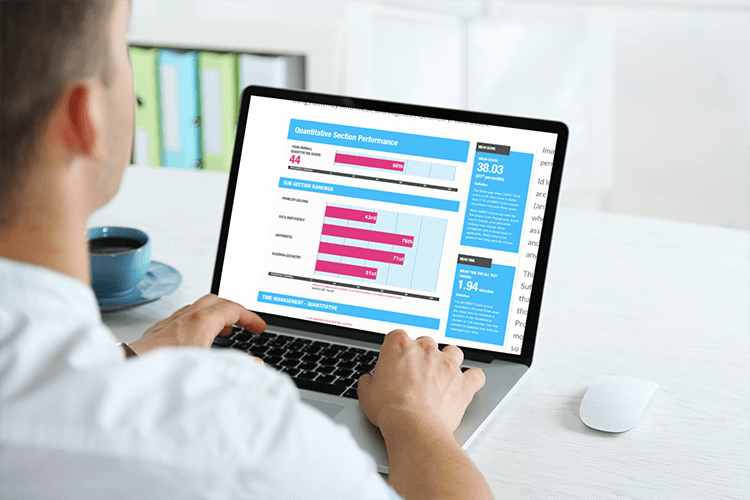
GMAT Enhanced Score Report (GMAT ESR): Do I Need It?
If you’re studying for the GMAT, you’ve probably heard a lot of test-takers talk about the GMAT Enhanced Score Report (ESR) by now. You may be wondering, what exactly will the GMAT ESR tell me about my test performance? Do I really need my ESR? In this article, we’ll answer all your questions about the GMAT Enhanced Score Report and give you some useful strategies for how to use your ESR — and how not to.
First, let’s briefly review what your GMAT score will look like and the different types of GMAT score reports.
Your GMAT Score
Your GMAT score is actually a few different scores. You’ll receive a separate score for each GMAT section — Quantitative Reasoning, Verbal Reasoning, Integrated Reasoning (IR), and Analytical Writing Assessment (AWA) — and then a Total Score that is based on your performance in the Quant and Verbal sections. Let’s take a quick look at the GMAT score ranges:
- Total Score Range: 200-800
- Quant Score Range: 6-51
- Verbal Score Range: 6-51
- IR Score Range: 1-8
- AWA Score Range: 0-6
So, you cannot receive a Total Score that is lower than 200 or a Quant score that is higher than 51, for instance. Note that your scores for any GMAT exam remain valid for up to 5 years after your test date.
Now, let’s look at how those scores are reported.
How Your Scores Are Reported
There are actually 3 different GMAT score reports you can receive for a single GMAT exam. Those 3 reports are:- Unofficial Score Report: Includes all scores except AWA, which is scored later. (Note that there is no AWA section for the GMAT Online exam). You will see your unofficial scores on the computer immediately after you finish your GMAT exam. If you don’t cancel your scores, you will also have the option of receiving a printout of your Unofficial Score Report at the test center.
- Official Score Report: This is the report you’ll send to business schools. It includes your scores for all sections of the test and your Total Score. Your official scores generally are the same as your unofficial scores; the difference is that the AWA score is included. You should receive your official scores within 3 weeks of taking your exam.
- Enhanced Score Report: This report is private to you, should you choose to purchase it. It provides a more detailed breakdown of test performance on each section and is available to you within 24-72 hours after you take your GMAT. Note that the ESR is currently not available for GMAT Online exams.
Now that we’ve covered the basics of GMAT scores and how they’re reported, let’s take a closer look at the GMAT ESR.
The GMAT ESR: An Overview
The GMAT Enhanced Score Report gives you a general sense of where your strengths and weaknesses were on a given GMAT and how you managed your time. The ESR is available to purchase for $30 from GMAC, the makers of the GMAT. You can purchase and access the ESR for a given GMAT at any point within 5 years of your exam date. Furthermore, you can order an ESR even for a canceled GMAT score. We’ll discuss a little bit later why doing so is generally a wise strategy.What Does the GMAT ESR Look Like?
Your ESR contains information on your overall exam performance and your performance in each section, and shows you how your performance stacks up against that of all other GMAT test-takers in the past 3 years. In addition to visual representations of your test performance, which we’ll review below, each performance breakdown includes a summary that provides a written snapshot of your performance and how it was analyzed, and the average scores and times per question of all GMAT test-takers in the past 3 years, so you can see how you performed in comparison to the average test-taker.Let’s look in detail at the information these breakdowns provide.
Overall GMAT Exam Performance
In the breakdown of your overall exam performance, you’ll see a bar graph of the information contained within your Official Score Report: your Total Score and section scores along with the percentile rankings for those scores. You’ll also see a bar graph of your average response time for a question in the Quant, Verbal, and IR sections. For instance, the ESR may show you that you took an average of 2 minutes and 10 seconds to answer a Quant question but only 1 minute and 47 seconds to answer a Verbal question.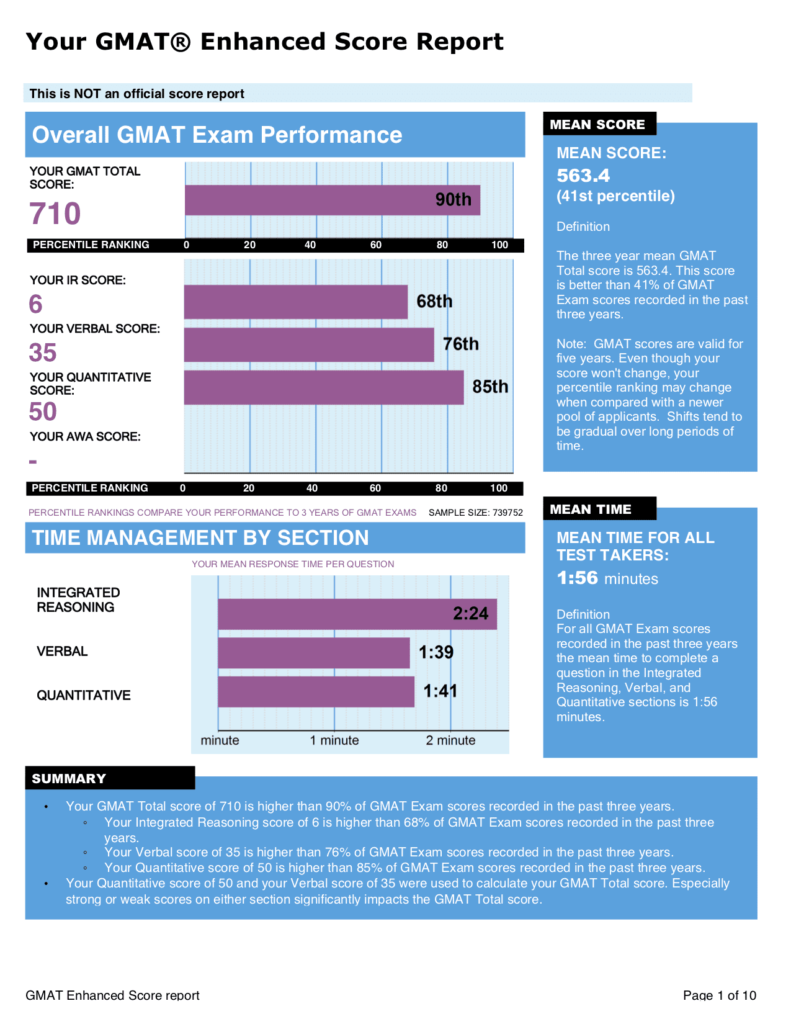
IR Performance
Your IR performance breakdown will be in the same format as your overall performance breakdown. However, in addition to your section score ranking, you’ll also see the percentage of IR questions you answered correctly. In the time-management section, you’ll once again see your overall average response time per IR question, but you’ll also see your average response time per question you answered correctly and per question you answered incorrectly. The mean score and time per question for all GMAT test-takers will once again be given, but this time for just the IR section, as opposed to the overall exam. As for the overall performance breakdown, there will be a summary section at the bottom of the page.Quant and Verbal Performance
The Quant and Verbal performance breakdowns look a bit different from the other data sets because both Quant and Verbal contain multiple subsections and many different question types.For Quant, you will see a bar graph of your percentile ranking for each Quant subsection: Problem Solving, Data Sufficiency, Arithmetic, and Algebra/Geometry. You will also see your time-management stats for each of those subsections. For instance, you may find that while your average time per question in the Quant section overall was 2 minutes and 5 seconds, your average time spent on Algebra/Geometry questions was a bit longer, at 2 minutes and 16 seconds, and your average time spent on Data Sufficiency questions was only 1 minute and 52 seconds. Of course, this information must be viewed in context. Perhaps you spent significantly more time on Geometry questions but also ranked much higher in terms of your performance in Geometry. Or, perhaps you moved swiftly through Data Sufficiency questions because they were second nature to you.
The bar graph of your performance on fundamental skills will help you interpret your subsection data. This graph shows your percentage correct for 5 question types: Geometry, Rates/Ratio/Percent, Value/Order/Factors, Equalities/Inequalities/Algebra, and Counting/Sets/Series. Of course, you will not know how many of the questions in each of those categories were easy, medium, or hard-level questions. So, you may have gotten 100% of the Rates/Ratio/Percent questions you saw correct but seen only easy and medium-level questions in that category.
Included, however, is a line graph that shows the average difficulty of all of the Quant questions you saw on your exam, the Quant questions you answered correctly, and the Quant questions you answered incorrectly. This graph will not tell you the question type, but it will allow you to get a rough idea of when during the section the question difficulty increased or decreased (or if the difficulty remained about the same throughout) and whether the questions you answered incorrectly were, on average, easier or more difficult questions, or a mix. Again, this information is quite general, but at the very least, stark patterns and trend lines in your performance should be apparent.
You may be able to glean some further insights into your performance from the bar graph charting your percentage of correct/incorrect answers throughout the section. For example, if you see on the line graph that average difficulty of questions presented in the final quarter of the Quant section was high, and the bar graph shows you that you got 95% of the questions in the final quarter of the Quant section correct, then you will know that you likely got most of the difficult questions that were presented to you correct. Of course, since you are looking at average difficulty and don’t have a breakdown of percentage correct by difficulty, you’re really just looking at overall trends.
Finally, there will be a more detailed breakdown of how you managed your time over the course of the section. You’ll see 4 pie charts, each one representing a quarter of the section and showing your average time per question for each quarter and what proportions of each “pie” were correct answers vs. incorrect answers. So, once again, this may be useful for noticing any major trends. For instance, if you averaged about 2 minutes and 30 seconds per question in the first three quarters of the section, but only about 1 minute and 10 seconds per question in the final quarter, and you got a significantly higher percentage of questions wrong in the final quarter, then you can bet that you had to rush to complete the section and consequently did sloppy work or guessed on several questions.
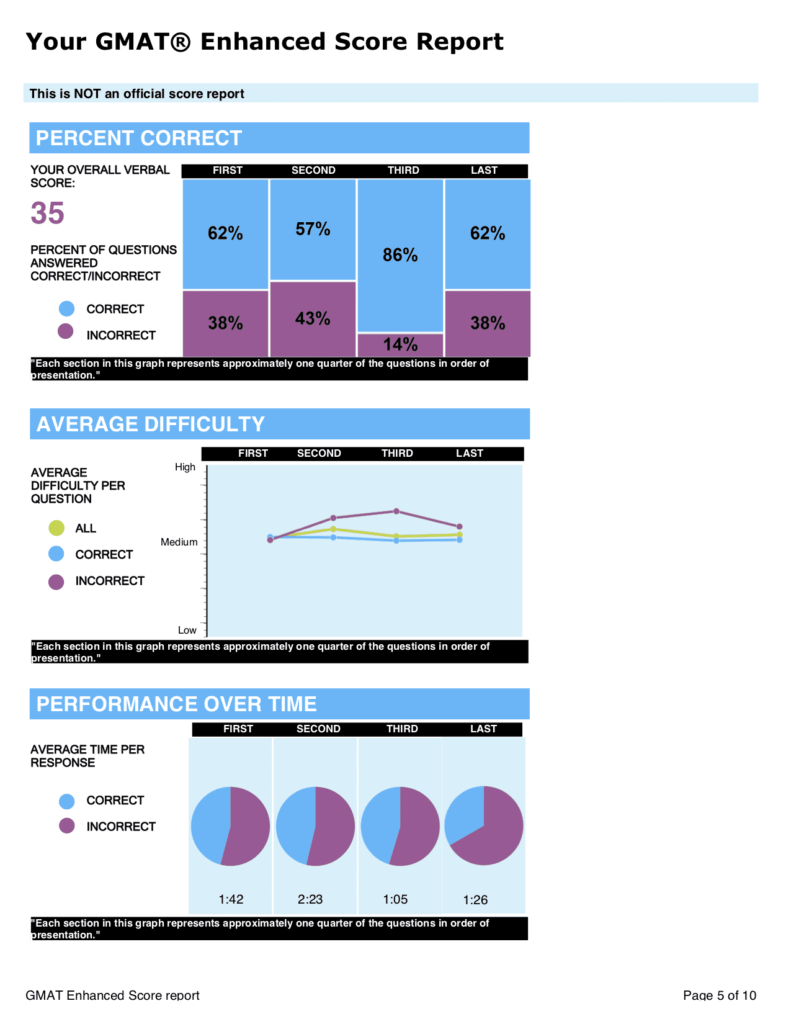
Your Verbal performance breakdown will follow the basic format of the Quant breakdown. This time, subsection percentile rankings and time-management data will be for Sentence Correction, Critical Reasoning, and Reading Comprehension, and your performance on fundamental skills will be broken down into two categories for each of those subsections. For SC, you’ll see your percentage of correct answers for Grammar and for Communication; for CR, you’ll see percentage correct for Analysis/Critique and Construction/Plan; and for RC, you’ll see percentage correct for Identify Inferred Idea and Identify Stated Idea.
To read the complete article, view my full article on Target Test Prep’s blog.

Moderator:






