Events & Promotions
| Last visit was: 27 Sep 2026, 05:36 |
It is currently 27 Sep 2026, 05:36 |
|
|

GMAT Club Daily Prep
Thank you for using the timer - this advanced tool can estimate your performance and suggest more practice questions. We have subscribed you to Daily Prep Questions via email.
Customized
for You
Track
Your Progress
Practice
Pays
Not interested in getting valuable practice questions and articles delivered to your email? No problem, unsubscribe here.
 Sep 27
01:30 AM EDT
-02:30 AM EDT
At one point, she believed GMAT wasn’t for her. After scoring 595, self-doubt crept in and she questioned her potential. But instead of quitting, she made the right strategic changes. The result? A remarkable comeback to 695. Check out how Saakshi did it. Sep 28
07:00 PM EDT
-10:00 PM EDT
Boost your GMAT score in less than one month in a live online class + 6 months access to TTP OnDemand video courses included! Class starts Mon, Tues, Wed, Thur, Fri Sept. 28, 2026 - Oct. 16, 2027, 7:00pm-10:00pm EST Sep 29
11:00 AM EDT
-01:00 PM EDT
" Description: Top scores are possible when you enroll in a powerful GMAT course, taught live online + 6 months access to TTP OnDemand video courses included! Class starts Tues/Thur Sept. 29, 2026 - Dec. 3, 2026, 11:00am-1:00pm EST Oct 01
02:00 AM EDT
-03:00 AM EDT
Tejas studied hard but kept repeating the same mistakes. After 3 attempts at 645, a focused 4-week strategy helped him identify and fix what was holding him back—leading to a 695 with just 12–15 hours of study per week. Oct 01
07:00 AM BST
-08:00 AM GMT
Welcome to the GMAT Club's Free Interview Prep Event for Top MBA Programs! Buy tickets - Virtual series that’s all set to equip you to -excel in your MBA interviews. Oct 03
01:00 PM EDT
-04:00 PM EDT
Top scores are possible when you enroll in a powerful GMAT course, taught live online + 6 months access to TTP OnDemand video courses included! Class starts Saturdays Oct. 3, 2026 - Dec. 26, 2026, 1:00pm-4:00pm EST

GMAT Syllabus 2019-20
The GMAT test takes three hours and seven minutes to solve if you take no breaks between sections. However, given the scope of the exam and its intensity, we recommend that you do take those breaks to reorient yourself.
Here’s the GMAT test pattern you should be preparing for:
1. Quantitative Reasoning – 62 minutes
Break – 8 min
2. Verbal Reasoning – 65 minutes
Break – 8 min
3. Integrated Reasoning Analytical Writing Assessment – 60 minutes
The GMAT test takes three hours and seven minutes to solve if you take no breaks between sections. However, given the scope of the exam and its intensity, we recommend that you do take those breaks to reorient yourself.
Here’s the GMAT test pattern you should be preparing for:
1. Quantitative Reasoning – 62 minutes
Break – 8 min
2. Verbal Reasoning – 65 minutes
Break – 8 min
3. Integrated Reasoning Analytical Writing Assessment – 60 minutes

MidhilaMohan


 20 Jun 2019, 06:48
Kudos
Bookmarks
I would also recommend to concentrate on answering a question right than rushing through the questions under time pressure. Also keep in mind that in GMAT the penalty for not answering a question is higher than answering it incorrectly. So focus on answering correctly and answering it all( A few guesses in-between does not matter and will only increase your score)
20 Jun 2019, 08:42
Kudos
Bookmarks
It's nice reminder for those already in the process and it's a good information for those new to GMAT. Don't forget there are variations to the order to write the exam. The first one is AWA/IR/Quant/Verbal, the second one is Verbal/Quant/IR/AWA and the third one is Quant/Verbal/IR/AWA. Cheers
Posted from my mobile device
Posted from my mobile device
 21 Jun 2019, 00:47
Kudos
Bookmarks
In April 2018, the GMAC made some key changes to the exam format.
The GMAT takes three hours and seven minutes to solve if you take no breaks between sections.
But I would strongly recommend that you do take those breaks.
Here’s a quick glimpse of the GMAT Syllabus:
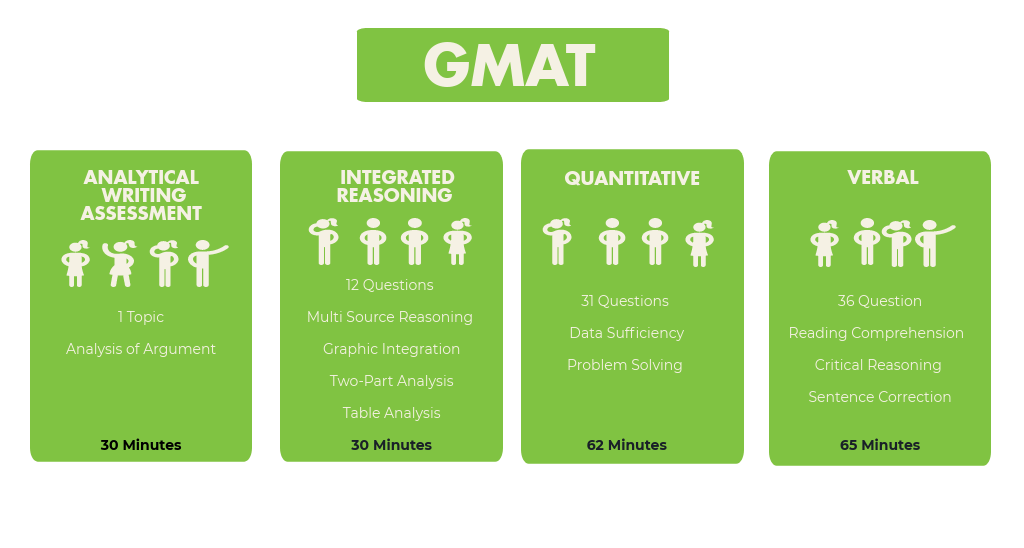
1. Analytical Writing Assessment – 30 minutes
This is essentially an essay section in which you’re given an argument. You are supposed to write an analysis of the given argument.
Your AWA score does not affect your GMAT score. The score range for AWA ranges from 0–6, with increments of 0.5 points.
2. Integrated Reasoning (IR) - 30 minutes
This section requires a combination of both Verbal and Quant skills and is similar to the Data Interpretation (DI) section on the CAT.
Overall, IR will have 12 questions that can be divided into four types:
Like AWA, your IR score also doesn’t affect your composite GMAT score.
The IR scores are given on a scale of 1 to 8.
3. Quantitative Reasoning: 62 minutes
There are 31 questions, so you have 2 minutes per question. The two types of questions you’ll find are:
4. Verbal Reasoning: 65 minutes
This section has 36 questions that you have to solve in 65 minutes.
Question types in the verbal section will be based on:
The score on your quant & verbal section contributes to your final GMAT score.
GMAT also introduced something called the GMAT Select Section Order, wherein GMAT takers can choose the order of the sections that they attempt. This means that a test taker can actually start the GMAT from the Verbal section instead of quant!
For more details, you could check out this detailed article on GMAT Syllabus
You could also watch this video to know more about the latest GMAT Syllabus & Exam Pattern:
The GMAT takes three hours and seven minutes to solve if you take no breaks between sections.
But I would strongly recommend that you do take those breaks.
Here’s a quick glimpse of the GMAT Syllabus:
1. Analytical Writing Assessment – 30 minutes
This is essentially an essay section in which you’re given an argument. You are supposed to write an analysis of the given argument.
Your AWA score does not affect your GMAT score. The score range for AWA ranges from 0–6, with increments of 0.5 points.
2. Integrated Reasoning (IR) - 30 minutes
This section requires a combination of both Verbal and Quant skills and is similar to the Data Interpretation (DI) section on the CAT.
Overall, IR will have 12 questions that can be divided into four types:
- Multi-Source Reasoning
- Graphics Interpretation
- Table Analysis
- Two-Part Analysis
Like AWA, your IR score also doesn’t affect your composite GMAT score.
The IR scores are given on a scale of 1 to 8.
3. Quantitative Reasoning: 62 minutes
There are 31 questions, so you have 2 minutes per question. The two types of questions you’ll find are:
- - Problem Solving (PS): Standard questions for which you need to calculate answers.
- Data Sufficiency (DS): For these, you don’t have to solve anything. All you need to do is interpret whether the given data is enough to answer the question.
4. Verbal Reasoning: 65 minutes
This section has 36 questions that you have to solve in 65 minutes.
Question types in the verbal section will be based on:
- - Reading Comprehension (RC): You have to answer questions related to a given passage.
- Critical Reasoning (CR): A short passage is given. You need to find the premise, conclusion, assumption, etc.
- Sentence Correction (SC): A part of the sentence is underlined, and five options are provided. You need to spot the error and mark the right option.
The score on your quant & verbal section contributes to your final GMAT score.
GMAT also introduced something called the GMAT Select Section Order, wherein GMAT takers can choose the order of the sections that they attempt. This means that a test taker can actually start the GMAT from the Verbal section instead of quant!
For more details, you could check out this detailed article on GMAT Syllabus
You could also watch this video to know more about the latest GMAT Syllabus & Exam Pattern:







