Last visit was: 11 May 2026, 00:13 It is currently 11 May 2026, 00:13
Close
GMAT Club Daily Prep
Thank you for using the timer - this advanced tool can estimate your performance and suggest more practice questions. We have subscribed you to Daily Prep Questions via email.

Customized
for You

we will pick new questions that match your level based on your Timer History

Track
Your Progress

every week, we’ll send you an estimated GMAT score based on your performance

Practice
Pays

we will pick new questions that match your level based on your Timer History
Not interested in getting valuable practice questions and articles delivered to your email? No problem, unsubscribe here.
Close
Request Expert Reply
Confirm Cancel
User avatar
walker
Joined: 17 Nov 2007
Last visit: 25 May 2025
Posts: 2,396
Own Kudos:
Given Kudos: 362
Concentration: Entrepreneurship, Other
Schools: Chicago (Booth) - Class of 2011
GMAT 1: 750 Q50 V40
Expert
Expert reply
Schools: Chicago (Booth) - Class of 2011
GMAT 1: 750 Q50 V40
Posts: 2,396
Kudos: 10,860
 [281]
71
Kudos
Add Kudos
210
Bookmarks
Bookmark this Post
Most Helpful Reply
User avatar
Bunuel
User avatar
Math Expert
Joined: 02 Sep 2009
Last visit: 10 May 2026
Posts: 110,252
Own Kudos:
Given Kudos: 106,172
Products:
Expert
Expert reply
Active GMAT Club Expert! Tag them with @ followed by their username for a faster response.
Posts: 110,252
Kudos: 814,144
 [41]
10
Kudos
Add Kudos
31
Bookmarks
Bookmark this Post
avatar
sanjay_gmat
Joined: 06 Jul 2007
Last visit: 05 Apr 2009
Posts: 119
Own Kudos:
91
 [22]
Posts: 119
Kudos: 91
 [22]
12
Kudos
Add Kudos
10
Bookmarks
Bookmark this Post
General Discussion
User avatar
walker
Joined: 17 Nov 2007
Last visit: 25 May 2025
Posts: 2,396
Own Kudos:
10,860
 [4]
Given Kudos: 362
Concentration: Entrepreneurship, Other
Schools: Chicago (Booth) - Class of 2011
GMAT 1: 750 Q50 V40
Expert
Expert reply
Schools: Chicago (Booth) - Class of 2011
GMAT 1: 750 Q50 V40
Posts: 2,396
Kudos: 10,860
 [4]
4
Kudos
Add Kudos
Bookmarks
Bookmark this Post
bigfernhead
Hi - can someone help me explain Tip #2? I don't really understand what it is saying. Thanks.

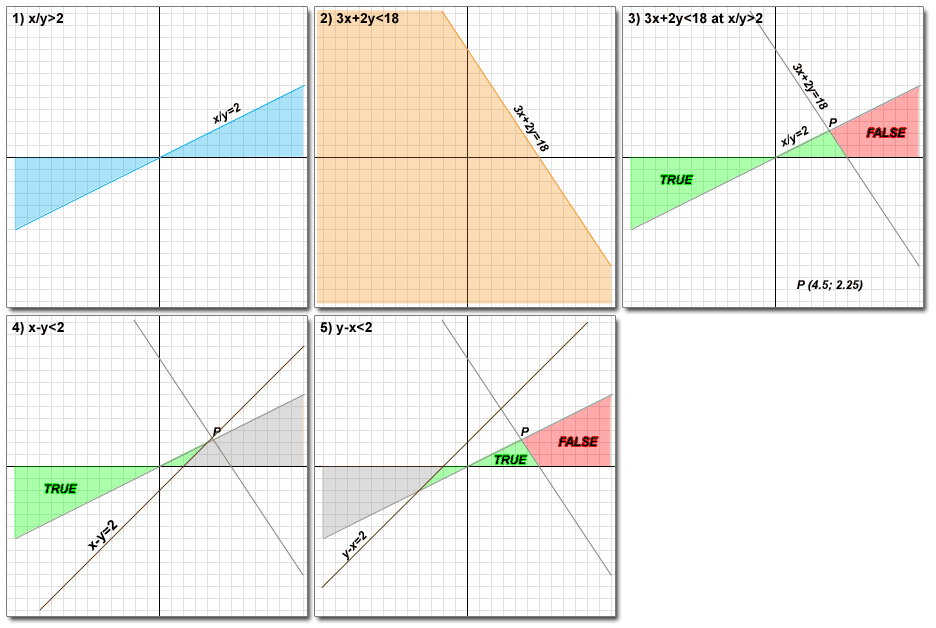
See fig.2 - we have line 3x+2y=18. Where is 3x+2y<18? left or right side? we put x=-infinity and y=0 --> -infinity<18. Is is correct? Yes. Therefore, left side corresponds to 3x+2y<18 (orange color in fig.2)
User avatar
walker
Joined: 17 Nov 2007
Last visit: 25 May 2025
Posts: 2,396
Own Kudos:
10,860
 [3]
Given Kudos: 362
Concentration: Entrepreneurship, Other
Schools: Chicago (Booth) - Class of 2011
GMAT 1: 750 Q50 V40
Expert
Expert reply
Schools: Chicago (Booth) - Class of 2011
GMAT 1: 750 Q50 V40
Posts: 2,396
Kudos: 10,860
 [3]
2
Kudos
Add Kudos
1
Bookmarks
Bookmark this Post
kbulse

how about this way:
\(x/y>2\) => \(y>x/2\) then draw the line y=x/2 and shade everything which is upper side of the line? is it not correct?


1) you should be careful with first operation because it is an inequality and you multiply both sides by y that can have a different sign and change a sign of the inequality.

The correct answer will be:
\(x/y>2\) => \(x/y * y>2 *y\) at y>=0 and \(x/y * y<2 *y\) at y<0 ==> \(y<x/2\) at y>=0 and \(y>x/2\) at y<0
User avatar
KarishmaB
Joined: 16 Oct 2010
Last visit: 09 May 2026
Posts: 16,455
Own Kudos:
79,578
 [2]
Given Kudos: 485
Location: Pune, India
Products:
Expert
Expert reply
Active GMAT Club Expert! Tag them with @ followed by their username for a faster response.
Posts: 16,455
Kudos: 79,578
 [2]
Kudos
Add Kudos
2
Bookmarks
Bookmark this Post
Responding to a pm:

To convert x/y > 2 to y = kx form, you can take two cases:

Case 1:
y > 0
x > 2y

Case 2:
y < 0
x < 2y

Now draw x = 2y (see the first diagram of the first post by walker. It's the blue line)
When y > 0 (i.e. region above the x axis), x > 2y. Just plug in a point to figure out the required region. Say, the inequality holds for (4, 1) and hence the required region is below the blue line (but above the x axis)

Similarly, when y < 0 (i.e. region below the x axis), x < 2y. Again, the region between the x axis and x = 2y will be the required region.

So you have got the entire blue region. This is where the relation x/y > 2 holds.
User avatar
KarishmaB
Joined: 16 Oct 2010
Last visit: 09 May 2026
Posts: 16,455
Own Kudos:
79,578
 [2]
Given Kudos: 485
Location: Pune, India
Products:
Expert
Expert reply
Active GMAT Club Expert! Tag them with @ followed by their username for a faster response.
Posts: 16,455
Kudos: 79,578
 [2]
1
Kudos
Add Kudos
1
Bookmarks
Bookmark this Post
Dipankar6435

Those were helpful indeed :-D. Thanks. Your Quarter Wit, Quarter Wisdom blog is an eye opener. However i feel that question could have been solved faster by an algebric approach, but only because we were provided that both x and y are positive. In absence of such constraints i think the graphical approach will be faster. Another query though. I found this mentioned at the end of the post. I hope you have come to appreciate the wide range of applicability of graphs. Next time, I will introduce a graphical way of working with Modulus and Inequalities. Could I get a link for that. Thnx in advance
And i faintly remember learning some tricks about plotting graphs in my high school. Something to the tune of-"Graph of y=kx can be drawn by expanding the graph of y=x by k times and y=K+x can be drawn by shifting y=x by k units(to the left or right?? :roll: ) Do i need to revisit those for the GMAT??

Sure, you can use either method - it depends on what you are more comfortable with. I find working with equations/inequalities way too cumbersome and have developed an ease with graphs (with practice of course). I prefer to take a holistic view and figure out the answer since GMAT questions are basically logic based, (and hence the ample use of graphs). You might find that graphs slow you down initially but with practice, they can save you a lot of time. Anyway, both the methods work perfectly fine so choose whichever you like more.

Check out this post: https://anaprep.com/algebra-inequalitie ... in-action/
and this video: https://youtu.be/VnEVS8kmWa8
User avatar
Bunuel
User avatar
Math Expert
Joined: 02 Sep 2009
Last visit: 10 May 2026
Posts: 110,252
Own Kudos:
814,144
 [2]
Given Kudos: 106,172
Products:
Expert
Expert reply
Active GMAT Club Expert! Tag them with @ followed by their username for a faster response.
Posts: 110,252
Kudos: 814,144
 [2]
Kudos
Add Kudos
2
Bookmarks
Bookmark this Post
GmatDestroyer2013
Can we use this technique to solve any of the in equality ques. My accuracy in such questions suffer.
Please mention how I should approach in equalities.....

Graphic approach is not a silver bullet for inequality questions. Yes, it's handy for some of them but certainly not for all of them.

Hope the links below help to attack them more efficiently:
Theory on Inequalities:
Solving Quadratic Inequalities - Graphic Approach: solving-quadratic-inequalities-graphic-approach-170528.html

inequalities-trick-91482.html
data-suff-inequalities-109078.html
range-for-variable-x-in-a-given-inequality-109468.html
everything-is-less-than-zero-108884.html
graphic-approach-to-problems-with-inequalities-68037.html

All DS Inequalities Problems to practice: search.php?search_id=tag&tag_id=184
All PS Inequalities Problems to practice: search.php?search_id=tag&tag_id=189

700+ Inequalities problems: inequality-and-absolute-value-questions-from-my-collection-86939.html
User avatar
bigfernhead
User avatar
Retired Moderator
Joined: 18 Jul 2008
Last visit: 15 Jun 2010
Posts: 515
Own Kudos:
2,147
 [1]
Given Kudos: 5
Posts: 515
Kudos: 2,147
 [1]
1
Kudos
Add Kudos
Bookmarks
Bookmark this Post
Hi - can someone help me explain Tip #2? I don't really understand what it is saying. Thanks.
User avatar
walker
Joined: 17 Nov 2007
Last visit: 25 May 2025
Posts: 2,396
Own Kudos:
10,860
 [1]
Given Kudos: 362
Concentration: Entrepreneurship, Other
Schools: Chicago (Booth) - Class of 2011
GMAT 1: 750 Q50 V40
Expert
Expert reply
Schools: Chicago (Booth) - Class of 2011
GMAT 1: 750 Q50 V40
Posts: 2,396
Kudos: 10,860
 [1]
1
Kudos
Add Kudos
Bookmarks
Bookmark this Post
...
But at x=4.5, actual value of y is 2.25, which is, indeed, not greater than 2.5!! What should I look for from this statement?

I guess I am missing something..... :? .

Figure 3. We have "true" and "false" regions. What happens in remaining area we don't care as the area doesn't satisfies problem's conditions.
Figure 4. Part of "true/false" regions is gray because it doesn't satisfy x-y<2 condition. Only in "color" part x-y<2 is true.

But in Figure4 we could have doubt about point P: where line x-y<2 passes P, left-above or bottom-right. In first case we will have only "true" region and in second case - "true" and "false" regions. As you correctly pointed out at x=4.5 y=2.5>2.25. So, point P is not included in "color" region (P does not satisfy x-y<2 condition) and x-y<2 passes left-above. So that, we can conclude we have only "true" region.
User avatar
walker
Joined: 17 Nov 2007
Last visit: 25 May 2025
Posts: 2,396
Own Kudos:
10,860
 [1]
Given Kudos: 362
Concentration: Entrepreneurship, Other
Schools: Chicago (Booth) - Class of 2011
GMAT 1: 750 Q50 V40
Expert
Expert reply
Schools: Chicago (Booth) - Class of 2011
GMAT 1: 750 Q50 V40
Posts: 2,396
Kudos: 10,860
 [1]
1
Kudos
Add Kudos
Bookmarks
Bookmark this Post
sher1978

How to identify true or false regions?

Why condition 1 is sufficient and condition 2 is not.As to me both of them have some points on true region and some on false region.
Let's say you have y>2x+1. You draw line y=2x+1 and above region is TRUE, below is FALSE. If you have some doubts about that, you may check any point from regions. For example, point (1,100) is above and 100>2+1 is TRUE.

No, only second condition has points on true and false regions. All points for first condition are on true region. (see figures)
User avatar
walker
Joined: 17 Nov 2007
Last visit: 25 May 2025
Posts: 2,396
Own Kudos:
10,860
 [1]
Given Kudos: 362
Concentration: Entrepreneurship, Other
Schools: Chicago (Booth) - Class of 2011
GMAT 1: 750 Q50 V40
Expert
Expert reply
Schools: Chicago (Booth) - Class of 2011
GMAT 1: 750 Q50 V40
Posts: 2,396
Kudos: 10,860
 [1]
1
Kudos
Add Kudos
Bookmarks
Bookmark this Post
fivedaysleft
i have a doubt...while plotting x/y>2...i multiplied both sides with y and got the inequality x>2y .....

Your problem is a typical one for inequalities and modulus questions. You just forget to consider the case when y is negative.
Here is what you should do:

1. x/y >2
2. x >2y (y>0) & x <2y (y<0)
3. solve both inequalities BUT don't forget to apply conditions (y>0 and y<0). For example, in your plot y can't be negative.

By the way, try to check out whether the answer makes sense. Moreover, sometimes it's useful think a bit about expression at the beginning. For example, x/y > 2 only if x and y have the same sign. So, your last graph fails to pass this test.

Actually, that is why I used graphic approach as it allows to avoid such kind of mistakes.
User avatar
walker
Joined: 17 Nov 2007
Last visit: 25 May 2025
Posts: 2,396
Own Kudos:
10,860
 [1]
Given Kudos: 362
Concentration: Entrepreneurship, Other
Schools: Chicago (Booth) - Class of 2011
GMAT 1: 750 Q50 V40
Expert
Expert reply
Schools: Chicago (Booth) - Class of 2011
GMAT 1: 750 Q50 V40
Posts: 2,396
Kudos: 10,860
 [1]
Kudos
Add Kudos
1
Bookmarks
Bookmark this Post
x/y >2 is not the same as x > 2y and here is how to approach it in a right way:

There are 3 options:
1) y>0: x > 2y ---> y < 1/2x
2) y=0: undefined
3) y<0: x < 2y ---> y > 1/2x

1) area above y=0 and below y = 1/2x
2) we are not drawing it but keeping in mind that at y=0 the inequality is undefined
3) area below y=0 and above y=1/2x
User avatar
KarishmaB
Joined: 16 Oct 2010
Last visit: 09 May 2026
Posts: 16,455
Own Kudos:
79,578
 [1]
Given Kudos: 485
Location: Pune, India
Products:
Expert
Expert reply
Active GMAT Club Expert! Tag them with @ followed by their username for a faster response.
Posts: 16,455
Kudos: 79,578
 [1]
1
Kudos
Add Kudos
Bookmarks
Bookmark this Post
alphonsa
Can you please tell me how do you know which region to shade? :( :(
I mean , to the left? or right? above or below the x axis?

How do you find out :?:

So you draw the line showing the equation represented by the inequality. How do you decide which side of the line does the inequality represent. Usually, you can do that by plugging in (0, 0) in the equation. The point (0, 0) will lie on one side of the line. Put x = 0 and y = 0 in your inequality. If it holds, it means the inequality holds for point (0, 0) and hence will hold for that entire side of the line. So you shade the side where (0, 0) lies.
If the inequality does not hold when you put (0, 0), it means (0, 0) is not a solution of the inequality and hence the inequality holds for the opposite side so you shade the opposite side.

If the line passes through (0, 0) try any other point which obviously lies on one side of the line.
User avatar
KarishmaB
Joined: 16 Oct 2010
Last visit: 09 May 2026
Posts: 16,455
Own Kudos:
79,578
 [1]
Given Kudos: 485
Location: Pune, India
Products:
Expert
Expert reply
Active GMAT Club Expert! Tag them with @ followed by their username for a faster response.
Posts: 16,455
Kudos: 79,578
 [1]
1
Kudos
Add Kudos
Bookmarks
Bookmark this Post
erikvm
VeritasPrepKarishma
erikvm
I don't understand how we can deduce from (2) that its not sufficient. What I see from the graph, is that y-x=2 never pass the red area. How am I supposed to interpret that graph?

All the other graphs makes sense "Oh okay, don't have any line passing the red part = sufficient" - but the last figure doesn't go through red zone either, yet still insufficient?

Am I supposed to realize that the lines can't pass through that white area just above "TRUE" either?

When the thread gets to the 6th page with, presumably, multiple solutions, you need to quote the post to which you are referring or give its link.

Figure 5. Original post. The line y-x=2 never goes through the red zone - yet "insufficient"

It has nothing to do with whether it passes from the red region or not.

You are given that y - x < 2.
When you draw y - x = 2 in figure 5, you get a line. But what is y - x < 2? It is the area to the right of the line y - x = 2. You can find this by putting in (0, 0) in the inequality y - x < 2. You get 0 - 0 < 2 that is 0 < 2 which is true. Since (0, 0) lies to the right of the line and satisfies the inequality, it means the right of the line is y - x < 2 and the left of the line is y - x > 2.

So you are given that points to the right of y - x = 2 are feasible. Look at all the points to the right of y - x= 2 and that satisfy x/y > 2 (i.e. the green and red regions). Note that of all the points to the right of y - x = 2, some lie in the green region and some lie in the red region (ignoring those that lie in neither region). The ones that lie in green region are those for which 3x+2y < 18. For those that lie in the red region, 3x + 2y > 18. So can we say whether 3x + 2y is less than 18? No. Because some points that satisfy y - x > 2 lie in the reg region and some lie in the green region.

When will an inequality be sufficient. It will be sufficient when the region it points to has points lying only in one region - either red or green.

Mind you, using graphing for inequalities isn't very easy at first. Only once you know instinctively what you are doing will you enjoy it.
Here are three posts that build up on these concepts.
https://www.gmatclub.com/forum/veritas-prep-resource-links-no-longer-available-399979.html#/2010/12 ... he-graphs/
https://www.gmatclub.com/forum/veritas-prep-resource-links-no-longer-available-399979.html#/2010/12 ... s-part-ii/
https://www.gmatclub.com/forum/veritas-prep-resource-links-no-longer-available-399979.html#/2011/01 ... -part-iii/
User avatar
KarishmaB
Joined: 16 Oct 2010
Last visit: 09 May 2026
Posts: 16,455
Own Kudos:
79,578
 [1]
Given Kudos: 485
Location: Pune, India
Products:
Expert
Expert reply
Active GMAT Club Expert! Tag them with @ followed by their username for a faster response.
Posts: 16,455
Kudos: 79,578
 [1]
Kudos
Add Kudos
1
Bookmarks
Bookmark this Post
parvgugnani
Bunuel / Chetan2u / Karishma : Your solution to this problem please ?


Thanks
Regards

You can also consider number line.

1. x - y < 2

________________________y __ __ x____________

x cannot be 2 units or more to the right of y. It is either closer or to the left of y (in the green region)
But x/y > 2 so x is more than twice of y.
If y is positive, y must be less than 2. So x will be less than 4 (cannot be 2 or more away from y).
y can take any negative value. x would be to the left of y. When x is to the left of y, it can take any value.
(If say y is 1, x could be 2.5; If y is -1, x could be -2.5)

Is 3x + 2y < 18?
x is less than 4 and y is less than 2 so 3x + 2y is less than 3*4 + 2*2 i.e. 16.
Sufficient.

2. y - x < 2

_________________________x __ __ y ___________

y cannot be 2 units or more to the right of x. It is either closer or to the left of x. (in the green region)
But x/y > 2 so x is more than twice of y.
If y is positive, any value of y is acceptable. y will be to the left of x.

Is 3x + 2y < 18?
We immediately note that since x and y can take large positive values or small ones, 3x + 2y may or may not be less than 18. Not sufficient.

Answer (A)
User avatar
Bunuel
User avatar
Math Expert
Joined: 02 Sep 2009
Last visit: 10 May 2026
Posts: 110,252
Own Kudos:
814,144
 [1]
Given Kudos: 106,172
Products:
Expert
Expert reply
Active GMAT Club Expert! Tag them with @ followed by their username for a faster response.
Posts: 110,252
Kudos: 814,144
 [1]
1
Kudos
Add Kudos
Bookmarks
Bookmark this Post
dc2880
Bunuel Can you please explain how you added and subtracted those two inequality equations? I don't understand why the direction of the sign effects whether or not you can add or subtract.
Thank you!

Check this: adding, subtracting, squaring etc. - Manipulating Inequalities.
User avatar
kbulse
Joined: 01 Jan 2008
Last visit: 22 Jan 2014
Posts: 138
Own Kudos:
Given Kudos: 2
Concentration: Finance, entrepreneurship
Schools:Booth, Stern, Haas
Posts: 138
Kudos: 119
Kudos
Add Kudos
Bookmarks
Bookmark this Post
walker
Hi all! My friend, Tarek, PM me and asked me to show how to use the graphic approach to problem with inequalities. I really love such approach because it is not only fast one after training, but also reliable. So, I try to illustrate how to use it.

1) If \((x/y)>2\), is \(3x+2y<18?\)

(1) \(x-y\) is less than \(2\)
(2) \(y-x\) is less than \(2\)

1. First of all, we draw x/y>2. x/y=2 - is a boundary. (see figure 1). we should note that if one of the variables is negative and other is positive, x/y will be always negative and less than 2. Therefore, our set of x,y that satisfied x/y>2 lies between line x/y=2 and x-axis.


How do we find which area should be shaded? In first step you defined that set of x and y lies between line x/y=2 and x-axis. Thanks
User avatar
walker
Joined: 17 Nov 2007
Last visit: 25 May 2025
Posts: 2,396
Own Kudos:
Given Kudos: 362
Concentration: Entrepreneurship, Other
Schools: Chicago (Booth) - Class of 2011
GMAT 1: 750 Q50 V40
Expert
Expert reply
Schools: Chicago (Booth) - Class of 2011
GMAT 1: 750 Q50 V40
Posts: 2,396
Kudos: 10,860
Kudos
Add Kudos
Bookmarks
Bookmark this Post
kbulse
How do we find which area should be shaded? In first step you defined that set of x and y lies between line x/y=2 and x-axis. Thanks

One of approaches is to check any point.
Let's consider x>0 and try point between x/y=2 and x=0, for example, x=2, y=0.5. For this point x/y=4>2 and the expression is true.
We could also try point above x/y=2 line. For example, x=2, y=2. For this point x/y=1 <2 and the expression is false.
In conclusion, to find what area works, just pick any point in that area (the better to choose a point, for which it is possible to calculate fast).
User avatar
kbulse
Joined: 01 Jan 2008
Last visit: 22 Jan 2014
Posts: 138
Own Kudos:
Given Kudos: 2
Concentration: Finance, entrepreneurship
Schools:Booth, Stern, Haas
Posts: 138
Kudos: 119
Kudos
Add Kudos
Bookmarks
Bookmark this Post
walker
kbulse
How do we find which area should be shaded? In first step you defined that set of x and y lies between line x/y=2 and x-axis. Thanks

One of approaches is to check any point.
Let's consider x>0 and try point between x/y=2 and x=0, for example, x=2, y=0.5. For this point x/y=4>2 and the expression is true.
We could also try point above x/y=2 line. For example, x=2, y=2. For this point x/y=1 <2 and the expression is false.
In conclusion, to find what area works, just pick any point in that area (the better to choose a point, for which it is possible to calculate fast).

Hi walker,

how about this way:
\(x/y>2\) => \(y>x/2\) then draw the line y=x/2 and shade everything which is upper side of the line? is it not correct?
 1   2   3   4   
Moderators:
Math Expert
110252 posts
Tuck School Moderator
852 posts