Events & Promotions
|
|

GMAT Club Daily Prep
Thank you for using the timer - this advanced tool can estimate your performance and suggest more practice questions. We have subscribed you to Daily Prep Questions via email.
Customized
for You
Track
Your Progress
Practice
Pays
Not interested in getting valuable practice questions and articles delivered to your email? No problem, unsubscribe here.
 Sep 24
08:00 AM EDT
-08:30 AM EDT
Meet Tuck at an informal student or staff-hosted coffee chat in a city near you! Sep 26
01:00 PM EDT
-04:00 PM EDT
Top scores are possible when you enroll in a powerful GMAT course, taught live online + 6 months access to TTP OnDemand video courses included. Class starts Saturdays Sept. 26, 2026 - Dec. 19, 2026, 1:00pm-4:00pm ES Sep 29
11:00 AM EDT
-01:00 PM EDT
" Description: Top scores are possible when you enroll in a powerful GMAT course, taught live online + 6 months access to TTP OnDemand video courses included! Class starts Tues/Thur Sept. 29, 2026 - Dec. 3, 2026, 11:00am-1:00pm EST Oct 01
07:00 AM BST
-08:00 AM GMT
Welcome to the GMAT Club's Free Interview Prep Event for Top MBA Programs! Buy tickets - Virtual series that’s all set to equip you to -excel in your MBA interviews.

mimosa1712


 Updated on: 30 Aug 2024, 20:23
Originally posted by mimosa1712 on 29 Aug 2024, 23:16.
Last edited by mimosa1712 on 30 Aug 2024, 20:23, edited 1 time in total.
Last edited by mimosa1712 on 30 Aug 2024, 20:23, edited 1 time in total.
Kudos
Bookmarks
I wanted to share how I finally broke through my GMAT score of 645 to reach the score I needed, 685 - with the help of e-gmat.
Initial context: I studied for three months on my own, using only the official guide. I scored 645 within two months. I studied again for one month by myself and took the test a second time : still stuck at 645.
Here’s what I did next:
Realized I needed help: I knew I had to try find another resource or approach, so I looked into various resources. After reviewing the different possibilities, I decided to go for e-GMAT because the reviews were more compelling and the price was lower than the other resources I found. I also checked their free sample videos, which looked like what I needed in terms of methodology. (Tip: They also do free webinars, which I did not know)
Initial consultation: My journey with e-GMAT started with a call with Rida where we reviewed my scores in detail and pinpointed where I needed to improve. This led me to join the Last Mile Push program.
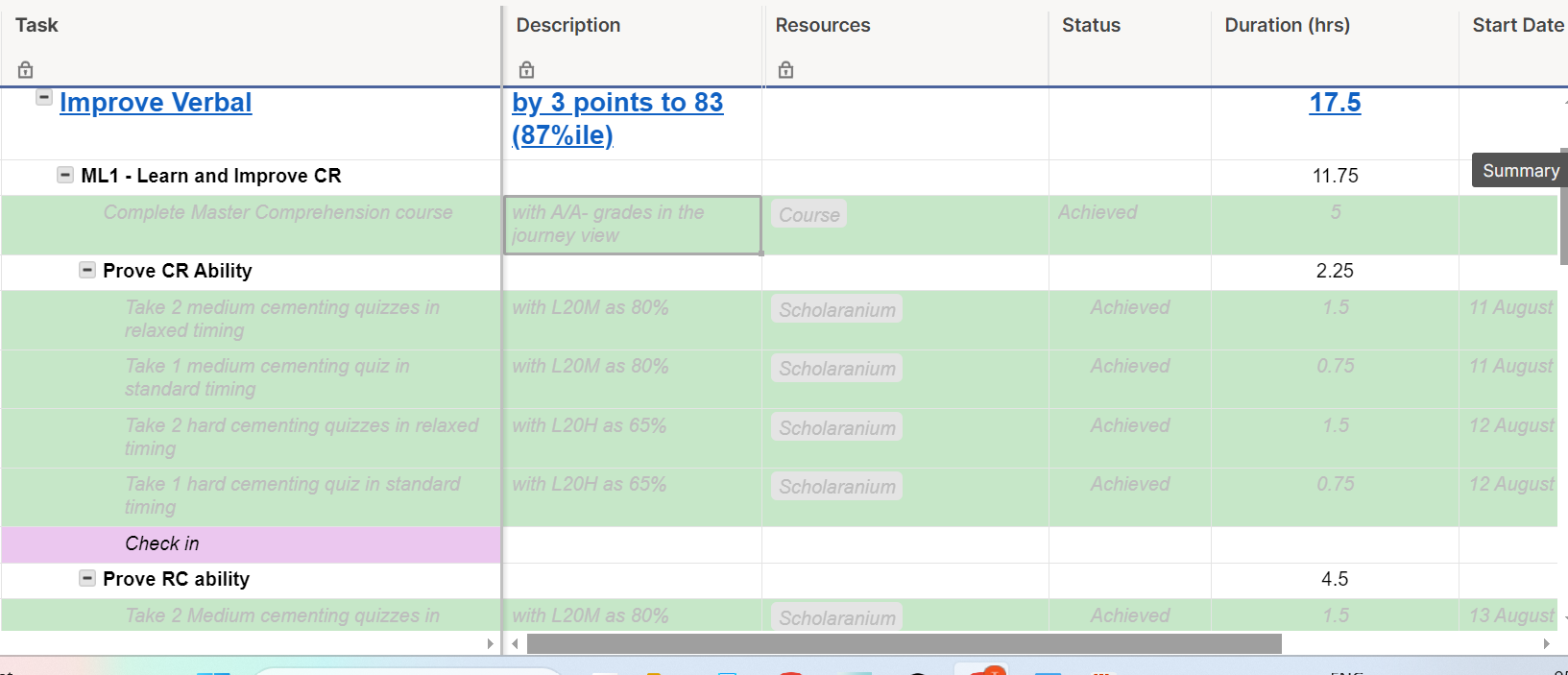
Detailed study plan: My coach, Rida, created a custom study plan for me. It covered all three sections of the GMAT and focused on my weak spots. The study plan includes the sub-section, the tasks I had to do, but also the accuracy levels I needed to reach - in order to get the score I wanted.
I ll attach a screenshot of what it looks like! (Currently not able to post - will try again)
My plan was as follows:
Practice with Scholaranium: I used e-GMAT’s platform, Scholaranium, to practice lots of questions at different difficulty levels. Each question had a detailed review, and I kept notes on why I took longer or why I got something wrong. This practice was key to mastering Hard questions.
Achieving test readiness: After finishing the courses and quizzes, my coach set a goal for me to reach a certain accuracy on Medium and Hard questions. This was my "test readiness," and it was tailored to my progress.
Confidence on test day: Unlike my previous trials, I went into the exam confident because I had already hit my "test readiness" goals.
In the end, e-GMAT’s structure, combined with consistent practice and error logging, made all the difference. If you stick with it, follow the plan and are ready to work, you can achieve the GMAT score you’re aiming for.
Let me know if you have questions!
Initial context: I studied for three months on my own, using only the official guide. I scored 645 within two months. I studied again for one month by myself and took the test a second time : still stuck at 645.
Here’s what I did next:
Realized I needed help: I knew I had to try find another resource or approach, so I looked into various resources. After reviewing the different possibilities, I decided to go for e-GMAT because the reviews were more compelling and the price was lower than the other resources I found. I also checked their free sample videos, which looked like what I needed in terms of methodology. (Tip: They also do free webinars, which I did not know)
Initial consultation: My journey with e-GMAT started with a call with Rida where we reviewed my scores in detail and pinpointed where I needed to improve. This led me to join the Last Mile Push program.
Detailed study plan: My coach, Rida, created a custom study plan for me. It covered all three sections of the GMAT and focused on my weak spots. The study plan includes the sub-section, the tasks I had to do, but also the accuracy levels I needed to reach - in order to get the score I wanted.
I ll attach a screenshot of what it looks like! (Currently not able to post - will try again)
My plan was as follows:
- Verbal: Master Comprehension - I first reviewed the basics of how sentences and arguments are built
- Verbal: Critical Reasoning- I did a few Medium and Hard quizzes. I realized that I did not have the right methodology, which involves visualising the argument and asking the right pre-thinking question. e-gmat provided me with an error log (cf. screenshot below). It is an Excel file that I filled after each question where I took longer than average or I did a mistake. Taking the time to reflect after each question helped me implement the right methodology almost “naturally”.
- Verbal: Reading Comprehension - After a few quizzes and learning videos, I realized that what was missing in my methodology was: ACTIVE READING. I learnt how to read actively (i.e. be engaged in the reading, be able to infer and anticipate) and it’s crazy how it helped me save time. PS I am not a native English speaker
- In parallel, I did the same process on Quant: Started with Number Properties, then Word Problems then Algebra and Advanced Topics. Because I already scored well on Quant, I only did Hard questions. Same here, my Error Log was my best friend: I took time after each faltered question to understand why I did that mistake.
- Then I moved to Data Insights. I really struggled to find proper resources on DI. I can say that e-gmat resources were mindblowing:
- They have a separate section for each type of questions: Graphic Interpretation, Table Analysis, Two-Part Analysis and Multi-Source Reasoning
- I first did the courses - where I learnt the right methodology for each sub-section, cf. below
- Before e-gmat, DI was a source of stress/panic for me (even though I am from a data background), I felt like I took too much time and did not know how to go through it. I learnt with e-gmat that the key was to not scroll the data source and rush, but rather spend time on the data, READ ACTIVELY (again) before moving to the questions. I also learnt that non necessary calculation was wasting my time on DI.
Practice with Scholaranium: I used e-GMAT’s platform, Scholaranium, to practice lots of questions at different difficulty levels. Each question had a detailed review, and I kept notes on why I took longer or why I got something wrong. This practice was key to mastering Hard questions.
Achieving test readiness: After finishing the courses and quizzes, my coach set a goal for me to reach a certain accuracy on Medium and Hard questions. This was my "test readiness," and it was tailored to my progress.
Confidence on test day: Unlike my previous trials, I went into the exam confident because I had already hit my "test readiness" goals.
In the end, e-GMAT’s structure, combined with consistent practice and error logging, made all the difference. If you stick with it, follow the plan and are ready to work, you can achieve the GMAT score you’re aiming for.
Let me know if you have questions!
mimosa1712
30 Aug 2024, 20:12
Kudos
Bookmarks
A screenshot of my study plan:

GMAT-Club-Forum-p1gs0p39.png [ 128.83 KiB | Viewed 565 times ]
Attachment:
GMAT-Club-Forum-p1gs0p39.png [ 128.83 KiB | Viewed 565 times ]
Moderator:







