Events & Promotions
|
|

GMAT Club Daily Prep
Thank you for using the timer - this advanced tool can estimate your performance and suggest more practice questions. We have subscribed you to Daily Prep Questions via email.
Customized
for You
Track
Your Progress
Practice
Pays
Not interested in getting valuable practice questions and articles delivered to your email? No problem, unsubscribe here.
 Sep 02
01:00 PM EDT
-11:59 PM EDT
Take 30% off all study plans with code COURSEWORK - Expires on Monday 9/7 Sep 04
01:30 AM EDT
-02:30 AM EDT
This Labor Day, turn your hard work into real score gains. From 615→715 in 15 days to 705 in 30 days, our students prove what's possible with personalized, expert guidance. Save up to 25% on 1-on-1 tutoring. Sep 04
10:00 AM EDT
-11:59 PM EDT
We’ve worked incredibly hard to build TTP into the best test prep experience possible, and it would mean a lot to us to win Newsweek’s 2026 Readers’ Choice Award for Best Test Prep. If TTP has helped you, we’d be incredibly grateful for your vote. Sep 06
09:30 AM EDT
-12:30 PM EST
Top scores are possible when you enroll in a powerful EA course, taught live online + 6 months access to TTP OnDemand video courses included! Perfect class schedule and easy course access for working professionals. Class starts Sundays Sept. 6, 2026. Sep 07
12:01 AM PDT
-11:59 PM PDT
On the 7th, GMAT Club Tests will be Free! Including all the Quizzes, Questions, and Tests. 12 AM - 11:59 PM PDT Sep 07
12:30 AM EDT
-01:30 AM EDT
Tejas studied hard but kept repeating the same mistakes. After 3 attempts at 645, a focused 4-week strategy helped him identify and fix what was holding him back—leading to a 695 with just 12–15 hours of study per week.- Sep 07
10:00 AM PDT
-11:00 AM PDT
A complete walkthrough of GMAT Club’s free 12-week GMAT study plan: what you study each week, how progress and goals are tracked, how the error log works, and how your practice unlocks paid tools at no cost. - Sep 09
07:00 AM PDT
-10:00 AM PDT
Meet AdComs and explore top Master’s programs - MiM, MiF, MSc, MSBA and more. - Application Fee Waivers - Free 1-Week of GMAT Club Tests: - Master's Application Toolkit - Grand Prize Giveaway - Sep 09
10:00 AM PDT
-11:00 AM PDT
Three MBA applications. Three rejections. No interview invites. A year later, Aman was admitted to Cambridge Judge, SMU, and IMD. In this episode of MBA Admit Stories, Aman shares how he rebuilt his MBA application...  Sep 10
08:00 PM PDT
-09:00 PM PDT
Free- full-length test + 15 concept videos + 150+ short videos + study plan! Sep 15
07:00 PM EDT
-09:00 PM EST
Elite scores are possible when you enroll in a powerful GMAT course, taught live online + 6 months access to TTP OnDemand video courses included! Class starts Tues/Thurs Sept. 15, 2026 - Nov. 15, 2027, 7:00pm-9:00pm EST Sep 21
08:00 PM EDT
-10:00 PM EDT
Boost your GMAT score in less than one month in a live online class + 6 months access to TTP OnDemand video courses included! Class starts Mon, Tues, Wed, Thur, Fri Sept. 21, 2026 - Oct. 9, 2027, 7:00pm-10:00pm EST

TalonShade
Joined: 21 Apr 2021
Last visit: 29 Dec 2022
Posts: 28
Own Kudos:
Given Kudos: 26
Location: India
Schools: IESE '25 (A)
GRE 1: Q165 V163
GPA: 2.24
 19 Apr 2022, 12:05
Kudos
Bookmarks
I'm curious if we have any data on how many 700-750 level questions can one expect on the verbal (SC, RC, CR each) and on the quant? This is assuming the person writing the test scores a 730+


 19 Apr 2022, 12:15
Kudos
Bookmarks
Not as many as people tend to think. The crazy part is that the numbers can also vary from test to test depending on the question bank being used.
I would say on my test I saw only one 750 level question and perhaps a handful of hard questions in verbal. Obviously this also depends on your progression and if you make a mistake, as you know you get an easier question and if you get it right, you get a hard question so and so forth. I think if you’re shooting for a 730 or higher score, you will likely see fewer than 2 750+ questions, and fewer than 5 700-level questions. This is a totally made up number. You could go through one of your GMAT prep tests and map out the difficulty using the GMAT Club timer and see what that research shows you.
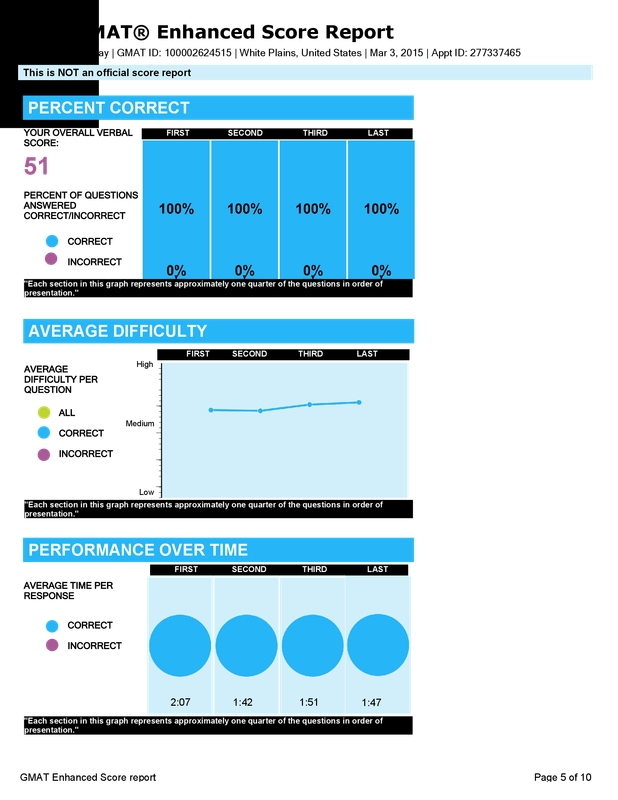
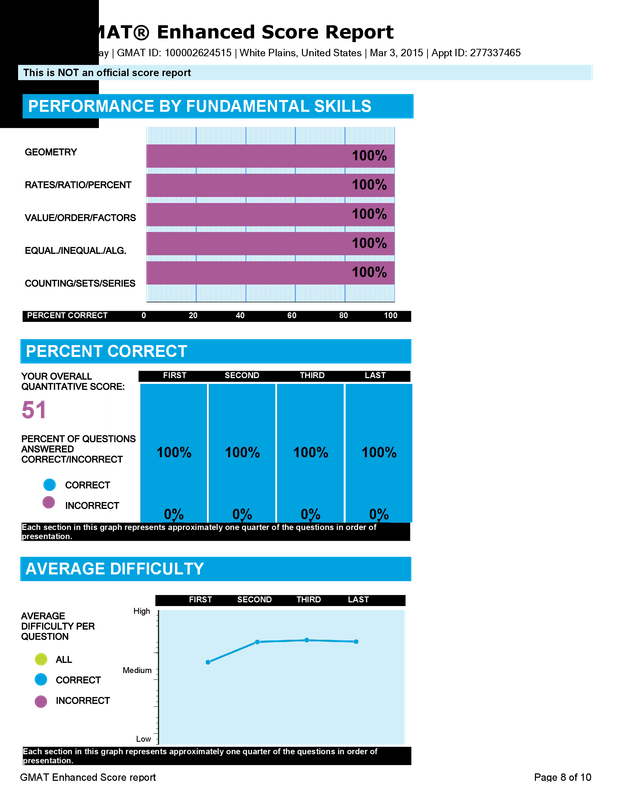
PS. We have seen several situations from the enhance score reports where people only made a couple mistakes and got pretty low scores for what you would think he would get. Analyzing their reports, it became clear that they never really got any hard questions and that was because the database did not have hard questions and because they made mistakes in a few medium difficulty questions, they got penalized quite a bit more. There was even a famous case when a person made zero mistakes in their verbal portion of the GMAT and they still did not get the top score. They had a peeled and it was manually adjusted but it underscores the point that the number of difficult questions you see is driven by the database and the reason you don’t see as many hard questions as everyone thinks, is that it’s very hard to write hard questions and it’s very very expensive. It is a lot cheaper and economical to provide medium and easy level questions and try to catch people that way and frankly, it’s sufficient as we can see.
PS. Bottom line is that you will have a lot better ROI focusing on medium level questions because you are guaranteed to see a lot more of those and in my experience especially in verbal, you have very different strategies for medium critical reasoning and hard critical reasoning questions. It’s good to know both but if you expect four out of five critical reasoning questions to be medium or easy, there’s no reason to start with the approach that you would use for a hard one. My 2 cents.
PPS. As a matter of fact, I know that a number of experts including GMAT Ninja do not agree with my critical reasoning approach. I like to answer critical reasoning questions ahead of time after reading the paragraph. I find it faster and more reliable. In their experience, tutoring students, they found that not to be the case for the majority so you have to figure out what works best for you. But the part I think they would agree with is that most questions you will encounter, will not be the hard questions.
Posted from my mobile device
I would say on my test I saw only one 750 level question and perhaps a handful of hard questions in verbal. Obviously this also depends on your progression and if you make a mistake, as you know you get an easier question and if you get it right, you get a hard question so and so forth. I think if you’re shooting for a 730 or higher score, you will likely see fewer than 2 750+ questions, and fewer than 5 700-level questions. This is a totally made up number. You could go through one of your GMAT prep tests and map out the difficulty using the GMAT Club timer and see what that research shows you.
PS. We have seen several situations from the enhance score reports where people only made a couple mistakes and got pretty low scores for what you would think he would get. Analyzing their reports, it became clear that they never really got any hard questions and that was because the database did not have hard questions and because they made mistakes in a few medium difficulty questions, they got penalized quite a bit more. There was even a famous case when a person made zero mistakes in their verbal portion of the GMAT and they still did not get the top score. They had a peeled and it was manually adjusted but it underscores the point that the number of difficult questions you see is driven by the database and the reason you don’t see as many hard questions as everyone thinks, is that it’s very hard to write hard questions and it’s very very expensive. It is a lot cheaper and economical to provide medium and easy level questions and try to catch people that way and frankly, it’s sufficient as we can see.
PS. Bottom line is that you will have a lot better ROI focusing on medium level questions because you are guaranteed to see a lot more of those and in my experience especially in verbal, you have very different strategies for medium critical reasoning and hard critical reasoning questions. It’s good to know both but if you expect four out of five critical reasoning questions to be medium or easy, there’s no reason to start with the approach that you would use for a hard one. My 2 cents.
PPS. As a matter of fact, I know that a number of experts including GMAT Ninja do not agree with my critical reasoning approach. I like to answer critical reasoning questions ahead of time after reading the paragraph. I find it faster and more reliable. In their experience, tutoring students, they found that not to be the case for the majority so you have to figure out what works best for you. But the part I think they would agree with is that most questions you will encounter, will not be the hard questions.
Posted from my mobile device
 Updated on: 21 Apr 2023, 01:20
Originally posted by GmatKnightTutor on 20 Apr 2022, 04:06.
Last edited by GmatKnightTutor on 21 Apr 2023, 01:20, edited 1 time in total.
Last edited by GmatKnightTutor on 21 Apr 2023, 01:20, edited 1 time in total.
Kudos
Bookmarks
Might be worth having a look at some of the ESRs of top Verbal scorers to see the difficulty level of the questions they faced. The ESRs don't specify them in number terms such as 600-650 or 700-750 level, though. You may see "Medium High" used as a classification, for example.
How to get a V40 or higher on the GMAT? What about a V51?
How to get a V40 or higher on the GMAT? What about a V51?