Events & Promotions
|
|

GMAT Club Daily Prep
Thank you for using the timer - this advanced tool can estimate your performance and suggest more practice questions. We have subscribed you to Daily Prep Questions via email.
Customized
for You
Track
Your Progress
Practice
Pays
Not interested in getting valuable practice questions and articles delivered to your email? No problem, unsubscribe here.
 Sep 24
08:00 AM EDT
-08:30 AM EDT
Meet Tuck at an informal student or staff-hosted coffee chat in a city near you! Sep 24
01:30 AM EDT
-01:30 AM EDT
Tejas studied hard but kept repeating the same mistakes. After 3 attempts at 645, a focused 4-week strategy helped him identify and fix what was holding him back—leading to a 695 with just 12–15 hours of study per week. Sep 26
01:00 PM EDT
-04:00 PM EDT
Top scores are possible when you enroll in a powerful GMAT course, taught live online + 6 months access to TTP OnDemand video courses included. Class starts Saturdays Sept. 26, 2026 - Dec. 19, 2026, 1:00pm-4:00pm ES Sep 26
06:00 PM PDT
-07:00 PM PDT
Free- full-length test + 15 concept videos + 150+ short videos + study plan! Sep 29
11:00 AM EDT
-01:00 PM EDT
" Description: Top scores are possible when you enroll in a powerful GMAT course, taught live online + 6 months access to TTP OnDemand video courses included! Class starts Tues/Thur Sept. 29, 2026 - Dec. 3, 2026, 11:00am-1:00pm EST Oct 01
07:00 AM BST
-08:00 AM GMT
Welcome to the GMAT Club's Free Interview Prep Event for Top MBA Programs! Buy tickets - Virtual series that’s all set to equip you to -excel in your MBA interviews.


 30 Nov 2020, 09:38
Kudos
Bookmarks
Dropdown 1: 12
Dropdown 2: less than
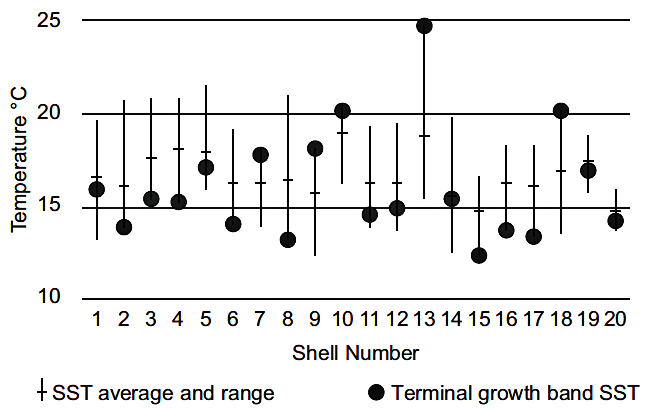
The graph shows the minimum, maximum, and mean sea-surface temperatures (with the mean indicated by —), as well as the terminal growth band SST (indicated by •) recorded for 20 sampled shells. The terminal growth band SST refers to the sea-surface temperature at the time the shell stopped growing.
Select from each drop-down menu the option that creates the most accurate statement, given the information provided.
The range of temperatures observed across all shells is approximately °C.
The median terminal growth band SST for all sampled shells is the average of the mean SSTs for all shells.
ShowHide Answer
Official Answer
Dropdown 1: 12
Dropdown 2: less than
30 Nov 2020, 09:38
Kudos
Bookmarks
Official Solution:
Drop-down 1:
From the graph, we can see that the highest temperature recorded for a shell was approximately 24°C (for shell #13), while the lowest temperature recorded was approximately 12°C (for shell #15). Therefore, the range of temperatures observed across all shells is approximately 24 - 12 = 12°C.
Drop-down 2:
The median of 20 data points is calculated as the average of the two middle terms when the data is arranged in order. Observing the graph, we see that 9 terminal growth band SSTs are at or below 15°C. The 10th and 11th largest values, which determine the median, are slightly above 15°C and correspond to approximately 16°C for shells #4 and #14. Thus, the median is 16°C.
However, the mean SSTs for most shells are well above 16°C (except for shells #15 and #20, where they are slightly below 16°C). Therefore, the average of the mean SSTs, with most values well above 16°C and only two slightly below, will also be higher than 16°C. Hence, the median terminal growth band SST for all sampled shells is less than the average of the mean SSTs for all shells.
Correct answer:
Dropdown 1: "12"
Dropdown 2: "less than"
Bunuel
Drop-down 1:
From the graph, we can see that the highest temperature recorded for a shell was approximately 24°C (for shell #13), while the lowest temperature recorded was approximately 12°C (for shell #15). Therefore, the range of temperatures observed across all shells is approximately 24 - 12 = 12°C.
Drop-down 2:
The median of 20 data points is calculated as the average of the two middle terms when the data is arranged in order. Observing the graph, we see that 9 terminal growth band SSTs are at or below 15°C. The 10th and 11th largest values, which determine the median, are slightly above 15°C and correspond to approximately 16°C for shells #4 and #14. Thus, the median is 16°C.
However, the mean SSTs for most shells are well above 16°C (except for shells #15 and #20, where they are slightly below 16°C). Therefore, the average of the mean SSTs, with most values well above 16°C and only two slightly below, will also be higher than 16°C. Hence, the median terminal growth band SST for all sampled shells is less than the average of the mean SSTs for all shells.
Correct answer:
Dropdown 1: "12"
Dropdown 2: "less than"
22 Nov 2024, 03:19
Kudos
Bookmarks
I have revised the question, solution, and formatting by adding more details to enhance clarity