Events & Promotions
|
|

GMAT Club Daily Prep
Thank you for using the timer - this advanced tool can estimate your performance and suggest more practice questions. We have subscribed you to Daily Prep Questions via email.
Customized
for You
Track
Your Progress
Practice
Pays
Not interested in getting valuable practice questions and articles delivered to your email? No problem, unsubscribe here.
 Aug 27
10:00 AM EDT
-11:00 AM EDT
We’ve worked incredibly hard to build TTP into the best test prep experience possible, and it would mean a lot to us to win Newsweek’s 2026 Readers’ Choice Award for Best Test Prep. If TTP has helped you, we’d be incredibly grateful for your vote. Sep 04
10:00 AM PDT
-11:00 AM PDT
What does test anxiety really look like on the GMAT? For many test takers, it does not look like a panic attack. Instead, it shows up as brain fog, rereading, negative comparisons, mental noise.... Sep 06
09:30 AM EDT
-12:30 PM EST
Top scores are possible when you enroll in a powerful EA course, taught live online + 6 months access to TTP OnDemand video courses included! Perfect class schedule and easy course access for working professionals. Class starts Sundays Sept. 6, 2026.- Sep 07
12:01 AM PDT
-11:59 PM PDT
On the 7th, GMAT Club Tests will be Free! Including all the Quizzes, Questions, and Tests. 12 AM - 11:59 PM PDT - Sep 09
07:00 AM PDT
-10:00 AM PDT
Meet AdComs and explore top Master’s programs - MiM, MiF, MSc, MSBA and more. - Application Fee Waivers - Free 1-Week of GMAT Club Tests: - Master's Application Toolkit - Grand Prize Giveaway  Sep 15
07:00 PM EDT
-09:00 PM EST
Elite scores are possible when you enroll in a powerful GMAT course, taught live online + 6 months access to TTP OnDemand video courses included! Class starts Tues/Thurs Sept. 15, 2026 - Nov. 15, 2027, 7:00pm-9:00pm EST Sep 21
08:00 PM EDT
-10:00 PM EDT
Boost your GMAT score in less than one month in a live online class + 6 months access to TTP OnDemand video courses included! Class starts Mon, Tues, Wed, Thur, Fri Sept. 21, 2026 - Oct. 9, 2027, 7:00pm-10:00pm EST


 12 Nov 2024, 03:14
Kudos
Bookmarks
In September 1997, Philadelphia’s long-time commercial classical station, WFLN, was sold for $85,000,000 and changed formats. One week later, Temple University’s WRTI, an all-jazz station since 1958, acquired WFLN’s collection and added classical music to its format.
After the format change, WRTI aired classical music on weekdays from 6 a.m. until 6 p.m., and jazz from 6 p.m. until 6 a.m. Saturday daytime hours were devoted to classical music (except for a 30-minute talk show at 6 a.m. and a 40-minute arts news show at 11 a.m.), while Sunday daytime hours were devoted to gospel or jazz until 3 p.m. Weekends also included syndicated programs such as Piano Jazz, Jazz 20 Profiles, and From the Top, as well as live broadcasts of performances by the Metropolitan Opera in season.
WRTI’s swift move not only prevented the demise of classical music radio in the nation’s sixth largest market but also benefited the station by drawing increased listeners and contributions, particularly from audiences left without another dedicated classical option after WFLN’s format change.
After the format change, WRTI aired classical music on weekdays from 6 a.m. until 6 p.m., and jazz from 6 p.m. until 6 a.m. Saturday daytime hours were devoted to classical music (except for a 30-minute talk show at 6 a.m. and a 40-minute arts news show at 11 a.m.), while Sunday daytime hours were devoted to gospel or jazz until 3 p.m. Weekends also included syndicated programs such as Piano Jazz, Jazz 20 Profiles, and From the Top, as well as live broadcasts of performances by the Metropolitan Opera in season.
WRTI’s swift move not only prevented the demise of classical music radio in the nation’s sixth largest market but also benefited the station by drawing increased listeners and contributions, particularly from audiences left without another dedicated classical option after WFLN’s format change.
For each of the following statements, select Supported if the statement can be reasonably inferred from the information provided. Otherwise, select Not supported.
| Supported | Not supported | |
| After acquiring WFLN’s collection, WRTI allocated more total airtime per week to classical music than to jazz. | ||
| From 1997 through 2005, WRTI had a greater percent increase in its average-quarter-hour (AQH) listenership than in its number of members. | ||
| The average contribution per member changed by less than 10% from 1997 to 2005 |
ShowHide Answer
Official Answer
After acquiring WFLN’s collection, WRTI allocated more total airtime per week to classical music than to jazz.: Not supported
From 1997 through 2005, WRTI had a greater percent increase in its average-quarter-hour (AQH) listenership than in its number of members.: Not supported
The average contribution per member changed by less than 10% from 1997 to 2005: Supported
18 Nov 2024, 12:01
Kudos
Bookmarks
Official Solution:
After acquiring WFLN’s collection, WRTI allocated more total airtime per week to classical music than to jazz.
• Tab 1 states that on weekdays, WRTI aired classical music from 6 a.m. to 6 p.m. and jazz from 6 p.m. to 6 a.m., resulting in an equal weekday split. On Saturdays, classical music aired during the daytime except for a 30-minute talk show and a 40-minute arts news program. On Sundays, gospel or jazz aired until 3 p.m., but it is unclear what was broadcast afterward. The weekend nighttime schedule and the durations of syndicated and seasonal programs are not specified. Because the full weekly distribution of airtime between classical music and jazz is not known, the statement cannot be confirmed.
From 1997 through 2005, WRTI had a greater percent increase in its average-quarter-hour (AQH) listenership than in its number of members.
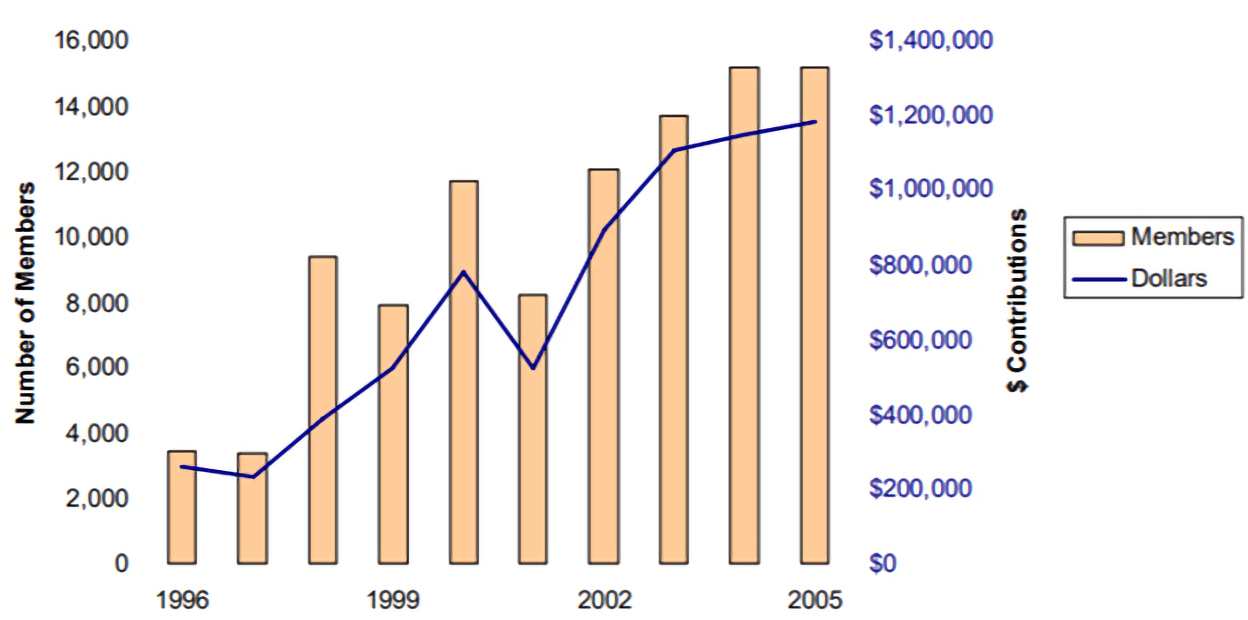
• Tab 2 states that AQH listeners increased from approximately 6,500 in 1997 to 18,300 in 2005, a gain of 180%. Over the same period, membership increased from 3,371 to 15,000, a gain of more than 340%. Since 340% is substantially greater than 180%, the statement is incorrect. Not supported.
The average contribution per member changed by less than 10% from 1997 to 2005.
• In 1997, Tab 2 reports 3,371 members and approximately $259,000 in member contributions. This gives an average of about $77 per member. In 2005, with 15,000 members and $1,200,000 in contributions, the average was exactly $80 per member. The difference is $3, which is less than a 10% change. Therefore, this statement is supported.
Correct answer:
After acquiring WFLN’s collection, WRTI allocated more total airtime per week to classical music than to jazz. "Not supported"
From 1997 through 2005, WRTI had a greater percent increase in its average-quarter-hour (AQH) listenership than in its number of members. "Not supported"
The average contribution per member changed by less than 10% from 1997 to 2005 "Supported"
Bunuel
After acquiring WFLN’s collection, WRTI allocated more total airtime per week to classical music than to jazz.
• Tab 1 states that on weekdays, WRTI aired classical music from 6 a.m. to 6 p.m. and jazz from 6 p.m. to 6 a.m., resulting in an equal weekday split. On Saturdays, classical music aired during the daytime except for a 30-minute talk show and a 40-minute arts news program. On Sundays, gospel or jazz aired until 3 p.m., but it is unclear what was broadcast afterward. The weekend nighttime schedule and the durations of syndicated and seasonal programs are not specified. Because the full weekly distribution of airtime between classical music and jazz is not known, the statement cannot be confirmed.
From 1997 through 2005, WRTI had a greater percent increase in its average-quarter-hour (AQH) listenership than in its number of members.
• Tab 2 states that AQH listeners increased from approximately 6,500 in 1997 to 18,300 in 2005, a gain of 180%. Over the same period, membership increased from 3,371 to 15,000, a gain of more than 340%. Since 340% is substantially greater than 180%, the statement is incorrect. Not supported.
The average contribution per member changed by less than 10% from 1997 to 2005.
• In 1997, Tab 2 reports 3,371 members and approximately $259,000 in member contributions. This gives an average of about $77 per member. In 2005, with 15,000 members and $1,200,000 in contributions, the average was exactly $80 per member. The difference is $3, which is less than a 10% change. Therefore, this statement is supported.
Correct answer:
After acquiring WFLN’s collection, WRTI allocated more total airtime per week to classical music than to jazz. "Not supported"
From 1997 through 2005, WRTI had a greater percent increase in its average-quarter-hour (AQH) listenership than in its number of members. "Not supported"
The average contribution per member changed by less than 10% from 1997 to 2005 "Supported"