Thank you for using the timer - this advanced tool can estimate your performance and suggest more practice questions. We have subscribed you to Daily Prep Questions via email.
Customized for You
we will pick new questions that match your level based on your Timer History
Track Your Progress
every week, we’ll send you an estimated GMAT score based on your performance
Practice Pays
we will pick new questions that match your level based on your Timer History
Not interested in getting valuable practice questions and articles delivered to your email? No problem, unsubscribe here.
Thank you for using the timer!
We noticed you are actually not timing your practice. Click the START button first next time you use the timer.
There are many benefits to timing your practice, including:
The Target Test Prep course represents a quantum leap forward in GMAT preparation, a radical reinterpretation of the way that students should study. Try before you buy with a 5-day, full-access trial of the course for FREE!
Prefer video-based learning? The Target Test Prep OnDemand course is a one-of-a-kind video masterclass featuring 400 hours of lecture-style teaching by Scott Woodbury-Stewart, founder of Target Test Prep and one of the most accomplished GMAT instructors
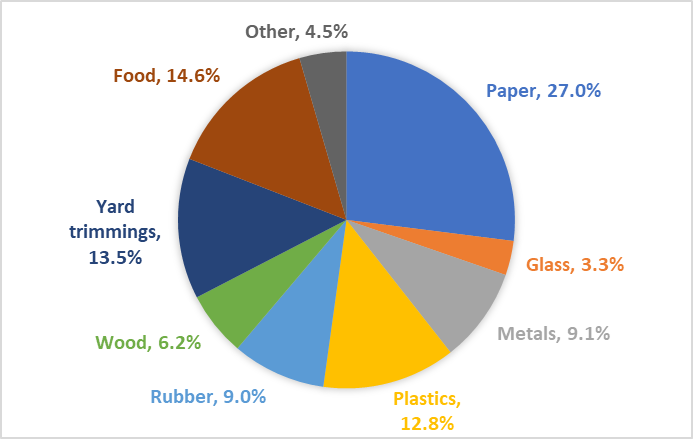
The graph above shows the proportions of 9 material categories comprising 254 million tons of municipal solid waste in 2013 before potential recycling.
Select from each drop-down menu the option that creates the most accurate statement based on the information provided.
If 50% of paper waste and 35% of metal waste were recycled in 2013, then the amount of recycled paper, in tons, would be approximately times that of recycled metal waste.
If the weight of plastic waste remained the same in 2014 while the weight of total waste increased by 10% from 2013 to 2014, and the increase in tons was evenly distributed across the other eight categories, then a increase would represent the greatest percent increase in tons of waste for any of the eight categories from 2013 to 2014.
The graph above shows the proportions of 9 material categories comprising 254 million tons of municipal solid waste in 2013 before potential recycling.
Select from each drop-down menu the option that creates the most accurate statement based on the information provided.
If 50% of paper waste and 35% of metal waste were recycled in 2013, then the amount of recycled paper, in tons, would be approximately times that of recycled metal waste.
If the weight of plastic waste remained the same in 2014 while the weight of total waste increased by 10% from 2013 to 2014, and the increase in tons was evenly distributed across the other eight categories, then a increase would represent the greatest percent increase in tons of waste for any of the eight categories from 2013 to 2014.
Show more
Drop-down 1:
Paper waste contributes 27% of the total waste. Since 50% of that was recycled, 13.5% of paper waste was recycled. Metal waste contributes 9.1% of the total waste. Since 35% of that was recycled, approximately 3.2% of metal waste was recycled. Therefore, the amount of recycled paper was approximately \(\frac{13.5}{3.2} \approx 4.2\) times that of recycled metal waste.
Drop-down 1:
The total waste increased by 10% from 2013 to 2014, accounting for a 25.4 million ton increase in total waste. Since this increase was evenly distributed across the eight categories, each category increased by \(\frac{25.4}{8} \approx 3.2\) million tons of waste. The addition of 3.2 million tons would result in the greatest percentage increase for the waste category with the least waste in 2013. That category was Glass, which accounted for 3.3% of 254 million tons, approximately 8.4 million tons. The increase of 3.2 million tons would constitute an increase of \(\frac{3.2}{8.4} * 100 \approx 38\%\).
I did not quite understand the solution. if the weight of plastic waste remained the same it means it's % stayed at 12.8 % correct? Then how is it possible that the solution says the increase in tons should be evenly (and solely) distributed amongst the other categories? By saying 'weight of plastic waste' it means some of the total increase goes to plastic waste right (since it's % remains the same but the base increases hence it also increases in tons).
Is the question wrong or where am I wrong?
Show more
The question is correct.
When the question says "the weight of plastic waste remained the same" — it means the absolute tons of plastic waste did not increase. It stayed at its original 2013 value.
This does not mean its percentage stays the same.
In fact, since total waste increased but plastic waste stayed constant in tons, the percentage of plastic waste in the total actually decreases.
That’s why the rest of the increase (the extra 25.4 million tons) gets evenly distributed only among the other 8 categories.
So the solution is correct — the key is:
Weight stayed the same = tons stayed the same. Percentage will decrease because the total increased but plastic waste didn’t.
I thought that we would use the percentage change formula here to find the percentage increase and hence i did 8.4-3.3/3.3*100 and arrived at 162%. I must be wrong, I was in the line of throught that 62% must be the change. Could you please help me understand what must be wrong in my line of thought and how i can differentiate when to use the percentage change formula vs the one you have used?
Thanks Jacob
Bunuel
Official Solution:
Bunuel
The graph above shows the proportions of 9 material categories comprising 254 million tons of municipal solid waste in 2013 before potential recycling.
Select from each drop-down menu the option that creates the most accurate statement based on the information provided.
If 50% of paper waste and 35% of metal waste were recycled in 2013, then the amount of recycled paper, in tons, would be approximately times that of recycled metal waste.
If the weight of plastic waste remained the same in 2014 while the weight of total waste increased by 10% from 2013 to 2014, and the increase in tons was evenly distributed across the other eight categories, then a increase would represent the greatest percent increase in tons of waste for any of the eight categories from 2013 to 2014.
Drop-down 1:
Paper waste contributes 27% of the total waste. Since 50% of that was recycled, 13.5% of paper waste was recycled. Metal waste contributes 9.1% of the total waste. Since 35% of that was recycled, approximately 3.2% of metal waste was recycled. Therefore, the amount of recycled paper was approximately \(\frac{13.5}{3.2} \approx 4.2\) times that of recycled metal waste.
Drop-down 1:
The total waste increased by 10% from 2013 to 2014, accounting for a 25.4 million ton increase in total waste. Since this increase was evenly distributed across the eight categories, each category increased by \(\frac{25.4}{8} \approx 3.2\) million tons of waste. The addition of 3.2 million tons would result in the greatest percentage increase for the waste category with the least waste in 2013. That category was Glass, which accounted for 3.3% of 254 million tons, approximately 8.4 million tons. The increase of 3.2 million tons would constitute an increase of \(\frac{3.2}{8.4} * 100 \approx 38\%\).
I thought that we would use the percentage change formula here to find the percentage increase and hence i did 8.4-3.3/3.3*100 and arrived at 162%. I must be wrong, I was in the line of throught that 62% must be the change. Could you please help me understand what must be wrong in my line of thought and how i can differentiate when to use the percentage change formula vs the one you have used?
Thanks Jacob
Bunuel
Official Solution:
Bunuel
The graph above shows the proportions of 9 material categories comprising 254 million tons of municipal solid waste in 2013 before potential recycling.
Select from each drop-down menu the option that creates the most accurate statement based on the information provided.
If 50% of paper waste and 35% of metal waste were recycled in 2013, then the amount of recycled paper, in tons, would be approximately times that of recycled metal waste.
If the weight of plastic waste remained the same in 2014 while the weight of total waste increased by 10% from 2013 to 2014, and the increase in tons was evenly distributed across the other eight categories, then a increase would represent the greatest percent increase in tons of waste for any of the eight categories from 2013 to 2014.
Drop-down 1:
Paper waste contributes 27% of the total waste. Since 50% of that was recycled, 13.5% of paper waste was recycled. Metal waste contributes 9.1% of the total waste. Since 35% of that was recycled, approximately 3.2% of metal waste was recycled. Therefore, the amount of recycled paper was approximately \(\frac{13.5}{3.2} \approx 4.2\) times that of recycled metal waste.
Drop-down 1:
The total waste increased by 10% from 2013 to 2014, accounting for a 25.4 million ton increase in total waste. Since this increase was evenly distributed across the eight categories, each category increased by \(\frac{25.4}{8} \approx 3.2\) million tons of waste. The addition of 3.2 million tons would result in the greatest percentage increase for the waste category with the least waste in 2013. That category was Glass, which accounted for 3.3% of 254 million tons, approximately 8.4 million tons. The increase of 3.2 million tons would constitute an increase of \(\frac{3.2}{8.4} * 100 \approx 38\%\).
Correct answer:
Dropdown 1: "4"
Dropdown 2: "38%"
Show more
Please re-read the question and the solution carefully.
You're confusing percentage of total with actual tonnage.
In 2013, Glass made up 3.3% of 254 million tons, which equals 8.4 million tons. In 2014, it increased by 3.2 million tons, so the total became 8.4 + 3.2 = 11.6 million tons.
The question asks what percent 3.2 million is of the original 8.4 million. So the correct calculation is 3.2/8.4.
I like the solution - it’s helpful. Is evenly distributed and proportionally distributed different? Will evenly distributed alwways mean equally distributed, not weighted or proportionate ?