Events & Promotions
| Last visit was: 06 Sep 2026, 17:59 |
It is currently 06 Sep 2026, 17:59 |
|
|

GMAT Club Daily Prep
Thank you for using the timer - this advanced tool can estimate your performance and suggest more practice questions. We have subscribed you to Daily Prep Questions via email.
Customized
for You
Track
Your Progress
Practice
Pays
Not interested in getting valuable practice questions and articles delivered to your email? No problem, unsubscribe here.
 Sep 07
12:01 AM PDT
-11:59 PM PDT
On the 7th, GMAT Club Tests will be Free! Including all the Quizzes, Questions, and Tests. 12 AM - 11:59 PM PDT- Sep 07
10:00 AM PDT
-11:00 AM PDT
A complete walkthrough of GMAT Club’s free 12-week GMAT study plan: what you study each week, how progress and goals are tracked, how the error log works, and how your practice unlocks paid tools at no cost.  Sep 02
01:00 PM EDT
-11:59 PM EDT
Take 30% off all study plans with code COURSEWORK - Expires on Monday 9/7 Sep 04
10:00 AM EDT
-11:59 PM EDT
We’ve worked incredibly hard to build TTP into the best test prep experience possible, and it would mean a lot to us to win Newsweek’s 2026 Readers’ Choice Award for Best Test Prep. If TTP has helped you, we’d be incredibly grateful for your vote. Sep 06
09:30 AM EDT
-12:30 PM EST
Top scores are possible when you enroll in a powerful EA course, taught live online + 6 months access to TTP OnDemand video courses included! Perfect class schedule and easy course access for working professionals. Class starts Sundays Sept. 6, 2026.- Sep 09
07:00 AM PDT
-10:00 AM PDT
Meet AdComs and explore top Master’s programs - MiM, MiF, MSc, MSBA and more. - Application Fee Waivers - Free 1-Week of GMAT Club Tests: - Master's Application Toolkit - Grand Prize Giveaway - Sep 09
10:00 AM PDT
-11:00 AM PDT
Three MBA applications. Three rejections. No interview invites. A year later, Aman was admitted to Cambridge Judge, SMU, and IMD. In this episode of MBA Admit Stories, Aman shares how he rebuilt his MBA application...  Sep 15
07:00 PM EDT
-09:00 PM EST
Elite scores are possible when you enroll in a powerful GMAT course, taught live online + 6 months access to TTP OnDemand video courses included! Class starts Tues/Thurs Sept. 15, 2026 - Nov. 15, 2027, 7:00pm-9:00pm EST Sep 21
08:00 PM EDT
-10:00 PM EDT
Boost your GMAT score in less than one month in a live online class + 6 months access to TTP OnDemand video courses included! Class starts Mon, Tues, Wed, Thur, Fri Sept. 21, 2026 - Oct. 9, 2027, 7:00pm-10:00pm EST


B
Be sure to select an answer first to save it in the Error Log before revealing the correct answer (OA)!
Difficulty:
 15%
(low)
15%
(low)
Question Stats:
82% (01:33) correct 18%
(01:43)
wrong
based on 8539
sessions
18%
(01:43)
wrong
based on 8539
sessions
History
Date
Time
Result
Not Attempted Yet
In ancient Thailand, much of the local artisans' creative energy was expended for the creation of Buddha images and when they constructed and decorated the temples that enshrined them.
(A) much of the local artisans' creative energy was expended for the creation of Buddha images and when they constructed and decorated the temples that enshrined them
(B) much of the local artisans' creative energy was expended on the creation of Buddha images and on construction and decoration of the temples in which they were enshrined
(C) much of the local artisans' creative energy was expended on the creation of Buddha images as well as constructing and decoration of the temples in which they were enshrined
(D) creating images of Buddha accounted for much of the local artisans' creative energy, and also constructing and decorating the temples enshrining them
(E) the creating of Buddha images accounted for much of the local artisans' creative energy as well as construction and decoration of the temples that enshrined them
Subscribe to GMAT Question of the Day: E-mail | RSS
For All QOTD Questions Click Here
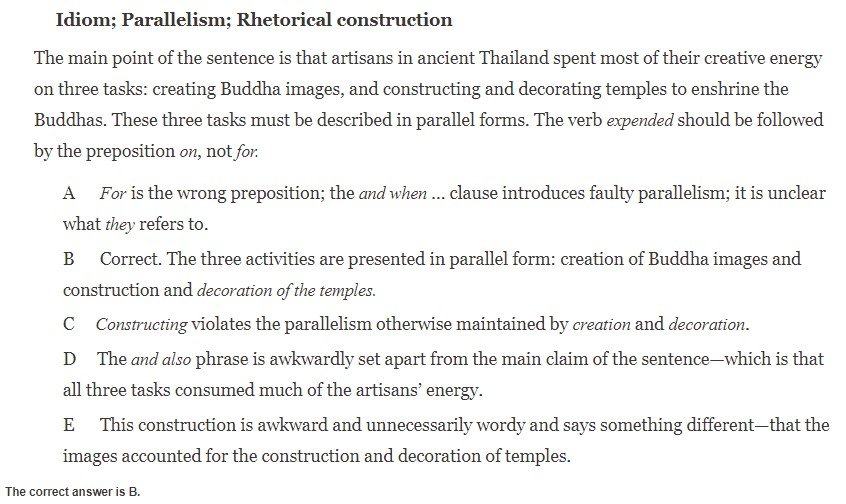
Annotation 2019-03-20 074036.jpg [ 114.42 KiB | Viewed 56964 times ]
(A) much of the local artisans' creative energy was expended for the creation of Buddha images and when they constructed and decorated the temples that enshrined them
(B) much of the local artisans' creative energy was expended on the creation of Buddha images and on construction and decoration of the temples in which they were enshrined
(C) much of the local artisans' creative energy was expended on the creation of Buddha images as well as constructing and decoration of the temples in which they were enshrined
(D) creating images of Buddha accounted for much of the local artisans' creative energy, and also constructing and decorating the temples enshrining them
(E) the creating of Buddha images accounted for much of the local artisans' creative energy as well as construction and decoration of the temples that enshrined them
Verbal Question of The Day: Day 172: Sentence Correction
Subscribe to GMAT Question of the Day: E-mail | RSS
For All QOTD Questions Click Here
Attachment:
Annotation 2019-03-20 074036.jpg [ 114.42 KiB | Viewed 56964 times ]


 06 Dec 2017, 00:09
Kudos
Bookmarks
Quote:
The biggest issue in (A) is the mess of pronouns toward the end of the sentence. That first “they” logically needs to refer to “local artisans”, but that raises two problems. First, “Buddha images” is the closest plural noun, so that raises a potential ambiguity issue. Second, “local artisans” is actually a possessive noun here, and in general on the GMAT, it’s not ideal to have a non-possessive pronoun (“they”) refer back to a possessive noun (artisans’).
If you need a refresher on pronouns, feel free to check out this YouTube webinar. To be fair, pronoun ambiguity isn’t an absolute rule, so you could keep (A) if you really wanted to be conservative. But in this case, I think we can agree that the pronouns are legitimately confusing, or at least we can agree that there are better options below.
And if that isn’t enough for you, there’s arguably a little parallelism issue in (A): “…the local artisans' creative energy was expended for the creation of Buddha images and when they constructed and decorated…” I’m not 100% certain that it’s WRONG, exactly: I guess it’s OK to say that “the local artisans’ creative energy was expended… when they constructed and decorated the temples…” But technically speaking, “for the creation” is a prepositional phrase, and “when they constructed” is not.
If you’re not convinced by that last paragraph, no worries: the pronoun thing is probably enough to allow us to get rid of (A), particularly since we’ll have better options in a moment.
Quote:
This one seems much better! The pronoun “they” logically need to refer to “Buddha images”, and there’s no real reason to worry about ambiguity here: “Buddha images” is really the only plausible plural referent, since “local artisans’” is possessive, and “temples” isn’t really an option, since “they” couldn’t plausibly refer back to temples in the phrase “temples in which they were enshrined.”
The parallelism is also much better here: “much of the local artisans' creative energy was expended on the creation of Buddha images and on construction and decoration…” Yup, that’s parallel.
So we can keep (B).
Quote:
(C) isn’t all that different from (B), but it does warp the parallelism a little bit. Let’s put the key part of the sentence side-by-side so we can see the differences:
- (B) “much of the local artisans' creative energy was expended on the creation of Buddha images and on construction and decoration…”
(C)“much of the local artisans' creative energy was expended on the creation of Buddha images as well as constructing and decoration…”
(C) isn’t totally awful, but I see absolutely no reason to use “as well as” here, when a nice, simple “and” does the trick. Plus, (B) is parallel throughout: the artisans’ energy was expended on the creation, construction, and decoration. That’s nice. In (C), it gets wonky: we have “on the creation”, but then “constructing and decoration.” That’s less nice.
Again, I wouldn’t argue that (C) is WRONG, exactly. But it’s clearly inferior to (B), so we can eliminate (C).
Quote:
This is a confusing mess. Basically, we can’t make any sense of the parallelism: “and” is followed by “constructing and decorating”, but I can’t figure out what “constructing and decorating” is parallel to. “Creating” is structurally similar, but if we’re trying to make “creating” parallel to “constructing and decorating”, then why aren’t all of them at the beginning of the sentence?
Plus, we could argue that “them” is more confusing than in (B). “Them” logically refers back to “images of Buddha”, which is waaaaay back in the beginning of the sentence in (D). The antecedent is much closer to the pronoun in (B). Again, pronoun ambiguity isn’t an absolute rule on the GMAT, and I wouldn’t necessarily argue that (D) is WRONG solely because of the pronoun – but the pronoun gives us another small reason to prefer (B) over (D).
Quote:
We can make the same argument about the pronoun “them” in (E) as we did in (D): it isn’t WRONG for “them” to reach all the way back to “Buddha images”, but it isn’t ideal, either.
More importantly, the meaning of the sentence is warped by the phrase “as well as construction and decoration.” It sounds like the sentence is trying to say that “the creating of Buddha images” accounted for several things: “the local artisans’ creative energy” and also “the construction and decoration of the temples.” And that doesn’t make sense: the creating of Buddha images didn’t “account for the construction and decoration of temples.”
Plus, I suppose you could also argue that “the creating of Buddha images” is a not-so-ideal use of a gerund. There’s no need to use the gerund “creating” when the noun “creation” is available to us. Again, I don’t think that “the creating of Buddha images” is WRONG, exactly, but it’s one more small reason to feel good about eliminating (E).
So (B) is our answer.
 10 Jan 2012, 13:21
Kudos
Bookmarks
Hi, there! I'm happy to help with this. 
Original sentence: In ancient Thailand, much of the local artisans’ creative energy was expended for the creation of Buddha images and when they constructed and decorated the temples that enshrined them.
First of all, notice the idiom with the verb "to expend." When I expend my energies, with the intended result of giving my energy to X, we say that "I expend my energies on X", not "I expend my energies for X." That eliminates answer choice A.
Notice also, what the original sentence is trying to do is construct a valid parallel structure. The "local artisan's creative energy" went to two places: (a) "creation of Buddha images", and (b) the work they did constructing & decorating temples. The correct sentence should have a valid parallel structure between those two elements. This is another flaw of answer (A) --- "the creation" vs. "they constructed and decorated". Not parallel.
Answer (C) repeats that problem: "the creation" vs. "constructing and decorating". Not parallel.
Answer (E) repeats that problem: "the creating" vs. "construction and decoration". Not parallel.
That narrows the choice down to (B) vs. (D).
Notice that (D) is very wordy; it has an indirect inactive structure (from "artisans expended energy on X", active, to "X accounted for artisans energy", passive and weak).
(B) gets the idiom ("expended on") correct; it gets the parallel structure correct; and it's a direct & active formulation of the information. Yeah! This is our best choice.
Does that made sense? Please let me know if you have any questions.
Mike
Original sentence: In ancient Thailand, much of the local artisans’ creative energy was expended for the creation of Buddha images and when they constructed and decorated the temples that enshrined them.
First of all, notice the idiom with the verb "to expend." When I expend my energies, with the intended result of giving my energy to X, we say that "I expend my energies on X", not "I expend my energies for X." That eliminates answer choice A.
Notice also, what the original sentence is trying to do is construct a valid parallel structure. The "local artisan's creative energy" went to two places: (a) "creation of Buddha images", and (b) the work they did constructing & decorating temples. The correct sentence should have a valid parallel structure between those two elements. This is another flaw of answer (A) --- "the creation" vs. "they constructed and decorated". Not parallel.
Answer (C) repeats that problem: "the creation" vs. "constructing and decorating". Not parallel.
Answer (E) repeats that problem: "the creating" vs. "construction and decoration". Not parallel.
That narrows the choice down to (B) vs. (D).
Notice that (D) is very wordy; it has an indirect inactive structure (from "artisans expended energy on X", active, to "X accounted for artisans energy", passive and weak).
(B) gets the idiom ("expended on") correct; it gets the parallel structure correct; and it's a direct & active formulation of the information. Yeah! This is our best choice.
Does that made sense? Please let me know if you have any questions.
Mike
 10 Dec 2021, 05:54
Kudos
Bookmarks
Dear Friends,
Here is a detailed explanation to this question-
Meaning is crucial to solving this problem:
Understanding the intended meaning is key to solving this question; the intended meaning of this sentence is that in ancient Thailand local artisans' expended much of their creative energy on the creation of Buddha images and on the construction and decoration of the temples in which the statues were enshrined.
Concepts tested here: Meaning + Tenses + Pronouns + Parallelism
• Any elements linked by a conjunction ("and" in this sentence) must be parallel.
• The simple past tense is used to refer to events that concluded in the past.
• Present participles ("verb+ing" – “enshrining” in this sentence) are used to modify nouns, refer to ongoing events in any time period, and (when preceded by a comma) express cause-effect relationships.
A: THis answer choice incorrectly uses "they" to refer to the "artisans" and uses "them" to refer to "images"; please remember, a pronoun and its derivatives can only be used to refer to one noun in a sentence. Further, Option A fails to maintain parallelism between "for the creation of Buddha images" and "when they constructed and decorated the temples"; please remember, any elements linked by a conjunction ("and" in this sentence) must be parallel.
B: Correct. This answer choice uses the clause "much of the local artisans' creative energy was expended...on construction and decoration of the temples", conveying the intended meaning - that local artisans' expended much of their creative energy on the creation of Buddha images and on the construction and decoration of the temples in which the statues were enshrined. Further, Option B maintains parallelism between "the creation of Buddha images" and "on construction and decoration of the temples" and between "construction" and "decoration". Additionally, Option B correctly uses the simple past tense verb "enshrined" to refer to an action that concluded in the past. Besides, Option B avoids the pronoun error seen in Option A, as it only uses "they" to refer to "images"
C: This answer choice fails to maintain parallelism between "on the creation of Buddha images" and "constructing and decoration of the temples" and fails to maintain parallelism between "constructing" and "decoration"; please remember, any elements linked by a conjunction ("and" in this case) must be parallel.
D: This answer choice alters the meaning of the sentence through the clause "creating images of Buddha accounted for...constructing and decorating the temples enshrining them"; the construction of this clause illogically implies that creating images of Buddha accounted for much of the local artisans' creative energy, and also accounted for constructing and decorating the temples that enshrined them; the intended meaning is that local artisans' expended much of their creative energy on the creation of Buddha images and on the construction and decoration of the temples in which the statues were enshrined. Further, Option D incorrectly uses the present perfect tense verb "enshrining" to refer to an event that concluded in the past; please remember, the simple past tense is used to refer to events that concluded in the past, and present participles ("verb+ing" – “enshrining” in this sentence) are used to modify nouns, refer to ongoing events in any time period, and (when preceded by a comma) express cause-effect relationships.
E:This answer choice alters the meaning of the sentence through the clause "the creating of Buddha images accounted for...construction and decoration of the temples that enshrined them"; the construction of this clause illogically implies that creating images of Buddha accounted for much of the local artisans' creative energy, and also accounted for constructing and decorating the temples that enshrined them; the intended meaning is that local artisans' expended much of their creative energy on the creation of Buddha images and on the construction and decoration of the temples in which the statues were enshrined.
Hence, B is the best answer choice.
All the best!
Experts' Global Team
Here is a detailed explanation to this question-
nakib77
Meaning is crucial to solving this problem:
Understanding the intended meaning is key to solving this question; the intended meaning of this sentence is that in ancient Thailand local artisans' expended much of their creative energy on the creation of Buddha images and on the construction and decoration of the temples in which the statues were enshrined.
Concepts tested here: Meaning + Tenses + Pronouns + Parallelism
• Any elements linked by a conjunction ("and" in this sentence) must be parallel.
• The simple past tense is used to refer to events that concluded in the past.
• Present participles ("verb+ing" – “enshrining” in this sentence) are used to modify nouns, refer to ongoing events in any time period, and (when preceded by a comma) express cause-effect relationships.
A: THis answer choice incorrectly uses "they" to refer to the "artisans" and uses "them" to refer to "images"; please remember, a pronoun and its derivatives can only be used to refer to one noun in a sentence. Further, Option A fails to maintain parallelism between "for the creation of Buddha images" and "when they constructed and decorated the temples"; please remember, any elements linked by a conjunction ("and" in this sentence) must be parallel.
B: Correct. This answer choice uses the clause "much of the local artisans' creative energy was expended...on construction and decoration of the temples", conveying the intended meaning - that local artisans' expended much of their creative energy on the creation of Buddha images and on the construction and decoration of the temples in which the statues were enshrined. Further, Option B maintains parallelism between "the creation of Buddha images" and "on construction and decoration of the temples" and between "construction" and "decoration". Additionally, Option B correctly uses the simple past tense verb "enshrined" to refer to an action that concluded in the past. Besides, Option B avoids the pronoun error seen in Option A, as it only uses "they" to refer to "images"
C: This answer choice fails to maintain parallelism between "on the creation of Buddha images" and "constructing and decoration of the temples" and fails to maintain parallelism between "constructing" and "decoration"; please remember, any elements linked by a conjunction ("and" in this case) must be parallel.
D: This answer choice alters the meaning of the sentence through the clause "creating images of Buddha accounted for...constructing and decorating the temples enshrining them"; the construction of this clause illogically implies that creating images of Buddha accounted for much of the local artisans' creative energy, and also accounted for constructing and decorating the temples that enshrined them; the intended meaning is that local artisans' expended much of their creative energy on the creation of Buddha images and on the construction and decoration of the temples in which the statues were enshrined. Further, Option D incorrectly uses the present perfect tense verb "enshrining" to refer to an event that concluded in the past; please remember, the simple past tense is used to refer to events that concluded in the past, and present participles ("verb+ing" – “enshrining” in this sentence) are used to modify nouns, refer to ongoing events in any time period, and (when preceded by a comma) express cause-effect relationships.
E:This answer choice alters the meaning of the sentence through the clause "the creating of Buddha images accounted for...construction and decoration of the temples that enshrined them"; the construction of this clause illogically implies that creating images of Buddha accounted for much of the local artisans' creative energy, and also accounted for constructing and decorating the temples that enshrined them; the intended meaning is that local artisans' expended much of their creative energy on the creation of Buddha images and on the construction and decoration of the temples in which the statues were enshrined.
Hence, B is the best answer choice.
All the best!
Experts' Global Team

 ~~it has to be B~~~







