Events & Promotions
| Last visit was: 26 Sep 2026, 22:24 |
It is currently 26 Sep 2026, 22:24 |
|
|

GMAT Club Daily Prep
Thank you for using the timer - this advanced tool can estimate your performance and suggest more practice questions. We have subscribed you to Daily Prep Questions via email.
Customized
for You
Track
Your Progress
Practice
Pays
Not interested in getting valuable practice questions and articles delivered to your email? No problem, unsubscribe here.
 Sep 28
07:00 PM EDT
-10:00 PM EDT
Boost your GMAT score in less than one month in a live online class + 6 months access to TTP OnDemand video courses included! Class starts Mon, Tues, Wed, Thur, Fri Sept. 28, 2026 - Oct. 16, 2027, 7:00pm-10:00pm EST Sep 29
11:00 AM EDT
-01:00 PM EDT
" Description: Top scores are possible when you enroll in a powerful GMAT course, taught live online + 6 months access to TTP OnDemand video courses included! Class starts Tues/Thur Sept. 29, 2026 - Dec. 3, 2026, 11:00am-1:00pm EST Oct 01
07:00 AM BST
-08:00 AM GMT
Welcome to the GMAT Club's Free Interview Prep Event for Top MBA Programs! Buy tickets - Virtual series that’s all set to equip you to -excel in your MBA interviews. Oct 03
01:00 PM EDT
-04:00 PM EDT
Top scores are possible when you enroll in a powerful GMAT course, taught live online + 6 months access to TTP OnDemand video courses included! Class starts Saturdays Oct. 3, 2026 - Dec. 26, 2026, 1:00pm-4:00pm EST

 18 Feb 2012, 16:28
Kudos
Bookmarks


C
Be sure to select an answer first to save it in the Error Log before revealing the correct answer (OA)!
Difficulty:
 5%
(low)
5%
(low)
Question Stats:
90% (01:56) correct 10%
(02:13)
wrong
based on 650
sessions
10%
(02:13)
wrong
based on 650
sessions
History
Date
Time
Result
Not Attempted Yet
In the rectangular coordinate plane points X and Z lie on the same line through the origin and points W and Y lie on the same line through the origin. If a^2 + b^2 = c^2 + d^2 and e^2 + f^2 = g^2 + h^2, what is the value of length XZ – length WY?
A. -2
B. -1
C. 0
D. 1
E. 2
For me the answer should be C ZERO. This is how I arrived to D. Please let me know whether this is correct or not as I don't have an OA.
Distance from all the 4 points from origin can be written as
\(\sqrt{a^2 +b^2}\) + \(\sqrt{e^2 + j^2}\) = \(\sqrt{c^2 + d^2}\) + \(\sqrt{g^2 + h^2}\)
The above will give the answer of zero if we substitute the values from question stem.
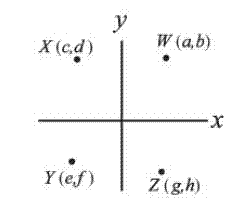
Distance.PNG [ 4.74 KiB | Viewed 26550 times ]
Distance from all the 4 points from origin can be written as
\(\sqrt{a^2 +b^2}\) + \(\sqrt{e^2 + j^2}\) = \(\sqrt{c^2 + d^2}\) + \(\sqrt{g^2 + h^2}\)
The above will give the answer of zero if we substitute the values from question stem.
Attachment:
Distance.PNG [ 4.74 KiB | Viewed 26550 times ]

 18 Feb 2012, 17:17
Kudos
Bookmarks
In the rectangular coordinate plane points X and Z lie on the same line through the origin and points W and Y lie on the same line through the origin. If a^2 + b^2 = c^2 + d^2 and e^2 + f^2 = g^2 + h^2, what is the value of length XZ – length WY?
A. -2
B. -1
C. 0
D. 1
E. 2
Since X and Z lie on the same line through the origin then the distance between X and Z will be equal to the sum of the individual distances of X and Z from the origin: \(\sqrt{c^2 + d^2}+\sqrt{g^2 + h^2}\);
The same way, the distance between W and Y will be equal to the sum of the individual distances of W and Y from the origin: \(\sqrt{a^2 + b^2}+\sqrt{e^2 + f^2}\);
\(XZ-WY=(\sqrt{c^2 + d^2}+\sqrt{g^2 + h^2})-(\sqrt{a^2 + b^2}+\sqrt{e^2 + f^2})=0\).
Answer: C.
General Discussion

mourinhogmat1
Joined: 08 Jun 2010
Last visit: 11 Aug 2015
Posts: 211
Given Kudos: 13
Location: United States
Concentration: General Management, Finance
Schools: Darden '15 (D) Wharton '15 (D) Johnson '15 (S)
GMAT 1: 680 Q50 V32
24 Feb 2012, 00:24
Kudos
Bookmarks
A quick question: All we know is that the line passes through X, origin, and Z vs. the second line passes through W, origin, and Y. There is no indication that the points are equidistant with respect to the origin. Can we assume this or is there a part of the wording from the original question missing?
The way I approached it:
sqrt ((g-c)^2+(h-d)^2) = sqrt ((a-e)^2+ (b-f)^2)
This simplifies to gc+hd = ae +bf.
Please explain.
The way I approached it:
sqrt ((g-c)^2+(h-d)^2) = sqrt ((a-e)^2+ (b-f)^2)
This simplifies to gc+hd = ae +bf.
Please explain.
24 Feb 2012, 01:15
Kudos
Bookmarks
mourinhogmat1
The formula to calculate the distance between two points \((x_1,y_1)\) and \((x_2,y_2)\) is \(d=\sqrt{(x_1-x_2)^2+(y_1-y_2)^2}\). Now, if one point is origin, coordinate (0, 0), then the formula can be simplified to: \(D=\sqrt{x^2+y^2}\).
Hence for our original question: a^2+b^2=c^2+d^2 means that points X and W are equidistant from the origin and e^2+f^2=g^2+h^2 means that points Y and Z are equidistant from the origin.
Next, since X and Z lie on the same line through the origin and W and Y lie on the same line through the origin then the distance of line segments XZ and WY is equal (for algebraic proof see above post).
Hope it's clear.





 I would appreciate your explanation






