Events & Promotions
|
|

GMAT Club Daily Prep
Thank you for using the timer - this advanced tool can estimate your performance and suggest more practice questions. We have subscribed you to Daily Prep Questions via email.
Customized
for You
Track
Your Progress
Practice
Pays
Not interested in getting valuable practice questions and articles delivered to your email? No problem, unsubscribe here.
 Sep 21
07:00 PM EDT
-10:00 PM EDT
Boost your GMAT score in less than one month in a live online class + 6 months access to TTP OnDemand video courses included!


 16 Sep 2014, 01:23
Kudos
Bookmarks
A sphere is inscribed in a cube with an edge of \(x\) centimeters. In terms of \(x\) what is the shortest possible distance from one of the vertices of the cube to the surface of the sphere?
A. \(x(\sqrt{3}-1)\)
B. \(\frac{x}{2}\)
C. \(x(\sqrt{2}-1)\)
D. \(\frac{x}{2}(\sqrt{3}-1)\)
E. \(\frac{x}{2}(\sqrt{2}-1)\)
A. \(x(\sqrt{3}-1)\)
B. \(\frac{x}{2}\)
C. \(x(\sqrt{2}-1)\)
D. \(\frac{x}{2}(\sqrt{3}-1)\)
E. \(\frac{x}{2}(\sqrt{2}-1)\)
16 Sep 2014, 01:23
Kudos
Bookmarks
Official Solution:
A sphere is inscribed in a cube with an edge of \(x\) centimeters. In terms of \(x\) what is the shortest possible distance from one of the vertices of the cube to the surface of the sphere?
A. \(x(\sqrt{3}-1)\)
B. \(\frac{x}{2}\)
C. \(x(\sqrt{2}-1)\)
D. \(\frac{x}{2}(\sqrt{3}-1)\)
E. \(\frac{x}{2}(\sqrt{2}-1)\)
Consider an image of a sphere inscribed in a cube:
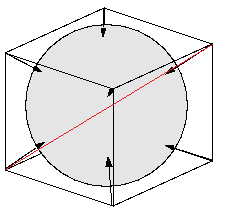
Let's assume that \(x=10\) centimeters.
Given that a sphere is inscribed in the cube, the edge length of the cube is equal to the sphere's diameter. Hence, \(Diameter=10\).
The cube's diagonal is then calculated as \(Diagonal=\sqrt{10^2+10^2+10^2}=10\sqrt{3}\).
The distance between the vertex of the cube and the surface of the sphere is equal to half of the difference between the diagonal and the diameter. Therefore, \(gap=\frac{Diagonal-Diameter}{2}=\frac{10*\sqrt{3}-10}{2}=5(\sqrt{3}-1)\).
Given that \(x=10\), we can express the gap as \(5(\sqrt{3}-1)=\frac{x}{2}(\sqrt{3} - 1)\).
Answer: D
A sphere is inscribed in a cube with an edge of \(x\) centimeters. In terms of \(x\) what is the shortest possible distance from one of the vertices of the cube to the surface of the sphere?
A. \(x(\sqrt{3}-1)\)
B. \(\frac{x}{2}\)
C. \(x(\sqrt{2}-1)\)
D. \(\frac{x}{2}(\sqrt{3}-1)\)
E. \(\frac{x}{2}(\sqrt{2}-1)\)
Consider an image of a sphere inscribed in a cube:
Let's assume that \(x=10\) centimeters.
Given that a sphere is inscribed in the cube, the edge length of the cube is equal to the sphere's diameter. Hence, \(Diameter=10\).
The cube's diagonal is then calculated as \(Diagonal=\sqrt{10^2+10^2+10^2}=10\sqrt{3}\).
The distance between the vertex of the cube and the surface of the sphere is equal to half of the difference between the diagonal and the diameter. Therefore, \(gap=\frac{Diagonal-Diameter}{2}=\frac{10*\sqrt{3}-10}{2}=5(\sqrt{3}-1)\).
Given that \(x=10\), we can express the gap as \(5(\sqrt{3}-1)=\frac{x}{2}(\sqrt{3} - 1)\).
Answer: D
General Discussion
09 Oct 2014, 08:16
Kudos
Bookmarks
Similar question to practice:
https://gmatclub.com/forum/a-carpenter- ... 87870.html
https://gmatclub.com/forum/a-rectangula ... 01511.html
https://gmatclub.com/forum/what-is-the- ... 88522.html
https://gmatclub.com/forum/the-figure-a ... 26246.html
https://gmatclub.com/forum/for-the-cube ... 13841.html
https://gmatclub.com/forum/the-figure-a ... 29650.html
https://gmatclub.com/forum/square-abcd- ... 56270.html
https://gmatclub.com/forum/a-cube-has-s ... 53098.html
https://gmatclub.com/forum/a-sphere-is- ... 27461.html
https://gmatclub.com/forum/a-sphere-is- ... 00798.html
https://gmatclub.com/forum/if-the-box-s ... 82136.html
https://gmatclub.com/forum/a-rectangula ... 28483.html
https://gmatclub.com/forum/if-the-box-s ... 27463.html
https://gmatclub.com/forum/a-rectangula ... 44733.html
https://gmatclub.com/forum/a-rectangula ... 28483.html
https://gmatclub.com/forum/q-is-a-cube- ... 93709.html
https://gmatclub.com/forum/what-is-the- ... 03680.html
https://gmatclub.com/forum/if-a-cube-is ... 54770.html
https://gmatclub.com/forum/what-is-the- ... 64377.html
https://gmatclub.com/forum/a-carpenter- ... 87870.html
https://gmatclub.com/forum/a-rectangula ... 01511.html
https://gmatclub.com/forum/what-is-the- ... 88522.html
https://gmatclub.com/forum/the-figure-a ... 26246.html
https://gmatclub.com/forum/for-the-cube ... 13841.html
https://gmatclub.com/forum/the-figure-a ... 29650.html
https://gmatclub.com/forum/square-abcd- ... 56270.html
https://gmatclub.com/forum/a-cube-has-s ... 53098.html
https://gmatclub.com/forum/a-sphere-is- ... 27461.html
https://gmatclub.com/forum/a-sphere-is- ... 00798.html
https://gmatclub.com/forum/if-the-box-s ... 82136.html
https://gmatclub.com/forum/a-rectangula ... 28483.html
https://gmatclub.com/forum/if-the-box-s ... 27463.html
https://gmatclub.com/forum/a-rectangula ... 44733.html
https://gmatclub.com/forum/a-rectangula ... 28483.html
https://gmatclub.com/forum/q-is-a-cube- ... 93709.html
https://gmatclub.com/forum/what-is-the- ... 03680.html
https://gmatclub.com/forum/if-a-cube-is ... 54770.html
https://gmatclub.com/forum/what-is-the- ... 64377.html