Events & Promotions
|
|

GMAT Club Daily Prep
Thank you for using the timer - this advanced tool can estimate your performance and suggest more practice questions. We have subscribed you to Daily Prep Questions via email.
Customized
for You
Track
Your Progress
Practice
Pays
Not interested in getting valuable practice questions and articles delivered to your email? No problem, unsubscribe here.
 Sep 21
07:00 PM EDT
-10:00 PM EDT
Boost your GMAT score in less than one month in a live online class + 6 months access to TTP OnDemand video courses included!


 25 Apr 2025, 04:06
Kudos
Bookmarks
A poll conducted at Wembley Stadium revealed that \(\frac{1}{6}\) of Messi fans are also fans of Mbappe, \(\frac{2}{5}\) of Mbappe fans are also fans of De Bruyne, and \(\frac{3}{4}\) of De Bruyne fans are also fans of Ronaldo. What is the probability that a random Messi fan at the stadium is also a fan of Ronaldo?
(1) There is not a single Mbappe fan who is not also a fan of Messi.
(2) For every Messi fan who is also a fan of Mbappe, there are 5 Messi fans who are also fans of De Bruyne.
(1) There is not a single Mbappe fan who is not also a fan of Messi.
(2) For every Messi fan who is also a fan of Mbappe, there are 5 Messi fans who are also fans of De Bruyne.
25 Apr 2025, 04:06
Kudos
Bookmarks
Official Solution:
A poll conducted at Wembley Stadium revealed that \(\frac{1}{6}\) of Messi fans are also fans of Mbappe, \(\frac{2}{5}\) of Mbappe fans are also fans of De Bruyne, and \(\frac{3}{4}\) of De Bruyne fans are also fans of Ronaldo. What is the probability that a random Messi fan at the stadium is also a fan of Ronaldo?
The question may seem convoluted at first, and it’s tempting to assign variables. However, simple reasoning and logic work better for this question. We are essentially asked to find the fraction of Messi fans who are also Ronaldo fans.
We’re told:
• \(\frac{1}{6}\) of Messi fans are also fans of Mbappe
• \(\frac{2}{5}\) of Mbappe fans are also fans of De Bruyne
• \(\frac{3}{4}\) of De Bruyne fans are also fans of Ronaldo
Notice that Messi fans and Ronaldo fans are not directly linked. We know that \(\frac{3}{4}\) of De Bruyne fans are also fans of Ronaldo; however, we know nothing about those Ronaldo fans who are not fans of De Bruyne, and more importantly, we know nothing about how Ronaldo fans and Messi fans overlap.
(1) There is not a single Mbappe fan who is not also a fan of Messi.
This implies that the Mbappe fans group is entirely inside the Messi fan group. Still, it is not sufficient, because we cannot establish the link between Messi fans and Ronaldo fans.
(2) For every Messi fan who is also a fan of Mbappe, there are 5 Messi fans who are also fans of De Bruyne.
This implies that the overlap between Messi and De Bruyne fans is 5 times the overlap between Messi and Mbappe fans. Still, it is not sufficient, since we cannot establish the link between Messi fans and Ronaldo fans.
(1) + (2) Let's assume there are 30 Messi fans. From (1), we get that there are 5 Mbappe fans, all of whom are Messi fans. From (2), we get that there are 25 Messi fans who are also De Bruyne fans. Since \(\frac{2}{5}\) of Mbappe fans are also fans of De Bruyne, the 5 and 25 groups have an overlap of 2 fans inside the Messi group. So, we have:
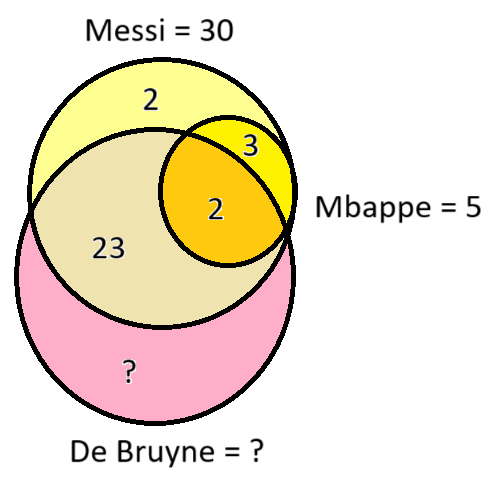
However, we still do not know how large the De Bruyne fan group outside the Messi group is, how large the Ronaldo fan group outside the De Bruyne group is, and most importantly, how Messi fans and Ronaldo fans overlap. Not sufficient.
Answer: E
A poll conducted at Wembley Stadium revealed that \(\frac{1}{6}\) of Messi fans are also fans of Mbappe, \(\frac{2}{5}\) of Mbappe fans are also fans of De Bruyne, and \(\frac{3}{4}\) of De Bruyne fans are also fans of Ronaldo. What is the probability that a random Messi fan at the stadium is also a fan of Ronaldo?
The question may seem convoluted at first, and it’s tempting to assign variables. However, simple reasoning and logic work better for this question. We are essentially asked to find the fraction of Messi fans who are also Ronaldo fans.
We’re told:
• \(\frac{1}{6}\) of Messi fans are also fans of Mbappe
• \(\frac{2}{5}\) of Mbappe fans are also fans of De Bruyne
• \(\frac{3}{4}\) of De Bruyne fans are also fans of Ronaldo
Notice that Messi fans and Ronaldo fans are not directly linked. We know that \(\frac{3}{4}\) of De Bruyne fans are also fans of Ronaldo; however, we know nothing about those Ronaldo fans who are not fans of De Bruyne, and more importantly, we know nothing about how Ronaldo fans and Messi fans overlap.
(1) There is not a single Mbappe fan who is not also a fan of Messi.
This implies that the Mbappe fans group is entirely inside the Messi fan group. Still, it is not sufficient, because we cannot establish the link between Messi fans and Ronaldo fans.
(2) For every Messi fan who is also a fan of Mbappe, there are 5 Messi fans who are also fans of De Bruyne.
This implies that the overlap between Messi and De Bruyne fans is 5 times the overlap between Messi and Mbappe fans. Still, it is not sufficient, since we cannot establish the link between Messi fans and Ronaldo fans.
(1) + (2) Let's assume there are 30 Messi fans. From (1), we get that there are 5 Mbappe fans, all of whom are Messi fans. From (2), we get that there are 25 Messi fans who are also De Bruyne fans. Since \(\frac{2}{5}\) of Mbappe fans are also fans of De Bruyne, the 5 and 25 groups have an overlap of 2 fans inside the Messi group. So, we have:
However, we still do not know how large the De Bruyne fan group outside the Messi group is, how large the Ronaldo fan group outside the De Bruyne group is, and most importantly, how Messi fans and Ronaldo fans overlap. Not sufficient.
Answer: E

 03 Dec 2025, 21:17
Kudos
Bookmarks
This is a gem of a question! This is one of those questions where you either spend 4 minutes on it, then decide to mark C and move ahead, ruining the whole test or spend 1 minute, get the idea and mark E!