Events & Promotions
| Last visit was: 06 Sep 2026, 01:40 |
It is currently 06 Sep 2026, 01:40 |
|
|

GMAT Club Daily Prep
Thank you for using the timer - this advanced tool can estimate your performance and suggest more practice questions. We have subscribed you to Daily Prep Questions via email.
Customized
for You
Track
Your Progress
Practice
Pays
Not interested in getting valuable practice questions and articles delivered to your email? No problem, unsubscribe here.
 Sep 06
09:30 AM EDT
-12:30 PM EST
Top scores are possible when you enroll in a powerful EA course, taught live online + 6 months access to TTP OnDemand video courses included! Perfect class schedule and easy course access for working professionals. Class starts Sundays Sept. 6, 2026. Sep 07
12:01 AM PDT
-11:59 PM PDT
On the 7th, GMAT Club Tests will be Free! Including all the Quizzes, Questions, and Tests. 12 AM - 11:59 PM PDT Sep 02
01:00 PM EDT
-11:59 PM EDT
Take 30% off all study plans with code COURSEWORK - Expires on Monday 9/7 Sep 04
10:00 AM EDT
-11:59 PM EDT
We’ve worked incredibly hard to build TTP into the best test prep experience possible, and it would mean a lot to us to win Newsweek’s 2026 Readers’ Choice Award for Best Test Prep. If TTP has helped you, we’d be incredibly grateful for your vote.- Sep 07
10:00 AM PDT
-11:00 AM PDT
A complete walkthrough of GMAT Club’s free 12-week GMAT study plan: what you study each week, how progress and goals are tracked, how the error log works, and how your practice unlocks paid tools at no cost. - Sep 09
07:00 AM PDT
-10:00 AM PDT
Meet AdComs and explore top Master’s programs - MiM, MiF, MSc, MSBA and more. - Application Fee Waivers - Free 1-Week of GMAT Club Tests: - Master's Application Toolkit - Grand Prize Giveaway - Sep 09
10:00 AM PDT
-11:00 AM PDT
Three MBA applications. Three rejections. No interview invites. A year later, Aman was admitted to Cambridge Judge, SMU, and IMD. In this episode of MBA Admit Stories, Aman shares how he rebuilt his MBA application...  Sep 15
07:00 PM EDT
-09:00 PM EST
Elite scores are possible when you enroll in a powerful GMAT course, taught live online + 6 months access to TTP OnDemand video courses included! Class starts Tues/Thurs Sept. 15, 2026 - Nov. 15, 2027, 7:00pm-9:00pm EST Sep 21
08:00 PM EDT
-10:00 PM EDT
Boost your GMAT score in less than one month in a live online class + 6 months access to TTP OnDemand video courses included! Class starts Mon, Tues, Wed, Thur, Fri Sept. 21, 2026 - Oct. 9, 2027, 7:00pm-10:00pm EST

 Updated on: 12 Jul 2021, 07:39
Originally posted by MontrealLady on 08 May 2010, 15:36.
Last edited by Bunuel on 12 Jul 2021, 07:39, edited 1 time in total.
Last edited by Bunuel on 12 Jul 2021, 07:39, edited 1 time in total.
Edited the question.
Kudos
Bookmarks


E
Be sure to select an answer first to save it in the Error Log before revealing the correct answer (OA)!
Difficulty:
 15%
(low)
15%
(low)
Question Stats:
78% (01:12) correct 22%
(01:21)
wrong
based on 1906
sessions
22%
(01:21)
wrong
based on 1906
sessions
History
Date
Time
Result
Not Attempted Yet
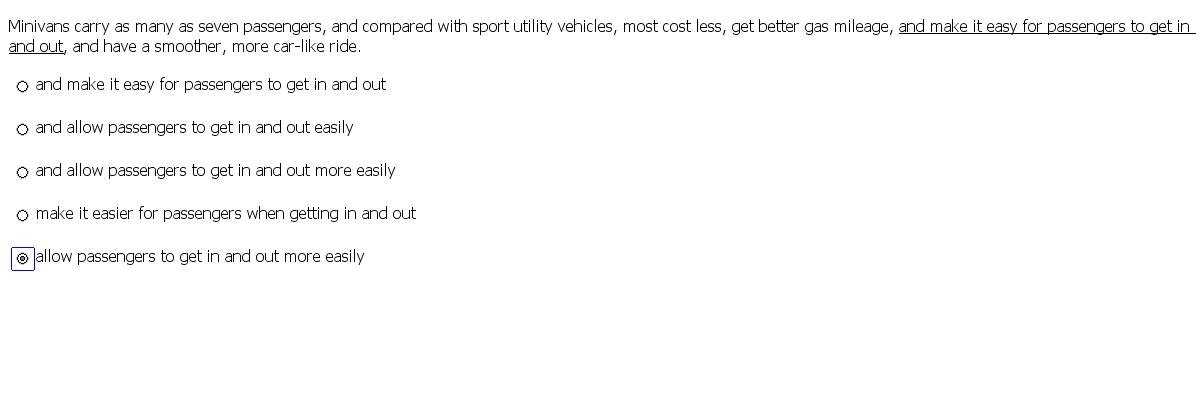
Minivans carry as many as seven passengers, and compared with sport utility vehicles, most cost less, get better gas mileage, and make it easy for passengers to get in and out, and have a smoother, more car-like ride.
(A) and make it easy for passengers to get in and out
(B) and allow passengers to get in and out easily
(C) and allow passengers to get in and out more easily
(D) make it easier for passengers when getting in and out
(E) allow passengers to get in and out more easily
Q13.jpg [ 37.36 KiB | Viewed 26990 times ]
Hi,
here is a question from GMAT Prep 2
I got the question correct, however, when I was reviewing it, I wasn't sure why the correct answer cannot be "D"
can someone explain the difference between D & E?
thanks,
(A) and make it easy for passengers to get in and out
(B) and allow passengers to get in and out easily
(C) and allow passengers to get in and out more easily
(D) make it easier for passengers when getting in and out
(E) allow passengers to get in and out more easily
Attachment:
Q13.jpg [ 37.36 KiB | Viewed 26990 times ]
here is a question from GMAT Prep 2
I got the question correct, however, when I was reviewing it, I wasn't sure why the correct answer cannot be "D"
can someone explain the difference between D & E?
thanks,
If this question felt shaky,
try an adaptive mini quiz of similar problems in
GMAT Club Forum Quiz →. Free plan gives 5 questions per day.
 23 Jan 2018, 16:08
Kudos
Bookmarks
zoezhuyan
Dear zoezhuyan,
How are you, my friend? I'm happy to help.

Typically, the structure "make it easy" or "make it easier" is followed by an infinitive, perhaps an infinitive with the subject of the infinitive in a "for" prepositional phrase.
. . . make it easy for passengers to get in and out . . .
Choice (A) would be correct if it didn't have the "and" at the beginning messing up the parallelism.
What's subtle and funny about (D) is that it almost feels as if there's a missing infinitive . . .
. . . make it easier for passengers to do something? when getting in and out . . .
Because the infinitive is so often used, and so often follows a "for" preposition, having something else makes the sentence feel as if an infinitive should be there somehow.
Also, the construction of (D) is technically illogical--it's a colloquial construction that native speakers use frequently in informal conversation, but it doesn't withstand logical analysis. Here's the correct construction again:
. . . make it easy for passengers to get in and out . . .
What is made easier? The act of getting in and out. The "dummy it" refers to the infinitive. That make sense.
Now, (D).
. . . make it easier for passengers when getting in and out . . .
What is made easier? The "dummy it" appears to refer to the subordinate clause beginning with "when." The "when" clause denotes a time. How is time itself "made easier?" Yes, yes, colloquial, people say stuff of this sort all the time ("she made lunchtime easier," "our end-of-year shopping package makes your holidays easier") It's colloquial and technically illogical. What is meant is that we something easier for someone at that time--we didn't make it easier for the time itself.
All of those are problems with (D).
Choice (E) is flawless. The word "allow" is used in an alternate sense. The primary definition has to do with permission ("the teacher allows the student to hand in the assignment a day late"). When it's an individual person doing the "allowing," then that person has the power to grant permission; when it's the law, though, then it's not so much permission as making something possible for law-abiding citizens. For example, on US roads in most places (not NYC), someone driving can make a right turn at a red light after coming to a full stop---the law "allows" drivers to do that--it's not so much a matter of anyone's "permission," but just the fact that this is a possible legal move. Yes, presumably one always could choose to break the law, but assuming that we want to be on the right side of the law, such an action is possible when the law allows it.
Now, rather than the political & social law, think of natural law, such as the Theory of Relativity. For example, the General Theory of Relativity allows for the existence of black holes. Elementary Quantum Mechanics allows an electron, under certain conditions, not to have a definite position. These are not a matter of permission at all, because no human decision makes these things true--each is simply something possible under the theory. All this opens up a more general definition of the verb "allow" when people are not involved. When an inanimate object "allows" something, it is simply makes that thing possible.
With this in mind, look at (E):
Minivans . . . allow passengers to get in and out more easily
In other words,
Minivans . . . make it possible for passengers to get in and out more easily
That is the intended meaning, and the parallelism is correct.
Does all this make sense?
Mike
 19 Feb 2017, 12:16
Kudos
Bookmarks
Minivans carry as many as seven passengers, and compared with sport utility vehicles, most cost less, get better gas mileage, and make it easy for passengers to get in and out, and have a smoother, more car-like ride.
A. and make it easy for passengers to get in and out
B. and allow passengers to get in and out easily
C. and allow passengers to get in and out more easily
D. make it easier for passengers when getting in and out
E. allow passengers to get in and out more easily
The theme concentrates on the positive effects of the minivans against the SUVs, they are cost effective, comparative good mileage ,good in/out facility and smooth ride as cars do.
A- another and changes the meaning of the sentence
B-Same
C-Same
D- it has no direct reference, it should refer to minivans, which is plural
E-Correct
A. and make it easy for passengers to get in and out
B. and allow passengers to get in and out easily
C. and allow passengers to get in and out more easily
D. make it easier for passengers when getting in and out
E. allow passengers to get in and out more easily
The theme concentrates on the positive effects of the minivans against the SUVs, they are cost effective, comparative good mileage ,good in/out facility and smooth ride as cars do.
A- another and changes the meaning of the sentence
B-Same
C-Same
D- it has no direct reference, it should refer to minivans, which is plural
E-Correct
 06 Oct 2022, 04:05
Kudos
Bookmarks
Dear Friends,
Here is a detailed explanation to this question-
Meaning is crucial to solving this problem:
Understanding the intended meaning is key to solving this question; the intended meaning of the crucial part of this sentence is that minivans allow passengers to get in and out more easily than sports utility vehicles do.
Concepts tested here: Meaning + Grammatical Construction
• The absolute form is used to describe something without drawing a comparison; the comparative form is used to compare two elements, and the superlative form is used to compare more than two elements.
• In a list of more than two elements; remember, the “comma + and” (oxford comma) construction is used to join the last element of a list of more than two other elements, and the other elements are linked through commas.
A: This answer choice alters the meaning of the sentence through the phrase "make it easy"; the use of the absolute adjective "easy" incorrectly implies that minivans allow passengers to get in and out easily, in general; the intended meaning is that minivans allow passengers to get in and out more easily than sports utility vehicles do; remember, the absolute forms are used to describe something without drawing a comparison; the comparative form is used to compare two elements, and the superlative form is used to compare more than two elements. Further, Option A incorrectly uses the oxford comma ("comma + and") to link the second last element - "make it easy for passengers to get in and out" - in a list of more than two elements; remember, the “comma + and” (oxford comma) construction is used to join the last element of a list of more than two other elements, and the other elements are linked through commas.
B: This answer choice alters the meaning of the sentence through the phrase "get in and out easily"; the use of the absolute adverb "easily" incorrectly implies that minivans allow passengers to get in and out easily, in general; the intended meaning is that minivans allow passengers to get in and out more easily than sports utility vehicles do; remember, the absolute forms are used to describe something without drawing a comparison; the comparative form is used to compare two elements, and the superlative form is used to compare more than two elements. Further, Option B incorrectly uses the oxford comma ("comma + and") to link the second last element - "allow passengers to get in and out easily" - in a list of more than two elements; remember, the “comma + and” (oxford comma) construction is used to join the last element of a list of more than two other elements, and the other elements are linked through commas.
C: This answer choice incorrectly uses the oxford comma ("comma + and") to link the second last element - "allow passengers to get in and out more easily" - in a list of more than two elements; remember, the “comma + and” (oxford comma) construction is used to join the last element of a list of more than two other elements, and the other elements are linked through commas.
D: This answer choice alters the meaning of the sentence through the phrase "make it easier for passengers when"; the use of "when" illogically implies that minivans make some unspecified action easier for passengers at that point in time when they are getting in and out; the intended meaning is that minivans allow passengers to get in and out more easily than sports utility vehicles do.
E: Correct. This answer choice uses the phrase "to get in and out more easily"; the use of the comparative adverb "more easily" conveys the intended meaning - that minivans allow passengers to get in and out more easily than sports utility vehicles do. Further, Option E correctly uses a comma to link the second last element - "allow passengers to get in and out more easily" - in a list of more than two elements.
Hence, E is the best answer choice.
To understand the concept of "Oxford Comma" on GMAT, you may want to watch the following video (~2 minutes):
All the best!
Experts' Global Team
Here is a detailed explanation to this question-
MontrealLady
Meaning is crucial to solving this problem:
Understanding the intended meaning is key to solving this question; the intended meaning of the crucial part of this sentence is that minivans allow passengers to get in and out more easily than sports utility vehicles do.
Concepts tested here: Meaning + Grammatical Construction
• The absolute form is used to describe something without drawing a comparison; the comparative form is used to compare two elements, and the superlative form is used to compare more than two elements.
• In a list of more than two elements; remember, the “comma + and” (oxford comma) construction is used to join the last element of a list of more than two other elements, and the other elements are linked through commas.
A: This answer choice alters the meaning of the sentence through the phrase "make it easy"; the use of the absolute adjective "easy" incorrectly implies that minivans allow passengers to get in and out easily, in general; the intended meaning is that minivans allow passengers to get in and out more easily than sports utility vehicles do; remember, the absolute forms are used to describe something without drawing a comparison; the comparative form is used to compare two elements, and the superlative form is used to compare more than two elements. Further, Option A incorrectly uses the oxford comma ("comma + and") to link the second last element - "make it easy for passengers to get in and out" - in a list of more than two elements; remember, the “comma + and” (oxford comma) construction is used to join the last element of a list of more than two other elements, and the other elements are linked through commas.
B: This answer choice alters the meaning of the sentence through the phrase "get in and out easily"; the use of the absolute adverb "easily" incorrectly implies that minivans allow passengers to get in and out easily, in general; the intended meaning is that minivans allow passengers to get in and out more easily than sports utility vehicles do; remember, the absolute forms are used to describe something without drawing a comparison; the comparative form is used to compare two elements, and the superlative form is used to compare more than two elements. Further, Option B incorrectly uses the oxford comma ("comma + and") to link the second last element - "allow passengers to get in and out easily" - in a list of more than two elements; remember, the “comma + and” (oxford comma) construction is used to join the last element of a list of more than two other elements, and the other elements are linked through commas.
C: This answer choice incorrectly uses the oxford comma ("comma + and") to link the second last element - "allow passengers to get in and out more easily" - in a list of more than two elements; remember, the “comma + and” (oxford comma) construction is used to join the last element of a list of more than two other elements, and the other elements are linked through commas.
D: This answer choice alters the meaning of the sentence through the phrase "make it easier for passengers when"; the use of "when" illogically implies that minivans make some unspecified action easier for passengers at that point in time when they are getting in and out; the intended meaning is that minivans allow passengers to get in and out more easily than sports utility vehicles do.
E: Correct. This answer choice uses the phrase "to get in and out more easily"; the use of the comparative adverb "more easily" conveys the intended meaning - that minivans allow passengers to get in and out more easily than sports utility vehicles do. Further, Option E correctly uses a comma to link the second last element - "allow passengers to get in and out more easily" - in a list of more than two elements.
Hence, E is the best answer choice.
To understand the concept of "Oxford Comma" on GMAT, you may want to watch the following video (~2 minutes):
All the best!
Experts' Global Team