Last visit was: 25 Apr 2026, 18:32 It is currently 25 Apr 2026, 18:32
Close
GMAT Club Daily Prep
Thank you for using the timer - this advanced tool can estimate your performance and suggest more practice questions. We have subscribed you to Daily Prep Questions via email.

Customized
for You

we will pick new questions that match your level based on your Timer History

Track
Your Progress

every week, we’ll send you an estimated GMAT score based on your performance

Practice
Pays

we will pick new questions that match your level based on your Timer History
Not interested in getting valuable practice questions and articles delivered to your email? No problem, unsubscribe here.
Close
Request Expert Reply
Confirm Cancel
avatar
Asifpirlo
Joined: 10 Jul 2013
Last visit: 26 Jan 2014
Posts: 220
Own Kudos:
1,195
 [18]
Given Kudos: 102
Posts: 220
Kudos: 1,195
 [18]
6
Kudos
Add Kudos
11
Bookmarks
Bookmark this Post
User avatar
maaadhu
Joined: 04 Apr 2013
Last visit: 16 Sep 2014
Posts: 96
Own Kudos:
194
 [3]
Given Kudos: 36
Posts: 96
Kudos: 194
 [3]
2
Kudos
Add Kudos
Bookmarks
Bookmark this Post
User avatar
blueseas
User avatar
Current Student
Joined: 14 Dec 2012
Last visit: 15 Jan 2019
Posts: 572
Own Kudos:
4,535
 [4]
Given Kudos: 197
Location: India
Concentration: General Management, Operations
GMAT 1: 700 Q50 V34
GPA: 3.6
GMAT 1: 700 Q50 V34
Posts: 572
Kudos: 4,535
 [4]
4
Kudos
Add Kudos
Bookmarks
Bookmark this Post
avatar
singhdoaba
Joined: 05 Sep 2011
Last visit: 22 Sep 2015
Posts: 1
Own Kudos:
4
 [4]
Posts: 1
Kudos: 4
 [4]
4
Kudos
Add Kudos
Bookmarks
Bookmark this Post
An alternative way to approach this problem would be to calculate the distance between the center point and the other two points mentioned in the problem. The distance between center point and other two given points should be the same (will be radius) .
Distance between two points can be calculated as square root of ((x2-x1)^2+(y2-y1)^2))

Option -1: Distance 1 is √(6.25+1 )=√7.25 , Distance 2 is √(2.25+4)=√6.25.Hence Incorrect.
Option-2: Distance1 is √(9+25 )=√34 , Distance 2 is √(1+64)=√65.Hence Incorrect.
Option-3: Distance1 is √(1+0 )=√1 , Distance 2 is √(9+9)=√18.Hence Incorrect.
Option-2: Distance1 is √(4+2.25)=√6.25 , Distance 2 is √(4+2.25)=√6.25. Both are equal and hence Correct.
Option-2: Distance1 is √(9+4 )=√13 , Distance 2 is √(1+1)=√2. Hence Incorrect.
avatar
Asifpirlo
Joined: 10 Jul 2013
Last visit: 26 Jan 2014
Posts: 220
Own Kudos:
Given Kudos: 102
Posts: 220
Kudos: 1,195
Kudos
Add Kudos
Bookmarks
Bookmark this Post
Asifpirlo
On the coordinate plane , points P and Q are defined by the coordinates (-1,0) and (3,3), respectively, and are connected to form a chord of a circle which also lies on the plane. If the area of the circle is (25/4) π , what are the coordinates of the center of the circle ?

(A) (1.5,1)
(B) (2,-5)
(C) (0,0)
(D) (1,1.5)
(E) (2,2)

really nice works everyone....................
User avatar
shivananthraj
Joined: 08 Aug 2012
Last visit: 12 Sep 2013
Posts: 2
Own Kudos:
Given Kudos: 9
Location: India
Concentration: Strategy, Human Resources
GPA: 3.51
WE:Engineering (Computer Software)
Posts: 2
Kudos: 5
Kudos
Add Kudos
Bookmarks
Bookmark this Post
I m sorry to ask this question.. I am new to GMAT, you may find this question silly but still I cant able to get this.
We have a point on the circle(x,y)=(-1,0) and we have radius r=5/2.
Equation of circle is : (x-a)^2+(y-b)^2 = r^2. By simply substituting above (x,y) and r we can find (a,b) which is the center.
Y WE ARE GETTING 2 EQUATIONS(as done by maaadhu) SOLVING IT TO GET A FINAL EQUATION AND THEN SUBSTITUTING ANSWER OPTIONS AND SEEING? :oops: :oops:
User avatar
Bunuel
User avatar
Math Expert
Joined: 02 Sep 2009
Last visit: 25 Apr 2026
Posts: 109,830
Own Kudos:
811,286
 [1]
Given Kudos: 105,886
Products:
Expert
Expert reply
Active GMAT Club Expert! Tag them with @ followed by their username for a faster response.
Posts: 109,830
Kudos: 811,286
 [1]
1
Kudos
Add Kudos
Bookmarks
Bookmark this Post
shivananthraj
I m sorry to ask this question.. I am new to GMAT, you may find this question silly but still I cant able to get this.
We have a point on the circle(x,y)=(-1,0) and we have radius r=5/2.
Equation of circle is : (x-a)^2+(y-b)^2 = r^2. By simply substituting above (x,y) and r we can find (a,b) which is the center.
Y WE ARE GETTING 2 EQUATIONS(as done by maaadhu) SOLVING IT TO GET A FINAL EQUATION AND THEN SUBSTITUTING ANSWER OPTIONS AND SEEING? :oops: :oops:

The approach you are talking about allows to get the answer without actually solving the equations.

BTW, how can you solve (-1-a)^2+(0-b)^2 = (5/2)^2 for a and b?
avatar
Asifpirlo
Joined: 10 Jul 2013
Last visit: 26 Jan 2014
Posts: 220
Own Kudos:
1,195
 [1]
Given Kudos: 102
Posts: 220
Kudos: 1,195
 [1]
1
Kudos
Add Kudos
Bookmarks
Bookmark this Post
shivananthraj
I m sorry to ask this question.. I am new to GMAT, you may find this question silly but still I cant able to get this.
We have a point on the circle(x,y)=(-1,0) and we have radius r=5/2.
Equation of circle is : (x-a)^2+(y-b)^2 = r^2. By simply substituting above (x,y) and r we can find (a,b) which is the center.
Y WE ARE GETTING 2 EQUATIONS(as done by maaadhu) SOLVING IT TO GET A FINAL EQUATION AND THEN SUBSTITUTING ANSWER OPTIONS AND SEEING? :oops: :oops:


Yes brother you can back solve it from the last equation you got...
but evaluating the reals roots of the equation will be cumbersome.......

Indeed you can solve any gmat problem without applying some formulas ,And just with few basic understandings.
User avatar
shivananthraj
Joined: 08 Aug 2012
Last visit: 12 Sep 2013
Posts: 2
Own Kudos:
Given Kudos: 9
Location: India
Concentration: Strategy, Human Resources
GPA: 3.51
WE:Engineering (Computer Software)
Posts: 2
Kudos: 5
Kudos
Add Kudos
Bookmarks
Bookmark this Post
Thanks Bunuel and Asif for your replies. I got the gap where i fell.
User avatar
gmatprav
Joined: 25 Oct 2013
Last visit: 19 Nov 2015
Posts: 109
Own Kudos:
186
 [3]
Given Kudos: 55
Posts: 109
Kudos: 186
 [3]
3
Kudos
Add Kudos
Bookmarks
Bookmark this Post
Area of the circle
\(pi*r^2 = \frac{25}{4}pi\)
=> \(r=\frac{5}{2}\)

Distance between the given points is
\(\sqrt{(3-(-1))^2 + (3-0)^2}\)

\(=\sqrt{16+9}\)

\(=5\)

Hence the given points are end points of diameter & mid point of these two points is the center of the circle.

mid-point is
\((\frac{{3+(-1)}}{2},\frac{{3+0}}{2})\)

\(=(1,1.5)\)
User avatar
M3sSiaH
Joined: 29 Mar 2015
Last visit: 19 Jan 2017
Posts: 69
Own Kudos:
Given Kudos: 21
Concentration: Strategy, Operations
GMAT 1: 700 Q51 V33
WE:Research (Other)
Products:
Kudos
Add Kudos
Bookmarks
Bookmark this Post
Asifpirlo
On the coordinate plane , points P and Q are defined by the coordinates (-1,0) and (3,3), respectively, and are connected to form a chord of a circle which also lies on the plane. If the area of the circle is (25/4) π , what are the coordinates of the center of the circle ?

(A) (1.5,1)
(B) (2,-5)
(C) (0,0)
(D) (1,1.5)
(E) (2,2)


Although it took me 3 mins to solve this question using all those equations, later I thought this question can be solved easily using options.

One property to keep in mind - A line passing through the centre of the circle bisects the chord (or passes from the mid point of the chord).

Now mid point of chord here is (-1+3)/2, (3+0)/2 i.e. (1,1.5) now luckily we have this in our Ans. choice. so definitely this is the ans. It also indictaes that PQ is the diameter of the circle.

There can be a case when PQ is not a diameter but in that case also the y-coordinate will remain same as it is the midpoint of the chord and we are moving up in the st. line to locate the centre of the circle.

If ans choices are all distinct (y cordinates) ONLY CHECK FOR Y CORDINATE and mark the ans.
User avatar
EgmatQuantExpert
User avatar
e-GMAT Representative
Joined: 04 Jan 2015
Last visit: 02 Apr 2024
Posts: 3,657
Own Kudos:
20,884
 [4]
Given Kudos: 165
Expert
Expert reply
Posts: 3,657
Kudos: 20,884
 [4]
3
Kudos
Add Kudos
1
Bookmarks
Bookmark this Post
nailgmat2015
Asifpirlo
On the coordinate plane , points P and Q are defined by the coordinates (-1,0) and (3,3), respectively, and are connected to form a chord of a circle which also lies on the plane. If the area of the circle is (25/4) π , what are the coordinates of the center of the circle ?

(A) (1.5,1)
(B) (2,-5)
(C) (0,0)
(D) (1,1.5)
(E) (2,2)


Although it took me 3 mins to solve this question using all those equations, later I thought this question can be solved easily using options.

One property to keep in mind - A line passing through the centre of the circle bisects the chord (or passes from the mid point of the chord).

Now mid point of chord here is (-1+3)/2, (3+0)/2 i.e. (1,1.5) now luckily we have this in our Ans. choice. so definitely this is the ans. It also indictaes that PQ is the diameter of the circle.

There can be a case when PQ is not a diameter but in that case also the y-coordinate will remain same as it is the midpoint of the chord and we are moving up in the st. line to locate the centre of the circle.

If ans choices are all distinct (y cordinates) ONLY CHECK FOR Y CORDINATE and mark the ans.


Hi nailgmat2015,

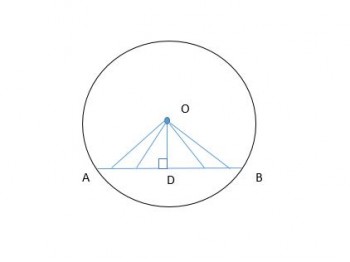
Please note that every line passing through centre of the circle does not bisect the chord. Only the line which passes through the centre and is perpendicular to the chord bisects the chord. For example refer the diagram below. In this diagram there are various lines which pass through the centre and intersect the chord, but only OD will bisect the chord as it is perpendicular to the chord.


For this question, you got the right answer as you assumed PQ to be the diameter which is actually the case. A better method for this question would have been:

Step-I
Find the radius of the circle from the given area of the circle which gives us radius = 2.5 and hence diameter = 5

Step-II
In this case, we can observe that the length of the chord PQ is 5( by using the distance formula). Since the length of chord PQ is equal to the length of the diameter that would mean that PQ is the diameter of the circle.
Since PQ is the diameter of the circle, the midpoint of PQ would be the centre of the circle which gives us the coordinates of centre as (1, 1.5)

Hope its clear :)

Regards
Harsh
User avatar
M3sSiaH
Joined: 29 Mar 2015
Last visit: 19 Jan 2017
Posts: 69
Own Kudos:
Given Kudos: 21
Concentration: Strategy, Operations
GMAT 1: 700 Q51 V33
WE:Research (Other)
Products:
Kudos
Add Kudos
Bookmarks
Bookmark this Post
EgmatQuantExpert
nailgmat2015
Asifpirlo
On the coordinate plane , points P and Q are defined by the coordinates (-1,0) and (3,3), respectively, and are connected to form a chord of a circle which also lies on the plane. If the area of the circle is (25/4) π , what are the coordinates of the center of the circle ?

(A) (1.5,1)
(B) (2,-5)
(C) (0,0)
(D) (1,1.5)
(E) (2,2)


Although it took me 3 mins to solve this question using all those equations, later I thought this question can be solved easily using options.

One property to keep in mind - A line passing through the centre of the circle bisects the chord (or passes from the mid point of the chord).

Now mid point of chord here is (-1+3)/2, (3+0)/2 i.e. (1,1.5) now luckily we have this in our Ans. choice. so definitely this is the ans. It also indictaes that PQ is the diameter of the circle.

There can be a case when PQ is not a diameter but in that case also the y-coordinate will remain same as it is the midpoint of the chord and we are moving up in the st. line to locate the centre of the circle.

If ans choices are all distinct (y cordinates) ONLY CHECK FOR Y CORDINATE and mark the ans.


Hi nailgmat2015,

Please note that every line passing through centre of the circle does not bisect the chord. Only the line which passes through the centre and is perpendicular to the chord bisects the chord. For example refer the diagram below. In this diagram there are various lines which pass through the centre and intersect the chord, but only OD will bisect the chord as it is perpendicular to the chord.


For this question, you got the right answer as you assumed PQ to be the diameter which is actually the case. A better method for this question would have been:

Step-I
Find the radius of the circle from the given area of the circle which gives us radius = 2.5 and hence diameter = 5

Step-II
In this case, we can observe that the length of the chord PQ is 5( by using the distance formula). Since the length of chord PQ is equal to the length of the diameter that would mean that PQ is the diameter of the circle.
Since PQ is the diameter of the circle, the midpoint of PQ would be the centre of the circle which gives us the coordinates of centre as (1, 1.5)

Hope its clear :)

Regards
Harsh


Hi harsh,

Thanks for such a wonderful explanation. I guess I need to brush up my basics once.

Thanks,
R
User avatar
santro789
Joined: 30 Apr 2013
Last visit: 22 Feb 2020
Posts: 58
Own Kudos:
Given Kudos: 9
Posts: 58
Kudos: 11
Kudos
Add Kudos
Bookmarks
Bookmark this Post
In the first explanation, after finding AC=5, how did we conclude that its a diameter? I am missing something here.
User avatar
bumpbot
User avatar
Non-Human User
Joined: 09 Sep 2013
Last visit: 04 Jan 2021
Posts: 38,986
Own Kudos:
Posts: 38,986
Kudos: 1,118
Kudos
Add Kudos
Bookmarks
Bookmark this Post
Automated notice from GMAT Club BumpBot:

A member just gave Kudos to this thread, showing it’s still useful. I’ve bumped it to the top so more people can benefit. Feel free to add your own questions or solutions.

This post was generated automatically.
Moderators:
Math Expert
109830 posts
Tuck School Moderator
852 posts