Last visit was: 21 Apr 2026, 08:56 It is currently 21 Apr 2026, 08:56
Close
GMAT Club Daily Prep
Thank you for using the timer - this advanced tool can estimate your performance and suggest more practice questions. We have subscribed you to Daily Prep Questions via email.

Customized
for You

we will pick new questions that match your level based on your Timer History

Track
Your Progress

every week, we’ll send you an estimated GMAT score based on your performance

Practice
Pays

we will pick new questions that match your level based on your Timer History
Not interested in getting valuable practice questions and articles delivered to your email? No problem, unsubscribe here.
Close
Request Expert Reply
Confirm Cancel
User avatar
slingfox
Joined: 18 Oct 2009
Last visit: 29 Dec 2010
Posts: 41
Own Kudos:
1,562
 [138]
Given Kudos: 3
Concentration: Finance
Schools:Kellogg
Posts: 41
Kudos: 1,562
 [138]
6
Kudos
Add Kudos
132
Bookmarks
Bookmark this Post
Most Helpful Reply
User avatar
sriharimurthy
Joined: 29 Oct 2009
Last visit: 23 Apr 2025
Posts: 125
Own Kudos:
3,084
 [37]
Given Kudos: 18
GMAT 1: 750 Q50 V42
GMAT 1: 750 Q50 V42
Posts: 125
Kudos: 3,084
 [37]
30
Kudos
Add Kudos
7
Bookmarks
Bookmark this Post
User avatar
Bunuel
User avatar
Math Expert
Joined: 02 Sep 2009
Last visit: 21 Apr 2026
Posts: 109,729
Own Kudos:
Given Kudos: 105,798
Products:
Expert
Expert reply
Active GMAT Club Expert! Tag them with @ followed by their username for a faster response.
Posts: 109,729
Kudos: 810,408
 [30]
17
Kudos
Add Kudos
13
Bookmarks
Bookmark this Post
General Discussion
User avatar
Bunuel
User avatar
Math Expert
Joined: 02 Sep 2009
Last visit: 21 Apr 2026
Posts: 109,729
Own Kudos:
Given Kudos: 105,798
Products:
Expert
Expert reply
Active GMAT Club Expert! Tag them with @ followed by their username for a faster response.
Posts: 109,729
Kudos: 810,408
 [12]
8
Kudos
Add Kudos
4
Bookmarks
Bookmark this Post
sriharimurthy

[Note to Bunuel : I think this one might have been missed in the post on triangles?]

This is a useful property, thank you. +1.

For an isosceles triangle with given length of equal sides right triangle (included angle) has the largest area.

And vise-versa:

Right triangle with a given hypotenuse has the largest area when it's an isosceles triangle.
User avatar
calvinhobbes
Joined: 21 Jan 2010
Last visit: 26 Mar 2013
Posts: 113
Own Kudos:
346
 [2]
Given Kudos: 38
2
Kudos
Add Kudos
Bookmarks
Bookmark this Post
Can I see it this way?

If you know what is function sin, it has a range from -1 to 1:

Since area of triangle = 1/2 x (side a x side b x sin C), where C is the angle in between side a and b.
The area would be at its maximum when C equals 90 degrees, i.e. sin C = 1.

In this case, we can take side a and side b the radii and C 90 degrees:
1/2 x 1 x 1 x 1 = 1/2

Hope this helps.
User avatar
shrouded1
User avatar
Retired Moderator
Joined: 02 Sep 2010
Last visit: 29 Apr 2018
Posts: 608
Own Kudos:
Given Kudos: 25
Location: London
Products:
Posts: 608
Kudos: 3,230
Kudos
Add Kudos
Bookmarks
Bookmark this Post
satishreddy
ps question
Trignometry based solution

Note that such a triangle is always isosceles, with two sides=1 (the radius of the circle).
Let the third side be b (the base) and the height be h.
If you imagine the angle subtended at the centre by the thrid side, and let this angle be x.

The base would be given by 2*sin(x/2) and the height by cos(x/2); where x is a number between 0 and 180

The area is therefore, sin(z)*cos(z), where z is between 0 and 90.
We can simplify this further as \(sin(z)*\sqrt{1-sin^2(z)}\), with z between 0 and 90, for which range sin(z) is between 0 and 1.

So the answer is maxima of the function \(f(y)=y*\sqrt{1-y^2}\) with y between 0 and 1.
This is equivalent to finding the point which will maximize the square of this function \(g(y)=y^2(1-y^2)\) which is easy to do taking the first derivative, \(g'(y)=2y-4y^3\), which gives the point as \(y=\frac{1}{\sqrt{2}}\).

If we plug it into f(y), the answer is area = 0.5 .. Hence answer is (b)

Basically the solution above proves that for an isosceles triangle, when the length of the equal sides is fixed, the area is maximum when the triangle is a right angled triangle (\(y=sin(x/2)=\frac{1}{\sqrt{2}}\) means x=90). This is a result you will most liekly see being quoted on alternate solutions.
User avatar
KarishmaB
Joined: 16 Oct 2010
Last visit: 21 Apr 2026
Posts: 16,438
Own Kudos:
79,372
 [3]
Given Kudos: 484
Location: Pune, India
Expert
Expert reply
Active GMAT Club Expert! Tag them with @ followed by their username for a faster response.
Posts: 16,438
Kudos: 79,372
 [3]
1
Kudos
Add Kudos
2
Bookmarks
Bookmark this Post
Interesting Question!
As CalvinHobbes suggested, the easiest way to deal with it might be through the area formula:
Area = (1/2)abSinQ
a and b are the lengths of two sides of the triangle and Q is the included angle between sides a and b.
(It is anyway good to remember this area formula if you are a little comfortable with trigonometry because it could turn your otherwise tricky question into a simple application.)

If we want to maximize area, we need to maximize Sin Q since a and b are already 1.
Maximum value of Sin Q is 1 which happens when Q = 90 degrees.

Therefore, maximum area of the triangle will be (1/2).1.1.1 = (1/2)
avatar
bscharm
Joined: 05 Aug 2012
Last visit: 16 Aug 2020
Posts: 15
Own Kudos:
Given Kudos: 8
Concentration: Finance, Economics
GMAT Date: 01-15-2014
GPA: 2.62
WE:Research (Finance: Investment Banking)
Posts: 15
Kudos: 13
Kudos
Add Kudos
Bookmarks
Bookmark this Post
I solved the question the following way..

I gathered the greatest possible triangle has a 90 degree angle where 2 sides meet (each length 1, the radius)
This means the 3rd side will be \(\sqrt{2}\) (90/45/45 rule)

It's base will be \(\sqrt{2}\) and its height will be \(\sqrt{2}\)/\(2\)

So base times height over 2 looks as such-

\(\sqrt{2}*\sqrt{2}/2\) all over 2

which yields 1/2.

am I getting the right answer the wrong way?
User avatar
KarishmaB
Joined: 16 Oct 2010
Last visit: 21 Apr 2026
Posts: 16,438
Own Kudos:
79,372
 [10]
Given Kudos: 484
Location: Pune, India
Expert
Expert reply
Active GMAT Club Expert! Tag them with @ followed by their username for a faster response.
Posts: 16,438
Kudos: 79,372
 [10]
7
Kudos
Add Kudos
3
Bookmarks
Bookmark this Post
bscharm
I solved the question the following way..

I gathered the greatest possible triangle has a 90 degree angle where 2 sides meet (each length 1, the radius)
This means the 3rd side will be \(\sqrt{2}\) (90/45/45 rule)

It's base will be \(\sqrt{2}\) and its height will be \(\sqrt{2}\)/\(2\)

So base times height over 2 looks as such-

\(\sqrt{2}*\sqrt{2}/2\) all over 2

which yields 1/2.

am I getting the right answer the wrong way?

I think you complicated the question for no reason even though your answer and method, both are correct (though not optimum). The most important part of the question is realizing that the triangle will be a right triangle. Once you did that, you know the two perpendicular sides of the triangle are 1 and 1 (the radii of the circle). The two perpendicular sides can very well be the base and the height. So area = (1/2)*1*1 = 1/2

In fact, this is used sometimes to find the altitude of the right triangle from 90 degree angle to hypotenuse. You equate area obtained from using the perpendicular side lengths with area obtained using hypotenuse. In this question, that will be

\((1/2)*1*1 = (1/2)*\sqrt{2}*Altitude\)
You get altitude from this.

How to realize it will be a right triangle without knowing the property:
You can do that by imagining the situation in which the area will be minimum. When the two sides overlap (i.e the angle between them is 0), the area will be 0 i.e. there will be no triangle. As you keep moving the sides away from each other, the area will increase till it eventually becomes 0 again when the angle between them is 180. So the maximum area between them will be when the angle between the sides is 90.
Attachment:
Ques3.jpg
Ques3.jpg [ 22.49 KiB | Viewed 66049 times ]
User avatar
jlgdr
Joined: 06 Sep 2013
Last visit: 24 Jul 2015
Posts: 1,302
Own Kudos:
Given Kudos: 355
Concentration: Finance
Posts: 1,302
Kudos: 2,974
Kudos
Add Kudos
Bookmarks
Bookmark this Post
Bunuel
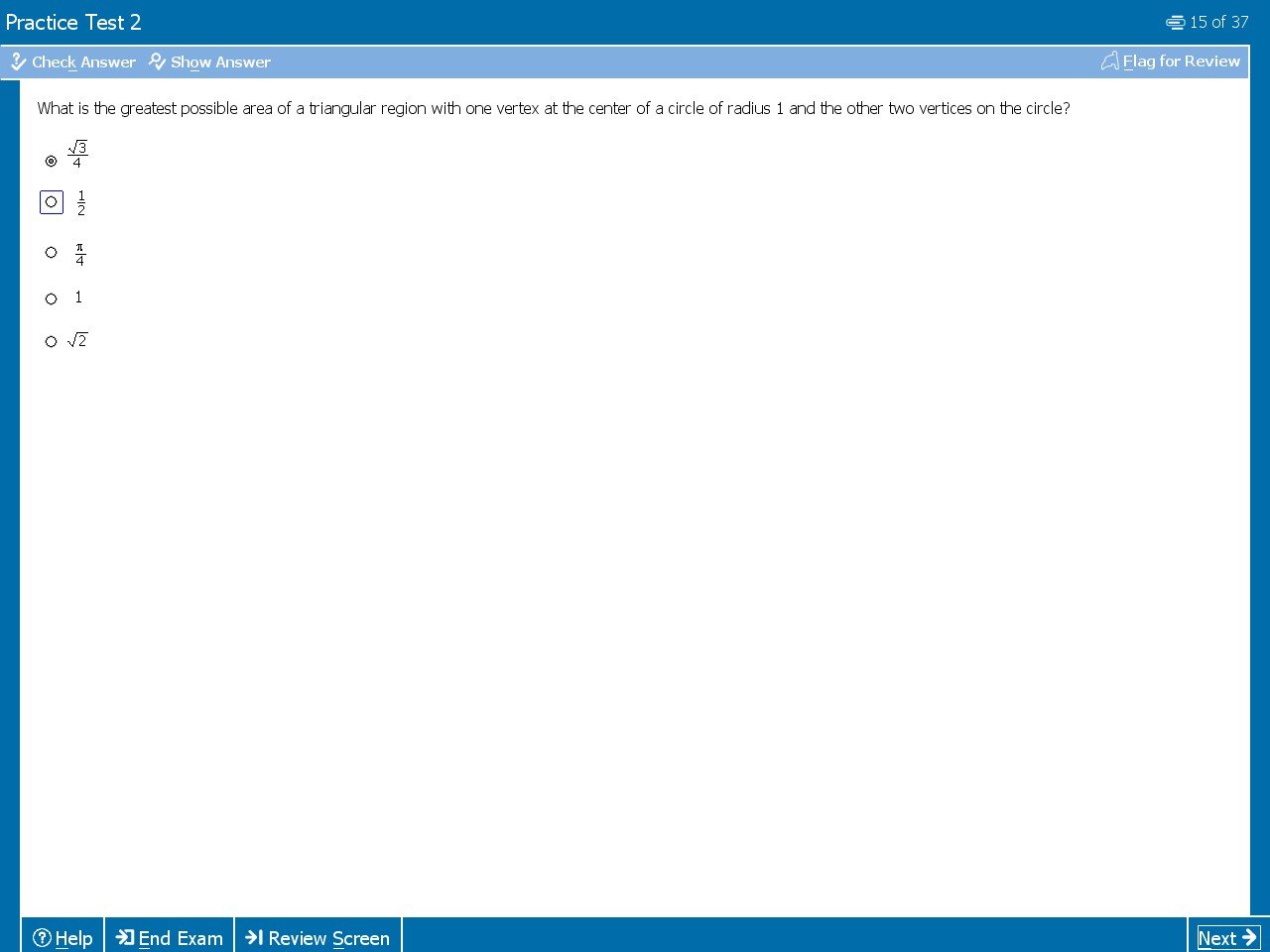
What is the greatest possible area of a triangular region with one vertex at the center of a circle of radius one and the other two vertices on the circle?

Clearly two sides of the triangle will be equal to the radius of 1.

Now, fix one of the sides horizontally and consider it to be the base of the triangle.

\(area=\frac{1}{2}*base*height=\frac{1}{2}*1*height=\frac{height}{2}\).

So, to maximize the area we need to maximize the height. If you visualize it, you'll see that the height will be maximized when it's also equals to the radius thus coincides with the second side (just rotate the other side to see). which means to maximize the area we should have the right triangle with right angle at the center.

\(area=\frac{1}{2}*1*1=\frac{1}{2}\).

Answer: B.

You can also refer to other solutions:
triangular-region-65317.html

Having some trouble figuring out why right isosceles triangle has greater area than equilateral triangle
Anyone would mind clarifying this?

Cheers!
J :)
User avatar
KarishmaB
Joined: 16 Oct 2010
Last visit: 21 Apr 2026
Posts: 16,438
Own Kudos:
79,372
 [1]
Given Kudos: 484
Location: Pune, India
Expert
Expert reply
Active GMAT Club Expert! Tag them with @ followed by their username for a faster response.
Posts: 16,438
Kudos: 79,372
 [1]
1
Kudos
Add Kudos
Bookmarks
Bookmark this Post
jlgdr
Bunuel
What is the greatest possible area of a triangular region with one vertex at the center of a circle of radius one and the other two vertices on the circle?

Clearly two sides of the triangle will be equal to the radius of 1.

Now, fix one of the sides horizontally and consider it to be the base of the triangle.

\(area=\frac{1}{2}*base*height=\frac{1}{2}*1*height=\frac{height}{2}\).

So, to maximize the area we need to maximize the height. If you visualize it, you'll see that the height will be maximized when it's also equals to the radius thus coincides with the second side (just rotate the other side to see). which means to maximize the area we should have the right triangle with right angle at the center.

\(area=\frac{1}{2}*1*1=\frac{1}{2}\).

Answer: B.

You can also refer to other solutions:
triangular-region-65317.html

Having some trouble figuring out why right isosceles triangle has greater area than equilateral triangle
Anyone would mind clarifying this?

Cheers!
J :)

Couple of ways to think about it:

Method 1:
Say base of a triangle is 1.
Area = (1/2)*base*height = (1/2)*height

Say, another side has a fixed length of 1. You start with the first figure on top left when two sides are 1 and third side is very small and keep rotating the side of length 1. The altitude keeps increasing. You get an equilateral triangle whose altitude is \(\sqrt{3}/2 * 1\) which is less than 1. Then you still keep rotating till you get the altitude as 1 (the other side). Now altitude is max so area is max. This is a right triangle.
When you rotate further still, the altitude will start decreasing again.
Attachment:
Ques3.jpg
Ques3.jpg [ 25.95 KiB | Viewed 65567 times ]

Method 2:

Given in my post above.
User avatar
AdmitJA
Joined: 04 Jul 2014
Last visit: 26 Mar 2018
Posts: 276
Own Kudos:
1,243
 [3]
Given Kudos: 420
Location: India
GMAT 1: 640 Q44 V34
GMAT 2: 710 Q49 V37
GPA: 3.58
WE:Analyst (Accounting)
Products:
GMAT 2: 710 Q49 V37
Posts: 276
Kudos: 1,243
 [3]
Kudos
Add Kudos
3
Bookmarks
Bookmark this Post
I found this statement as a rule in a flashcard: "If you are given 2 sides of a triangle or a parallelogram, you can maximize the area by placing those two sides perpendicular." I had some concerns in appreciating this statement and I find it related to this question. Was able to understand the statement better when I solved this question.

For those who are unable to appreciate this statement from the flash card, hope this below example helps! Let's say we know that the 2 sides of a triangle are 4 and 3. The question asks when will the area of the triangle with 2 of these vertices be the maximum. Consider these 3 scenarios:
Attachment:
Triangles.png
Triangles.png [ 3.87 KiB | Viewed 46720 times ]
What do we see from the figure above? The triangle with 2 sides as perpendicular bisectors will have the greatest areas. If you knew this rule, this question would have been a cake walk! :)

Hope this helps! :-D
User avatar
EgmatQuantExpert
User avatar
e-GMAT Representative
Joined: 04 Jan 2015
Last visit: 02 Apr 2024
Posts: 3,657
Own Kudos:
20,859
 [1]
Given Kudos: 165
Expert
Expert reply
Posts: 3,657
Kudos: 20,859
 [1]
1
Kudos
Add Kudos
Bookmarks
Bookmark this Post
Here's how this question can be solved from the first principles, by making use of only the most basic properties:

The first step is to draw a diagram to visualize the given information. Here it is:


We've dropped a perpendicular OP on the base AB.

So, the area of the triangle OAB = \(\frac{1}{2}\)*AB*OP . . . (1)

Now, let's assume the angle AOP to be x degrees.

So, OP = OAcosx = 1*cosx = cosx . . . (2)
Similarly, AP = OAsinx = 1*sinx = sinx . . . (3)

Now, we know that the perpendicular drawn from the center of a circle to a chord bisects the chord.

So, perpendicular OP bisects the chord AB.
Therefore, AP = BP = AB/2 . . . (4)

Combining (3) and (4), we get:

AB = 2sinx . . . (5)

Using (2) and (5) in (1), we get:

Area of triangle OAB = \(\frac{1}{2}\)*(2sinx)*(cosx)

So, Area of triangle OAB = (sinx)*(cosx)

We have to maximize the area, and therefore, we've to maximize the value of (sinx)*(cosx)

When sinx is maximum (for x = 90 degrees), cosx = 0, and so, the product (sinx)*(cosx) = 0
When cosx is maximum (for x = 0 degrees), sinx = 0, and so, the product (sinx)*(cosx) = 0

It's easy to see that the product (sinx)*(cosx) will be maximum when sinx = cosx. This happens for x = 45 degrees. At this point, sinx = cosx = \(\frac{1}{\sqrt{2}}\)

Therefore, maximum area = (\(\frac{1}{\sqrt{2}}\))*(\(\frac{1}{\sqrt{2}}\)) = \(\frac{1}{2}\)

As you can see, in solving this question, we have used only three basic properties from the concepts of Triangles, Circles and Trigonometry respectively. All students preparing for the GMAT already know these three basic properties:

1. The formula for area of triangle
2. The property that the perpendicular drawn from the center of a circle to a chord bisects the chord
3. The values of sin x and cos x for x = 0 degrees, 45 degrees and 90 degrees


Takeaway from the discussion

The questions on GMAT do not test your knowledge of esoteric properties, but your ability to apply basic concepts from a variety of topics

Hope this helped! :)

Regards

Japinder
User avatar
fskilnik
Joined: 12 Oct 2010
Last visit: 03 Jan 2025
Posts: 883
Own Kudos:
1,878
 [1]
Given Kudos: 57
Status:GMATH founder
Expert
Expert reply
Posts: 883
Kudos: 1,878
 [1]
Kudos
Add Kudos
1
Bookmarks
Bookmark this Post
slingfox
What is the greatest possible area of a triangular region with one vertex at the center of a circle of radius one and the other two vertices on the circle?

A. \(\frac{\sqrt{3}}{4}\)

B. \(\frac{1}{2}\)

C. \(\frac{\pi}{4}\)

D. 1

E. \(\sqrt{2}\)


\(?\,\,\, = \,\,{S_{\Delta ABC}}\,\,\max\)

Let C be the center of the circle with unitary radius.

Without loss of generality, we may (and will) assume point A is one unit at the right of point C (as shown in the figure on the left).

For the last vertex (B), without loss of generality (in terms of exploring possible areas) there are only two possibilities:

(1) B is in the arc AD (figure in the middle) or (2) B is in the arc DE (figure on the right)

In BOTH cases we have:

\({S_{\Delta ABC}} = {{AC \cdot h} \over 2} = {h \over 2}\,\,\,\,\,\,\, \Rightarrow \,\,\,\,\,\,\,? = {1 \over 2}\,\,\,\,\,\,\left( {{\rm{when}}\,\,h = CD\,,\,\,{\rm{i}}{\rm{.e}}{\rm{.}},\,\,B = D} \right)\)


This solution follows the notations and rationale taught in the GMATH method.

Regards,
Fabio.
User avatar
Praveenksinha
Joined: 11 Apr 2018
Last visit: 08 Jul 2021
Posts: 105
Own Kudos:
Given Kudos: 298
Location: India
Concentration: Entrepreneurship, Marketing
GPA: 3.7
WE:Sales (Energy)
Products:
Posts: 105
Kudos: 107
Kudos
Add Kudos
Bookmarks
Bookmark this Post
"If you are given 2 sides of a triangle or a parallelogram, you can maximize the area by placing those two sides perpendicular."
Thank you for this rule.
avatar
amoghhlgr
Joined: 16 Jun 2019
Last visit: 19 Jul 2023
Posts: 27
Own Kudos:
Given Kudos: 135
Location: India
Schools: Said'16
GMAT 1: 690 Q44 V40
GPA: 3.5
Schools: Said'16
GMAT 1: 690 Q44 V40
Posts: 27
Kudos: 9
Kudos
Add Kudos
Bookmarks
Bookmark this Post
Bunuel
What is the greatest possible area of a triangular region with one vertex at the center of a circle of radius one and the other two vertices on the circle?

A. \(\frac{\sqrt{3}}{4}\)

B. \(\frac{1}{2}\)

C. \(\frac{\pi}{4}\)

D. 1

E. \(\sqrt{2}\)

Clearly two sides of the triangle will be equal to the radius of 1.

Now, fix one of the sides horizontally and consider it to be the base of the triangle.

\(area=\frac{1}{2}*base*height=\frac{1}{2}*1*height=\frac{height}{2}\).

So, to maximize the area we need to maximize the height. If you visualize it, you'll see that the height will be maximized when it's also equals to the radius thus coincides with the second side (just rotate the other side to see). which means to maximize the area we should have the right triangle with right angle at the center.

\(area=\frac{1}{2}*1*1=\frac{1}{2}\).

Answer: B.

Why is not an equilateral triangle with all sides equal to 1, wouldn't that have the maximum area? Or is it not possible to inscribe an equilateral triangle inside a circle?
avatar
Alisha2006
Joined: 10 Mar 2020
Last visit: 10 Dec 2022
Posts: 5
Own Kudos:
Given Kudos: 66
Products:
Posts: 5
Kudos: 8
Kudos
Add Kudos
Bookmarks
Bookmark this Post
With once vertex at centre, other two on circumference we can compare areas with angle 90 degrees or less than 90 degrees b/w 2 isosceles sides
if 90 degrees, triangle is right isosceles triangle -->Area =1/2*1*1 =0.5
For less than 90 degrees, take example of 60 degrees, triangle becomes equilateral --> Area = sqrt(3)/4*1*1 =1.73/4 =0.43
we observe that for angle less than 90 degrees,, area would be less than what it would be when angle =90, hence largest area would be of right isosceles triangle --> 1/2 Ans
In short, we have theorem that in isosceles triangle, area enclosed is maximum when angle between the equal sides is 90 degrees
User avatar
svashist
Joined: 27 May 2019
Last visit: 13 Mar 2025
Posts: 4
Own Kudos:
Given Kudos: 26
Location: India
GMAT 1: 730 Q50 V38
GPA: 3.3
GMAT 1: 730 Q50 V38
Posts: 4
Kudos: 1
Kudos
Add Kudos
Bookmarks
Bookmark this Post
Area of triangle = [1][/2]*a*b*sin(angle between a and b). Given that two sides are between the centre of the circle to the vertices on the circle, which is the radius of the circle, implying a = b= r = 1.

Hence, Area = [1][/2]*r^2*sin[theta]. Maximum value of sin theta can be 1, assuming the angle to be 90 degrees between the two sides. Hence area = 1/2
User avatar
bumpbot
User avatar
Non-Human User
Joined: 09 Sep 2013
Last visit: 04 Jan 2021
Posts: 38,944
Own Kudos:
Posts: 38,944
Kudos: 1,117
Kudos
Add Kudos
Bookmarks
Bookmark this Post
Automated notice from GMAT Club BumpBot:

A member just gave Kudos to this thread, showing it’s still useful. I’ve bumped it to the top so more people can benefit. Feel free to add your own questions or solutions.

This post was generated automatically.
Moderators:
Math Expert
109729 posts
Tuck School Moderator
853 posts