Last visit was: 21 Apr 2026, 08:56 It is currently 21 Apr 2026, 08:56
Close
GMAT Club Daily Prep
Thank you for using the timer - this advanced tool can estimate your performance and suggest more practice questions. We have subscribed you to Daily Prep Questions via email.

Customized
for You

we will pick new questions that match your level based on your Timer History

Track
Your Progress

every week, we’ll send you an estimated GMAT score based on your performance

Practice
Pays

we will pick new questions that match your level based on your Timer History
Not interested in getting valuable practice questions and articles delivered to your email? No problem, unsubscribe here.
Close
Request Expert Reply
Confirm Cancel
User avatar
amitdgr
Joined: 30 Jun 2008
Last visit: 21 May 2013
Posts: 534
Own Kudos:
3,210
 [128]
Given Kudos: 1
Posts: 534
Kudos: 3,210
 [128]
15
Kudos
Add Kudos
113
Bookmarks
Bookmark this Post
Most Helpful Reply
User avatar
Bunuel
User avatar
Math Expert
Joined: 02 Sep 2009
Last visit: 21 Apr 2026
Posts: 109,729
Own Kudos:
Given Kudos: 105,798
Products:
Expert
Expert reply
Active GMAT Club Expert! Tag them with @ followed by their username for a faster response.
Posts: 109,729
Kudos: 810,408
 [52]
23
Kudos
Add Kudos
29
Bookmarks
Bookmark this Post
User avatar
EgmatQuantExpert
User avatar
e-GMAT Representative
Joined: 04 Jan 2015
Last visit: 02 Apr 2024
Posts: 3,657
Own Kudos:
20,859
 [8]
Given Kudos: 165
Expert
Expert reply
Posts: 3,657
Kudos: 20,859
 [8]
5
Kudos
Add Kudos
3
Bookmarks
Bookmark this Post
General Discussion
User avatar
maratikus
Joined: 01 Jan 2008
Last visit: 22 Jul 2010
Posts: 257
Own Kudos:
347
 [1]
Given Kudos: 1
Posts: 257
Kudos: 347
 [1]
Kudos
Add Kudos
1
Bookmarks
Bookmark this Post
amitdgr
If 0<x<1 , which of the following inequalities must be true ?

I. \(x^5 < x^3\)
II. \(x^4 + x^5 < x^3 + x^2\)
III. \(x^4 - x^5 < x^2 - x^3\)

* None
* I only
* II only
* I and II only
* I,II and III

The answer is E

I: x^5-x^3 = x^3*(x-1)*(x+1) < 0 since x > 0 and x < 1
II: x^4+x^5-x^3-x^2 = x^2*(x+1)*(x-1)*(x+1) < 0 for same reasons
III: x^4-x^5-x^2+x^3 = x^2*(1-x)*(x-1)*(x+1) = -x^2*(x-1)^2*(x+1) < 0
User avatar
JohnLewis1980
Joined: 21 Apr 2008
Last visit: 04 Nov 2010
Posts: 285
Own Kudos:
Given Kudos: 13
Concentration: Industrial Sector
Schools:Kellogg, MIT, Michigan, Berkeley, Marshall, Mellon
Posts: 285
Kudos: 104
Kudos
Add Kudos
Bookmarks
Bookmark this Post
My two cents:

I beeter if you divided by x^2: x^2+x^3<x+1 -> always
II better if you divided by x^2: x^2-x^3<1-x^2 always
III dividing by x^2: x^2-x^3<1-x^2
if x=0.1 thus 0.01-0.001<1-0.01 always
if x=0.9 thus 0.81-0.729<1-0.9 // 0.081<1 always

E

OA?

Cheers
User avatar
smahamkl
Joined: 27 Sep 2008
Last visit: 14 Oct 2008
Posts: 6
Own Kudos:
258
 [1]
Posts: 6
Kudos: 258
 [1]
1
Kudos
Add Kudos
Bookmarks
Bookmark this Post
I also believe the answer is E since even the third equation,
x^4 - x^5 < x^2 - x^3
= x^4 + x^3 < x^2 + x^5
=x^2 + x < 1+x^3
which is true since the value on the right hand side will be greater than 1.

thanks
SM
User avatar
ALD
Joined: 15 Apr 2008
Last visit: 01 Oct 2012
Posts: 90
Own Kudos:
24
 [1]
Given Kudos: 1
Posts: 90
Kudos: 24
 [1]
Kudos
Add Kudos
1
Bookmarks
Bookmark this Post
i will also go with E

raising a decimal number to any power reduces the value of the number.
so .1^2=.01
and .1^3=.001

can be solved by picking numbers
User avatar
sinhap07
Joined: 27 Aug 2014
Last visit: 09 Oct 2018
Posts: 48
Own Kudos:
Given Kudos: 3
Posts: 48
Kudos: 30
Kudos
Add Kudos
Bookmarks
Bookmark this Post
Bunuel
scofield1521
People, please throw some more light!!

If 0 < x < 1, which of the following inequalities must be true ?

I. \(x^5 < x^3\)
II. \(x^4 + x^5 < x^3 + x^2\)
III. \(x^4 - x^5 < x^2 - x^3\)

A. None
B. I only
C. II only
D. I and II only
E. I, II and III

If 0 < x < 1, then x > x^2 > x^3 > x^4 > x^5 ...

I. \(x^5 < x^3\). True.

II. \(x^4 + x^5 < x^3 + x^2\). Each term on the left hand side is less than each term on the right hand side, thus LHS < RHS.

III. \(x^4 - x^5 < x^2 - x^3\) --> \(x^4(1 - x) < x^2(1 - x)\). Since 0 < x < 1, then 1 - x > 0, so we can reduce by it: \(x^4 < x^2\). True.

Answer: E.

Hope it's clear.


Bunuel

Can we do this question algebraically without substituting fractions? By trying to prove that each of the statements given indeed have x values within the range of 0 and 1 on the number line?
User avatar
sinhap07
Joined: 27 Aug 2014
Last visit: 09 Oct 2018
Posts: 48
Own Kudos:
Given Kudos: 3
Posts: 48
Kudos: 30
Kudos
Add Kudos
Bookmarks
Bookmark this Post
Bunuel

Can we do this question algebraically without substituting fractions? By trying to prove that each of the statements given indeed have x values within the range of 0 and 1 on the number line?[/quote]

Hi sinhap07,

Please find the algebraic approach for the question

I. \(x^5 <x^3\)

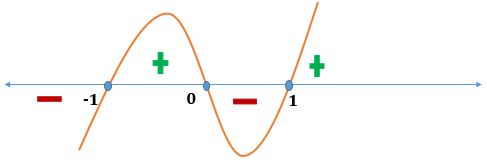
\(x^3(x^2 - 1) < 0\) i.e. \(x^3 (x -1) (x +1) < 0.\)

Using the wavy line method we know that for \(0 < x < 1\) the inequality holds true.


II.\(x^4 + x^5 < x^3 + x^2\)

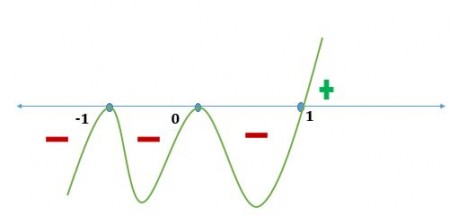
\(x^5 - x^3 + x^4 - x^2 < 0\) i.e. \(x^2(x -1) (x + 1)^2 < 0\)

Using wavy line method we know that for \(0 < x < 1\) the inequality holds true


III.\(x^4 - x^5 < x^2 - x^3\)

\(x^4 - x^2 - x^5 + x^3 < 0\) i.e. \(x^2 (x + 1)(x - 1) (1 -x) < 0\)

\(x^2 (x -1)^2(x + 1) > 0\)

Using wavy line method we know that for \(0 < x < 1\) the inequality holds true
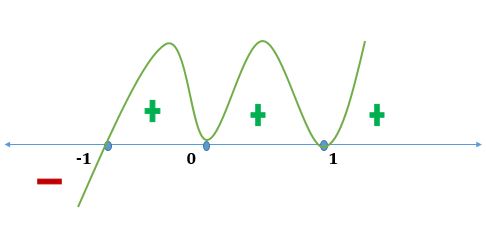


Thus all the three inequalities are true for the range \(0 < x < 1\)

Hope it's clear :)

Regards
Harsh[/quote]


Thanks Harsh for your reply. Can you please throw some more light on the wave method? Of what I knw, signs usually alternate but what I see in your workings, signs don't always alternate. Can you explain it?
Second, why are we ignoring the negative portions say in statement 1 that makes it less than -1. It shows x values dont only pertain to 0 and 1 region. So how can stmt 1 be sufficient?
User avatar
EgmatQuantExpert
User avatar
e-GMAT Representative
Joined: 04 Jan 2015
Last visit: 02 Apr 2024
Posts: 3,657
Own Kudos:
20,859
 [3]
Given Kudos: 165
Expert
Expert reply
Posts: 3,657
Kudos: 20,859
 [3]
2
Kudos
Add Kudos
1
Bookmarks
Bookmark this Post
Quote:
Bunuel

Can we do this question algebraically without substituting fractions? By trying to prove that each of the statements given indeed have x values within the range of 0 and 1 on the number line?

Quote:
Hi sinhap07,

Please find the algebraic approach for the question

I. \(x^5 <x^3\)

\(x^3(x^2 - 1) < 0\) i.e. \(x^3 (x -1) (x +1) < 0.\)

Using the wavy line method we know that for \(0 < x < 1\) the inequality holds true.


II.\(x^4 + x^5 < x^3 + x^2\)

\(x^5 - x^3 + x^4 - x^2 < 0\) i.e. \(x^2(x -1) (x + 1)^2 < 0\)

Using wavy line method we know that for \(0 < x < 1\) the inequality holds true


III.\(x^4 - x^5 < x^2 - x^3\)

\(x^4 - x^2 - x^5 + x^3 < 0\) i.e. \(x^2 (x + 1)(x - 1) (1 -x) < 0\)

\(x^2 (x -1)^2(x + 1) > 0\)

Using wavy line method we know that for \(0 < x < 1\) the inequality holds true


Thus all the three inequalities are true for the range \(0 < x < 1\)

Hope it's clear :)

Regards
Harsh


Quote:
Thanks Harsh for your reply. Can you please throw some more light on the wave method? Of what I knw, signs usually alternate but what I see in your workings, signs don't always alternate. Can you explain it?
Second, why are we ignoring the negative portions say in statement 1 that makes it less than -1. It shows x values dont only pertain to 0 and 1 region. So how can stmt 1 be sufficient?

Hi sinhap07,

You are right when you say signs usually alternate around zero points of the inequality but they only alternate when the expression is sign dependent i.e. for odd powers. For example sign of \(x^3\) is dependent on the sign of \(x\) but sign of \(x^2\) is independent of sign of \(x\). Hence for expressions, signs of which are independent of the signs of their base variable, the wave would not alternate but rather bounce back to the same region it is currently in.

I would also suggest you to go through this post on Wavy Line method which will help you understand it better.

For your second query, in st-I the range of \(x\) for which the inequality holds is \(0 < x < 1\) or \(x < -1\) as seen from the wavy line diagram. However as the question asks us if the inequality is true for the range \(0 < x < 1\), we are not concerned about the other possible values of x for which the inequality is true. Once the inequality satisfies the range \(0 < x < 1\), we have our answer.

Hope it's clear :)

Regards
Harsh
User avatar
sinhap07
Joined: 27 Aug 2014
Last visit: 09 Oct 2018
Posts: 48
Own Kudos:
Given Kudos: 3
Posts: 48
Kudos: 30
Kudos
Add Kudos
Bookmarks
Bookmark this Post
EgmatQuantExpert
Quote:
Bunuel

Can we do this question algebraically without substituting fractions? By trying to prove that each of the statements given indeed have x values within the range of 0 and 1 on the number line?

Quote:
Hi sinhap07,

Please find the algebraic approach for the question

I. \(x^5 <x^3\)

\(x^3(x^2 - 1) < 0\) i.e. \(x^3 (x -1) (x +1) < 0.\)

Using the wavy line method we know that for \(0 < x < 1\) the inequality holds true.


II.\(x^4 + x^5 < x^3 + x^2\)

\(x^5 - x^3 + x^4 - x^2 < 0\) i.e. \(x^2(x -1) (x + 1)^2 < 0\)

Using wavy line method we know that for \(0 < x < 1\) the inequality holds true


III.\(x^4 - x^5 < x^2 - x^3\)

\(x^4 - x^2 - x^5 + x^3 < 0\) i.e. \(x^2 (x + 1)(x - 1) (1 -x) < 0\)

\(x^2 (x -1)^2(x + 1) > 0\)

Using wavy line method we know that for \(0 < x < 1\) the inequality holds true


Thus all the three inequalities are true for the range \(0 < x < 1\)

Hope it's clear :)

Regards
Harsh


Quote:
Thanks Harsh for your reply. Can you please throw some more light on the wave method? Of what I knw, signs usually alternate but what I see in your workings, signs don't always alternate. Can you explain it?
Second, why are we ignoring the negative portions say in statement 1 that makes it less than -1. It shows x values dont only pertain to 0 and 1 region. So how can stmt 1 be sufficient?

Hi sinhap07,

You are right when you say signs usually alternate around zero points of the inequality but they only alternate when the expression is sign dependent i.e. for odd powers. For example sign of \(x^3\) is dependent on the sign of \(x\) but sign of \(x^2\) is independent of sign of \(x\). Hence for expressions, signs of which are independent of the signs of their base variable, the wave would not alternate but rather bounce back to the same region it is currently in.

I would also suggest you to go through this post on Wavy Line method which will help you understand it better.

For your second query, in st-I the range of \(x\) for which the inequality holds is \(0 < x < 1\) or \(x < -1\) as seen from the wavy line diagram. However as the question asks us if the inequality is true for the range \(0 < x < 1\), we are not concerned about the other possible values of x for which the inequality is true. Once the inequality satisfies the range \(0 < x < 1\), we have our answer.

Hope it's clear :)

Regards
Harsh

Ok Harsh, but by the same logic haven't been able to crack the question below? Can you help?

If –1 < x < 1 and x ≠ 0, which of the following inequalities must be true?
I. x3 < x
II. x2 < |x|
III. x4 – x5 > x3 – x2
(A) I only
(B) II only
(C) III only
(D) II and III only
(E) I, II, and III
User avatar
EgmatQuantExpert
User avatar
e-GMAT Representative
Joined: 04 Jan 2015
Last visit: 02 Apr 2024
Posts: 3,657
Own Kudos:
Given Kudos: 165
Expert
Expert reply
Posts: 3,657
Kudos: 20,859
Kudos
Add Kudos
Bookmarks
Bookmark this Post
sinhap07
EgmatQuantExpert
Quote:
Bunuel

Can we do this question algebraically without substituting fractions? By trying to prove that each of the statements given indeed have x values within the range of 0 and 1 on the number line?

Quote:
Hi sinhap07,

Please find the algebraic approach for the question

I. \(x^5 <x^3\)

\(x^3(x^2 - 1) < 0\) i.e. \(x^3 (x -1) (x +1) < 0.\)

Using the wavy line method we know that for \(0 < x < 1\) the inequality holds true.


II.\(x^4 + x^5 < x^3 + x^2\)

\(x^5 - x^3 + x^4 - x^2 < 0\) i.e. \(x^2(x -1) (x + 1)^2 < 0\)

Using wavy line method we know that for \(0 < x < 1\) the inequality holds true


III.\(x^4 - x^5 < x^2 - x^3\)

\(x^4 - x^2 - x^5 + x^3 < 0\) i.e. \(x^2 (x + 1)(x - 1) (1 -x) < 0\)

\(x^2 (x -1)^2(x + 1) > 0\)

Using wavy line method we know that for \(0 < x < 1\) the inequality holds true


Thus all the three inequalities are true for the range \(0 < x < 1\)

Hope it's clear :)

Regards
Harsh


Quote:
Thanks Harsh for your reply. Can you please throw some more light on the wave method? Of what I knw, signs usually alternate but what I see in your workings, signs don't always alternate. Can you explain it?
Second, why are we ignoring the negative portions say in statement 1 that makes it less than -1. It shows x values dont only pertain to 0 and 1 region. So how can stmt 1 be sufficient?

Hi sinhap07,

You are right when you say signs usually alternate around zero points of the inequality but they only alternate when the expression is sign dependent i.e. for odd powers. For example sign of \(x^3\) is dependent on the sign of \(x\) but sign of \(x^2\) is independent of sign of \(x\). Hence for expressions, signs of which are independent of the signs of their base variable, the wave would not alternate but rather bounce back to the same region it is currently in.

I would also suggest you to go through this post on Wavy Line method which will help you understand it better.

For your second query, in st-I the range of \(x\) for which the inequality holds is \(0 < x < 1\) or \(x < -1\) as seen from the wavy line diagram. However as the question asks us if the inequality is true for the range \(0 < x < 1\), we are not concerned about the other possible values of x for which the inequality is true. Once the inequality satisfies the range \(0 < x < 1\), we have our answer.

Hope it's clear :)

Regards
Harsh

Ok Harsh, but by the same logic haven't been able to crack the question below? Can you help?

If –1 < x < 1 and x ≠ 0, which of the following inequalities must be true?
I. x3 < x
II. x2 < |x|
III. x4 – x5 > x3 – x2
(A) I only
(B) II only
(C) III only
(D) II and III only
(E) I, II, and III

Hi sinhap07,

Please refer to this post where Japinder has presented the algebraic approach using the wavy line method.

Request you to go through it and let us know if you have trouble at any point of the solution :)

Regards
Harsh
User avatar
sinhap07
Joined: 27 Aug 2014
Last visit: 09 Oct 2018
Posts: 48
Own Kudos:
Given Kudos: 3
Posts: 48
Kudos: 30
Kudos
Add Kudos
Bookmarks
Bookmark this Post
Ok Harsh, but by the same logic haven't been able to crack the question below? Can you help?

If –1 < x < 1 and x ≠ 0, which of the following inequalities must be true?
I. x3 < x
II. x2 < |x|
III. x4 – x5 > x3 – x2
(A) I only
(B) II only
(C) III only
(D) II and III only
(E) I, II, and III[/quote]

Hi sinhap07,

Please refer to this post where Japinder has presented the algebraic approach using the wavy line method.

Request you to go through it and let us know if you have trouble at any point of the solution :)

Regards
Harsh[/quote]

Hey Harsh

Saw Japinder's solution and posted some concerns. Haven't managed a reply yet. Pls find below my comments.

Japinder two concerns:
1. why have we not flipped the inequality sign for stmt 2 when changing the sign to negative?
2. for stmt 3, we have x values less than 1 till negative infinity. how can this be sufficient as the range we want it to be is from -1 to +1
User avatar
EgmatQuantExpert
User avatar
e-GMAT Representative
Joined: 04 Jan 2015
Last visit: 02 Apr 2024
Posts: 3,657
Own Kudos:
Given Kudos: 165
Expert
Expert reply
Posts: 3,657
Kudos: 20,859
Kudos
Add Kudos
Bookmarks
Bookmark this Post
Quote:
sinhap07
Ok Harsh, but by the same logic haven't been able to crack the question below? Can you help?

If –1 < x < 1 and x ≠ 0, which of the following inequalities must be true?
I. x3 < x
II. x2 < |x|
III. x4 – x5 > x3 – x2
(A) I only
(B) II only
(C) III only
(D) II and III only
(E) I, II, and III

Hi sinhap07,

Please refer to this post where Japinder has presented the algebraic approach using the wavy line method.

Request you to go through it and let us know if you have trouble at any point of the solution :)

Regards
Harsh

Hey Harsh

Saw Japinder's solution and posted some concerns. Haven't managed a reply yet. Pls find below my comments.

Japinder two concerns:
1. why have we not flipped the inequality sign for stmt 2 when changing the sign to negative?
2. for stmt 3, we have x values less than 1 till negative infinity. how can this be sufficient as the range we want it to be is from -1 to +1

Hi sinhap07

Please refer to the post here where Japinder has addressed your concerns.

Also restraint from posting doubts of a question into another question's thread for avoiding confusion to others.

Hope this helps :)

Regards
Harsh
User avatar
BrainLab
User avatar
Current Student
Joined: 10 Mar 2013
Last visit: 26 Jan 2025
Posts: 343
Own Kudos:
Given Kudos: 200
Location: Germany
Concentration: Finance, Entrepreneurship
GMAT 1: 580 Q46 V24
GPA: 3.7
WE:Marketing (Telecommunications)
GMAT 1: 580 Q46 V24
Posts: 343
Kudos: 3,211
Kudos
Add Kudos
Bookmarks
Bookmark this Post
amitdgr
If 0 < x < 1, which of the following inequalities must be true ?

I. \(x^5 < x^3\)
II. \(x^4 + x^5 < x^3 + x^2\)
III. \(x^4 - x^5 < x^2 - x^3\)

A. None
B. I only
C. II only
D. I and II only
E. I, II and III

I've started with I: just pick x=1/2 --> 1/32<1/8. Now look at the answer choices -which would be easier to test. As we already know "I" is correct, now, if we test III and it's correct, we don't need to test II anymore, because the only answer choice that has I and III is E.
If you manipulate III as stated in many solutions here, one can see that it must be true --> Answer E (we could save some time by picking III after I)
User avatar
LogicGuru1
Joined: 04 Jun 2016
Last visit: 28 May 2024
Posts: 463
Own Kudos:
2,642
 [3]
Given Kudos: 36
GMAT 1: 750 Q49 V43
GMAT 1: 750 Q49 V43
Posts: 463
Kudos: 2,642
 [3]
2
Kudos
Add Kudos
1
Bookmarks
Bookmark this Post
amitdgr
If 0 < x < 1, which of the following inequalities must be true ?

I. \(x^5 < x^3\)
II. \(x^4 + x^5 < x^3 + x^2\)
III. \(x^4 - x^5 < x^2 - x^3\)

A. None
B. I only
C. II only
D. I and II only
E. I, II and III

There is a clear indication that x is a positive decimal (fraction) Let us say 0.5
When a positive decimal is squared it becomes smaller than the original value 0.5>0.25
Every subsequent increase in exponent makes a decimal smaller than the earlier one 0.5>0.25>0.125

I. \(x^5 < x^3\) TRUE

II. \(x^4 + x^5 < x^3 + x^2\)
\(x^4(x+1) < x^2(x+1)\) cancel (x+1 from both side)
\(x^4< x^2\) TRUE

III. \(x^4 - x^5 < x^2 - x^3\)
\(x^4(1-x) < x^2(1-x)\) (cancel (1-x) from both side
\(x^4 < x^2\) TRUE

ANSWER IS E (I,II, and II)
avatar
abcd0087
Joined: 24 Apr 2016
Last visit: 21 Dec 2019
Posts: 5
Own Kudos:
Given Kudos: 894
Posts: 5
Kudos: 15
Kudos
Add Kudos
Bookmarks
Bookmark this Post
first teo are obvious....
for 3rd....it is logical that...difference between X^4-X5 will be less than X^2-X^3.
User avatar
generis
User avatar
Senior SC Moderator
Joined: 22 May 2016
Last visit: 18 Jun 2022
Posts: 5,258
Own Kudos:
37,723
 [1]
Given Kudos: 9,464
Expert
Expert reply
Posts: 5,258
Kudos: 37,723
 [1]
1
Kudos
Add Kudos
Bookmarks
Bookmark this Post
amitdgr
If 0 < x < 1, which of the following inequalities must be true ?

I. \(x^5 < x^3\)
II. \(x^4 + x^5 < x^3 + x^2\)
III. \(x^4 - x^5 < x^2 - x^3\)

A. None
B. I only
C. II only
D. I and II only
E. I, II and III
When you get handed a gift . . .
I looked at the answer choices and decided to test option III, which is included only in Answer E. If option III must be true, the answer is E. (And if III is not part of the answer, given the answer choices, I would be in no worse shape than if I had started with option I.)

Let x = \(\frac{1}{2}\)

III. \(x^4 - x^5 < x^2 - x^3\)

\(\frac{1}{16} - \\
\frac{1}{32} < \frac{1}{4} - \frac{1}{8}\) ??

LHS: \(\frac{2}{32} - \frac{1}{32} = \frac{1}{32}\)

RHS: \(\frac{2}{8} - \frac{1}{8} = \frac{1}{8}\)

\(\frac{1}{32} < \frac{1}{8}\) TRUE

ANSWER E
User avatar
dabaobao
Joined: 24 Oct 2016
Last visit: 20 Jun 2022
Posts: 542
Own Kudos:
Given Kudos: 143
GMAT 1: 670 Q46 V36
GMAT 2: 690 Q47 V38
GMAT 3: 690 Q48 V37
GMAT 4: 710 Q49 V38 (Online)
Posts: 542
Kudos: 1,696
Kudos
Add Kudos
Bookmarks
Bookmark this Post
amitdgr
If 0 < x < 1, which of the following inequalities must be true ?

I. \(x^5 < x^3\)
II. \(x^4 + x^5 < x^3 + x^2\)
III. \(x^4 - x^5 < x^2 - x^3\)

A. None
B. I only
C. II only
D. I and II only
E. I, II and III

0 < x < 1 => Improper Fractions. Property: x > x^2 > x^3 ...

1) x^5 < x^3 => MBT

2) x^4 (1+x) < x^2 (1+x)
Since 1+x > 0, we can cancel it off from both sides
x^4 < x^2 => MBT

3) x^4 (1-x) < x^2 (1-x)
Since 1-x > 0, we can cancel it off from both sides
x^4 < x^2 => MBT

ANSWER: E
User avatar
KshitijMittal
Joined: 11 May 2019
Last visit: 07 Mar 2024
Posts: 2
Own Kudos:
Given Kudos: 64
Location: India
GMAT 1: 620 Q47 V30
GMAT 1: 620 Q47 V30
Posts: 2
Kudos: 1
Kudos
Add Kudos
Bookmarks
Bookmark this Post
Hey Guys

I have a quick Qs for option -
III. x4−x5<x2−x3

The Qs fails when I take x2 to LHS and x5 to RHS-

x4-x2 <x5-x3
x2(x2 -1) < x3(x2 -1)

So here x2 < x3 : wiz incorrect

Could anyone please explain this ?

Thanks in Advance!
 1   2   
Moderators:
Math Expert
109729 posts
Tuck School Moderator
853 posts