|
|

GMAT Club Daily Prep
Thank you for using the timer - this advanced tool can estimate your performance and suggest more practice questions. We have subscribed you to Daily Prep Questions via email.
Customized
for You
Track
Your Progress
Practice
Pays
Not interested in getting valuable practice questions and articles delivered to your email? No problem, unsubscribe here.


 Updated on: 16 Jun 2026, 02:50
Originally posted by Sajjad1994 on 24 Oct 2023, 09:15.
Last edited by Bunuel on 16 Jun 2026, 02:50, edited 1 time in total.
Last edited by Bunuel on 16 Jun 2026, 02:50, edited 1 time in total.
Kudos
Bookmarks


Dropdown 1: 3.5%
Dropdown 2: 10
Be sure to select an answer first to save it in the Error Log before revealing the correct answer (OA)!
Difficulty:
 85%
(hard)
85%
(hard)
Question Stats:
64% (02:40) correct 36%
(03:08)
wrong
based on 729
sessions
36%
(03:08)
wrong
based on 729
sessions
History
Date
Time
Result
Not Attempted Yet
McGraw-Hill
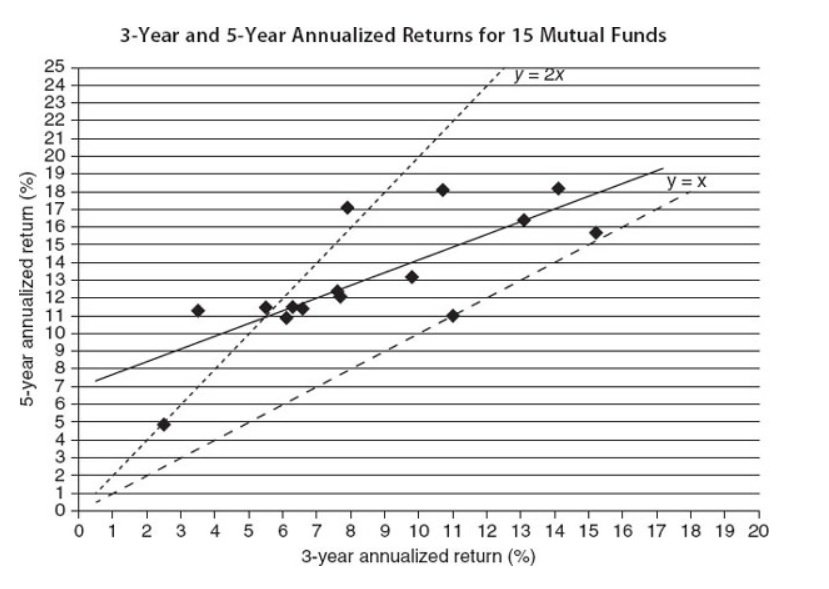
The following graph compares the 5-year annualized return for 15 mutual funds with the 3-year annualized return for the same funds. The solid line is the line of best fit.
132.jpg [ 103.91 KiB | Viewed 7831 times ]
The fund for which the ratio of 5-year return to 3-year return was largest had a 3-year return of approximately .
The highest 3-year return for any fund exceeds the 5-year returns of funds.
Question #1 based on the same graph is available here
The following graph compares the 5-year annualized return for 15 mutual funds with the 3-year annualized return for the same funds. The solid line is the line of best fit.
Attachment:
132.jpg [ 103.91 KiB | Viewed 7831 times ]
The fund for which the ratio of 5-year return to 3-year return was largest had a 3-year return of approximately .
The highest 3-year return for any fund exceeds the 5-year returns of funds.
Show SpoilerAdditional Question
The median 3-year return is approximately ____________.
(A) 5.8%
(B) 6.4%
(C) 7.5%
(D) 8.5%
(E) 10.0%
Answer: C
(A) 5.8%
(B) 6.4%
(C) 7.5%
(D) 8.5%
(E) 10.0%
Answer: C
Question #1 based on the same graph is available here
Archived Topic
Hi there,
This topic has been closed and archived due to inactivity or violation of community quality standards. No more replies are possible here.
Where to now? Join ongoing discussions on thousands of quality questions in our Graphs and Tables (G&T) Forum
Still interested in this question? Check out the "Best Topics" block below for a better discussion on this exact question, as well as several more related questions.
Thank you for understanding, and happy exploring!
ShowHide Answer
Official Answer
Dropdown 1: 3.5%
Dropdown 2: 10

 21 May 2024, 10:17
Kudos
Bookmarks
Sajjad1994 can you please explain the solution to the second part of the question.