Events & Promotions
|
|

GMAT Club Daily Prep
Thank you for using the timer - this advanced tool can estimate your performance and suggest more practice questions. We have subscribed you to Daily Prep Questions via email.
Customized
for You
Track
Your Progress
Practice
Pays
Not interested in getting valuable practice questions and articles delivered to your email? No problem, unsubscribe here.
 Sep 21
07:00 PM EDT
-10:00 PM EDT
Boost your GMAT score in less than one month in a live online class + 6 months access to TTP OnDemand video courses included! Sep 18
10:00 AM IST
-11:00 PM IST
Start your journey with a fully customized action plan and work with a dedicated mentor to achieve a 735+ score. Sep 26
01:00 PM EDT
-04:00 PM EDT
Top scores are possible when you enroll in a powerful GMAT course, taught live online + 6 months access to TTP OnDemand video courses included. Class starts Saturdays Sept. 26, 2026 - Dec. 19, 2026, 1:00pm-4:00pm ES


 01 Jun 2026, 08:15
Kudos
Bookmarks
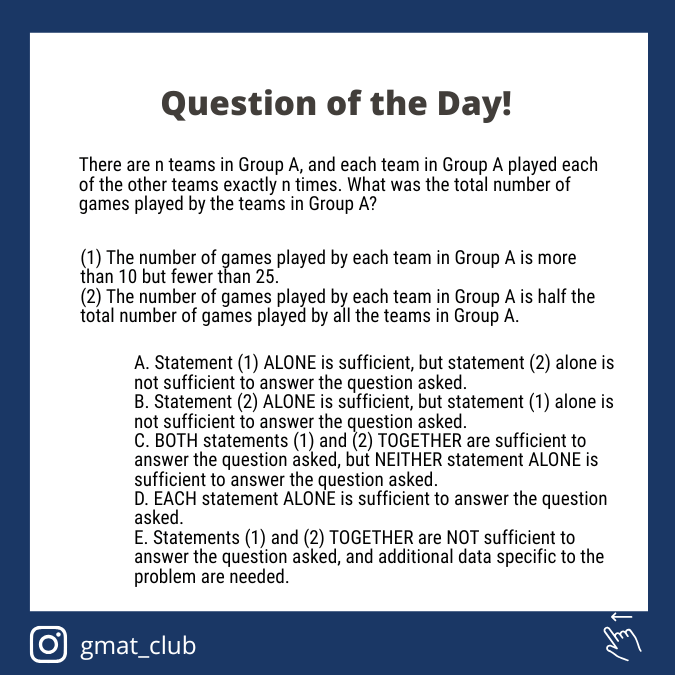
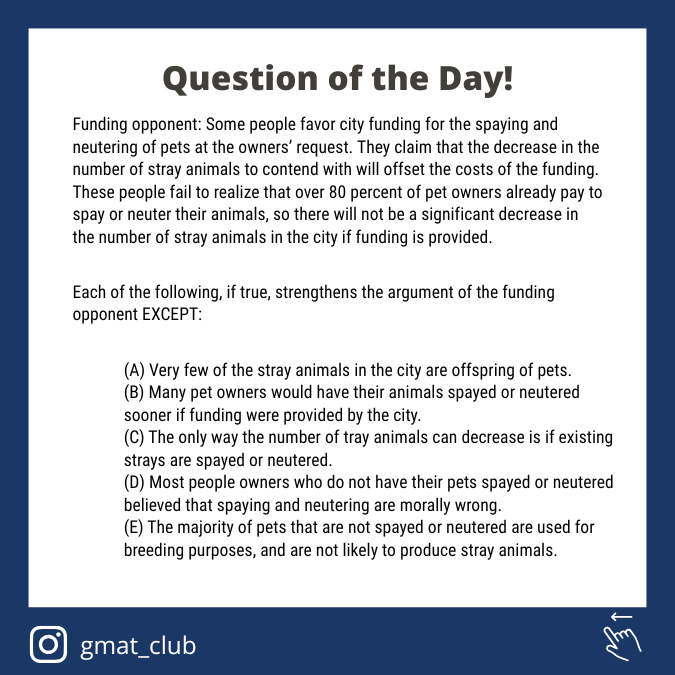
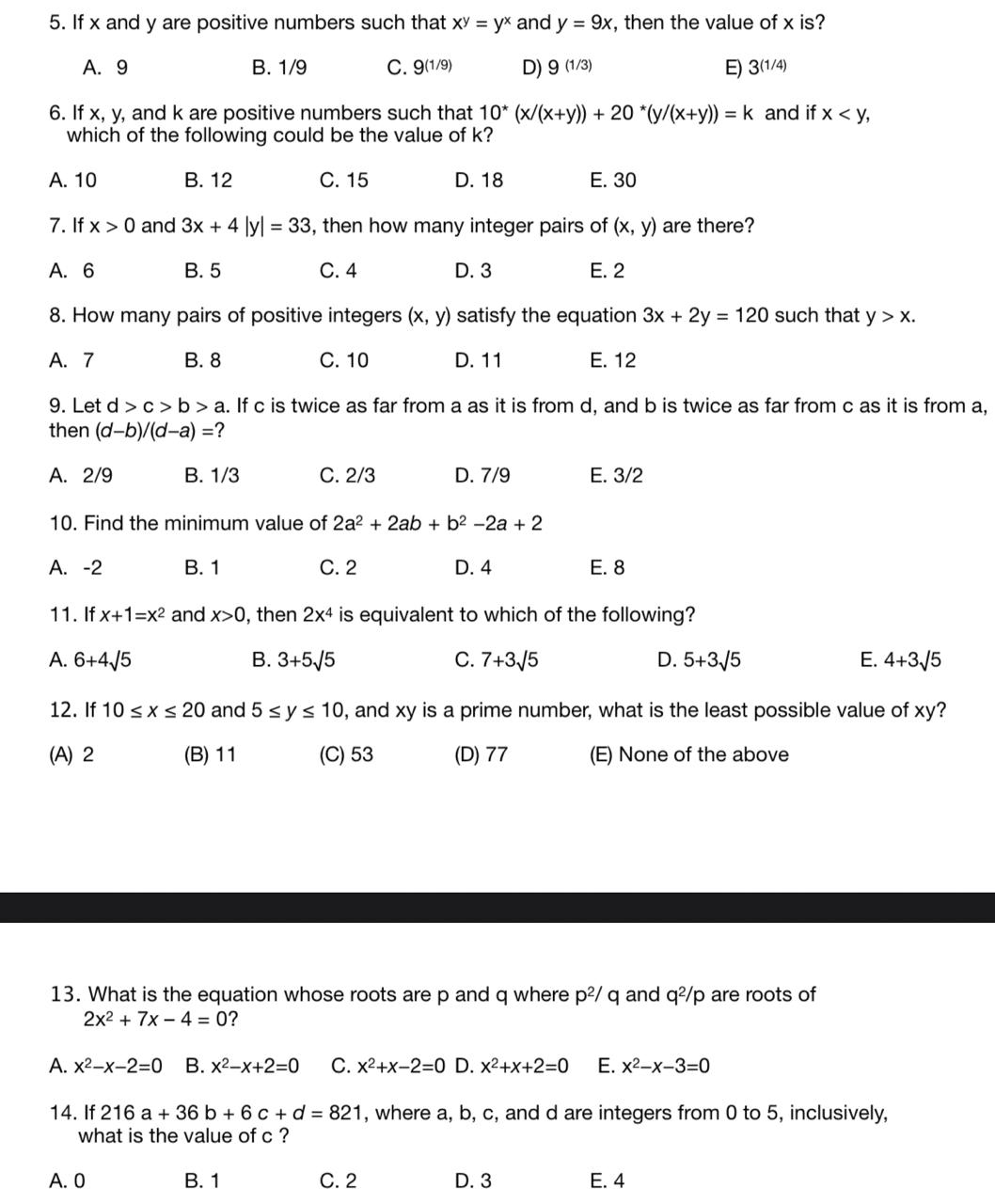
June 1st Verbal Question of the Day
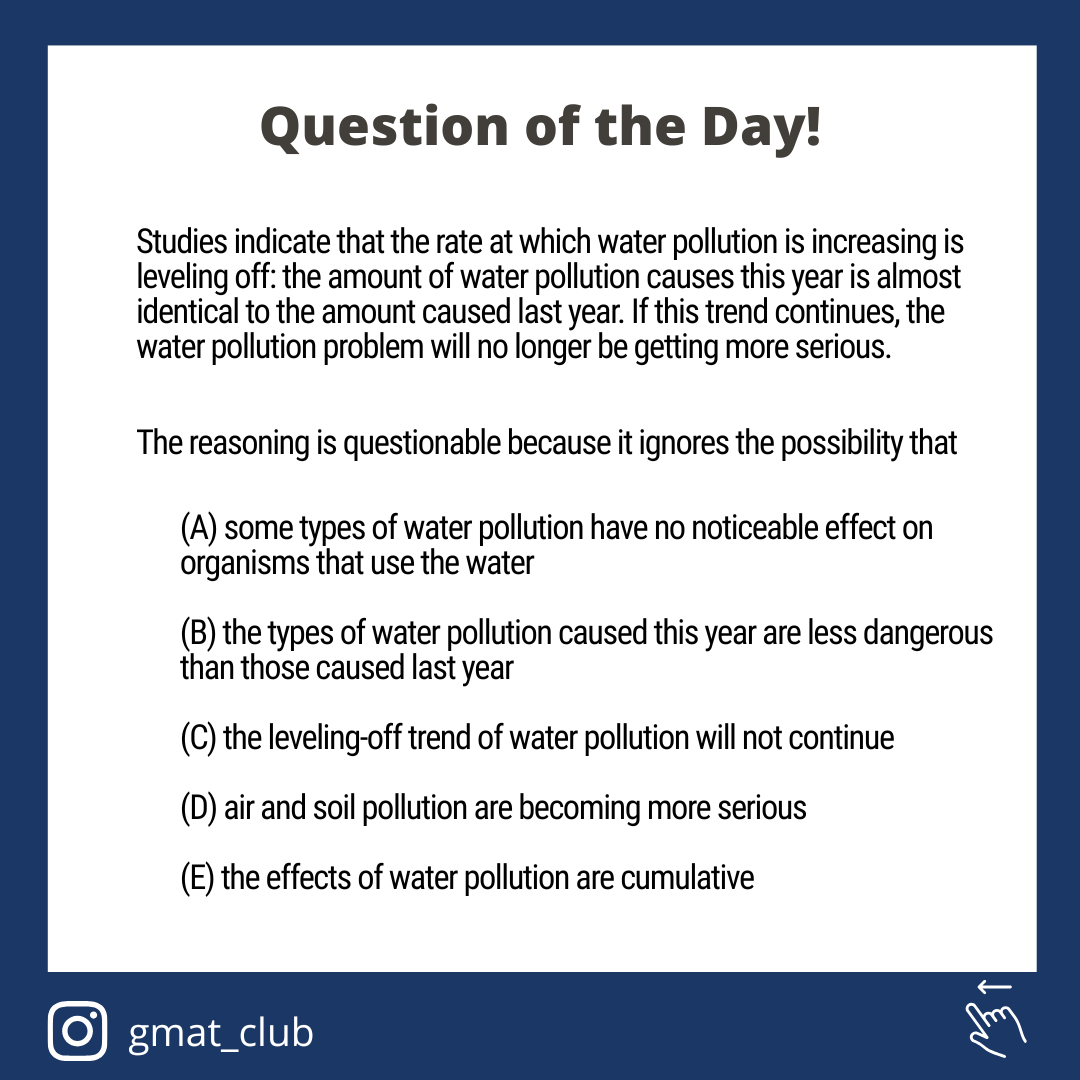
Answer and Explanation | Subscribe via E-mail, Forum, Instagram, or YouTube
Answer and Explanation | Subscribe via E-mail, Forum, Instagram, or YouTube
 01 Jun 2026, 14:48
Kudos
Bookmarks
| Problem Solving Butler: June 2026 | ||
| June 2 | PS 1 | PS 2 |
________________________
PS 1
There are five History and three Science books on a shelf. A student picked three books randomly. What is the probability that he picked at least one Science book?
A. 3/8
B. 5/8
C. 5/28
D. 11/14
E. 23/28
_____________________________
PS 2
Set S contains 11 integers. Set T contains 11 terms, obtained by doubling each integer of set S. Which of the following may be true?
I. The average of S is greater than the average of T.
II. The median of S is greater than the median of T.
III. The range of S is greater than the range of T.
A. None
B. I only
C. III only
D. I and II only
E. I, II, and III
01 Jun 2026, 14:50
Kudos
Bookmarks
| Critical Reasoning Butler: June 2026 | ||
| June 2 | CR 1 | CR 2 |
____________________
CR 1
A certain watchmaker is attempting to increase its market share by deeply discounting the price of its watches for the upcoming holiday season. The discounts will eat into profits, but because they will be heavily advertised the watchmaker hopes that they will attract buyers away from rival watchmakers' products. In the long term, the watchmaker believes that consumers initially attracted by the discounts may become loyal customers.
In assessing the plan's chances of achieving its aim, it would be most useful to know which of the following?
(A) Whether the watchmaker's competitors are likely to respond by offering deep discounts of their own products
(B) Whether the advertisements will be created by the watchmaker's current advertising agency
(C) Whether some of the watch styles will be more deeply discounted than others
(D) Whether the watchmaker will be able to cut costs sufficiently to maintain profit margins even when the discounts are in effect
(E) Whether an alternative strategy might enable the watchmaker to enhance its profitability while holding a constant or diminishing share of the market
____________________
CR 2
Heavy consumption of alcohol causes impaired judgment, a loss of fine motor skills, slower reaction times, a decrease in visual acuity, and other short-term symptoms. Since alcohol can be metabolized in the average person’s body at a rate of 0.015 BAC (or “blood alcohol content”) per hour, a severely intoxicated individual with a BAC of 0.15 should be symptom-free after 10 hours. After this time, if the individual exhibits similar symptoms, such symptoms cannot be caused by alcohol.
Which of the following, if true, most seriously weakens the conclusion above?
(A) Some symptoms normally associated with alcohol consumption may resemble symptoms caused by prescription drugs or even drowsiness.
(B) Increases in BAC are based on the amount of alcohol consumed rather than the number of drinks (some drinks contain more alcohol than others).
(C) Heavy alcohol consumption has numerous long term effects such as cirrhosis of the liver, stomach ulcers, and birth defects.
(D) The metabolic rate of alcohol varies according to a person’s health, weight, diet, and genetic predispositions.
(E) Some people, due to an acute sensitivity to alcohol, cannot even reach a BAC of 0.15 before becoming violently ill.