Events & Promotions
|
|

GMAT Club Daily Prep
Thank you for using the timer - this advanced tool can estimate your performance and suggest more practice questions. We have subscribed you to Daily Prep Questions via email.
Customized
for You
Track
Your Progress
Practice
Pays
Not interested in getting valuable practice questions and articles delivered to your email? No problem, unsubscribe here.
 Sep 28
07:00 PM EDT
-10:00 PM EDT
Boost your GMAT score in less than one month in a live online class + 6 months access to TTP OnDemand video courses included! Class starts Mon, Tues, Wed, Thur, Fri Sept. 28, 2026 - Oct. 16, 2027, 7:00pm-10:00pm EST Sep 29
11:00 AM EDT
-01:00 PM EDT
" Description: Top scores are possible when you enroll in a powerful GMAT course, taught live online + 6 months access to TTP OnDemand video courses included! Class starts Tues/Thur Sept. 29, 2026 - Dec. 3, 2026, 11:00am-1:00pm EST Oct 01
07:00 AM BST
-08:00 AM GMT
Welcome to the GMAT Club's Free Interview Prep Event for Top MBA Programs! Buy tickets - Virtual series that’s all set to equip you to -excel in your MBA interviews. Oct 03
01:00 PM EDT
-04:00 PM EDT
Top scores are possible when you enroll in a powerful GMAT course, taught live online + 6 months access to TTP OnDemand video courses included! Class starts Saturdays Oct. 3, 2026 - Dec. 26, 2026, 1:00pm-4:00pm EST

Question 1


B
Be sure to select an answer first to save it in the Error Log before revealing the correct answer (OA)!
Difficulty:
 15%
(low)
15%
(low)
Question Stats:
78% (02:09) correct 22%
(02:19) wrong
based on 408
sessions
22%
(02:19) wrong
based on 408
sessions
History
Date
Time
Result
Not Attempted Yet
Question 2
E
Be sure to select an answer first to save it in the Error Log before revealing the correct answer (OA)!
Difficulty:
 65%
(hard)
65%
(hard)
Question Stats:
48% (01:14) correct 52%
(01:27) wrong
based on 422
sessions
History
Date
Time
Result
Not Attempted Yet
Question 3
E
Be sure to select an answer first to save it in the Error Log before revealing the correct answer (OA)!
Difficulty:
5%
(low)
Question Stats:
91% (00:46) correct 9%
(01:20) wrong
based on 362
sessions
History
Date
Time
Result
Not Attempted Yet
GMAT-Club-Forum-gypw4dnf.png [ 121.85 KiB | Viewed 2601 times ]
GMAT-Club-Forum-1zsbjzdu.png [ 55.69 KiB | Viewed 2600 times ]
GMAT-Club-Forum-g1txjfu4.png [ 59 KiB | Viewed 2597 times ]
GMAT-Club-Forum-6mk25glx.png [ 52.71 KiB | Viewed 2594 times ]
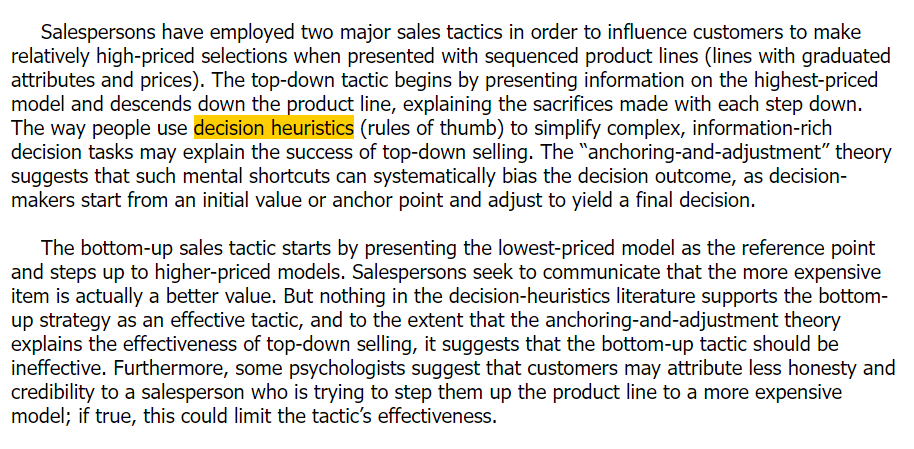
Salespersons have employed two major sales tactics in order to influence customers to make relatively high-priced selections when presented with sequenced product lines (lines with graduated attributes and prices). The top-down tactic begins by presenting information on the highest-priced model and descends down the product line, explaining the sacrifices made with each step down. The way people use decision heuristics (rules of thumb) to simplify complex, information-rich decision tasks may explain the success of top-down selling. The "anchoring-and-adjustment" theory suggests that such mental shortcuts can systematically bias the decision outcome, as decision- makers start from an initial value or anchor point and adjust to yield a final decision.
The bottom-up sales tactic starts by presenting the lowest-priced model as the reference point and steps up to higher-priced models. Salespersons seek to communicate that the more expensive item is actually a better value. But nothing in the decision-heuristics literature supports the bottom- up strategy as an effective tactic, and to the extent that the anchoring-and-adjustment theory explains the effectiveness of top-down selling, it suggests that the bottom-up tactic should be ineffective. Furthermore, some psychologists suggest that customers may attribute less honesty and credibility to a salesperson who is trying to step them up the product line to a more expensive model; if true, this could limit the tactic’s effectiveness.
The bottom-up sales tactic starts by presenting the lowest-priced model as the reference point and steps up to higher-priced models. Salespersons seek to communicate that the more expensive item is actually a better value. But nothing in the decision-heuristics literature supports the bottom- up strategy as an effective tactic, and to the extent that the anchoring-and-adjustment theory explains the effectiveness of top-down selling, it suggests that the bottom-up tactic should be ineffective. Furthermore, some psychologists suggest that customers may attribute less honesty and credibility to a salesperson who is trying to step them up the product line to a more expensive model; if true, this could limit the tactic’s effectiveness.
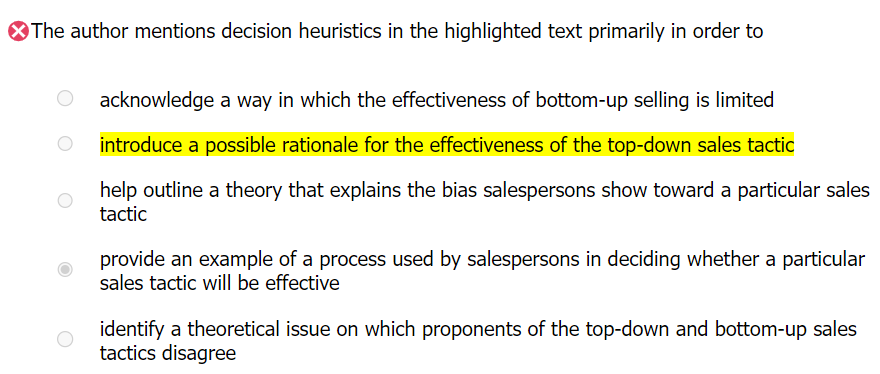
1. The author mentions decision heuristics in the highlighted text primarily in order to
A. acknowledge a way in which the effectiveness of bottom-up selling is limited
B. introduce a possible rationale for the effectiveness of the top-down sales tactic
C. help outline a theory that explains the bias salespersons show toward a particular sales tactic
D. provide an example of a process used by salespersons in deciding whether a particular sales tactic will be effective
E. identify a theoretical issue on which proponents of the top-down and bottom-up sales tactics disagree
A. acknowledge a way in which the effectiveness of bottom-up selling is limited
B. introduce a possible rationale for the effectiveness of the top-down sales tactic
C. help outline a theory that explains the bias salespersons show toward a particular sales tactic
D. provide an example of a process used by salespersons in deciding whether a particular sales tactic will be effective
E. identify a theoretical issue on which proponents of the top-down and bottom-up sales tactics disagree
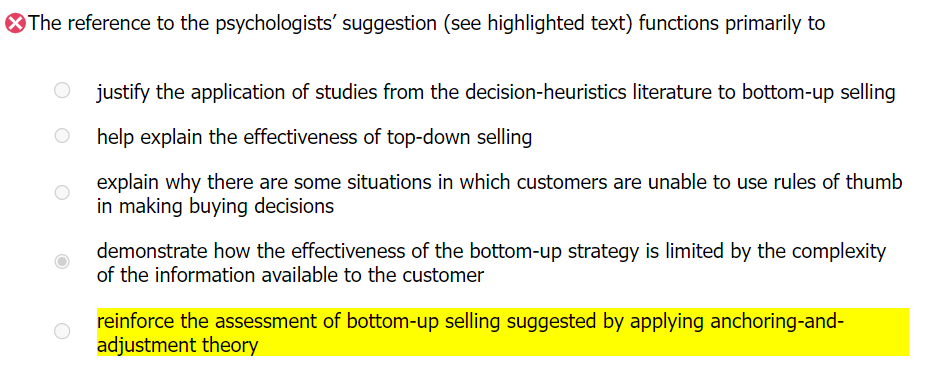
2. The reference to the psychologists' suggestion (see highlighted text) functions primarily to
A. justify the application of studies from the decision-heuristics literature to bottom-up selling
B. help explain the effectiveness of top-down selling
C. explain why there are some situations in which customers are unable to use rules of thumb in making buying decisions
D. demonstrate how the effectiveness of the bottom-up strategy is limited by the complexity of the information available to the customer
E. reinforce the assessment of bottom-up selling suggested by applying anchoring-and-adjustment theory
A. justify the application of studies from the decision-heuristics literature to bottom-up selling
B. help explain the effectiveness of top-down selling
C. explain why there are some situations in which customers are unable to use rules of thumb in making buying decisions
D. demonstrate how the effectiveness of the bottom-up strategy is limited by the complexity of the information available to the customer
E. reinforce the assessment of bottom-up selling suggested by applying anchoring-and-adjustment theory
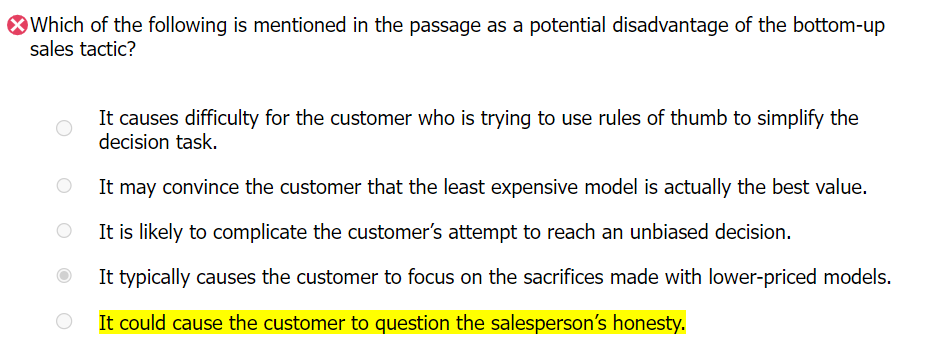
3. Which of the following is mentioned in the passage as a potential disadvantage of the bottom-up sales tactic?
A. It causes difficulty for the customer who is trying to use rules of thumb to simplify the decision task.
B. It may convince the customer that the least expensive model is actually the best value.
C. It is likely to complicate the customer’s attempt to reach an unbiased decision.
D. It typically causes the customer to focus on the sacrifices made with lower-priced models.
E. It could cause the customer to question the salesperson's honesty.
A. It causes difficulty for the customer who is trying to use rules of thumb to simplify the decision task.
B. It may convince the customer that the least expensive model is actually the best value.
C. It is likely to complicate the customer’s attempt to reach an unbiased decision.
D. It typically causes the customer to focus on the sacrifices made with lower-priced models.
E. It could cause the customer to question the salesperson's honesty.
Attachment:
GMAT-Club-Forum-gypw4dnf.png [ 121.85 KiB | Viewed 2601 times ]
Attachment:
GMAT-Club-Forum-1zsbjzdu.png [ 55.69 KiB | Viewed 2600 times ]
Attachment:
GMAT-Club-Forum-g1txjfu4.png [ 59 KiB | Viewed 2597 times ]
Attachment:
GMAT-Club-Forum-6mk25glx.png [ 52.71 KiB | Viewed 2594 times ]
Trying to understand why the right answer is right?
GMAT Club Tests explanations walk through concepts, shortcuts, and common traps on many questions.
See how →

maximilius491
Joined: 01 May 2023
Last visit: 12 Dec 2025
Posts: 16
Given Kudos: 53
Location: Canada
Schools: Said '27 (A) IESE '27 (A) Judge '26 (II)
GMAT Focus 1: 645 Q86 V82 DI78 
GPA: 3.2
 28 Jul 2024, 16:14
Kudos
Bookmarks
2.
The reference to the psychologists' suggestion about customers attributing less honesty and credibility to a salesperson using the bottom-up tactic is intended to reinforce the assessment of the bottom-up strategy by highlighting a potential limitation of its effectiveness
The reference to the psychologists' suggestion about customers attributing less honesty and credibility to a salesperson using the bottom-up tactic is intended to reinforce the assessment of the bottom-up strategy by highlighting a potential limitation of its effectiveness
- A. justify the application of studies from the decision-heuristics literature to bottom-up selling: The psychologists' suggestion does not justify applying decision-heuristics studies to bottom-up selling. Instead, it highlights a potential drawback of the tactic itself.
- B. help explain the effectiveness of top-down selling: The psychologists' suggestion does not directly explain the effectiveness of top-down selling but rather points out a potential issue with the bottom-up tactic.
- C. explain why there are some situations in which customers are unable to use rules of thumb in making buying decisions: The psychologists' suggestion does not address customers' inability to use rules of thumb but rather concerns perceptions of honesty and credibility.
- D. demonstrate how the effectiveness of the bottom-up strategy is limited by the complexity of the information available to the customer: The suggestion does not focus on the complexity of information but rather on the perceived credibility of the salesperson.
- E. reinforce the assessment of bottom-up selling suggested by applying anchoring-and-adjustment theory: The psychologists' suggestion reinforces the negative assessment of bottom-up selling, as it supports the view that this strategy is less effective, aligning with the anchoring-and-adjustment theory's implications.
Therefore E
 02 Mar 2026, 04:37
Kudos
Bookmarks
Automated notice from GMAT Club VerbalBot:
A member just gave Kudos to this thread, showing it’s still useful. I’ve bumped it to the top so more people can benefit. Feel free to add your own questions or solutions.
This post was generated automatically.
A member just gave Kudos to this thread, showing it’s still useful. I’ve bumped it to the top so more people can benefit. Feel free to add your own questions or solutions.
This post was generated automatically.




