Last visit was: 22 Apr 2026, 21:35 It is currently 22 Apr 2026, 21:35
Close
GMAT Club Daily Prep
Thank you for using the timer - this advanced tool can estimate your performance and suggest more practice questions. We have subscribed you to Daily Prep Questions via email.

Customized
for You

we will pick new questions that match your level based on your Timer History

Track
Your Progress

every week, we’ll send you an estimated GMAT score based on your performance

Practice
Pays

we will pick new questions that match your level based on your Timer History
Not interested in getting valuable practice questions and articles delivered to your email? No problem, unsubscribe here.
Close
Request Expert Reply
Confirm Cancel
User avatar
nocilis
Joined: 19 Nov 2004
Last visit: 11 Jul 2008
Posts: 274
Own Kudos:
1,545
 [164]
Location: SF Bay Area, USA
Posts: 274
Kudos: 1,545
 [164]
22
Kudos
Add Kudos
142
Bookmarks
Bookmark this Post
Most Helpful Reply
User avatar
Narenn
User avatar
Major Poster
Joined: 22 Feb 2012
Last visit: 22 Apr 2026
Posts: 9,291
Own Kudos:
11,303
 [50]
Given Kudos: 4,711
Affiliations: GMAT Club
Test: Test
Posts: 9,291
Kudos: 11,303
 [50]
27
Kudos
Add Kudos
23
Bookmarks
Bookmark this Post
User avatar
IanStewart
User avatar
GMAT Tutor
Joined: 24 Jun 2008
Last visit: 17 Apr 2026
Posts: 4,143
Own Kudos:
11,270
 [23]
Given Kudos: 99
Expert
Expert reply
Posts: 4,143
Kudos: 11,270
 [23]
17
Kudos
Add Kudos
6
Bookmarks
Bookmark this Post
User avatar
Bunuel
User avatar
Math Expert
Joined: 02 Sep 2009
Last visit: 22 Apr 2026
Posts: 109,754
Own Kudos:
Given Kudos: 105,827
Products:
Expert
Expert reply
Active GMAT Club Expert! Tag them with @ followed by their username for a faster response.
Posts: 109,754
Kudos: 810,694
 [21]
14
Kudos
Add Kudos
7
Bookmarks
Bookmark this Post
kirankp
What is the probability that a student randomly selected from a class of 60 students will be a male who has brown hair?
(1) One-half of the students have brown hair.
(2) One-third of the students are males.

We have four goups of students:
M(b) - Males with brown hairs;
M(n) - Males with non-brown hairs;
F(b) - Females with brown hairs;
F(n) - Females with non-brown hairs;

\(\frac{M(b)}{M(b)+M(n)+F(b)+F(n)}=\frac{M(b)}{60}=?\)

(1) \(\frac{M(b)+F(b)}{M(b)+M(n)+F(b)+F(n)}=\frac{1}{2}\) --> \(M(b)+F(b)=M(n)+F(n)\). --> \(\frac{M(b)}{M(b)+F(b)+M(b)+F(b)}=\frac{M(b)}{2M(b)+2F(b)}=\frac{M(b)}{60}\) --> Not sufficient.

(2) \(\frac{M(b)+M(n)}{M(b)+M(n)+F(b)+F(n)}=\frac{1}{3}\) --> \(2M(b)+2M(n)=F(b)+F(n)\) --> \(\frac{M(b)}{M(b)+M(n)+2M(b)+2M(n)}=\frac{M(b)}{3M(b)+3M(n)}=\frac{M(b)}{60}\). Not sufficient.

(1)+(2) Basically we have two equations with three variables. We can not express variables so that to get the numerical value of the fraction asked. Not sufficient.

Answer: E.
General Discussion
User avatar
banerjeea_98
Joined: 18 Nov 2004
Last visit: 17 May 2012
Posts: 674
Own Kudos:
201
 [3]
Posts: 674
Kudos: 201
 [3]
2
Kudos
Add Kudos
1
Bookmarks
Bookmark this Post
"E" for me.....even after combining.....the 20 mals student might belong entirely to the gp of 30 brown hair students or may be 10, 5...etc....so insuff.
avatar
Samarth0711
Joined: 25 Apr 2010
Last visit: 14 Aug 2011
Posts: 3
Own Kudos:
5
 [5]
Given Kudos: 2
Posts: 3
Kudos: 5
 [5]
4
Kudos
Add Kudos
1
Bookmarks
Bookmark this Post
What is the probability that a student randomly selected from a class of 60 students will
be a male who has brown hair?
(1) One-half of the students have brown hair.
(2) One-third of the students are males.

Is'nt this straightforward independant events probability:
(1/2)* (1/3) ??

That would get the answer as (C) but the correct answer is given as (E) ??
I know there's something really fundamental I am missing here!?
User avatar
frank1
Joined: 24 Apr 2010
Last visit: 11 Dec 2010
Posts: 42
Own Kudos:
24
 [4]
Posts: 42
Kudos: 24
 [4]
4
Kudos
Add Kudos
Bookmarks
Bookmark this Post
Spoiler of this question seems to be
well when we say 1/3 of 60 ie 20 are boys....it is actually not that all those 20 have brown hair....so we actually dont know actual numbers of boys who have brown hair....so E
(but i confess i was fooled at first glance...)
avatar
rmohan1234
Joined: 09 May 2014
Last visit: 18 Sep 2014
Posts: 1
Own Kudos:
5
 [3]
Posts: 1
Kudos: 5
 [3]
3
Kudos
Add Kudos
Bookmarks
Bookmark this Post
I think the answer should be (C). Please see the following approach and explain the flaw if possible:

I agree that "Male intersection Brown" can be anywhere between 0 and 20. Class is 60. This leads to probability being between 0 and 1/3.
But I disagree that we can NOT answer the question. The Answer should be 1/6. If we take the as mentioned by colleagues above, isn't the the entire concept of probability is lost?
Also, being male and brown hair are independent. When a person is born, BOTH of these traits are TOTALLY independent of each other.

Probability is a concept. Not a certainty, or a guarantee. It is only a likelihood.
Let me try and explain what I am saying.
Lets take a simple standard question for which there is no confusion.
# What is the Prob of getting all heads if I toss a coin 3 times.
Ans: We take sample space where we have 8 options. Favourable is 1. Answer is that probability is 1/8.

This means 1 out of 8 try's shall give us 1 success (3 Heads).

NOW

If I toss a coin 40 times can we say WE SHALL DEFINITELY GET 5 SUCCESSES ?

Obviously NO. But possible & likely.

If I toss a coin 40 times can we say WE SHALL DEFINITELY GET 0 SUCCESSES ?

Obviously NO. But possible.

If I toss a coin 40 times can we say WE SHALL DEFINITELY GET 40 SUCCESSES ?

Obviously NO. But possible.

So do we conclude that probability can be anywhere between 0 and 1.
As such, we do not have enough data to answer the question ? But, We say the probability is 1/8

I think we need to approach the Q39 in same way.

Any insights to refute/question my thinking process will be highly appreciated!
User avatar
MathRevolution
User avatar
Math Revolution GMAT Instructor
Joined: 16 Aug 2015
Last visit: 27 Sep 2022
Posts: 10,063
Own Kudos:
20,000
 [3]
Given Kudos: 4
GMAT 1: 760 Q51 V42
GPA: 3.82
Expert
Expert reply
GMAT 1: 760 Q51 V42
Posts: 10,063
Kudos: 20,000
 [3]
3
Kudos
Add Kudos
Bookmarks
Bookmark this Post
What is the probability that a student randomly selected from a class of 60 students will be a male who has brown hair?

(1) One-half of the students have brown hair.
(2) One-third of the students are males.

In the original condition, the question is frequently given in the Gmat Math test, which is "2 by 2" que like the table below.
Attachment:
GCDS   nocilis       What is the probability that a student (20151219).jpg
GCDS nocilis What is the probability that a student (20151219).jpg [ 26.39 KiB | Viewed 240666 times ]
In the above, there are 4 variables((a,b,c,d), and 1 equation(a+b+c+d=60), which should match with the number equations. So you need 3 more equations. For 1) 1 equation, for 2) 1 equation, which is likely make E the answer.
When 1) & 2), you cannot find the value of b in a unique way from a+b=30, b+d=20, which is not sufficient. Therefore, the answer is E.


-> For cases where we need 1 more equation, such as original conditions with “1 variable”, or “2 variables and 1 equation”, or “3 variables and 2 equations”, we have 1 equation each in both 1) and 2). Therefore, there is 59 % chance that D is the answer, while A or B has 38% chance and C or E has 3% chance. Since D is most likely to be the answer using 1) and 2) separately according to DS definition. Obviously there may be cases where the answer is A, B, C or E.
User avatar
BrentGMATPrepNow
User avatar
Major Poster
Joined: 12 Sep 2015
Last visit: 31 Oct 2025
Posts: 6,733
Own Kudos:
36,446
 [5]
Given Kudos: 799
Location: Canada
Expert
Expert reply
Posts: 6,733
Kudos: 36,446
 [5]
5
Kudos
Add Kudos
Bookmarks
Bookmark this Post
nocilis
What is the probability that a student randomly selected from a class of 60 students will be a male who has brown hair?

(1) One-half of the students have brown hair.
(2) One-third of the students are males.

Here's a step-by-step approach using the Double Matrix method.

Here, we have a population of students, and the two characteristics are:
- male or female
- has brown hair or doesn't have brown hair.

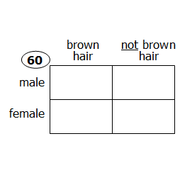
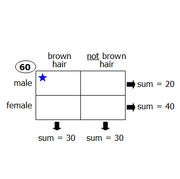
There are 60 students altogether, so we can set up our diagram as follows:


Target question: What is the probability that a student randomly selected from a class of 60 students will be a male who has brown hair?
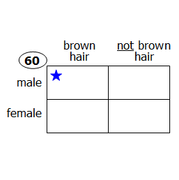
So, we must determine how many of the 60 students are males with brown hair. Let's place a STAR in the box that represents this information:


Statement 1: one-half of the students have brown hair.
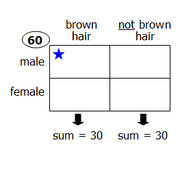
So, 30 of the students have brown hair, which means the remaining 30 students do NOT have brown hair.
When we add this information to our diagram, we get:

Do we now have enough information to determine the number in the starred box? No.
So, statement 1 is NOT SUFFICIENT

Statement 2: one-third of the students are males
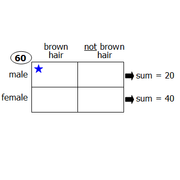
So, 20 of the students are males, which means the remaining 40 students are NOT males.
When we add this information to our diagram, we get:

Do we now have enough information to determine the number in the starred box? No.
So, statement 2 is NOT SUFFICIENT

Statements 1 and 2 combined
Combining the information, we get:

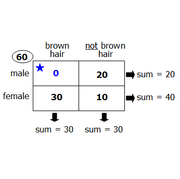
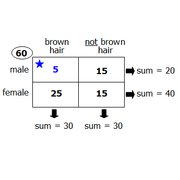
Do we now have enough information to determine the number in the starred box? No. Consider these two conflicting cases:

case a:

Here, 0 of the 60 students are males with brown hair, so P(selected student is male with brown hair) = 0/60

case b:

Here, 5 of the 60 students are males with brown hair, so P(selected student is male with brown hair) = 5/60

Since we cannot answer the target question with certainty, the combined statements are NOT SUFFICIENT

Answer:
RELATED VIDEO

MORE PRACTICE
avatar
SuyashA
Joined: 22 Sep 2016
Last visit: 03 Jul 2022
Posts: 42
Own Kudos:
Given Kudos: 127
Location: India
Concentration: International Business, General Management
Products:
Posts: 42
Kudos: 58
Kudos
Add Kudos
Bookmarks
Bookmark this Post
GMATPrepNow
nocilis
What is the probability that a student randomly selected from a class of 60 students will be a male who has brown hair?

(1) One-half of the students have brown hair.
(2) One-third of the students are males.

Here's a step-by-step approach using the Double Matrix method.

Here, we have a population of students, and the two characteristics are:
- male or female
- has brown hair or doesn't have brown hair.

There are 60 students altogether, so we can set up our diagram as follows:


Target question: What is the probability that a student randomly selected from a class of 60 students will be a male who has brown hair?
So, we must determine how many of the 60 students are males with brown hair. Let's place a STAR in the box that represents this information:


Statement 1: one-half of the students have brown hair.
So, 30 of the students have brown hair, which means the remaining 30 students do NOT have brown hair.
When we add this information to our diagram, we get:

Do we now have enough information to determine the number in the starred box? No.
So, statement 1 is NOT SUFFICIENT

Statement 2: one-third of the students are males
So, 20 of the students are males, which means the remaining 40 students are NOT males.
When we add this information to our diagram, we get:

Do we now have enough information to determine the number in the starred box? No.
So, statement 2 is NOT SUFFICIENT

Statements 1 and 2 combined
Combining the information, we get:

Do we now have enough information to determine the number in the starred box? No. Consider these two conflicting cases:

case a:

Here, 0 of the 60 students are males with brown hair, so P(selected student is male with brown hair) = 0/60

case b:

Here, 5 of the 60 students are males with brown hair, so P(selected student is male with brown hair) = 5/60

Since we cannot answer the target question with certainty, the combined statements are NOT SUFFICIENT

Answer:
RELATED VIDEO

MORE PRACTICE

Hi,

How to identify whether a double matrix method can be used in a problem?

Thanks.
User avatar
BrentGMATPrepNow
User avatar
Major Poster
Joined: 12 Sep 2015
Last visit: 31 Oct 2025
Posts: 6,733
Own Kudos:
36,446
 [1]
Given Kudos: 799
Location: Canada
Expert
Expert reply
Posts: 6,733
Kudos: 36,446
 [1]
1
Kudos
Add Kudos
Bookmarks
Bookmark this Post
SpiritualYoda

Hi,

How to identify whether a double matrix method can be used in a problem?

Thanks.

The Double Matrix Method can be used for most questions featuring a population in which each member has two characteristics associated with it (aka overlapping sets questions).

Here, we have a population of students, and the two characteristics are:
- male or female
- has brown hair or doesn't have brown hair

Cheers,
Brent
User avatar
CrackverbalGMAT
User avatar
Major Poster
Joined: 03 Oct 2013
Last visit: 22 Apr 2026
Posts: 4,846
Own Kudos:
9,180
 [1]
Given Kudos: 226
Affiliations: CrackVerbal
Location: India
Expert
Expert reply
Posts: 4,846
Kudos: 9,180
 [1]
1
Kudos
Add Kudos
Bookmarks
Bookmark this Post
Solution:

The information provided is that there are 60 students.
A student is randomly selected.
We have to calculate the probability of the student being a male with brown hair.

St(1)- One-half of the students have brown hair.
We have no information about the female students. (Insufficient) -Eliminate A,D-

St(2)- One-third of the students are males.
We have no information about the students with brown hair. Once again (insufficient) - Eliminate B-

Combining both,
We have 1/3rd of 60 which is 20 students being male from St(2) and 1/2 or 30 of the students from among 60 with brown hair.
These 30 students can be male or female.
So,the number of males with brown hair cannot be derived.
(Insufficient) (option e)

Devmitra Sen
GMAT SME
User avatar
hassan233
Joined: 28 Dec 2020
Last visit: 16 Feb 2022
Posts: 51
Own Kudos:
60
 [4]
Given Kudos: 25
Location: United States
Posts: 51
Kudos: 60
 [4]
3
Kudos
Add Kudos
1
Bookmarks
Bookmark this Post
The answers here are pretty confusing and can be simplified.
P(A and B) = P(A) + P(B) - P(A or B)
From statement 1 and 2, we know P(A) and P(B) but not P(A or B)
We do not know the P(A or B) because in order to know P(A or B) we need to the number of people who have brown hair but are not male + people who are male but do not have brown hair + people who are both male and brown-haired.
In the question stem, this information is abstracted from us, we are given the birds-eye view of the "total" but not the breakdown.
Since we are not told that these events are mutually exclusive or not, we can assume the worst case that they are not mutually exclusive. In this case, we there is no way to find P(A or B) with the given information.
User avatar
Shadwal
Joined: 22 Aug 2019
Last visit: 15 Jan 2022
Posts: 7
Given Kudos: 16
Location: India
Schools: ISB '23 (S)
GMAT 1: 770 Q51 V42
GPA: 3.25
Schools: ISB '23 (S)
GMAT 1: 770 Q51 V42
Posts: 7
Kudos: 0
Kudos
Add Kudos
Bookmarks
Bookmark this Post
14 Aug 2021, 21:10
Hi,

The correct answer should be (E) and not (C).

We cannot consider the events independent and say that P(male with brown hair) = P(male) x P(brown hair) because we do not know what is the likelihood of a male to have brown hair compared to a female.

I had given an incorrect example before:

Let's say the question said,
What is the probability of selecting a capital boy from a set of 4 students?
1. 50% of students are boys
2. 50% of students are capital

Now, if we combine the two statements, we know that 50% of students are boys and 50% of students are capital.
Possible cases:
Case A: bbGG - 1 possibility
Case B: BBgg - 1 possibility
Case C: BbGg - 4 possibilities (since the students are different entities)
Overall 1+1+4 = 6 possible ways in which out of 4 students, 50% are boys and 50% are capital.

Probability of selecting a capital boy
= P(Case A)xP(capital B given case A) + P(Case B)xP(capital B given case B) + P(Case C)x(capital B given case C)
=1/6x0 + 1/6x1/2 + 4/6x1/4
=0 + 1/12 + 1/6
=1/4
i.e. P(boys)xP(capital)

Here, I had made the assumption that a boy is as likely to be capital as a girl, even though the question did not explicitly say so. If a boy was twice as likely to be capital as a girl, the probability of cases A & B to occur (bbGG vs BBgg) wouldn't be the same. Similarly, in the original question, we should not assume that a male student is as likely to have brown hair as a female student.

It is different from tossing two fair coins because in that case, we know that the probability of getting HH is same as the probability of getting HL
avatar
Guest96
Joined: 11 Jan 2021
Last visit: 13 Apr 2026
Posts: 64
Own Kudos:
Given Kudos: 404
Location: India
Concentration: Strategy, Social Entrepreneurship
GPA: 4
WE:Analyst (Internet and New Media)
Posts: 64
Kudos: 19
Kudos
Add Kudos
Bookmarks
Bookmark this Post
Bunuel

This question is also available in GMATPrep Practice Exam 4. I think we can add it as a source (tag).
User avatar
Bunuel
User avatar
Math Expert
Joined: 02 Sep 2009
Last visit: 22 Apr 2026
Posts: 109,754
Own Kudos:
Given Kudos: 105,827
Products:
Expert
Expert reply
Active GMAT Club Expert! Tag them with @ followed by their username for a faster response.
Posts: 109,754
Kudos: 810,694
Kudos
Add Kudos
Bookmarks
Bookmark this Post
SlowTortoise
Bunuel

This question is also available in GMATPrep Practice Exam 4. I think we can add it as a source (tag).

Added the tag. Thank you!
User avatar
Rickooreoisb
Joined: 18 Jul 2025
Last visit: 05 Apr 2026
Posts: 157
Own Kudos:
Given Kudos: 575
Location: India
Concentration: Finance, Marketing
GPA: 9
WE:Investment Banking (Finance: Investment Banking)
Posts: 157
Kudos: 41
Kudos
Add Kudos
Bookmarks
Bookmark this Post
Learning point

In the above question you cannot be P(A and B) as P(A) * P(B) because they are not independent event. However, this can be solved when they are independent event. Try question - https://gmatclub.com/forum/if-event-a-a ... 90932.html
Moderators:
Math Expert
109754 posts
498 posts
212 posts