| Last visit was: 22 Apr 2026, 07:57 |
It is currently 22 Apr 2026, 07:57 |
|
|
Customized
for You
Track
Your Progress
Practice
Pays
| FROM Tuck Admissions Blog: The 30th Tuck Winter Carnival |
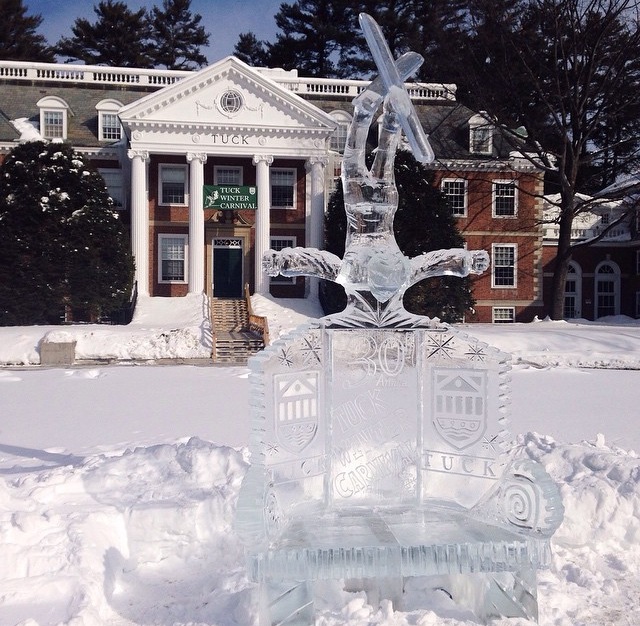
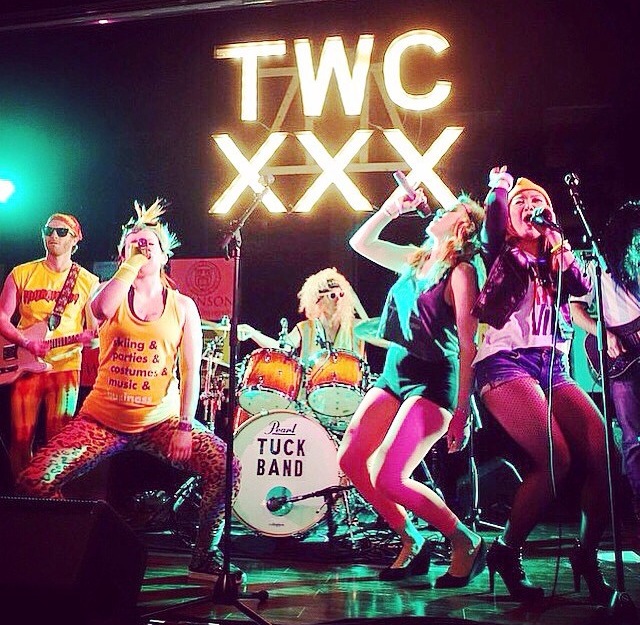
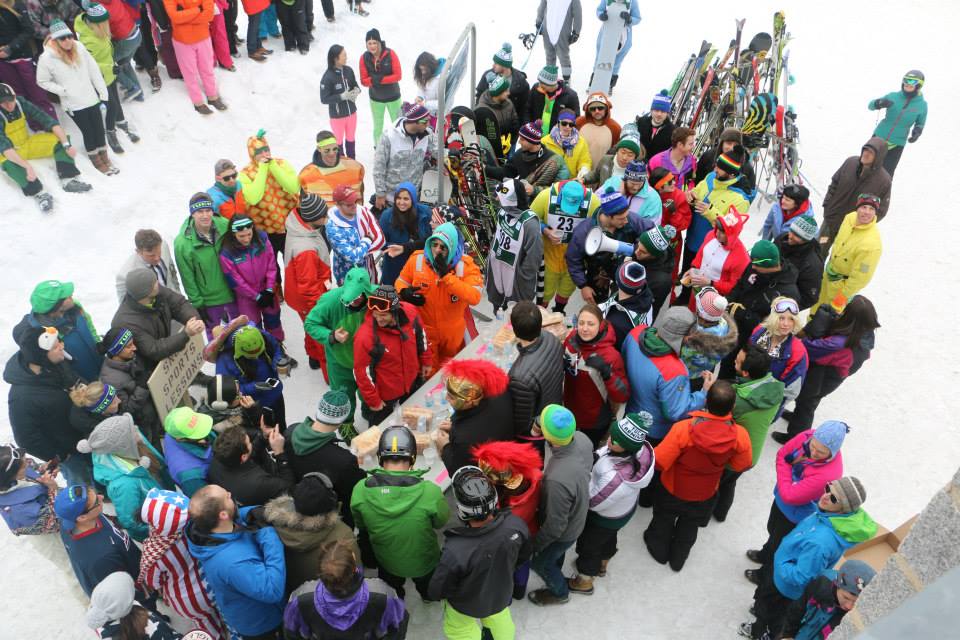
![]() ![]() Kat is a second-year student who spent four years as a director at a boutique marketing consulting firm before coming to Tuck. She has used her time at school to transition into brand management, spending this past summer at Colgate-Palmolive in NYC. When not planning TWC2015 (or being sad that it’s over), Kat spends her time playing tripod hockey and skiing in the Upper Valley. “Skiing & parties & costumes & music & business.” – TWC2015 Saturday Night Party T-Shirt For the past ten months, five fellow T’15 classmates and I had the honor of organizing the great annual tradition that is Tuck Winter Carnival, now in its 30th year. For those who are not familiar with TWC, the Tuck Winter Carnival is an annual extravaganza that brings MBA students from over 15 schools together (650+ people!) to celebrate the winter season in our hometown of Hanover, NH. Unlike case competitions or recruiting fairs, this is a one-of-a-kind inter-collegiate event for MBAs with the sole purpose of enjoying the outdoors and making connections with other students—all while wearing our best neon gear and listening to hits from the 80s. Given our skiing and snowboarding expertise, tolerance for freezing temperatures, and penchant for fun, only the Tuck School of Business could host this kind of event. (At least we think so.) Leading TWC with my fellow co-chairs has been my most fulfilling, exhilarating role during my two years at Tuck. In a way, the task of planning such a big event requires many of the same skills I will need in my time after Tuck: working closely with a team, managing a staff of volunteers, arranging logistics with external suppliers, sticking to a budget … the list goes on. While we certainly experienced our challenges along the way, there is probably nothing more rewarding for hard work than seeing a sea of neon in the Upper Valley for 48 hours straight—it is a glorious sight. Upon receiving countless thank you emails from Tuck students and other schools, and after reviewing the photo and video evidence from the weekend (#twc2015), the TWC co-chairs believe this year’s Carnival was a great success. TWC2015 had many highlights to share:
A big thanks to the other MBA programs who traveled near and far to get to the Upper Valley to party with us: Babson, Booth, Carroll (BC), Columbia, Cornell Johnson, Darden, Fuqua, Haas, HBS, Kellogg, MIT Sloan, NYU Stern, Tepper, Wharton, and Yale SOM. One of the best things about TWC is the camaraderie across different schools that ensues over the course of the weekend (despite some healthy competition along the way), and the connections that continue well beyond the event. Perhaps most importantly, the weekend would not have been possible without the spirit of the Tuck community. The welcoming, generous, and friendly culture that Tuck is known for was certainly apparent in interactions throughout the weekend. It is because of our students, staff, and volunteers that we are able to share the uniqueness of our Tuck experience with other MBA students through TWC. We undoubtedly showed our visitors what they are missing out on! The TWC2015 Co-Chairs are psyched to select next year’s committee. Only 11 months and 21 days until TWC2016! TWC2015 Co-Chairs: Kat Amato T’15 Joe DeBonis T’15 Adam Hewson T’15 Ewa Kisilewicz T’15 Matt Prescottano T’15 Chris White T’15 ![]() ![]() ![]()
|
| FROM Tuck Admissions Blog: Recruiting Advice for the Tech Industry from CDO Expert Mathias Machado T’09 |
![]() ![]() Mathias Machado T’09 is an associate director of Tuck's Career Development Office. Discuss how you’d prepare for fit interviews for the tech industry. One of the things about tech to keep in mind is that it’s not the same as consulting or investment banking where it’s about one role. Tech companies are so different—not just culturally, but also from a role perspective—and tech has so many niches. The questions you can expect really depend on the role, but in general you should remember that each company will be looking for different things and it’s important to figure that out. For example, Amazon has 14 leadership principles and they make sure when they ask behavioral questions that they look for them in candidates. Google looks for four attributes in any interview: cognitive ability, leadership or emerging leadership, culture fit (“Googliness”), and role-related knowledge. (That last one is the least important unless it’s for very specific roles.) The best way to prepare for an interview in tech, besides knowing your story and prepping for the generic behavioral questions, is have an understanding of what’s going on in the industry. You can’t just pick up the newspaper today if you have an interview tomorrow. You really have to look over a period of six months and follow stories. For example, if today Google is acquiring a company, there’s a reason behind it you should know, whether it’s a strategic move to be more competitive in a certain space or to prevent another company from buying it. The only way to know these things is to continuously follow the news. You can do that however you prefer: listening to podcasts, following Twitter, or reading blogs and publications. Besides knowing the news, you need to also form opinions, which takes time. An interviewer can tell in five minutes whether or not you’re truly passionate and informed about tech. Shed some light on technical questions that are asked in the tech industry. It’s difficult to know because it depends on what role you’re interviewing for. If you’re going for a product-related role, they might ask you to tell them your favorite product and why as well as what would you change about it and why. You need to be able to dig deep. I’m just making this example up, but let’s say they ask you to pretend that you’re the product manager for Amazon Prime, which hasn’t been released yet and you have to price it. How much would it be and why? There’s no right answer, but an interviewer will be interested to analyze your thought processes. Tell me about the logistics of the typical interview process for the tech industry. Again, there are no “typical” interviews. Amazon, Google, and Microsoft are the three biggest recruiters at Tuck in terms of numbers. Amazon would do first and final rounds in the same week here at Tuck. You would have two interviews with one interviewer each in the first round and two in the second round. For Google, you would have one or two phone interviews then they would fly you out to Mountain View. For some Microsoft roles, like marketing, you would interview here, but for others you would do a phone interview before they fly you out to Seattle. Most interviews will include a mini case—not as full-fledged as a consulting case—just for reasoning ability. I always tell students to practice consulting cases, even if they’re not going to do consulting because it’s always helpful. Google used to do brainteasers but now they’re more geared towards reasoning through business problems. One sample case question could be if you were to put a vending machine on an airplane, where it would go, what you would sell, how you would manage inventory, how much you would charge, etc. Your first reaction might be to think about a vending machine selling cans of soda, but if you think differently, you could have earplugs or phone chargers or books. Getting into these kinds of questions tells an interviewer a lot about you and how you think. For the tech industry, how important is prior experience vs. performance in interview vs. networking? It depends by company. My experience tells me that for Google, for example, prior experience is important, but it’s less so at Amazon and Microsoft. With Google, if you’ve done marketing before, you’ll probably get a marketing interview, for example. You will be able to move laterally or between functions once you join the company. Tech is not networking heavy like banking or consulting. It’s always important, however, because it can give you the idea of what makes a marketing role at Microsoft different from one at Amazon. It’s not that companies put emphasis on networking, but it’s important for a student to network to get the right information to then do well in the interview. Any other advice on how best to prepare for interviews in the tech industry? Connect with alumni, understand what to expect in an interview, and know the news and the company. Formulate your value position: where do you see yourself fitting in the company and what things would you would like to work on? The nice thing about the tech industry is that it’s very public. There’s a lot of things written about the tech industry from news to opinion pieces. |
| FROM Tuck Admissions Blog: Week in the Life of a First-Year Tuckie |
![]() ![]() By Avi Sethi T'16 Avi is a first-year student at Tuck who previously worked for the NewSchools Venture Fund, a Palo Alto based ed-tech seed investor. Previous to NewSchools, he worked in strategy consulting at Accenture based out of New York City. He started his career as a high school math teacher in Charlotte, NC through the Teach for America program. Avi is a proud Minnesota Golden Gopher alum. One of my fraternity brothers recently got back to the U.S. after spending the past three and a half months backpacking across South East Asia (amazing, right?!). While catching up, he asked me how business school was going. Hoping to talk more about his trip, I was vague and said, “It’s great!” Unsatisfied, he pushed me further: “Describe in detail what you did this past week.” Accepting his challenge, I opened up my iPhone’s calendar app and walked him through step-by-step, only to realize that, while it was a pretty typical week, there were some highlights that had made it pretty special and displayed the “fabric of Tuck” in ways that are usually difficult to describe. Monday My first class was Corporate Finance. While any Monday can be hard to wake up for, this Monday was particularly hard given that Tuck Winter Carnival took place that past weekend. Winter Carnival is an event hosted by Tuck when students from over 15 business schools come together to enjoy an 80s-themed ski weekend at the nearby Whistler Blackcomb Ski Resort. Luckily, today’s class featured a prominent guest speaker, Tim Koller from McKinsey & Company, who wrote a book on valuation. I also woke up to a string of emails as an interview I did with a reporter from The Dartmouth, Dartmouth’s student newspaper, was featured in Monday’s edition! This was our last full week of classes before finals and then spring break. Over break, I will be traveling to Japan for a Tuck-sponsored Global Insight Expedition (GIX), where we will examine the 2011 “Triple Disaster” (earthquake, tsunami, and nuclear reactor meltdown) and its effect on business, government, and society. This was also the week of Tuck’s annual Business & Society Conference, which was held Friday. I helped put together the education panel as well as the conference’s marketing efforts. Once classes were over, I split my day between preparing for the week’s classes/homework, finalizing logistics and marketing for the conference, and catching up with people in the impact investing space (I am recruiting for something unique/specific in the ed-tech venture capital space). Tuesday With our Marketing class cancelled so our study groups could work on finalizing our MarkStrat simulation project, I used the extra time in the morning to both sleep in and get in a quick workout before classes. I find that working out before the craziness of the day ensures I actually get it done. It’s the tearing-myself-out-of-bed part that is the hardest. In our Finance class, we discussed how to use the option-valuation-methodology to decide whether investing in an oil field is worth it. Luckily the girl sitting next to me in class had worked in both investment banking and private equity in the oil industry in Houston, TX before Tuck and could translate everything I didn’t understand (pretty much everything). After class, I had to make a few recruiting/networking calls and then I met up with my study group to finalize the work on our upcoming final project for Corporate Strategy. Our group chose to look into how education technology companies were disrupting the K-12 education industry and what the possible effects may be both economically and socially. Later, I met up with my soon-to-be First Year Project (FYP) team for a quick beer at Murphy’s to talk through project goals. FYPs are projects you work on in groups of six during the spring quarter. My FYP team is going to help Tuck design a social venture fund which will look to make early-stage investments in entrepreneurs and track both the financial and social returns garnered by our capital. To end the day, I went over to a second-year student’s house for a Small Group Dinner. These small group dinners are held periodically throughout the year and offer a randomly selected group of students, partners, faculty members, and staff members to get together and enjoy some home-cooking and “family time.” Our host for the night cooked the juiciest grilled chicken and cheesiest mac and cheese. It was a good thing I went to the gym that morning. Wednesday On Wednesdays and Thursdays this term, I am taking Global Economics for Managers—affectionately known as GEM—and Corporate Strategy. This week in GEM we focused on the auto industry in the 1980s. Wednesday’s class gave us a better understanding of how changes in currency exchange rates made the Jaguar a more attractive car to American buyers. During Thursday’s class, we looked at how “endaka”—which the Yen’s soaring appreciation in value and Japan’s reliance on exports—forced Japanese automakers to get creative with their growth strategy in order to survive increasing price competition from American automakers. In Corporate Strategy we focused on Disney, spending Wednesday examining what makes Disney so special and how it has maintained its top-tier brand value over so many generations. On Thursday, we examined Disney and Pixar before its merger and tried to assess whether Disney made the right move and how Steve Jobs may have used some genius negotiation tactics to push up Pixar’s value. After class, I attended a lunch with other student organizers from Tuck’s Private Equity and Venture Capital Conference to discuss how we could make next year’s event even better. I spent the remainder of the afternoon catching up on my Hulu queue trying not to get choked up watching the series finale of Parks and Recreation finishing up schoolwork. On Wednesday night, I attended a dinner with Aly Jeddy D’93, a partner within McKinsey & Company’s private equity practice. I was invited to the dinner along with six second years and one other first year by Professor Curt Welling D’71, T’77. Professor Welling chose us to attend because of our interest in understanding whether there was truly a negative tradeoff between financial and social returns when making venture capital or private equity investments. Aly argued, and we all agreed, there is not—if you invest correctly. Thursday After GEM and Strategy on Thursday, I enjoyed some salad in the lunch room catching up with a few friends. One of my future roommates sat down and we started discussing how we might split the different rooms and rent costs for the house we were going to be moving into next fall. With three of our lunch crew having worked in banking—one here in the US, another in Dubai, and the final one in Singapore—the discussion quickly turned to auction and reverse-auction strategies which could satisfy each individual’s preferences and willingness to pay, etc. Just before the laptops and excel models opened up, we changed the topic—thankfully. I arrived in my final class of the week—Entrepreneurial Thinking—particularly excited about the day’s topic: How Andreessen Horowitz was disrupting the venture capital industry. One study group is chosen each class to discuss their case analysis, usually in front of someone (the entrepreneur, venture investors, etc.) from the case. When I arrived, I saw that our group was chosen to present this week. I thought that was cool, but especially because there was no way someone from Andreessen—which only has one office on Sand Hill Road in Menlo Park, CA—would come all the way out to Tuck for this class. I figured today’s class was the best of days to present because the pressure would be off. Tom Naughton D’89, T’96, our professor and the executive director of Tuck’s Center for Private Equity and Entrepreneurship, began the class by introducing our guest: Scott Kupor, managing partner (CEO) of Andreessen Horowitz. My heart immediately sank. Sure, I had presented to CEOs before when I was a strategy consultant, but never on an analysis of the company which I had only spent a few hours on. Admitting my nervousness to Scott and the rest of my class, my study group and I walked through what we thought Andreessen was doing well and how it was winning in this industry. Luckily, after we finished, Scott gave us the nod that we had done a good job. After class, I was chatting with one of my group-mates about how lucky we were to have been selected to present. Here I was looking for a job in the venture capital industry, and here Scott was, starting a company and looking for venture financing. Then it hit us—Tom definitely used his knowledge of our backgrounds and career goals to give us this spotlight in front of Scott. While there have been many times before when Tuckies went out of their way to help each other out, this was one shining example of a Tuck professor REALLY knowing you and finding a way to help you in your career development. Given that I had experienced something similar just the night before when Curt Welling invited me to the private dinner with Aly, I felt a closeness to Tuck that was hard to describe. This place truly is a family. As if my Thursday hadn’t been awesome enough, it was the day before Tuck’s Business & Society Conference. This night, we were lucky enough to host some of our panelists from out of town and treat them to a small group dinner in Hanover. The education panel I helped develop featured Graham VanderZanden, an associate partner from the NewSchools Venture Fund, Tammy Battaglino, co-head of The Parthenon Group’s education practice, and Emary Aronson, head of education investing at The Robin Hood Foundation. While Graham and Tammy were going to drive up from Boston on Friday morning, Emary and her boss, Amy Houston T’97—who also happens to be on Tuck’s MBA Advisory Board—came up Thursday night and joined us for dinner. We discussed how Robin Hood was pioneering metrics that would improve the way foundations make investments in areas such as K-12 education. Friday After all the work and planning that went into it, the Business & Society conference was finally here! With over 350 registrants, Tuck was abuzz with people who saw business principles as a conduit for improving society. The event started out with Nancy Pfund, managing director of Double Bottom Line (DBL) Investors, a venture capital firm that looks to maximize both financial and social returns. DBL’s portfolio includes companies like Tesla Motors, Revolution Foods, Pandora, and Solar City. After the opening keynote, we broke into different panel discussions that were planned throughout the day. Panel topics included corporate social Responsibility, education, energy, ethics, health care, and Social Entrepreneurship. Speakers included people from .406 Ventures, Burton, Cabot Creamery, Deutsche Bank, Freight Farms, Grassroots Soccer, and New Profit. The conference came to a close with a keynote from Diarmuid O’Connell, vice president of business development for Tesla Motors, who talked about the Tesla story, its current projects, the challenges in battery technology and energy storage, and how Tesla is working to change the world one car at a time. It was a truly amazing way to end what had been a great day. After a quick power nap that recharged my personal battery, I attended the annual Tuck Suits and Stethoscopes party which is a gathering hosted by the Dartmouth MD-MBAs. It brings together both the business and medical schools for a night of dancing and fun. Once I finished my story, my fraternity brother said it sounded like I had done more in this past week than he had done during his months of travel in Southeast Asia. A part of me was jealous of all the free-time he had had to travel, sightsee, and reflect on his own personal journey. But, then again, it was clear from my last week that my Tuck family provides me with all those things as well—just in a different way. It was a great week. Now it’s time to stop reflecting and study for finals! |
| FROM Tuck Admissions Blog: Tuckies Visit Top Consulting Firms on London Consulting Trek |
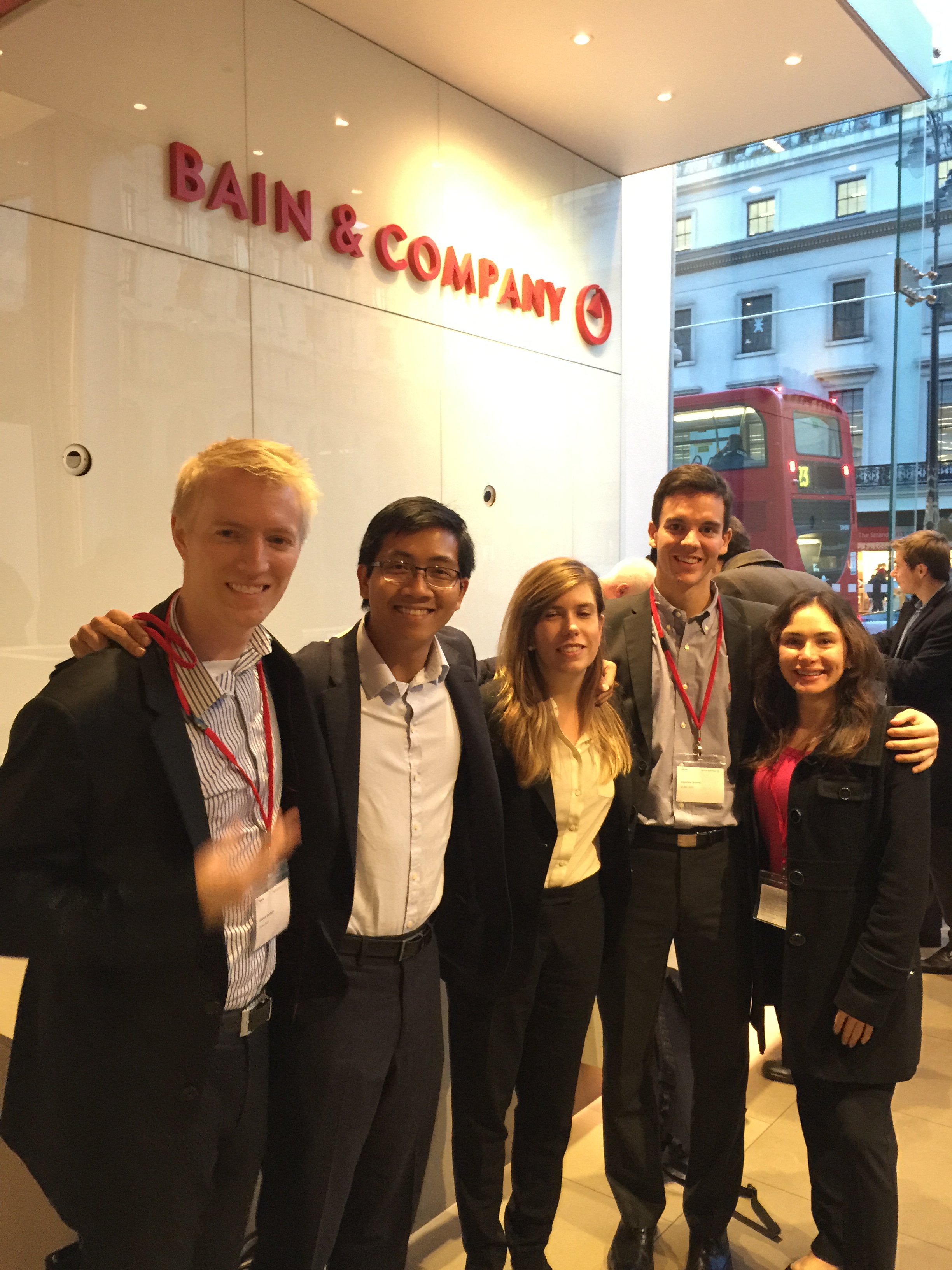
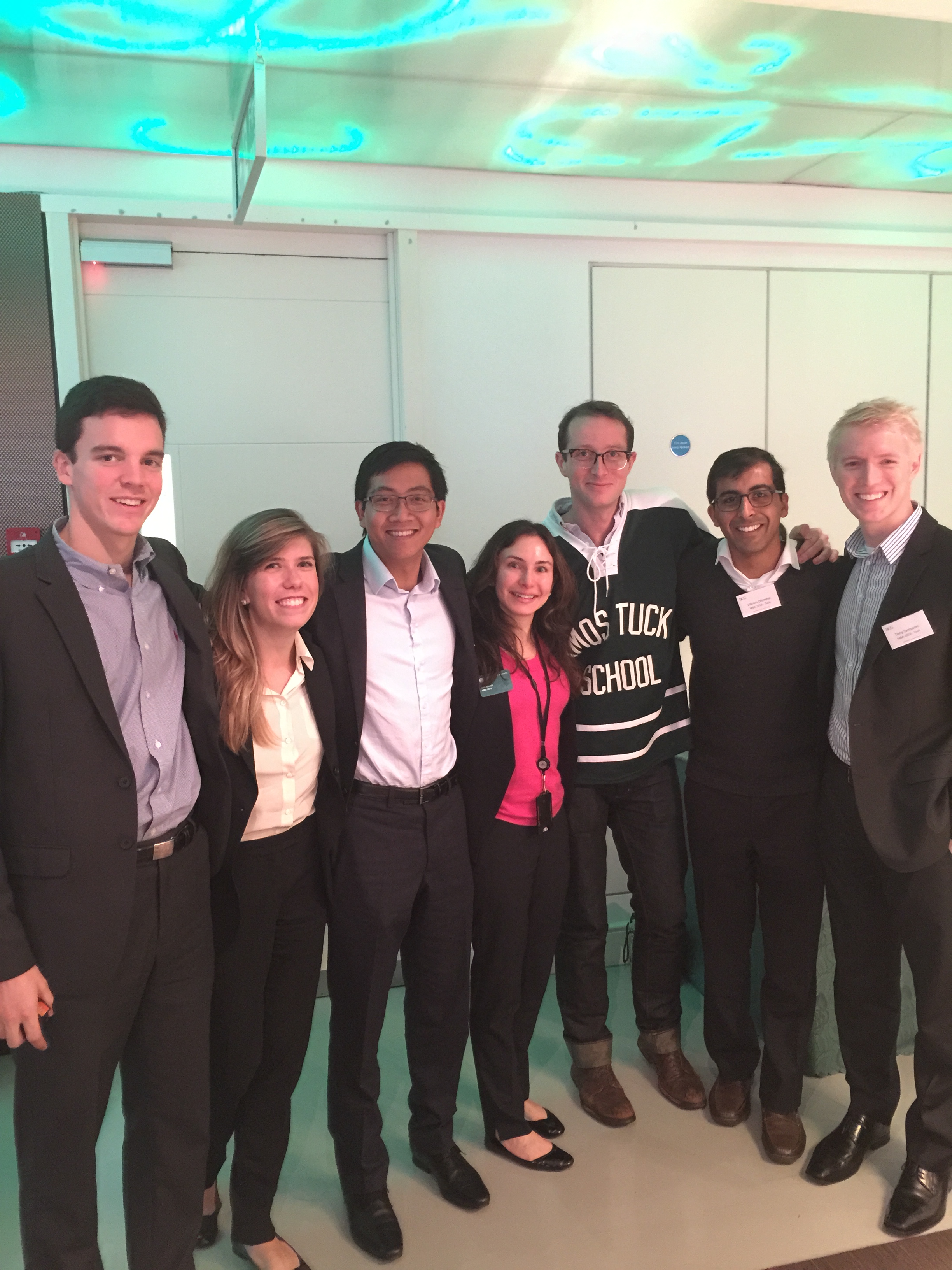
![]() By Tony Sampson T'16 Tony is a first-year student at Tuck. Prior to arriving in Hanover, he worked in bank regulation and capital policy at the Federal Reserve Board in Washington, D.C., where he focused primarily on insurance companies. Tony earned a Bachelor of Science in Accountancy and a Bachelor of Arts in Chinese from Brigham Young University, and a Master of Science in Finance and Economics from the University of Warwick (UK). While most of our first-year classmates were resting from the Fall B term and celebrating Thanksgiving, five classmates and I headed across the pond for a hearty feast of networking, office visits, and company presentations. In what has become an annual tradition, Tuck students pursuing careers in the UK spend the holiday in the offices of various London consulting firms. The experience provides first-year students the invaluable opportunity to visit the offices, meet the London office consultants and recruiting teams, and get a first-hand look at the local office culture. The Thanksgiving trek to London is student led—preparations for the trip began soon after we arrived in September. We met with a second-year student who led the London trek the previous year. She supplied us with the recruiting contacts at the firms; we did the rest. To plan the trek, we reached out to recruiters at the various consulting firms, connected with Tuckies in London, and coordinated the office visits and presentations. Our London Trek itinerary was as follows: Tuesday (evening) Depart for London Wednesday Free day in London Sightseeing, shopping, meeting up with friends/family, attending a football (UK style) match! Thursday OC&C Strategy Monitor Deloitte McKinsey & Co. Drinks with London Tuckies Friday The Boston Consulting Group Bain & Company Saturday & Sunday Free day and return travel In the end, the trek was a success. Upon arriving at Tuck in September, I knew I wanted to work in London. The trek gave me a much greater sense of which London consulting firm was right for me, strengthened my network of London Tuckies, and gave me an even greater appreciation for a city I love—all critical components to beginning my future career in London. (Main photo above at Bain: from left to right, Tony Sampson, Dominic Yau, Nicole Daniele, Alex Kremer, and Alex Macchi) (Photo at right at BCG: From left to right, Alex Kremer, Nicole Daniele, Dominic Yau, Alex Macchi, Josh Mellen T’14, Vikram Dhindsa, Tony Sampson) |
Success stories and strategies from high-scoring candidates.